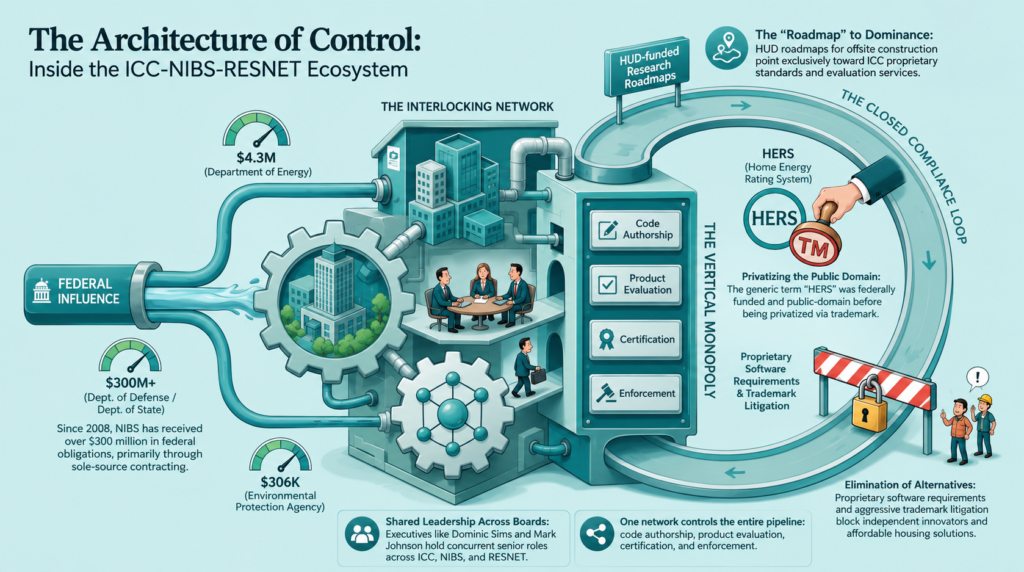
Most Americans view building codes as a dry, bureaucratic necessity—a set of safety rules that exist quietly behind their drywall. But follow the money, and a different story emerges. At the center of the American built environment sits the International Code Council (ICC), a private 501(c)(6) trade association that reported a staggering $109.9 million in revenue in FY2024 alone. Despite its non-profit status, the ICC has built a massive, interconnected apparatus that dictates the cost, safety, and technological future of every home in the country.While it presents itself as a neutral arbiter of public safety, the ICC sits at the heart of what can only be described as a “gatekeeping” monopoly. By leveraging shared leadership, hundreds of millions in federal obligations, and aggressive intellectual property enforcement, a small circle of organizations has effectively centralized market power over the American home.
The "Interlocking Boardroom" of Building Science
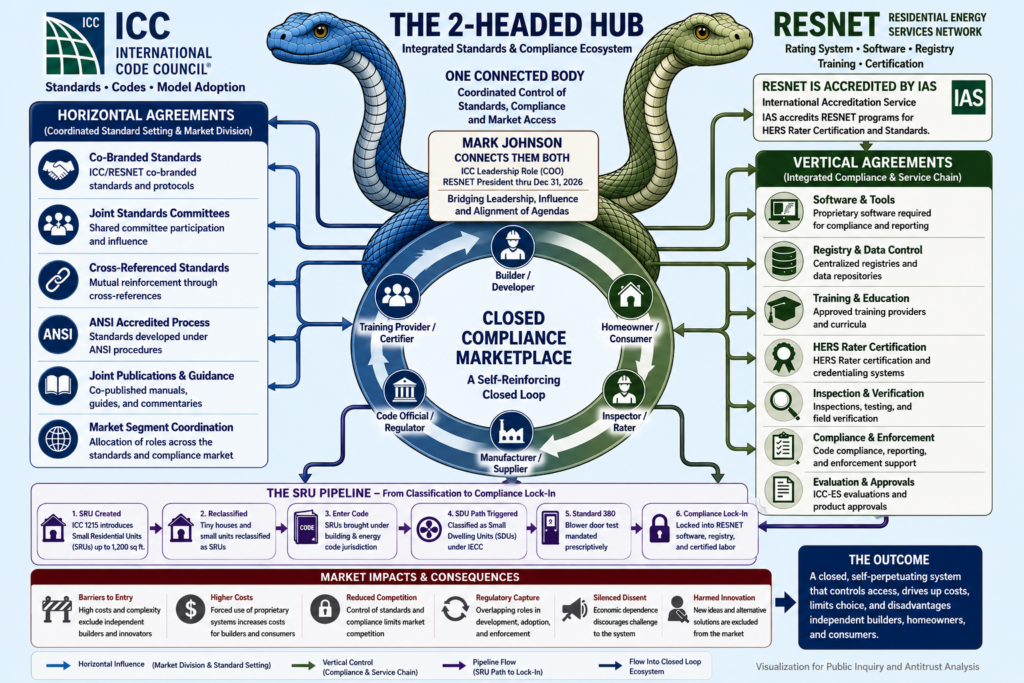
In the world of federal regulation, there is supposed to be a clear line between the “player” (the industry) and the “referee” (the oversight body). In the building code ecosystem, that line has all but vanished. An analysis of leadership data reveals a “shared leadership” model where the same executives hold concurrent or successive senior roles across the ICC, the National Institute of Building Sciences (NIBS), and the Residential Energy Services Network (RESNET).|
Dominic Sims:Chief Executive Officer, International Code Council, 2012–2024 NIBS Board of Directors, 2019–2022; 2025–2028 (Term began October 1, 2025)
John “JC” Hudgison — ICC Board Member; Chair, Emerging Leaders Council; NIBS Board of Directors; Founding Past Chair, NIBS Off-Site Construction Council
Ryan M. Colker — VP, Innovation; Executive Director, ANCR; Former VP at NIBS; Chair, NIBS Off-Site Construction Council,
Mark Johnson — Chief Operating Officer, ICC; President, RESNET Board of Directors, Term through 2026
Follow The Money- And Let The Documents Tell You The Story
I traced the funds and created reports below which are sourced from USASPENDING.gov that documents the funds that has flowed from the government in staggering amounts to these organizations. Before viewing the reports, please read the documents regarding HUD.
Funding Snapshot
NIBS: Over $300 million in federal obligations since FY2008.
RESNET: $306,200.
ICC: $4.35 million, including a large DOE award.
HUD Fails to Address Critical Audit Warnings on Housing Assistance
The Department of Housing and Urban Development is failing to address critical vulnerabilities in how it manages billions of dollars in federal housing assistance, according to a new Government Accountability Office assessment. HUD open recommendations that were flagged as priorities more than a year agoremain unimplemented, creating persistent risks in disaster recovery funding, affordable housing financing, and information technology security.
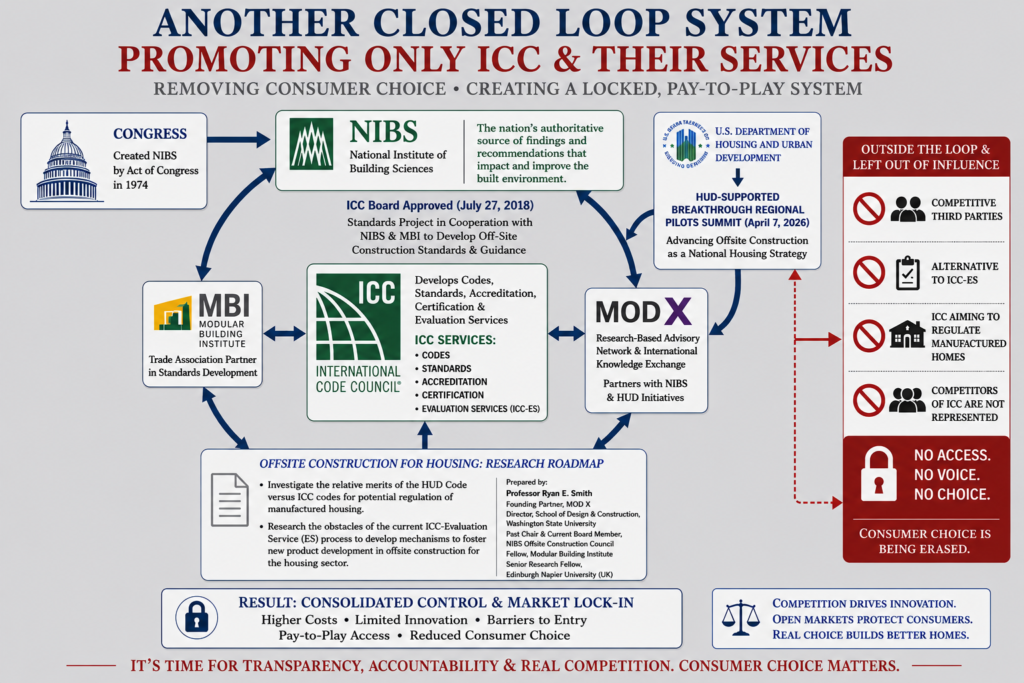
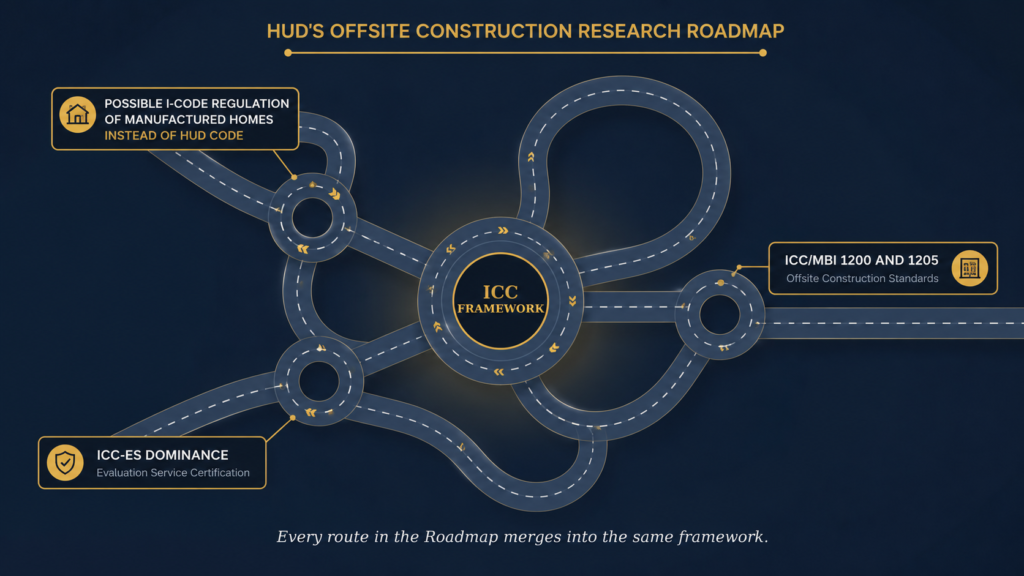
These reports document the financial and leadership ties between the International Code Council (ICC), the National Institute of Building Sciences (NIBS), and the Residential Energy Services Network (RESNET). Through analysis of federal spending data, the sources reveal that these organizations have received millions in taxpayer funding while maintaining deeply overlapping executive boards. I highlighted in the text express significant antitrust concerns, alleging that this network creates a “closed compliance marketplace” that stifles competition. The reports document how federal grants may be helping the ICC consolidate control over building codes, standards, evaluation reports, and emerging sectors like off-site construction and tiny houses. Furthermore, the government is inadvertently subsidizing a private monopoly by funneling research and regulatory authority into this interconnected ecosystem. These findings serve as a call for federal investigations into potential market allocation.
NIBS Federal Funding Report And Relationship To ICC
The provided evidence outlines an integrated ecosystem where federal funding and shared leadership have positioned the International Code Council at the center of American building regulation. The reports reveal a concentration of power that has resulted in “coordinated control” and “regulatory capture” with the help of federal agencies that continue to fund these entities that create a barrier to entry and eliminates competition and creates significant barriers for small-scale and innovative housing providers.