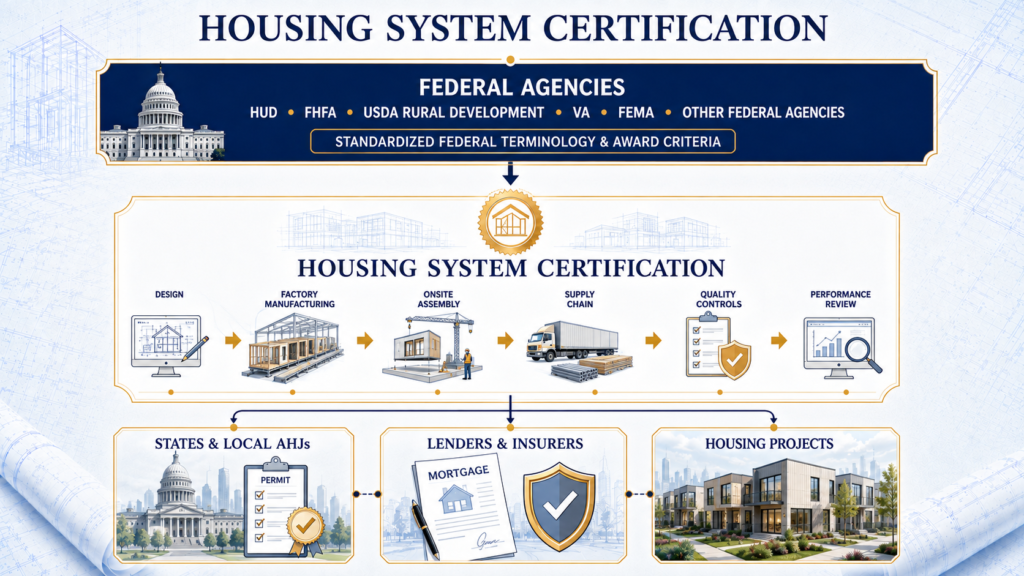
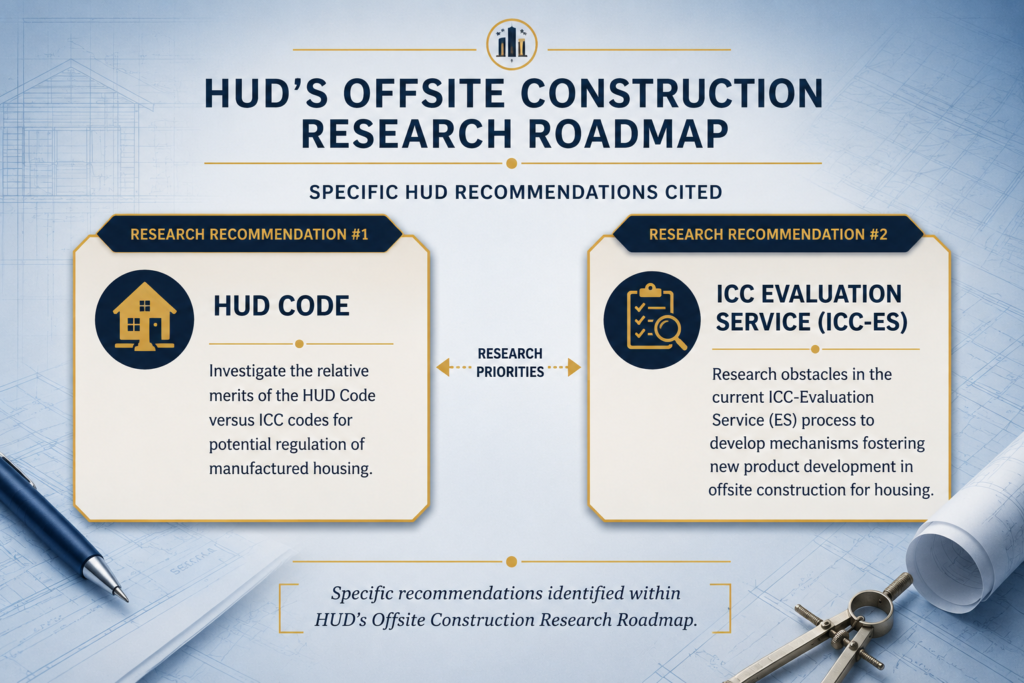
The following paper examines the 2023 HUD Offsite Construction for Housing: Research Roadmap, the 2026 HUD Action Plan, and Dr. Ivan Rupnik’s May 2026 written testimony to Congress, The Unfinished Breakthrough. Read together, they propose a major federal housing-policy framework: standardize terminology and award criteria across HUD, FHFA, USDA Rural Development, VA, FEMA, and other federal agencies; develop a federally sanctioned Housing System Certification program through NIBS; and move toward performance-based building-code reform, extend into state and local approvals, lending, insurance, permitting, inspection, incentives, and housing delivery.
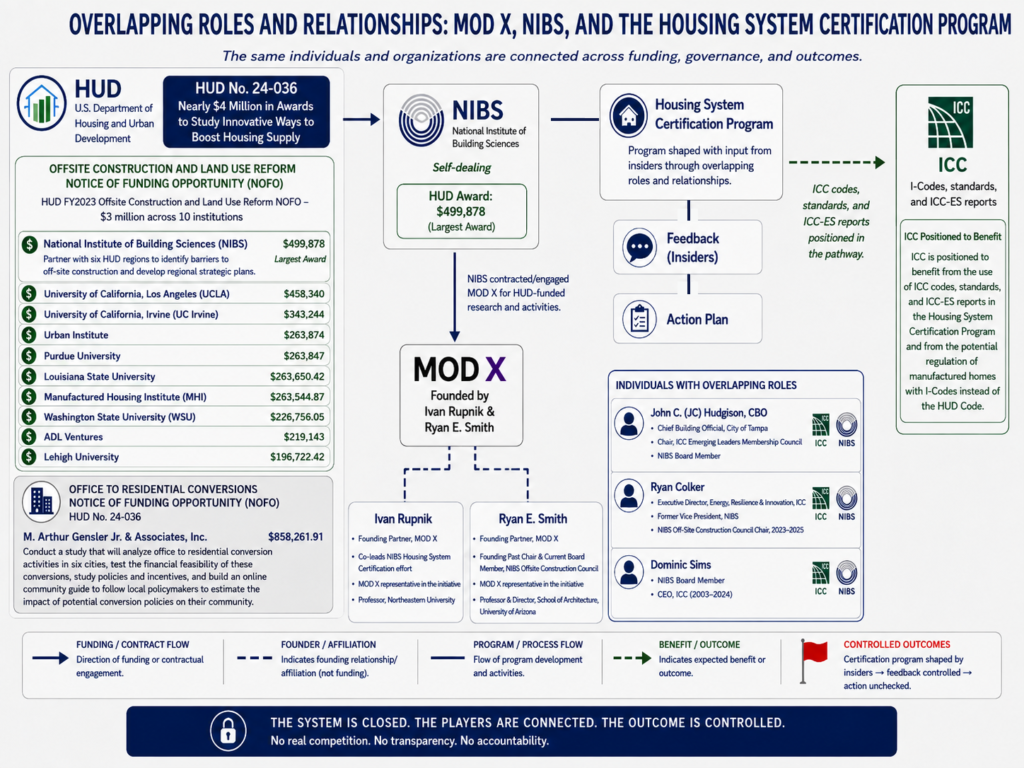
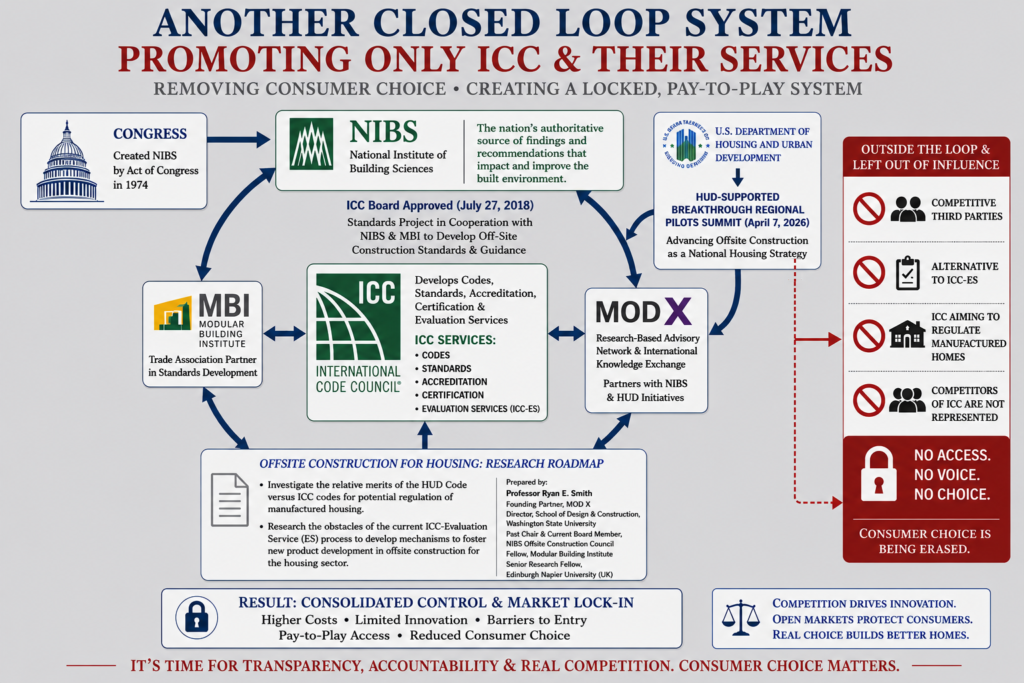
My concern is who is shaping this framework, what history is being presented, and who stands to benefit if it is adopted. In my opinion, the same relatively small network of organizations and executives appears repeatedly across the research, stakeholder process, peer review, standards development, certification, inspection, evaluation, and conformity-assessment functions. That creates a serious appearance of conflicts of interest and regulatory capture.
The proposal does not stop at federal terminology. The testimony explains that a certified housing system could become the basis for streamlined permitting and inspection, and for lender and insurer underwriting. The Action Plan recommends federal leadership in certification for federally funded projects, incentives, and subsidies, with private financial and insurance industries expected to adopt the certification over time. In other words, this framework is designed to reach from federal agencies into state and local regulatory systems, financing, insurance, and the approval of individual housing projects.
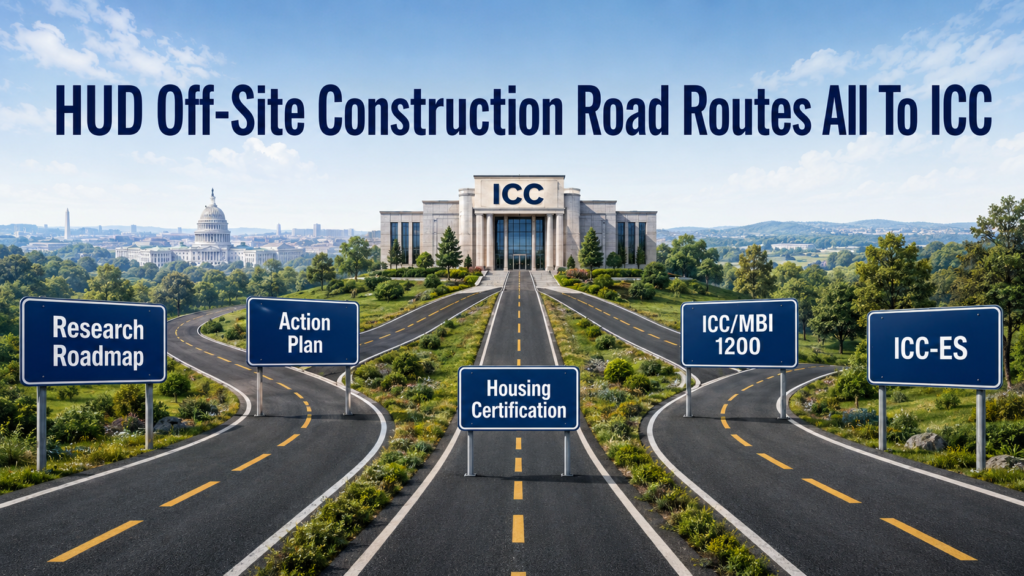
That is why the organizations and individuals involved matter. The two HUD publications were managed by NIBS and written by MOD X principals. ICC representatives participated in the 2023 Roadmap’s technical committee and stakeholder process; ICC-connected individuals also appear as project partners and peer reviewers in the 2026 Action Plan. MBI, which co-developed the ICC/MBI 1200-series standards, is likewise represented in the Action Plan’s project-partner structure.
ICC is central to this concern because it is not solely a model-code organization. It develops model codes and standards, while their subsidiaries offer training, and within its conformity-assessment structure provide evaluation, inspection, accreditation, and certification services. ICC-ES evaluates code compliance; ICC NTA provides inspection and certification services; and IAS provides accreditation. Thus, the same corporate structure can be involved in writing the codes and standards, evaluating compliance with it, inspecting or certifying against it, and participating in the federally funded research recommending new certification pathways.
In my opinion, this is not a broad, independent process. It is a relatively small, overlapping network of executives and organizations appearing at multiple points: defining the problem, participating in the research process, reviewing the recommendations, developing standards, and operating services that could benefit from the resulting certification framework. That creates a serious conflict-of-interest and regulatory-capture concern—not because private entities are prohibited from participating, but because their influence is concentrated while the proposal could restructure housing regulation for everyone else.
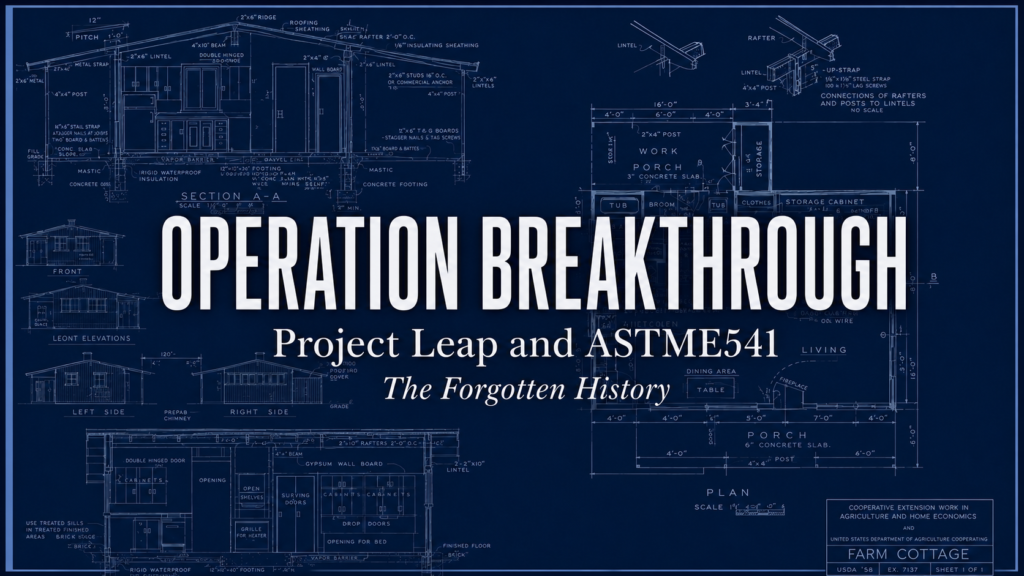
The historical record is also incomplete. The publications and testimony invoke Operation Breakthrough and the 1974 NIBS mandate, but they do not fully present the federal regulatory-infrastructure work developed through the National Bureau of Standards. That work included the Laboratory Evaluation and Accreditation Program (LEAP), the Coordinated Evaluation System (CES), and the work that became ASTM E541, Standard Criteria for Agencies Engaged in System Analysis and Compliance Assurance for Manufactured Buildings. These programs addressed the same core question now being raised: who is qualified to evaluate housing systems and provide compliance assurance.
Leaving out LEAP, CES, and ASTM E541 leaves out an important history of independent evaluation and accreditation work. It also minimizes an established alternative to a system increasingly centered on organizations that write standards, influence policy, and sell related evaluation, inspection, accreditation, and certification services.
What Is Housing System Certification?
The quoted wording is reproduced verbatim from the 3 source documents with a focus on the Housing System Certification Source footnote/citation call numbers may be omitted for readability, but the quoted words themselves are not paraphrased. Ellipses are retained only where they appear in the source itself. Page numbers are the printed page numbers found in each source file (testimony PDF pages 1–10; HUD Action Plan and Research Roadmap page numbers as printed in the footer of each page of the source text). Where a document’s own front matter uses roman numerals, that is preserved.
The Three Sources
The Unfinished Breakthrough — Dr. Ivan Rupnik’s written testimony before the House Select Committee on Small Business (May 21, 2026). This is the advocacy document: a 10-page statement recommending that Congress direct NIBS to build the housing system certification framework it was authorized to create in 1974. It draws on and condenses the HUD Action Plan below, adding two live operational case studies (JPI and Fading West Development) not found in the other two sources.
Offsite Construction for Housing: Research Roadmap — Smith, Rupnik, Schmetterer, and Barry (2023), also published by HUD’s Office of Policy Development and Research. This is the earlier, exploratory document that first identified “Regulatory Framework” as the industry’s top research priority, but it does not yet define housing system certification as a concrete framework — it only gestures toward the need for one.