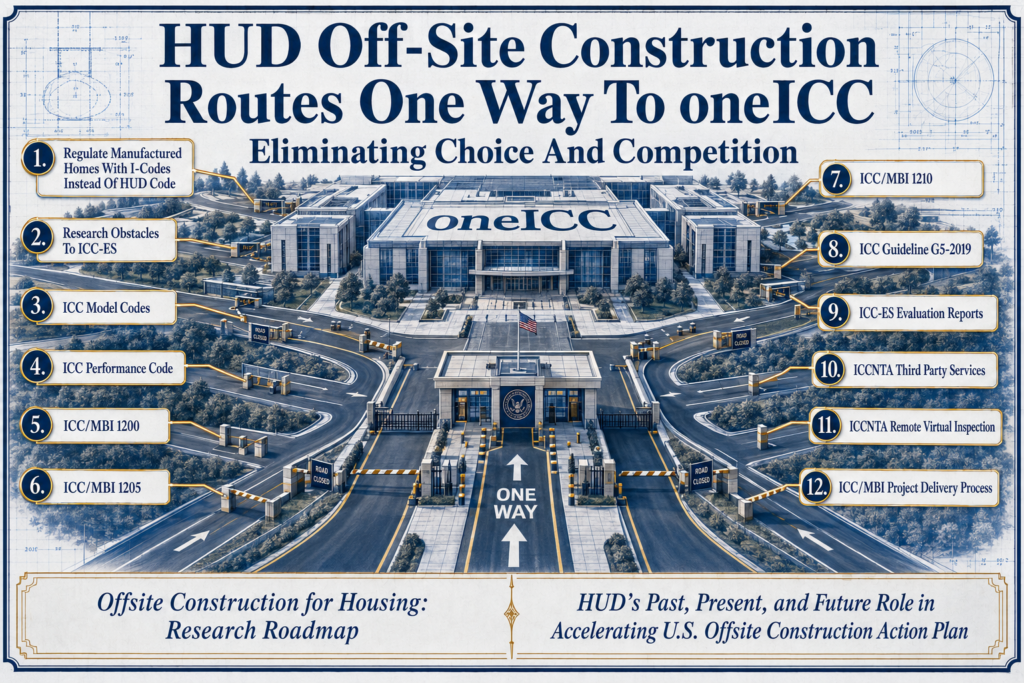
The HUD Off-Site Construction Is Routing All Roads To oneICC
HUD has recently published and promoted two federally funded publications—Offsite Construction for Housing: Research Roadmap and HUD’s Past, Present, and Future Role in Accelerating U.S. Offsite Construction for Housing: A Comparative Study and Action Plan—as broad research into improving housing production, innovation, and affordability.
I Am Requesting A Federal Investigation Of These Grants
My investigation found that these HUD grants are not isolated research projects. Together, they fund connected work involving land-use reform, building codes, standards, product development, inspection, certification, financing, regional pilots, Housing System Certification, and a forthcoming national implementation handbook. The underlying research priorities were shaped through an invite-only process led by NIBS and MOD X, with overlapping ICC executives, officials, authors, participants, and peer reviewers, while grant recipients and participating trade associations have direct institutional and financial interests in the regulatory framework being advanced toward oneICC.
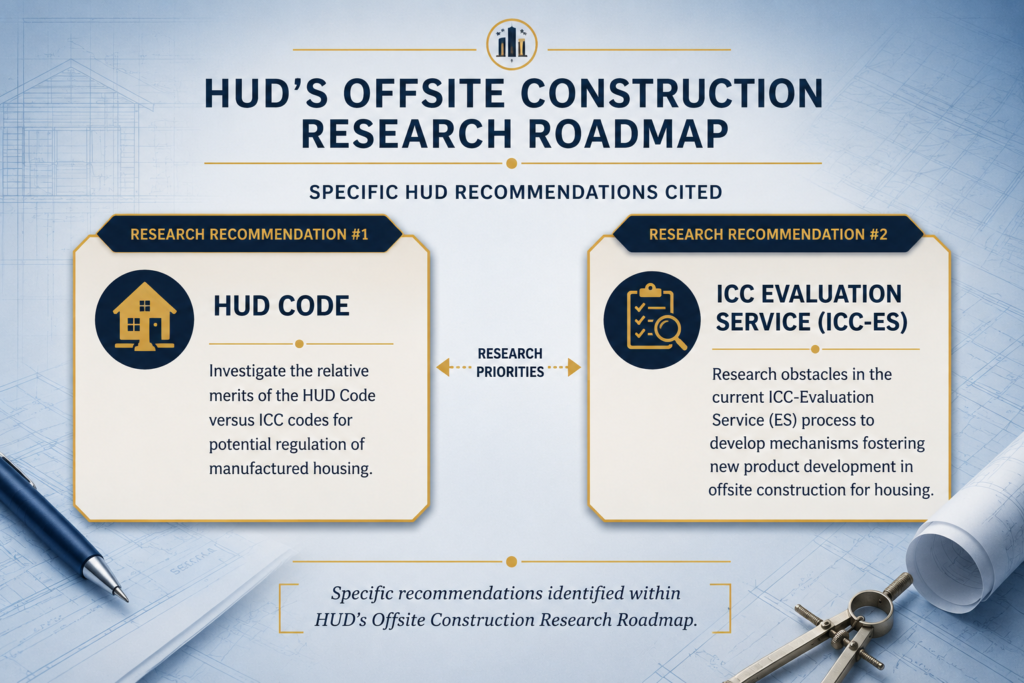
I am requesting a federal investigation into the selection and administration of these grants; the organizational, financial, family, and employment conflicts involved; the adequacy of disclosures, recusals, and competitive safeguards; and HUD’s compliance with its own Code of Conduct and conflict-of-interest requirements. The investigation should determine how federally funded research and implementation programs came to route codes, standards, product evaluation, accreditation, inspection, certification, training, and national replication toward the vertically integrated International Code Council oneICC framework . The research included researching the obstacles to ICC’s own proprietary ICC-ES services and investigating the potential regulation of manufactured homes with ICC codes instead of the federal preemptive HUD code.
Code of Conduct for HUD Grant Programs
Code of Conduct policies must address the “Conducting Business in Accordance with Ethical Standards” requirements included in the Administrative, National & Departmental Policy Requirements and Terms for HUDs Financial Assistance.
A. Code of Conduct for Procuring Property and Services. All Federal award recipients, except states, and all subrecipients under Federal awards must have a code of conduct (or written standards of conduct) for procurements that meets all requirements in 2 CFR 200.318(c). Before entering into an agreement with HUD, each applicant selected for an award (other than a state) must ensure an up-to-date copy of the organization’s code of conduct, dated and signed by the Executive Director, Chair, or equivalent official, of the governing body of the organization, is available in the Code of Conduct e-library.
Applicants can check the Code of Conduct List to confirm HUD has received their Code of Conduct. HUD does not collect or review state codes of conduct for compliance with 2 CFR 200.318(c). Instead, each state must follow the same policies and procedures for procurements under Federal awards that the state uses for procurements from its non-Federal funds, as provided in 2 CFR 200.317.
B. Other Conflicts of Interest. All recipients and subrecipients must comply with the conflict-of-interest requirements in the applicable program regulations and grant agreements. If there are no program-specific regulations for the award, the following conflict-of-interest requirements apply:
i. Conflicts Subject to Procurement Regulations. In the procurement of property or services by recipients and subrecipients, the conflict-of-interest rules in 2 CFR 200.317 and 2 CFR 200.318(c) shall apply. In all cases not governed by 2 CFR 200.317 and 2 CFR 200.318(c), recipients and subrecipients must follow the requirements contained in the list of exceptions located in the Administrative, National & Departmental Policy Requirements and Terms for HUDs Financial Assistance.
General Prohibition
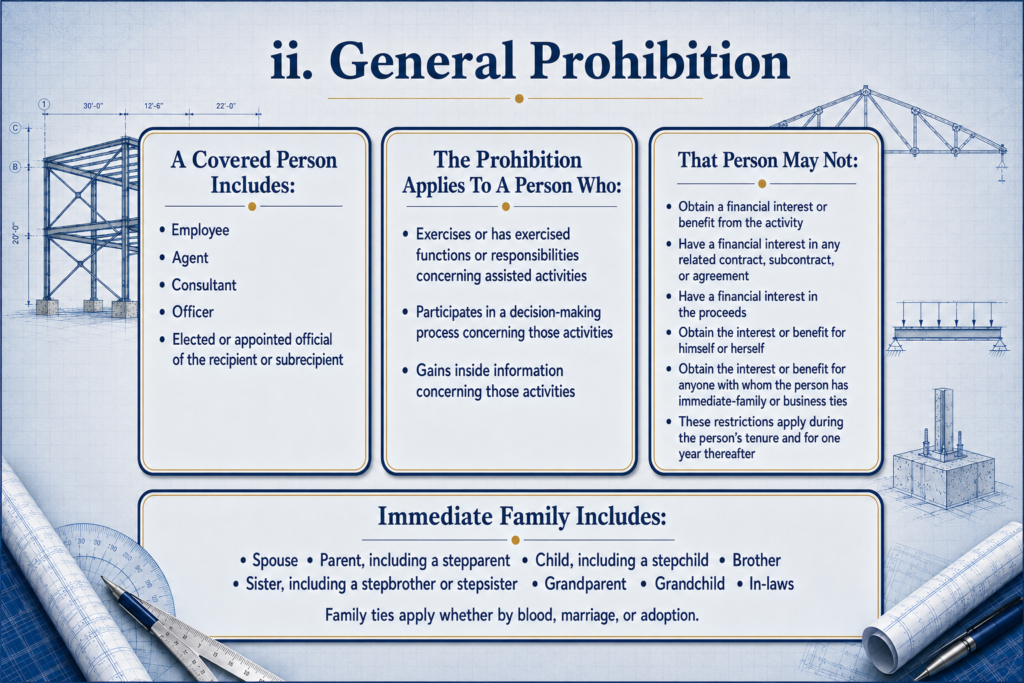
ii. General prohibition. No person who is an employee, agent, consultant, officer, or elected or appointed official of the recipient or subrecipient and who exercises or has exercised any functions or responsibilities with respect to assisted activities, or who is in a position to participate in a decision making process or gain inside information with regard to such activities, may obtain a financial interest or benefit from the activity, or have a financial interest in any contract, subcontract, or agreement with respect thereto, or the proceeds thereunder, either for himself or herself or for those with whom he or she has immediate
family or business ties, during his or her tenure or for one year thereafter. Immediate family ties include (whether by blood, marriage or adoption) the spouse, parent (including a stepparent), child (including a stepchild), brother, sister (including a stepbrother or stepsister), grandparent, grandchild, and in-laws of a covered person.
A list of exceptions can be found in the Administrative, National & Departmental Policy Requirements and Terms for HUDs Financial Assistance.
Codes of Conduct must:
- Include a cover letter on the company’s letterhead that provides the name and title of the responsible official, mailing address, business telephone number and email address;
- Prohibit real and apparent conflicts of interest that may arise among officers, employees or agents, or any member of his or her immediate family, his or her partner or an organization that employs any of the indicated parties;
- If applicable, the standards must also cover organizational conflicts of interest;
- Prohibit the solicitation and acceptance by employees, of gifts or gratuities in excess of minimum value; and
- Provide for administrative and disciplinary actions to be applied for violations of such standards.
Failure to provide a copy of the organizations Code of Conduct and/or notify HUD of potential conflicts of interest may prevent applicants from receiving HUD funds.
If your organization is not listed in the Code of Conduct e-library, please forward an electronic copy of the Code of Conduct statement to as****@*ud.gov.
The email should contain:
- Organization UEI#
- Organization Legal Business Name (from SAM.gov)
- Complete mailing address
- Name, title, email and phone# for the person with executive authority.
- Electronic codes of conduct statement (searchable documents preferred)
The Code of Conduct e-library will be recorded in a single Microsoft Excel workbook displaying organizations with a compliant Code of Conduct policy submissions. The Code of Conduct e-library is updated at least quarterly.
The email should contain:
- Organization UEI#
- Organization Legal Business Name (from SAM.gov)
- Complete mailing address
- Name, title, email and phone# for the person with executive authority.
- Electronic codes of conduct statement (searchable documents preferred)
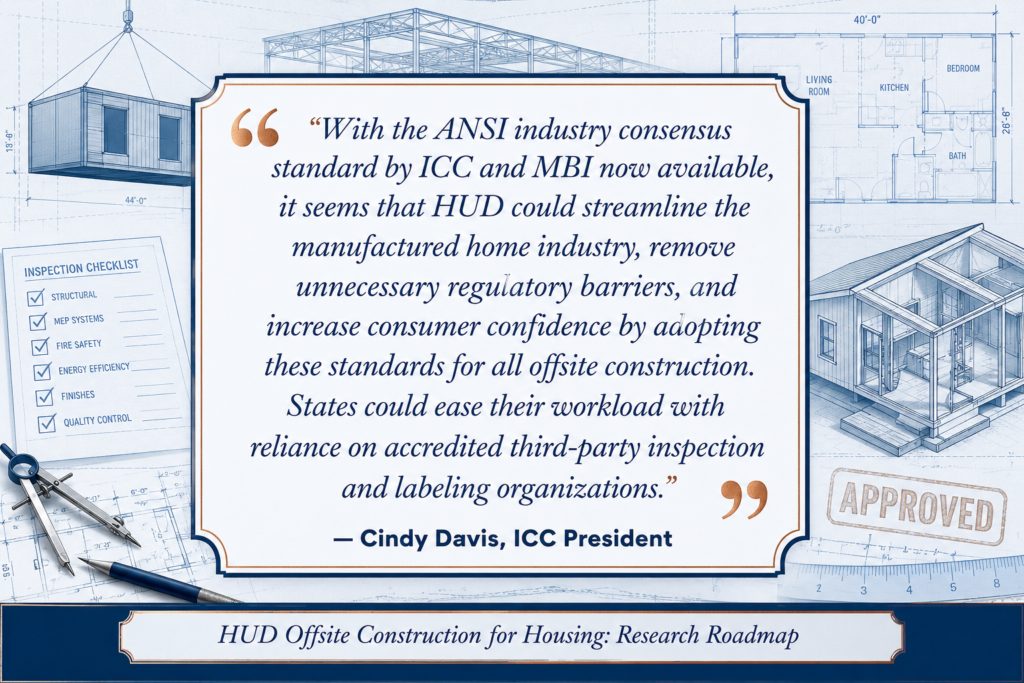
Why the quote is so crucial is because the ICC/MBI standards do NOT apply to manufactured homes. That is stated in the forward of the standards, so there is an obvious power grab being promoted to HUD from ICC that the standards would include all types of off-site housing for inspection and accreditation, but here’s the rub, manufactured homes have a federal program for third party agencies that are known as IPIA and DAPIA agencies that are approved by HUD.
It is the modular industry that has a patchwork of different regulations.
Told Ya, We Know A Cattle Re-Brand When We See One

So the story they are selling is that by adopting the ICC/MBI standards, it will ‘’ease the state’s
workload with reliance on accredited third-party inspection and labeling organizations. ‘’
Once again- manufactured homes and modular homes have separate regulations. Third-party
inspection and labeling requirements for manufactured homes have a uniform nationwide system
already in place.
Overlapping Executives: HUD Off-Site Construction Plans
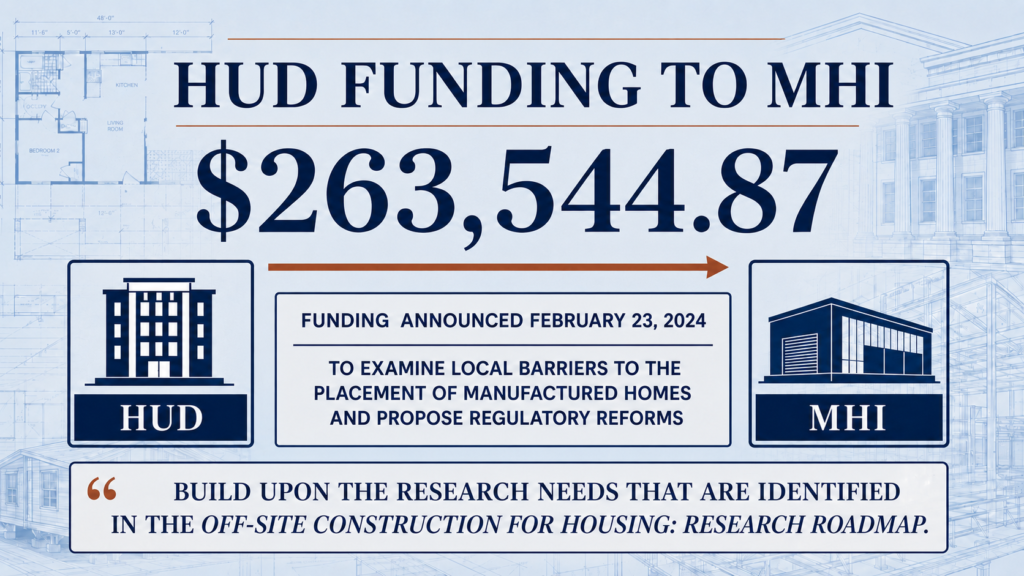
HUD Funded MHI $263,544.87
The Timeline Connecting HUD, MHI, and Teresa Payne
HUD published the Offsite Construction for Housing: Research Roadmap in January 2023. HUD subsequently issued the Offsite Construction and Land Use Reform Notice of Funding Opportunity to fund research addressing needs identified in that Roadmap.
On February 8, 2024, Teresa Payne participated in the MOD X workshop at HUD headquarters while serving as a senior HUD manufactured-housing official. The workshop was part of the research process used to develop HUD’s separate offsite-construction Action Plan. MOD X identified Payne among its combined list of “HUD workshop participants and project Key Partners.”
Fifteen days later, on February 23, 2024, HUD announced that MHI had received $263,544.87 to examine local barriers to manufactured-home placement and propose regulatory reforms. HUD expressly stated that the research awards built upon needs identified in the 2023 Research Roadmap.
MHI represents the largest manufactured-housing manufacturers in the country, some of which are certified by ICCNTA. The federal funding therefore placed an industry trade organization representing companies directly affected by manufactured-housing regulation in the position of conducting HUD-funded research and proposing regulatory reforms affecting that industry.
In May 2025, MHI announced that Payne had left HUD and joined MHI as Vice President of Policy, responsible for leading its policy team and advocating for the manufactured-housing industry at the federal and state levels.
The documented sequence is:
- January 2023: HUD published the Research Roadmap.
- December 2023: HUD announced the Offsite Construction and Land Use Reform research funding opportunity.
- February 8, 2024: Payne participated in the HUD/MOD X Action Plan workshop.
- February 23, 2024: HUD announced $263,544.87 in funding to MHI for research and proposed regulatory reforms that HUD expressly connected to the Roadmap.
- May 2025: Payne became MHI’s Vice President of Policy.
- May 19, 2025: MHARR announced its FOIA request for HUD records concerning Payne’s departure, outside contacts regarding her MHI position, and post-employment ethics.
Sources:
- HUD — Nearly $4 Million Awarded to Study Innovative Ways to Boost Housing Supply, February 23, 2024
- HUD — The Future Is Modular: HUD and MOD X’s Offsite Construction Workshop and Tours
- MOD X — HUD Workshop Participants and Project Key Partners
- MHI — About the Manufactured Housing Institute
- Housing Alert — MHI’s Appointment of Teresa Payne, May 2, 2025
- MHARR — FOIA Request Concerning Teresa Payne’s Departure from HUD
MHARR CALLS ON HUD SECRETARY TO FUNDAMENTALLY REFORM FEDERAL MANUFACTURED HOUSING PROGRAM
Another disturbing fact is that MHI has close ties to the MHCC which advises HUD
MHARR, in an August 12, 2026 communication to HUD Secretary Scott Turner (redacted copy attached), has called for a complete investigation of – and fundamental wide-reaching reforms to – the operation of the federal manufactured housing program administered by HUD’s Office of Manufactured Housing Programs (OMHP).
Citing multiple examples of irregularities, manipulation and potential “inside-outside” coordination of key functions and aspects of the HUD program – all to the extreme detriment of the industry’s smaller mainstream businesses — MHARR seeks, and has requested that the Secretary undertake, a full and independent investigation of the OMHP with regard to – among other things:
- HUD/OMHP manipulation of Manufactured Housing Consensus Committee (MHCC) appointments;
- Repeated, overlapping MHCC appointments for certain favored persons/entities;
- HUD/OMHP exclusion of collective small business voting representation on the MHCC;
- Targeted, biased HUD/OMHP rejections of independent MHCC nominees;
- HUD/OMHP manipulation of MHCC procedures and processes to exclude small business representation and input;
- Overall anti-small business bias in the operation of the MHCC and other HUD/OMHP functions;
- A near-total lack of transparency regarding OMHP actions, policies and decisions including, but not limited to failure to comply with multiple Freedom of Information Act requests;
- Evidence of possible “inside-outside” coordination related to former program officials;
- A total failure to implement the enhanced federal preemption of the Manufactured Housing Improvement Act of 2000; and
- A failure to conduct legitimate competitive solicitations for the program monitoring contract or to comply with sole-source contract safeguards, resulting in the selection of the same program contractor for the entire 50-year history of the program.
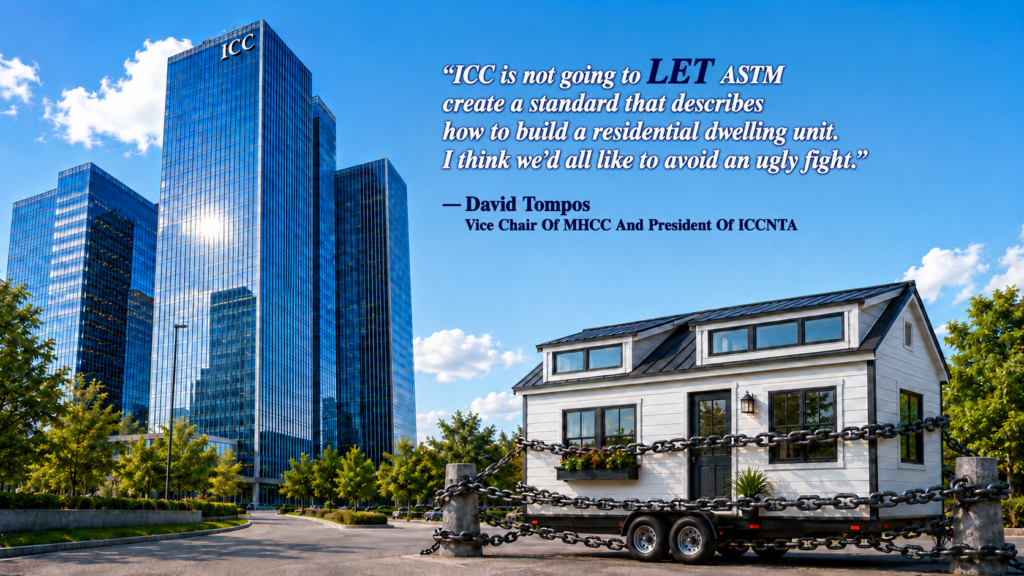
Teresa Payne Ignored My Complaint Regarding David Tompos: 2022
He Was Vice Chair Of MHCC And President Of ICCNTA
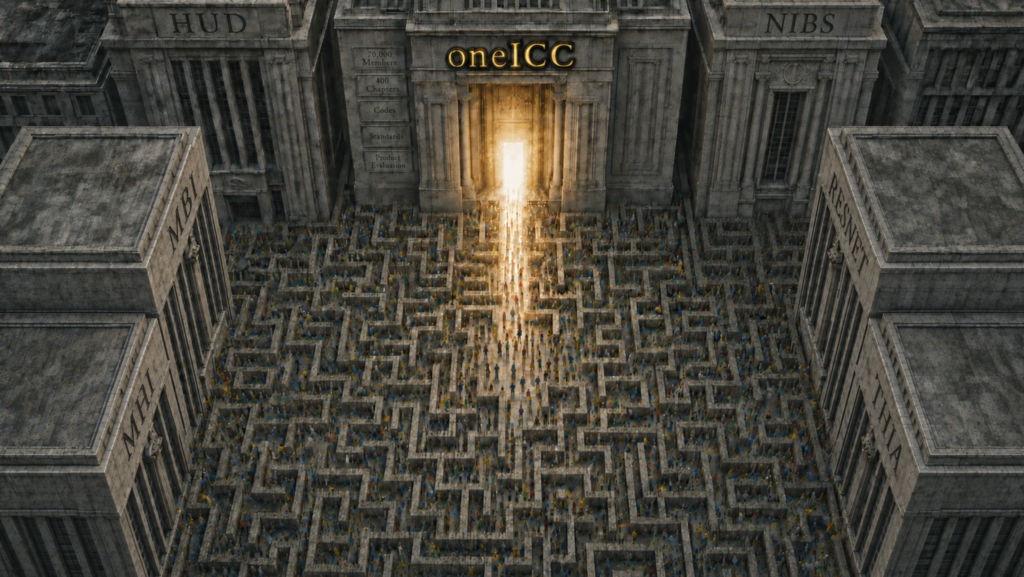
One Door: HUD’s Off-Site Roadmap and Action Plan Route Only to oneICC
The American people are not choosing a path. They are walking predetermined routes.
HUD funded the map. NIBS and MOD X drew it. Every corridor is a loop. There is only one
lighted door. They already named it oneICC.
The Roadmap’s “Industry Consensus” Was Developed Through an Invite-Only Workshop
HUD’s Offsite Construction for Housing: Research Roadmap describes its development as an “industry consensus process.” However, the workshop used to review, validate, and prioritize the Roadmap’s research questions was not open to the public or the broader industry and was peer reviewed by ICC employees.
The Roadmap states that NIBS and MODX held an “invitation-only workshop” during Phase 3 of the project. Appendix A further confirms that the December 2021 event was an “invite-only, half-day virtual workshop.”
NIBS, MOD X, and members of the Project Technical Committee nominated approximately 70 candidates for invitations. More than 40 invited participants attended. These selected participants reviewed and validated the proposed research questions, recommended additional subjects, and helped determine the priorities incorporated into the final HUD Roadmap.
NIBS and MOD X then summarized the invite-only workshop discussions for inclusion in the final report. The resulting Roadmap established research priorities that HUD later used to support federal funding awards—including $263,544.87 to MHI to examine local barriers to manufactured-home placement and propose regulatory reforms.
Source: HUD — Offsite Construction for Housing: Research Roadmap, PDF pages 7 and 80, Appendix A-1.
Conflicts Of Interest
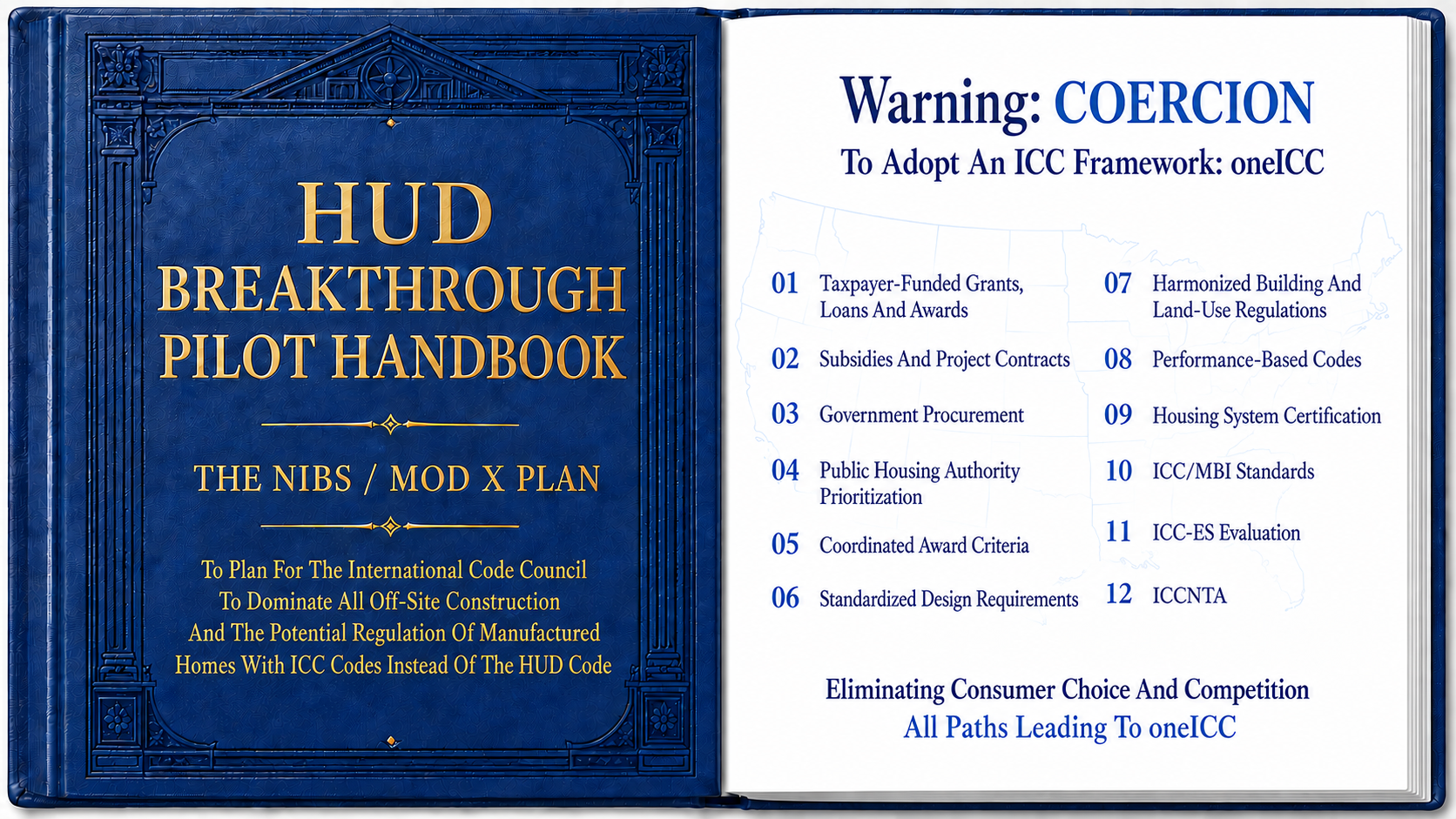
The Forthcoming HUD Pilot Handbook
HUD funded NIBS to identify regional barriers, conduct pilots, develop strategic plans, document the results, and produce a handbook intended to help additional regions “foster off-site construction capacity and encourage uptake.” The handbook could therefore carry the Housing System Certification framework tested or developed through the six selected regions into other HUD regions, states, municipalities, housing agencies, and regulatory systems.
The forthcoming HUD Breakthrough Pilot Handbook is where the research, regional pilots, and policy recommendations may be converted into a repeatable implementation process supporting Housing System Certification.
The central investigative question is no longer simply what each recipient studied. It is whether these federally funded projects are constructing interdependent components of a coordinated Housing System Certification framework—and whether the forthcoming handbook will institutionalize that framework around the same private codes, standards, evaluation services, inspection organizations, certification pathways, financing mechanisms, and implementation partners repeatedly identified throughout the Roadmap and Action Plan.
HUD Breakthrough Pilot Programs
Led By MODX In Partnership With The National Institute Of Building Sciences
Purpose
This project focuses on the regional development of offsite construction capacity to rapidly
increase housing supply across the United States. The initiative operationalizes two primary
strategies identified in MOD X’s prior HUD Action Plan for Accelerating Offsite Construction for
Housing:
• Aggregating market demand for offsite construction at the local and regional scale •
Harmonizing building regulations to remove barriers to offsite construction
Each of the six participating regions will develop a Regional Action Plan and a localized pilot
program that can serve as a replicable model for other regions across the country. The project
will culminate in a HUD Breakthrough Pilots Handbook, published by HUD and disseminated
This project includes six Regional Pilot Partners from across the country, along with Strategic
Pilot Partners — including the Harvard Joint Center for Housing Studies, the International Code
Council (ICC/NTA), and Ivory Innovations — who provide support throughout the project.
Conclusion: HUD Federal Awards Are Building the Components of a National Implementation System
The HUD-funded projects examined in this report are not isolated studies of individual housing problems. Each recipient is developing a different component of the regulatory, technical, financial, and implementation infrastructure that could support a national Housing System Certification framework.
Offsite Construction and Land Use Reform Recipients
- National Institute of Building Sciences — $499,878: Six regional off-site construction pilots, regional strategic plans, implementation documentation, and a pilot handbook intended to encourage adoption in additional regions.
- University of California, Los Angeles — $458,340: ADU legalization and production, housing prices, rents, and changes in land values—including properties where newly authorized development rights are not exercised.
- University of California, Irvine — $343,244: California’s state-level reduction of local and private ADU barriers in the context of Affirmatively Furthering Fair Housing.
- Urban Institute — $263,874: The relationship among local zoning reforms, housing costs, housing production, and segregation.
- Purdue University — $263,847: The treatment of building codes as land-use restrictions and the effects of revisions to the International Building Code and International Code Council framework on housing supply and affordability.
- Louisiana State University — $263,650.42: Manufacturing, siting, resilience, and expanded adoption of elevated, wind-resistant manufactured housing.
- Manufactured Housing Institute — $263,544.87: Local barriers to manufactured-home placement and regulatory reforms intended to address those barriers.
- Washington State University — $226,756.05: Development and demonstration of modular mass-timber hybrid construction and guidance supporting standardized modular design.
- ADL Ventures — $219,143: Financing industrialized off-site construction and expanding access to capital. ADL has separately identified adoption of ICC/MBI standards as an implementation example.
- Lehigh University — $196,722.42: ADU ordinances, zoning reforms, design guidelines, preapproved plans, financial incentives, municipal implementation, and approaches capable of replication in other jurisdictions.
Separate Office-to-Residential Conversions Award
HUD awarded M. Arthur Gensler Jr. & Associates, Inc. $858,261.91 through the separate Office-to-Residential Conversions NOFO.
Gensler’s project examines office-to-residential conversions in six cities, financial feasibility, building-code and zoning flexibility, public incentives, and implementation tools for local policymakers. It also incorporates Gensler’s proprietary Conversions+™ building-assessment platform.
HUD Awards Nearly $4 Million to Study Innovative Ways to Boost Housing Supply Including Office-to-Residential Conversion: Feb 23, 2024
HUD Archive
HUD Announces Research Grant Opportunity to Study Off-site Construction and Land Use Reforms: June 21, 2023
Greater Boston Is a Separate $3 Million PRO Housing Project
HUD separately awarded the Metropolitan Area Planning Council $3 million through the PRO Housing program for the Greater Boston Regional Offsite Construction Strategy.
Greater Boston is one of the six regions participating in the NIBS/MOD X HUD Breakthrough Regional Pilots Project. Its regional implementation is also supported by a separate $3 million HUD PRO Housing award to MAPC, whose project materials identify MOD X and the International Code Council as subject-matter experts. NIBS | MAPC project | MAPC project-partner presentation
What the Award Portfolio Builds
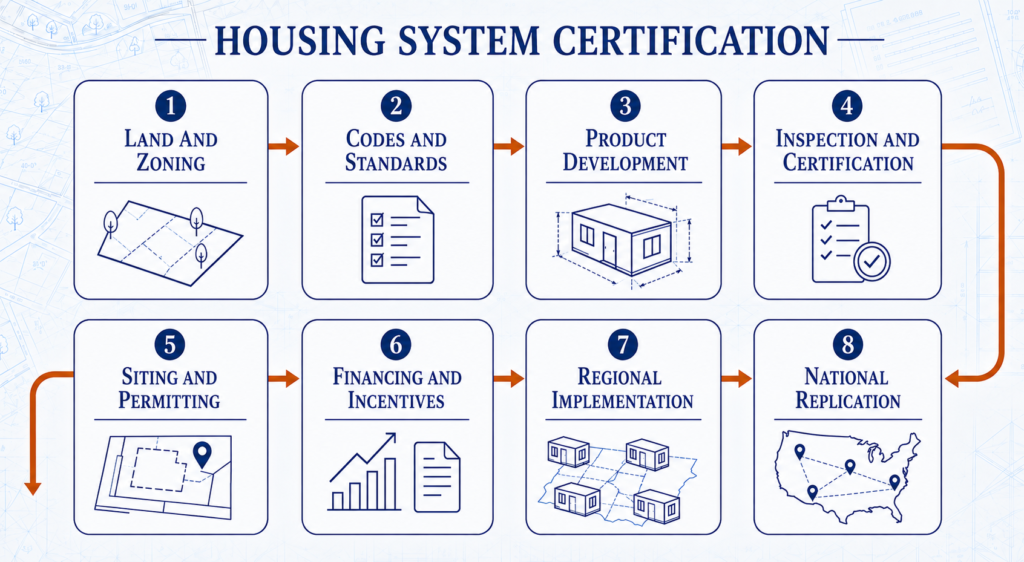
Taken together, the funded projects address different components surrounding Housing System Certification:
land and zoning → codes and standards → product development → inspection and certification → siting and permitting → financing and incentives → regional implementation → national replication
The land-use recipients examine where and under what conditions housing can be constructed. Purdue addresses the building-code framework. LSU and Washington State University address manufactured and modular product development. MHI addresses placement and regulatory reform. ADL addresses capital. NIBS converts the research into regional pilots, strategic plans, a forthcoming handbook, and broader replication.
Who Is The National Institute Of Building Sciences?
We were created by act of Congress in 1974 to be the nation’s authoritative source of findings and recommendations that impact and improve the built environment for the American people. At the National Institute of Building Sciences (NIBS), we connect research, policy, and practical application to advance innovation in the built environment. Our mission is to create a safer, more resilient, and technologically advanced infrastructure that serves American communities and strengthens our nation’s future.
Source NIBS
NIBS, MOD X, HUD, and three powerful trade associations—the International Code Council, the Modular Building Institute, and the Manufactured Housing Institute—are ushering in the complete domination of the off-site construction industry by ICC. With approximately 70,000 members and 400 chapters, ICC is not merely a code developer; it is an already vertically integrated monopoly that writes the I-Codes, jointly develops proprietary off-site standards with MBI, evaluates products through ICC-ES, accredits conformity-assessment organizations through IAS, performs plan review, inspection, certification, and labeling through ICCNTA, credentials industry professionals, and sells the training, publications, software, and digital tools required to navigate the system it created. MBI supplies the modular-industry network and jointly branded standards, while MHI represents the country’s largest manufactured-housing producers and advances regulatory reforms affecting the market its members control that are also represented on MHCC that advises HUD.
Through federally funded research, selected committees, regional pilots, demand aggregation, performance-based regulation, Housing System Certification, and a forthcoming national handbook, HUD is partnering with these three trade associations to place off-site construction—from codes and standards to evaluation, accreditation, inspection, certification, training, and implementation—inside a single private monopoly: oneICC.
ICC''s Report On Accelerating Off-Site Construction Through Collaboration
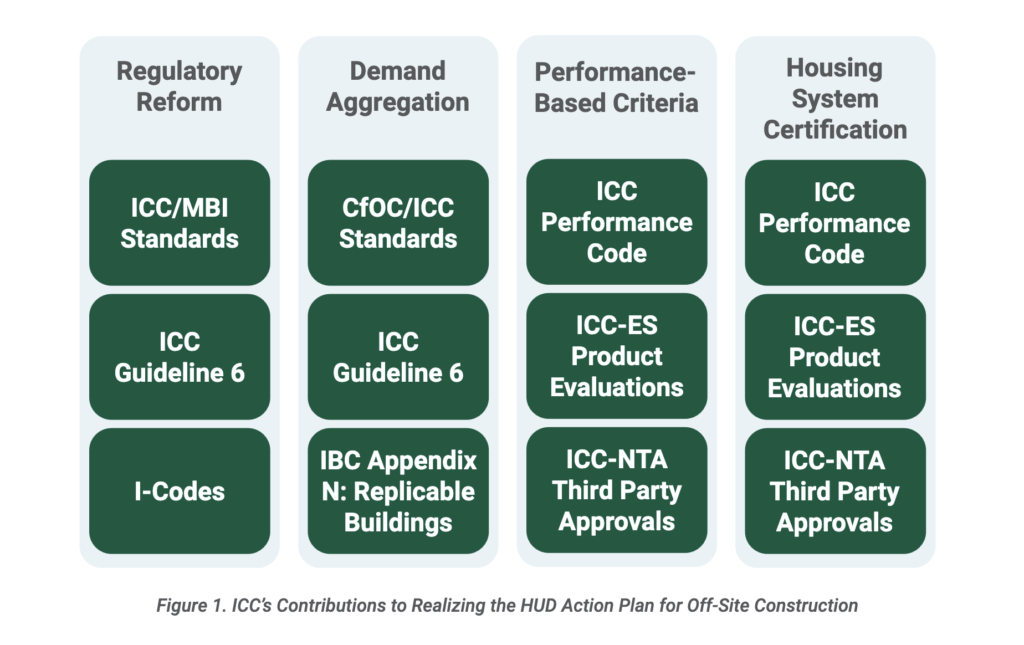
ICC's 'Contributions' To Realizing The Hud Action Plan For Off-Site Construction '
When An Image Is All You Need
On May 2026 the International Code Council responded with its own report, Accelerating Off-Site Construction Through Collaboration. ICC presents its existing codes, standards, evaluation services, and third-party programs as the ready-made solutions to the priorities identified in the Action Plan. On the surface this appears to be ordinary standards-development work and ordinary policy advocacy. When the documents are examined together, however—along with the historical federal record, the funding path, the leadership overlaps, and the specific language directed at manufactured housing—a clearer and more consequential pattern emerges.
ICC’s May 2026 report is written as if it is simply responding to an independent federal plan—explaining how its existing tools already address what HUD has asked for. That framing makes the ask sound cooperative and neutral: “Here is how we can help deliver the Action Plan.” In reality, the sequence runs the other way. The Roadmap and Action Plan are recommendations to HUD, produced through a process that included ICC-connected participants and peer reviewers. ICC then takes those recommendations, maps every major priority onto its own standards, evaluation services, third-party programs, and subsidiaries, and asks HUD to fund, prefer, and operationalize that package. The federal documents become the public justification for accelerating ICC’s vertically integrated system. The report is not an independent technical response to a settled HUD policy. It is ICC treating the recommendations as the blueprint for its own expansion and asking the federal government to underwrite and preference that expansion. The language of collaboration and “supporting the Action Plan” obscures the fact that the Action Plan is being used as the vehicle for one organization’s preferred implementation path.
My Response To The ICC Article
References To ICC In HUD Roadmap Publication
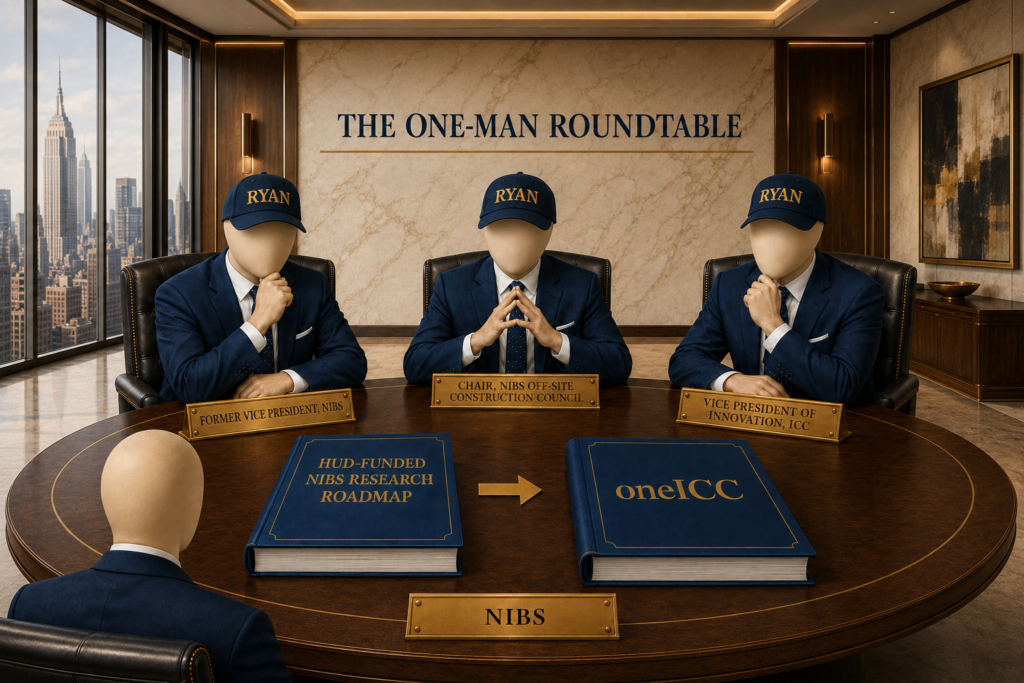
ICC's Testimony To NIBS Regarding Affordable Housing
Ryan Colker testifying to NIBS is almost a one-man roundtable: a former Vice President of NIBS, the Chair of the NIBS Off-Site Construction Council, and ICC’s Vice President of Innovation—all explaining to NIBS why the answer is ICC. With the HUD-funded NIBS Research Roadmap pointing in the same direction, it looks less like independent testimony and more like oneICC presenting to itself.

If That Was Not Enough- ICC Is Vying To Take Over Manufactured Housing
No, You Thought That Was It? No -They Want It All
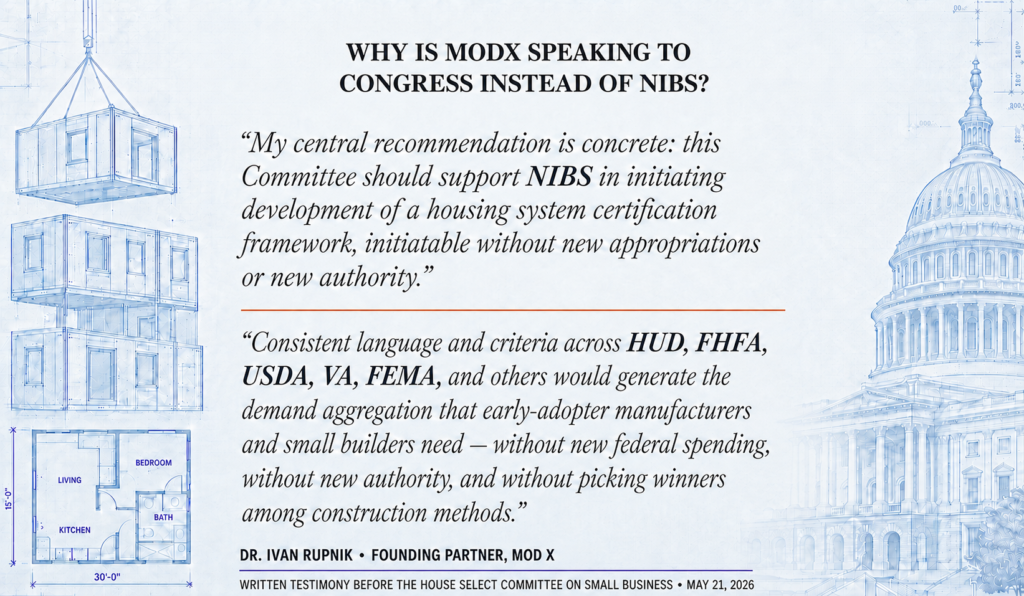
What I want to know is why MODX—a for-profit partner with deep institutional ties to NIBS—is speaking to Congress on NIBS’s behalf. Those relationships are documented in the preceding report identifying the overlapping executives involved in the HUD publications, grants, and resulting implementation framework.
My Response To The Rupnix Testimony To Congress
Operation Breakthrough- What The HUD Publications Left Out

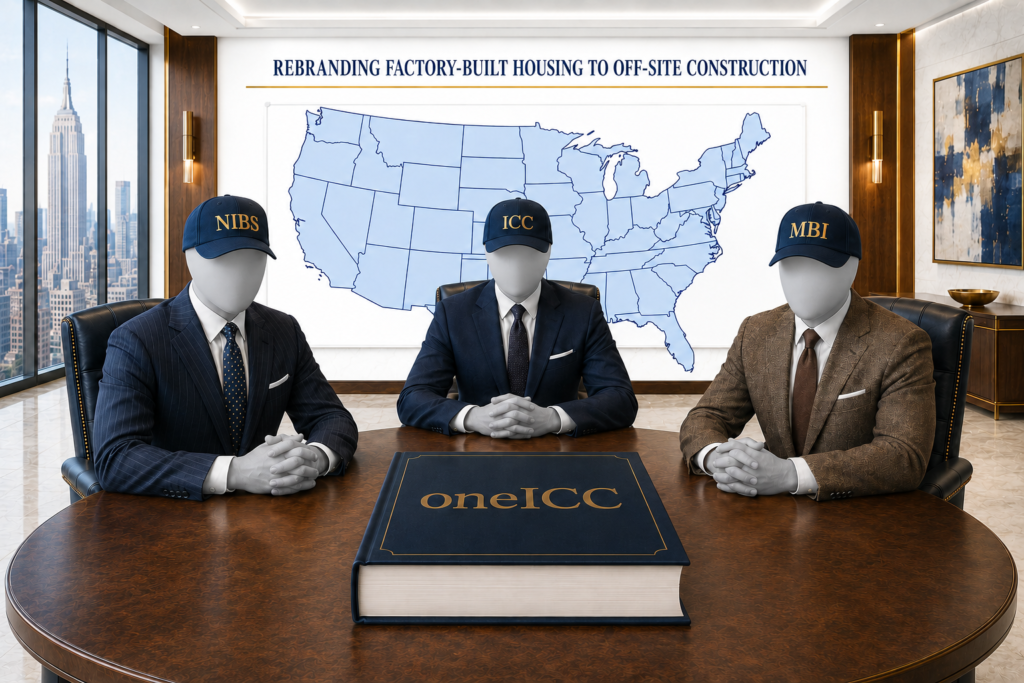
2028 ICC Meeting With NIBS And MBI
Motion made and seconded to approve a Standards Project in cooperation with the
National Institute of Building Sciences (NIBS) and the Modular Building Institute (MBI) to
explore and develop a portfolio of Standards and Guidance tools to support the off-site
construction industry
CEO Sims provided an update on The U.S. Department of Housing and Urban
Development’s (HUD) new rule to eliminate the HUD-inspector list and rely on ICC-
certified inspectors to perform HUD inspections.
My Petition To HUD Was Never Answered
We End With Simple Wisdom

“With the ANSI industry consensus standard by ICC and MBI now available, it seems that HUD could streamline the manufactured home industry, remove unnecessary regulatory barriers, and increase consumer confidence by adopting these standards for all offsite construction. ”
-Cindy Davis- ICC President -Quote from HUD Off-Site Construction Roadmap.
“Consumer confidence? The same cattle-rustling outfit is staking the land, writing the rules, approving the products, controlling the inspections and certification, issuing the permits, steering the financing and incentives, running the regional pilots, and preparing to spread the whole scheme nationwide. Now its partner is riding into Congress asking for the keys to the territory. I’d sooner trust a rattlesnake wearing a sheriff’s badge—at least he rattles before he strikes. They call it consumer confidence; I call it snake oil with a certification label. Fiddlesticks.”
August 31st, 2026