The Chassis Will Now Be Optional For Manufactured Homes
On July 11, 2026, the signing of the 21st Century ROAD to Housing Act was heralded as a definitive solution to the American housing crisis. For decades, a singular question has dogged policymakers: Why can’t we build affordable, high-quality homes with the same industrial efficiency as we build cars or aircraft? The Act promises to answer this by removing a seemingly trivial technicality—the requirement that manufactured homes be built on a permanent steel chassis.
The Term ''Affordable'' Is About As Meaningful As The Term ''Natural''
To the casual observer, the “permanent chassis” is a dusty regulatory relic that forced manufactured homes to remain visually distinct from traditional “site-built” houses. By making the chassis optional, the new law allows factory-built homes to sit on permanent foundations, look like neighborhood-standard architecture, and qualify for conventional financing. It looks like a win for modernization. But is it? Everyone keeps loosely throwing around the term affordable as casual as the food manufactuers label our food as so called natural.
But Wait- Not So Fast
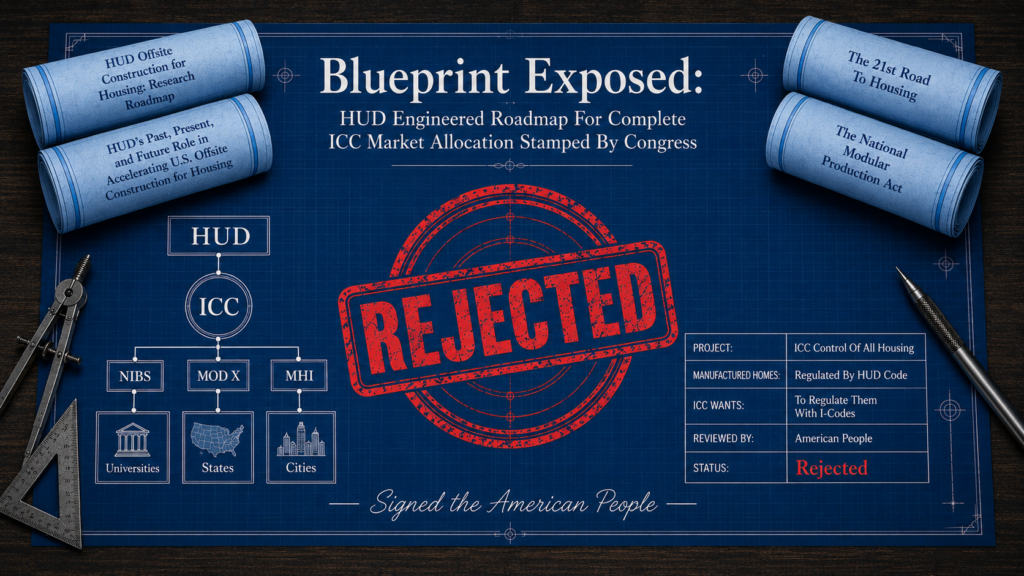
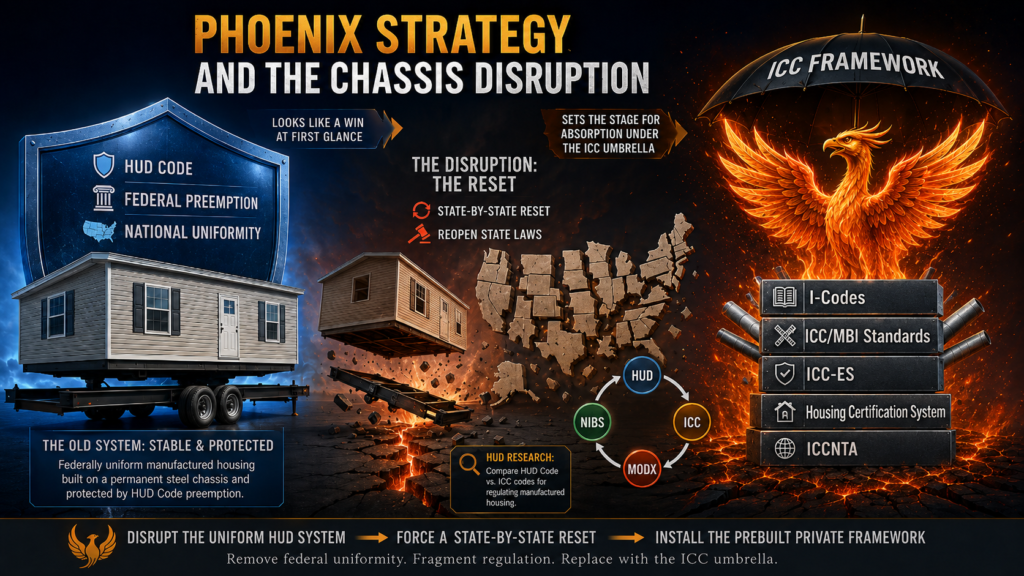
Beneath this veneer of flexibility lies a deeper shift in the hidden architecture of housing policy. The removal of the chassis is actually the linchpin of a massive regulatory pivot. It is the beginning of a “Phoenix Strategy”—a process of dismantling a 50-year-old federal system of national uniformity to make way for a private, vertically integrated regulatory apparatus that has been underway for years that will ”magically take itsplace. ” What is being built from the ashes of the old steel frame may not be a more open market, but a more exclusive one, giving the International Code Council complete market allocation of housing with the full support of HUD.
Every State Will Have To Reconsider Their Own Laws In Regards To Certification
I have created a report that argues that the change has a second, less visible effect. Removing the chassis also removes a defining element of the nationally uniform HUD Code category, which requires every state to reconsider its own laws and certify its treatment of the new chassis-less product to HUD in regards to certification. The 21st Century Road To Housing by itself seems very supportive of manufactured housing, except is does nothing to change the barriers to zoning. What alarms me is what is happening along side of the bill. So many have already complained that a manufactured home is already becoming too much like a modular home, and the lines are getting blurred. This is my opinion, and it remains to be seen, but I feel this is on purpose, and I feel sometime in the not so distance future, a manufactured home will just be absorbed under the ICC umbrella, because there will no need for these two types of housing.
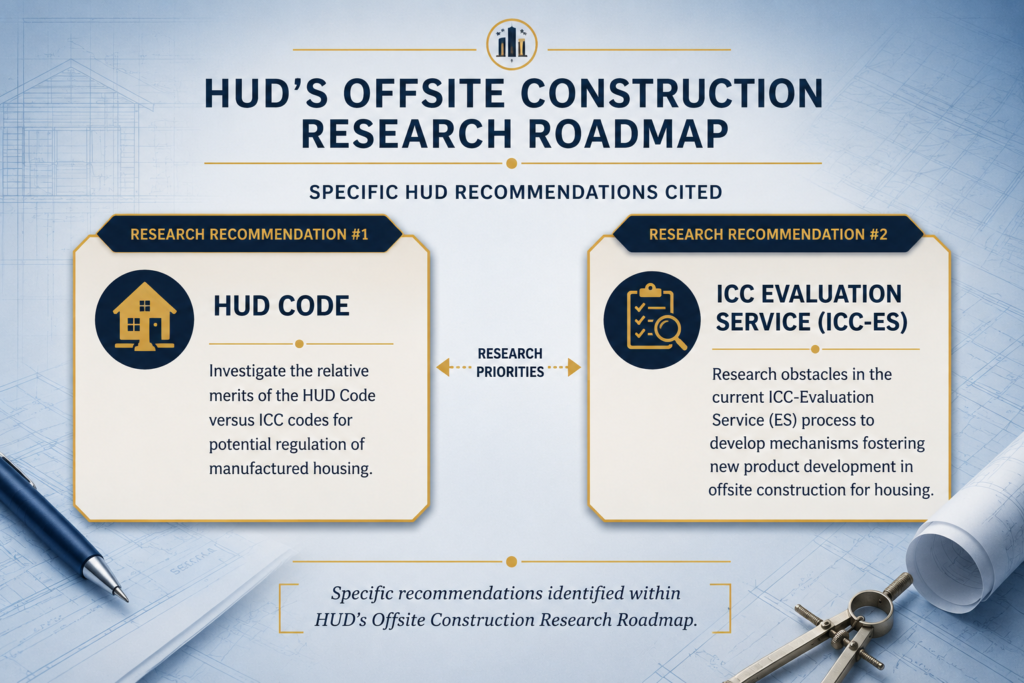
The chassis removal is not happening in a vacuum: since at least 2018, ICC, NIBS, MBI, MOD X, ICC-ES and ICC-NTA have been jointly building off-site construction standards, inspection credentials, federally funded research, and a Housing System Certification Program, with pilots already running in several states before the chassis provision became law. The most blatant proof of my prediction is the fact that the HUD funded publication, stated -”investigate the relative merits of the HUD code versus ICC codes for potential regulation of manufactured housing. ” I have also concluded this potential outcome because of the way both ICC and HUD are addressing preemption in the ICC 1215 standard after participating for two years. ICC is disregarding preemption and HUD has not defended the HUD code. Learn more.
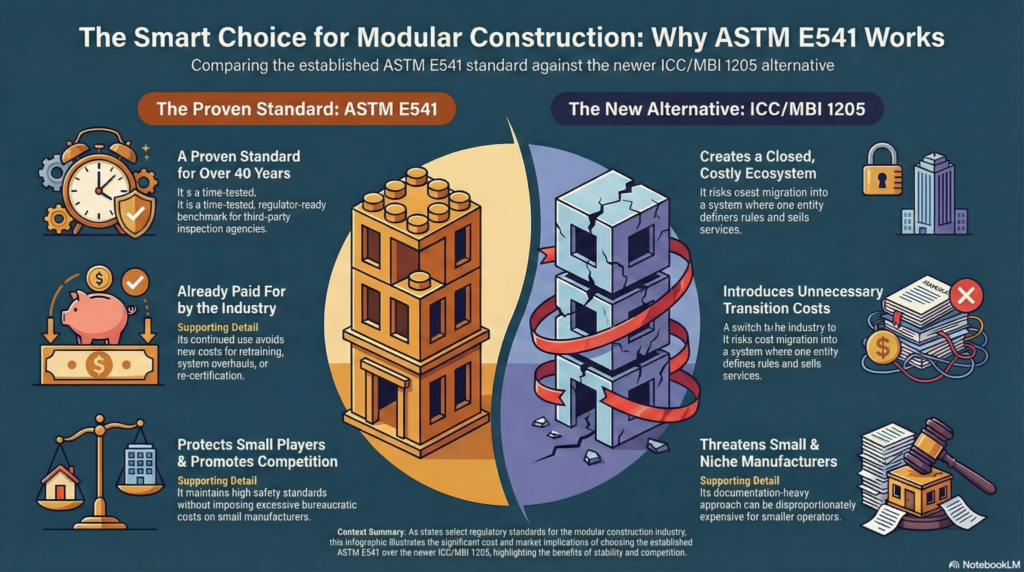
The report traces that timeline through ICC board minutes, HUD-funded research (which explicitly considers regulating manufactured housing under ICC codes instead of the HUD Code), congressional testimony, and federal funding records showing over $300 million in federal awards to NIBS since FY2008 alongside significant leadership overlap between NIBS and ICC. It also documents a competing, decades-old compliance pathway — ASTM E541, still cited in federal regulation and active in a dozen states — that the newer framework’s advocates do not mention.
What Is A Phoenix Strategy?
A Phoenix strategy is the deliberate dismantling or destabilization of an existing system so that a new system can rise from the disruption and replace it for regulatory capture. In this case, the pattern is.
Disrupt the nationally uniform HUD Code framework, force a state-by-state regulatory reset for certification, and position a pre-developed private code, standards, evaluation, inspection and housing certification system as the solution with the ICC NIBS MODX blueprint.
Where It All Began: ICC Board Meeting With NIBS And MBI
It is important to note that Dominic Sims was both CEO Of ICC and on the board Of NIBS at the same exact time in 2018.
ICC Testimony To NIBS Housing Affordability Hearing
Ryan Colker, while employed as Vice President of Innovation at the International Code Council, formally testified before the National Institute of Building Sciences Consultative Council on November 6, 2023 — the same NIBS body on which he had previously served as a NIBS Vice President and as Chair of NIBS’s Off-Site ConstructionCouncil — and used that platform to urge adoption of ICC’s own model codes and the ICC/MBI 1200 and 1205 off-site construction standards.
Utah Adopts ASTM E541 As An Alternative To ICC Standards
Following Virginia, Utah became the second state to adopt the ICCMBI 1200 AND 1205 standards and is the foundation of Utah’s first ever Modular State Program. All the press releases fail to mention that ASTM E541-22 is an alternative to the ICC standards that they have adopted as well. Virginia also accepts ASTME541.
The State of Utah Modular Building Program is administered by the Division of Facilities Construction and Management. Administration of this program is an independent function of the division’s activities which provide construction project management services and facilities management of state-owned buildings.