
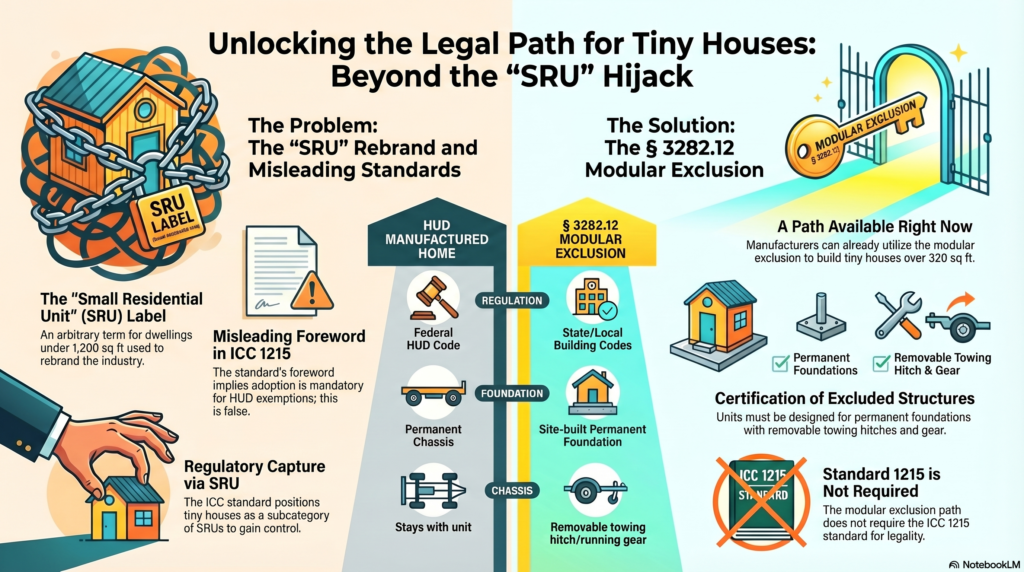
Hidden In The Forward Of The Standard
I have written extensively about ICC/THIA 1215 -Design, Construction and Regulation of Small Residential Units and Tiny Houses for Permanent Occupancy standard and the hijack of the standard by the Small Residential Unit ( SRU) an arbitrary, unconstitutional term that ICC has cooked up to rebrand the tiny house industry for the regulatory capture of the tiny house industry for their control. The SRU is not needed for the structural integrity, fire safety of tiny houses or any reason at all, it is a whim of ICC.
To understand the objections regarding the Small Residential Unit, please read and sign my petition.
Short Summary Of The Small Residential Unit Issue
There has been a great debate in the OSMTH 1215 committee regarding the Small Residential Unit takeover of the standard which is the agenda of ICC.
They want to position the Small Residential Unit, a made up term that is not used by anyone and is not enforceable over Tiny Houses, a codified term in the IRC, making Tiny Houses a subcategory under the Small Residential Unit.
SMALL RESIDENTIAL UNIT (SRU). A dwelling that is 1200 square feet (111 m2) or less excluding lofts and is constructed as a permanent residential structure with or without a permanent chassis.
Note: There has been discussion about changing the size down to 600 square feet but that has not been reflected in meeting notes that I have seen. That changes nothing.
Short Video Explainer
Below is a statement that is in the foreward of the standard that hides the opportunity for manufacturers that could utilize this opportunity RIGHT NOW for legal placement and mortgages for tiny houses. I am not saying it is simple, but the opportunity has been right under our nose all this time. Below are also important resources to understand HUD preemption, and the RV exemption. It is especially important to understand that HUD does not regulate the use and occupancy of RVs, that is beyond the scope of HUD, and under the local and state purview.
I will always support tiny houses built to RV standards as a housing choice when the manufacturer supersedes the minimum requirements for recreational vehicles, which most do.
I will include more helpful links to get caught up on the backstory.
The Statement
“The information contained in this forward is not part of this American National Standard (ANS) and has not been processed in accordance with ANSI’s requirements for an ANS. As such, this foreword may contain material that has not been subjected to public review or a consensus process. In addition, it does not contain requirements necessary for conformance to this standard.”
“This Standard will not address tiny houses used for temporary or seasonal occupancy, tiny houses installed on temporary foundations, or tiny house community development or microgrids.”
“In the U.S., off-site constructed units with a permanent chassis and over 320 sq ft may be subject to requirements under the HUD code. If the Authority Having Jurisdiction adopts this standard as part of its building code, the tiny house may qualify for an exemption.”
Issues With The Statement
Who would read the forward of the standard? No one right. What is so disturbing is that it is inaccurate, misleading, states half truths, and ICC has no authority to put out bulletins regarding HUD rulings regarding tiny houses that HUD has not ruled on. This part of the statement was written by ICC, and it does not go through consensus, it is not discussed, voted on, it does not go through public comments, and it is not subject to the ANSI Process.
ICC Liability Disclaimer -Also In The Forward
“ICC, its members and those participating in the development of ICC/THIA 1215-202x do not accept any liability resulting from compliance or noncompliance with the provisions of ICC/THIA 1215-202x. ICC does not have the power or authority to police or enforce compliance with the contents of this standard. Only the governmental body that enacts this standard into law has such authority.”
ICC shifts all liability to the government body that enacts the standard into law.
Breaking Down The False And Misleading Statements
“In the U.S., off-site constructed units with a permanent chassis and over 320 sq ft may be subject to requirements under the HUD code. If the Authority Having Jurisdiction adopts this standard as part of its building code, the tiny house may qualify for an exemption.”
1) Misleading statement. This is partially taken from the § 3282.12 – Excluded structures—modular homes.
My previous blog post details the Modular Exclusion
2) False– they ARE subject to, NOT may be subject to
3) Misleading -”If the Authority Having Jurisdiction adopts this standard as part of its building code, the tiny house may qualify for an exemption. ”
How it is misleading is that it is written in a manner that at first glance, you think it means that the standard has to be adopted first to qualify for a tiny house to qualify for an exemption.
Not true. False- the modular exclusion does NOT call it an exemption, it is referred to as an exclusion, and the steps are available right NOW for a manufacturer to be excluded from HUD regulation with a voluntary certification process and following exact steps so the unit can be built to building codes that include all the state and local requirements, all steps must be followed.
The standard is not needed for the exclusion. ICC is adding a step for their own benefit that is NOT even required.
4) The Modular Exclusion is the path that a manufacturer needs to take that will address the 320 issue of HUD preemption if the builder wants to build a tiny house 320 or larger. You will only be limited by size requirements of the state and building codes which includes habitable room sizes.
5) The fact that this statement is hidden in the forward and not brought up for discussion with the voting members, and interested parties is very disturbing because this is an opportunity for the tiny house industry that could be used right now for legal placement, and instead of directing the manufacturers, they are hiding it in the foreward. It should be front and center of the discussion.
6) What is equally disturbing is the fact that the building officials on the committee are in charge of modular programs and should know this information like the back of their hands and I have never heard them mention it and are currently considering comments that include select HUD provisions instead of motor vehicle preemptive laws and requirements.
It is a complete contradiction that a manufacturer would voluntarily exclude their units from HUD requirements to then build to HUD provisions. HUD does not allow this.
7) The 3282.12 – Excluded structures—modular homes pathway eliminates the need to use the term Small Residential Unit instead of the tiny house term for those who do not want to use that term. The committee has pushed the narrative that it is needed to build larger tiny houses. They already can -through the § 3282.12 – Excluded structures—modular homes.
The justification to use the term was based on ridiculous reasons and down right lies that I cover in this blog post.
The only partially true part of this statement is that off-site constructed units over 320 are subject to requirements under the HUD code- though they are NOT accurately stating that they are subject to HUD requirements.
Complaint And Preemption Inquiry
I have sent a complaint and preemption inquiry to ICC that they will be voting on at the ICC board meeting. I am asking for the ICC board to strike the information in the foreward of the standard that discusses HUD and the 320 footprint. This is vital to the industry and does not belong in the foreward of the standard. It must be discussed, go through consensus, public comments, and through the ANSI process.
See below.
Statutory Definition Of A Manufactured Home
Manufactured home means a structure, transportable in one or more sections, which in the traveling mode, is eight body feet or more in width or forty body feet or more in length, or, when erected on site, is three hundred twenty or more square feet, and which is built on a permanent chassis and designed to be used as a dwelling with or without a permanent foundation when connected to the required utilities, and includes the plumbing, heating, air-conditioning, and electrical systems contained therein. Calculations used to determine the number of square feet in a structure will be based on the structure’s exterior dimensions measured at the largest horizontal projections when erected on site. These dimensions will include all expandable rooms, cabinets, and other projections containing interior space, but do not include bay windows. This term includes all structures which meet the above requirements except the size requirements and with respect to which the manufacturer voluntarily files a certification pursuant to 24 CFR 3282.13 and complies with the standards set forth in 24 CFR part 3280.
§ 3282.12 - Excluded Structures—Modular Homes
(a) The purpose of this section is to provide the certification procedure authorized by section 604(h) of the National Manufactured Housing Construction and Safety Standards Act under which modular homes may be excluded from coverage of the Act if the manufacturer of the structure elects to have them excluded. If a manufacturer wishes to construct a structure that is both a manufactured home and a modular home, the manufacturer need not make the certification provided for by this section and may meet both the Federal manufactured home requirements and any modular housing requirements. When the certification is not made, all provisions of the Federal requirements shall be met.
(b) Any structure that meets the definition of manufactured home at 24 CFR 3282.7(u) is excluded from the coverage of the National Manufactured Housing Construction and Safety Standards Act, 42 U.S.C. 5401 et seq., if the manufacturer certifies as prescribed in paragraph (c) of this section that:
(1) The structure is designed only for erection or installation on a site-built permanent foundation;
(i) A structure meets this criterion if all written materials and communications relating to installation of the structure, including but not limited to designs, drawings, and installation or erection instructions, indicate that the structure is to be installed on a permanent foundation.
(ii) A site-built permanent foundation is a system of supports, including piers, either partially or entirely below grade which is:
(A) Capable of transferring all design loads imposed by or upon the structure into soil or bedrock without failure,
(B) Placed at an adequate depth below grade to prevent frost damage, and
(C) Constructed of concrete, metal, treated lumber or wood, or grouted masonry; and
(2) The structure is not designed to be moved once erected or installed on a site-built permanent foundation;
(i) A structure meets this criterion if all written materials and communications relating to erection or installation of the structure, including but not limited to designs, drawings, calculations, and installation or erection instructions, indicate that the structure is not intended to be moved after it is erected or installed and if the towing hitch or running gear, which includes axles, brakes, wheels and other parts of the chassis that operate only during transportation, are removable and designed to be removed prior to erection or installation on a site-built permanent foundation; and
(3) The structure is designed and manufactured to comply with the currently effective version of one of the following:
(i) One of the following nationally recognized building codes:
(A) That published by Building Officials and Code Administrators (BOCA) and the National Fire Protection Association (NFPA) and made up of the following:
(1) BOCA Basic Building Code,
(2) BOCA Basic Industrialized Dwelling Code,
(3) BOCA Basic Plumbing Code,
(4) BOCA Basic Mechanical Code, and
(5) National Electrical Code, or
(B) That published by the Southern Building Code Congress (SBCC) and the NFPA and made up of the following:
(1) Standard Building Code,
(2) Standard Gas Code,
(3) Standard Mechanical Code,
(4) Standard Plumbing Code, and
(5) National Electrical Code, or
(C) That published by the International Conference of Building Officials (ICBO), the International Association of Plumbing and Mechanical Officials (IAPMO), and the NFPA and made up of the following:
(1) Uniform Building Code,
(2) Uniform Mechanical Code,
(3) Uniform Plumbing Code, and
(4) National Electrical Code or
(D) The codes included in paragraphs (b)(3)(i)(A), (B), or (C) in connection with the One- and Two-Family Dwelling Code, or
(E) Any combination of the codes included in paragraphs (b)(3)(i)(A), (B), (C), and (D), that is approved by the Secretary, including combinations using the National Standard Plumbing Code published by the National Association of Plumbing, Heating and Cooling Contractors (PHCC), or
(F) Any other building code accepted by the Secretary as a nationally recognized model building code, or
(ii) Any local code or State or local modular building code accepted as generally equivalent to the codes included under paragraph (b)(3)(i), (the Secretary will consider the manufacturer’s certification under paragraph (c) of this section to constitute a certification that the code to which the structure is built is generally equivalent to the referenced codes. This certification of equivalency is subject to the provisions of paragraph (f) of this section) or
(iii) The minimum property standards adopted by the Secretary pursuant to title II of the National Housing Act; and
(4) To the manufacturer’s knowledge, the structure is not intended to be used other than on a site-built permanent foundation.
(c) When a manufacturer makes a certification provided for under paragraph (b) of this section, the certification shall state as follows:
The manufacturer of this structure, Name ____________________ Address ____________________ (location where structure was manufactured).
Certifies that this structure (Ser. No. ________) is not a manufactured home subject to the provisions of the National Manufactured Housing Construction and Safety Standards Act and is—
(1) designed only for erection or installation on a site-built permanent foundation,
(2) not designed to be moved once so erected or installed,
(3) designed and manufactured to comply with ______________ (Here state which code included in paragraph (b)(3) of this section has been followed), and
(4) to the manufacturer’s knowledge is not intended to be used other than on a site-built permanent foundation.
(d) This certification shall be affixed in a permanent manner near the electrical panel, on the inside of a kitchen cabinet door, or in any other readily accessible and visible location.
(e) As part of this certification, the manufacturer shall identify each certified structure by a permanent serial number placed on the structure during the first stage of production. If the manufacturer also manufactures manufactured homes that are certified under §§ 3282.205 and 3282.362(c), the series of serial numbers for structures certified under this section shall be distinguishable on the structures and in the manufacturer’s records from the series of serial numbers for the manufactured homes that are certified under §§ 3282.205 and 3282.362(c).
(1) If a manufacturer wishes to certify a structure as a manufactured home under §§ 3282.205 and 3282.362(c) after having applied a serial number identifying it as exempted under this section, the manufacturer may do so only with the written consent of the Production Inspection Primary Inspection Agency (IPIA) after thorough inspection of the structure by the IPIA at at least one stage of production and such removal or equipment, components, or materials as the IPIA may require to perform inspections to assure that the structure conforms to the Federal manufactured home standards. The manufacturer shall remove the original serial number and add the serial number required by § 3280.6.
(2) A manufacturer may not certify a structure under this section after having applied the manufactured home serial number under § 3280.6.
(f) All certifications made under this section are subject to investigation by the Secretary to determine their accuracy. If a certification is false or inaccurate, the certification for purposes of this section is invalid and the structures that have been or may be the subject of the certification are not excluded from the coverage of the Act, the Federal Manufactured Home Construction and Safety Standards, or these Regulations.
(1) If the Secretary has information that a certification may be false or inaccurate, the manufacturer will be given written notice of the nature of this information by certified mail and the procedure of this subparagraph will be followed.
(i) The manufacturer must investigate this matter and report its findings in writing as to the validity of this information to the Secretary within 15 days from the receipt of the Secretary’s notice.
(ii) If a written report is received within the time prescribed in paragraph (f)(1)(i) of this section, the Secretary will review this report before determining whether a certification is false or inaccurate. If a report is not received within 15 days from the receipt of the Secretary’s notice, the Secretary will make the determination on the basis of the information presented.
(iii) If the Secretary determines that a certification is false or inaccurate, the manufacturer will be given written notice and the reasons for this determination by certified mail.
(2) The Secretary may seek civil and criminal penalties provided for in section 611 of the Act, 42 U.S.C. 5410,if.
[44 FR 68733, Nov. 29, 1979, as amended at 49 FR 10666, Mar. 22, 1984]
Link To CFR
§ 3282.11 - Preemption and Reciprocity.
(a) No State manufactured home standard regarding manufactured home construction and safety which covers aspects of the manufactured home governed by the Federal standards shall be established or continue in effect with respect to manufactured homes subject to the Federal standards and these regulations unless it is identical to the Federal standards.
(b) No State may require, as a condition of entry into or sale in the State, a manufactured home certified (by the application of the label required by § 3282.362(c)(2)(i)) as in conformance with the Federal standards to be subject to State inspection to determine compliance with any standard covering any aspect of the manufactured home covered by the Federal standards. Nor may any State require that a State label be placed on the manufactured home certifying conformance to the Federal standard or an identical standard. Certain actions that States are permitted to take are set out in § 3282.303.
(c) States may participate in the enforcement of the Federal standards enforcement program under these regulations either as SAAs or PIAs or both. These regulations establish the exclusive system for enforcement of the Federal standards. No State may establish or keep in effect through a building code enforcement system or otherwise, procedures or requirements which constitute systems for enforcement of the Federal standards or of identical State standards which are outside the system established in these regulations or which go beyond this system to require remedial actions which are not required by the Act and these regulations. A State may establish or continue in force consumer protections, such as warranty or warranty performance requirements, which respond to individual consumer complaints and so do not constitute systems of enforcement of the Federal standards, regardless of whether the State qualifies as an SAA or PIA.
(d) No State or locality may establish or enforce any rule or regulation or take any action that stands as an obstacle to the accomplishment and execution of the full purposes and objectives of Congress. The test of whether a State rule or action is valid or must give way is whether the State rule can be enforced or the action taken without impairing the Federal superintendence of the manufactured home industry as established by the Act.
§ 3282.15 - Exemption For Recreational Vehicles
(a) Exemption. A recreational vehicle that meets the requirements of this section is exempt from 24 CFR parts 3280 and 3282.
(b) Definition. A recreational vehicle is:
(1) A vehicle or vehicular structure not certified as a manufactured home;
(2) Designed only for recreational use and not as a primary residence or for permanent occupancy; and is either:
(i) Built and certified in accordance with either NFPA 1192 (incorporated by reference, see § 3282.16) or ANSI A119.5 (incorporated by reference, see § 3282.16) as provided by paragraph (c) of this section; or
(ii) Any vehicle which is self-propelled.
(c) Notice and certification requirements. In order for the exemption to apply to an ANSI A119.5-15 certified recreational vehicle, a Manufacturer’s Notice must be delivered to the consumer prior to the completion of the sales transaction. The Manufacturer’s Notice must also be prominently displayed in a temporary manner in the kitchen (i.e., countertop or exposed cabinet face). The Manufacturer’s Notice must meet the following requirements:
(1) Title of Manufacturer’s Notice. The title of the Manufacturer’s Notice shall be “*****MANUFACTURER’S NOTICE*****” which shall be legible and typed using bold letters at least 1 inch in size.
(2) Content of Notice. The content of the Manufacturer’s Notice text shall be as follows:
The Manufacturer of this unit certifies that it is a Park Model Recreational Vehicle designed only for recreational use, and not for use as a primary residence or for permanent occupancy. The manufacturer of this unit further certifies that this unit has been built in accordance with the ANSI A119.5-15 consensus standard for Park Model Recreational Vehicles.
(3) Text of Notice. The text of the Manufacturer’s Notice, aside from the Manufacturer’s Notice’s title shall be legible and typed using letters at least 1/2 inch in size.
(4) Removal of Manufacturer’s Notice. The Manufacturer’s Notice shall not be removed by any party until the entire sales transaction has been completed.
(5) Completion of sales transaction. A sales transaction with a Park Model Recreational Vehicle purchaser is considered completed when all the goods and services that the dealer agreed to provide at the time the contract was formed have been provided. Completion of a retail sale will be at the time the dealer completes installation of the Park Model Recreational Vehicle, if the dealer has agreed to provide the installation, or at the time the dealer delivers the recreational vehicle to a transporter, if the dealer has not agreed to transport or install the Park Model Recreational Vehicle. The sale is also complete upon delivery to the site if the dealer has not agreed to provide installation as completion of sale.
Related Blog Posts
Summary
The modular exclusion allows builders to bypass HUD preemption and build to state and local requirements. It eliminates the purported need for the SRU term, as larger tiny houses can already be built legally under this modular framework.
The industry stands at a crossroads: Are you willing to navigate the complex but available federal exclusion path today, or will you wait for the ICC to define—and control—your Small Residential Unit future?
This standard is being developed under ‘the guise of standardization’ and progress for the tiny house industry but instead it is throwing the tiny house industry in chaos and to crush small artisan builders and they are blocking the paths for compliance that is already in place, and they trying to find a work around federal requirements, and disregarding motor vehicle and HUD preemption, the exact steps needed for compliance. I end this with a song I wrote in the style of western satire. Below is also the written tale that goes with the song.
The Little House In The Desert That Leaves No Tracks
A Western Satire Tale Of Tiny House Swindlin’, Rustled By Free-Wheelin’ Back Door Dealin' Small Residential Unit Rich Barons.
Much Needed Comic Relief : A Pause From The Battle For Tiny Houses
This blog post is centered around the International Code Council ICC/THIA 1215 tiny house standard written with much needed humor to lighten the heaviness and stress of the issues I will present. The blog post includes a short satire video explainer and the tale of The Little House In The Desert -A Wagon That Leaves No Tracks – A Western Satire Tale Of Tiny House Swindlin’, Rustled By Free-Wheelin’, Backdoor Dealin’ Small Residential Unit Rich Barons written in a spaghetti western theme depicting the Wild Wild West, sprinkled with lots of satire.
I will add relevant blog posts at the end if you need to get caught up on the main issues including how the standard was hijacked by the small residential unit and how ICC is disregarding and ignoring motor vehicle and HUD preemption and the very path that could lead tiny houses on wheels to compliance for mortgages and legal placement. ICC is purposely rerouting tiny houses through the small residential unit detour that will stifle the industry.
The result is a “ghost trailer”—a structure that moves through jurisdictions without being regulated as a motor vehicle or as a manufactured home, without a VIN, without registration at the DMV, and without a title.
The small residential unit, is arbitrary and unconstitutional, a whim of ICC, and has nothing to do with structural integrity, life and fire safety or for consumer protection for tiny houses.
This strategic move will cause a regulatory reset, squeeze out small artisan builders in favor of BIG Players in the industry.
The reset will cause a slow adoption of a 50 state patchwork of different regulations, exactly what preemption is in place to prevent for their market control and domination with the strategy of rebranding tiny houses.
ICC 1215: Satire On The Ghost Trailer That Leaves No Ruts
April 11, 2026