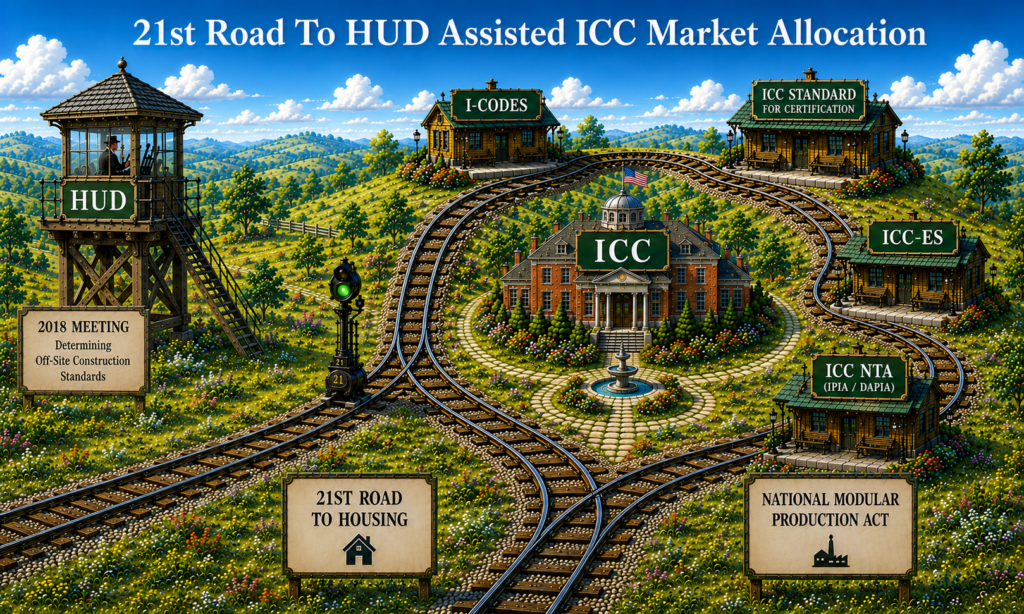
Connecting The DOTS Since 2018 With ICC/NIBS/MBI And HUD
I have created a report that documents how HUD has a relationship with the International Code Council that requires careful scrutiny and how HUD has used taxpayer-funded research grants to help build a private certification system for offsite construction giving complete market allocation to the International Code Council, that is already a vertically integrated orgnaization and how this ties into the 21st Road To Housing Act that went into effect on July 11, 2026 and the potential S-2489- National Modular Production Act that was introduced in 2025.
21st Century ROAD to Housing Act Enacted July 11, 2026
Statutory Mandate: This act officially removes the mandatory requirement for the chassis of a manufactured home, stripping away the physical boundary that separates federal HUD Code preemption from local zoning networks.
S. 2489-National Modular Production ActL: Introduced
SEC. 4. Standardized uniform commercial code for modular homes states—
- (a) Award. The Secretary may award a grant to study the design and feasibility of a standardized uniform commercial code for modular homes, which shall evaluate—
- (1) the utility of a standardized coding system for serializing and securing modules, streamlining design and construction, and improving modular home innovation; and
- (2) a means to coordinate a standardized code with financing incentives.
- (b) Authorization of appropriations.—There is authorized to be appropriated such funds as may be necessary to carry out subsection (a).
Bottom Line-This Has Been In The Works For Almost A Decade
Bottom line- a handful of people wearing multiple institutional hats, in the same organizations with overlapping executives used federal research money to recommend, build, and pilot a private certification and identification system for off-site construction — routed around existing federal consumer protections — before the public or Congress had fully reckoned with what was being created which will eliminate consumer choice and competition to the International Code Council, with the full support of HUD.
HUD Is Allowing The Erosion Of The HUD Code For ICC To Takeover
HUD refuses to answer complaints, petitions, and disregards that the ICC acquisition of NTA, now known as ICCNTA has caused a conflict of interest to federal laws, because ICCNTA is controlled by ICC. HUD gives ICCNTA and ICC preferred treatment and is eliminating competition and removing consumer choice. HUD is ignoring complaints about HUD preemption that ICC is disregarding in the ICC 1215 standard v=currently being developed.
§ 3282.359 Conflict of interest
a) All submissions by private organizations shall include a statement that the submitting party is independent in that it does not have any actual or potential conflict of interest and is not affiliated with or influenced or controlled by any producer, supplier, or vendor of products in any manner which might affect its capacity to render reports of findings objectively and without bias.
(b) A private organization shall be judged to be free of conflicting affiliation, influence, and control if it demonstrates compliance with all of the following criteria:
(1) It has no managerial affiliation with any producer, supplier, or vendor of products for which it performs PIA services, and is not engaged in the sale or promotion of any such product or material;
(2) The results of its work do not accrue financial benefits to the organization via stock ownership of any producer, supplier or vendor of the products involved;
ICC/THIA Standard 1215 on the Design, Construction, Inspection and Regulation of Tiny Houses for Permanent Occupancy
I have written extensively about ICC/THIA 1215 -Design, Construction and Regulation of Small Residential Units and Tiny Houses for Permanent Occupancy standard and the hijack of the standard by the Small Residential Unit ( SRU) an arbitrary, unconstitutional term that ICC has cooked up to rebrand the tiny house industry for the regulatory capture of the tiny house industry for their control. The SRU is not needed for the structural integrity, fire safety of tiny houses or any reason at all, it is a whim of ICC.
There has been a great debate in the OSMTH 1215 committee regarding the Small Residential Unit takeover of the standard which is the agenda of ICC.
They want to position the Small Residential Unit, a made up term that is not used by anyone and is not enforceable over Tiny Houses, a codified term in the IRC, making Tiny Houses a subcategory under the Small Residential Unit.
SMALL RESIDENTIAL UNIT (SRU). A dwelling that is 1200 square feet (111 m2) or less excluding lofts and is constructed as a permanent residential structure with or without a permanent chassis.
Note: There has been discussion about changing the size down to 600 square feet but that has not been reflected in meeting notes that I have seen. That changes nothing.
ICC has not aligned with the HUD excluded structures- modular homes in the HUD code, denies the need for VIN numbers, certification labels. and HUD is allowing this. ICC is creating a ‘ghost trailer’ never in the NHTSA/DOT system. See related blog posts at the end.
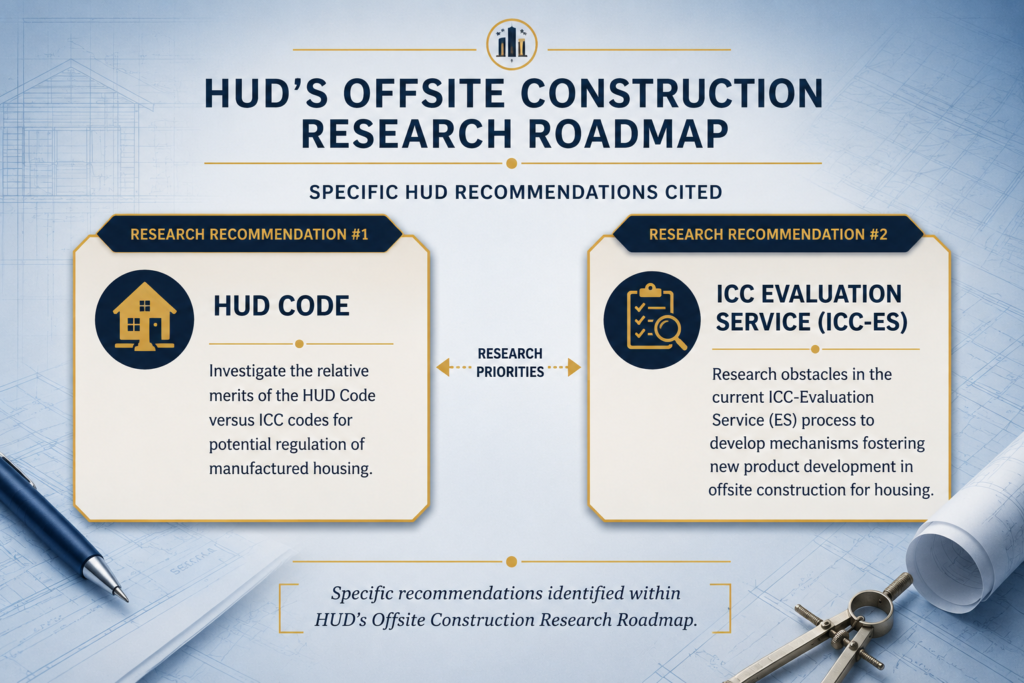
Here is the short version. HUD paid for two reports — “Offsite Construction for Housing: Research Roadmap” (2023) and “HUD’s Past, Present, and Future Role in Accelerating U.S. Offsite Construction for Housing: A Comparative Study and Action Plan” (2024–2025) — recommending changes to how these homes are regulated. The organizations paid to do that research — NIBS and MOD X — are led by, and closely tied to, the same people who run the International Code Council (ICC), the private organization that writes the building codes and standards these homes must follow and certifies compliance with them. That taxpayer-funded research has since become an actual certification program, already piloted in six states, before Congress has passed any law making it mandatory. The 21st ROAD to Housing Act would take that privately built system and make it federal law, requiring every state to certify compliance with it.
NIBS. MODX Launch Inisative To Streamline Housing Approval Through System Certification: Feb. 12, 2026
“In practical terms, Housing System Certification aims to support reduced redundancy for repeat deployments, clearer verification and accountability, more predictable review and inspection workflows enabling more consistent outcomes across jurisdictions, and greater confidence for lenders, insurers, and owners through verifiable evidence and repeatable quality processes”, said Ivan Rupnik, Founding Partner of MOD X.
Source
The Report Below Is A Detailed Timeline
The report details the organizations, the individuals that are executives that overlap organizations, and relevant dates starting with the ICC board meeting on July 27, 2018 that approved the off-site construction standards with ICC. NIBS, and MBI that became the ICC/MBI 1200 series and how that ties into the two HUD off-site construction funded research plans, the 21st Road to Housing and the National Modular Production Act.
International Code Council Approved Meetings With ICC/NIBS/MBI
CEO Sims provided an update on The U.S. Department of Housing and Urban Development’s (HUD) new rule to eliminate the HUD-inspector list and rely on ICC certified inspectors to perform HUD inspections.
Motion made and seconded to approve a Standards Project in cooperation with the National Institute of Building Sciences (NIBS) and the Modular Building Institute (MBI) to explore and develop a portfolio of Standards and Guidance tools to support the off-site construction industry.
Antitrust Concerns
- Market Allocation: Federal research roadmaps explicitly favor the trade association’s proprietary evaluation service while completely excluding numerous competing third-party testing and evaluation agencies.
- Unlawful Monopolization: The 21st Century ROAD to Housing Act (enacted July 11, 2026) codifies this private system into federal law, forcing states to mandate compliance or face strict market prohibitions.
Structural Abuse and Capture
- Interlocking Directorates: A small network of executives hold overlapping leadership roles across federal advisory institutes, private research firms, and the trade association itself.
- Pre-Legislative Execution: These overlapping leaders used federal research grants to pilot a proprietary certification system across six states before Congress formally voted on the mandate, bypassing public scrutiny.
- Bypassing Competitive Bidding: A congressionally chartered advisory institute leverages unique statutory exemptions to bypass standard competitive-bidding requirements, funneling millions in federal housing obligations directly into this closed network.
Barriers to Entry and Elimination of Choice
- Suppressed Alternatives: Regulatory memos and federal reports systematically omit or phase out valid, long-standing alternative compliance standards, leaving independent manufacturers with no viable choice but the trade association’s framework.
- Proprietary Lock-in: By substituting private serial numbers for recognized federal tracking systems, the framework traps smaller builders in an expensive, proprietary ecosystem necessary for consumers to secure refinancing.
July 26, 2026