

The International Code Council is the leading global source of model codes and standards and building safety solutions that include product evaluation, accreditation, technology, training, and certification. The Code Council’s codes, standards, and solutions are used to ensure safe, affordable, and sustainable communities and buildings worldwide.
The International Code Council (ICC) family of solutions includes the ICC Evaluation Service (ICC‑ES), S. K. Ghosh Associates, the International Accreditation Service (IAS), General Code, ICC NTA, ICC Community Development Solutions, Alliance for National & Community Resilience (ANCR), and American Legal Publishing, which are dedicated to the construction of safe, sustainable, affordable and resilient structures. Find out more about each of our individual family of solutions here.
For more information about the Code Council, view our overview video, read our annual report, our overview brochure, and our 2030 strategic plan.
ICC Family Of Solutions
As the largest international association of building safety professionals, the Code Council offers solutions dedicated to providing businesses and municipalities with the tools needed to build safe, affordable and sustainable communities and buildings worldwide.
We have decades of knowledge that leads our thinking when developing codes, testing products, issuing certifications and developing technological solutions.
There Were 2 PINS Announcements In ANSI Standards Action In April 2023 Alerting The Industry That ICC Was Developing A New Standard On Tiny Houses
The April 21, 2023 removed the term temporary and permanent from the April 7, 2023 PINS.
Both PINS Included Tiny House Builders As A Primary Stakeholder
April 2023 PINS
The American National Standards (ANS) approval process begins when an ANSI-Accredited Standards Developer (ASD) files a PINS form, indicating the initiation of an ANS project and its announcement for public comment. The PINS form contains information on the purpose of the proposed American National Standard and a description of relevant stakeholders and project needs.
Stakeholders Can File Their Own Deliberation Report To ANSI
Stakeholders who were involved in the PINS deliberation process may also file separate Deliberation Report(s) with ANSI and the developer within 30 days after conclusion of any deliberation for consideration by the BSR, the standard is submitted to ANSI for approval.
Send to ps*@**si.org
ANSI PINS Process: An Informative Summary (2022)
1.0 Essential Requirements for Due Process
These requirements apply to activities related to the development of consensus for approval, revision, reaffirmation, and withdrawal of American National Standards (ANS).
Due process means that any party (organization, company, government agency, individual, etc.) with a direct and material interest has a right to participate by: a) expressing a position and its basis, b) having that position considered, and c) having the right to appeal. Due process allows for equity and fair play. The following constitute the minimum acceptable due process requirements for the development of consensus.
ANSI-Accredited Standards Developers have the right to use the ASD mark and display the ANS mark on their approved American National Standards. These designations are recognized nationally and internationally as indicators of an equitable, open standards development process, enhancing the public profile of a developer and increasing the acceptance and use of its standards.
Link
The Off-Site Construction Tiny Houses Standard Consensus Committee (IS-OSMTH) was appointed by the ICC Board of Directors in November 2023 for the development of the new ICC/THIA 1215-202x standard.
Link
The meeting notes were listed on this page up until May 15, 2025.
Link
cdpACCESS® allows you to create code change proposals and public comments and store them in the cloud for easy access and submission. You can also invite colleagues to view, comment and collaborate on your proposals/comments. Once you log in, click on “My cdpACCESS”, then “New Proposal” to begin.
Link To Create An Account
Join us the weekend of April 26–27 for FREE Leadership Week events that offer Code Council members the opportunity to earn CEUs and network with colleagues. Get inspired, participate in industry-leading conversations, and connect with other members at this valuable building safety forum held prior to the hearings.
The 2025 Committee Action Hearings (CAH) begin at 1 pm ET on Sunday, April 27
and are open to the public. The event concluded on Sunday, May 4, 2025.
We’re excited to welcome you to Cleveland, Ohio, for the 2025 International Code Council’s Annual Conference, Expo and Committee Action Hearings – Group B #2
Link To Page
25.06.06 | IS-OSMTH has moved to this new committee website
As part of ICC’s continuous process improvement, the committee page has moved to this new website with enhanced features building upon the open and transparent processes that make ICC the global leader in codes, standards and guideline development for the built environment.
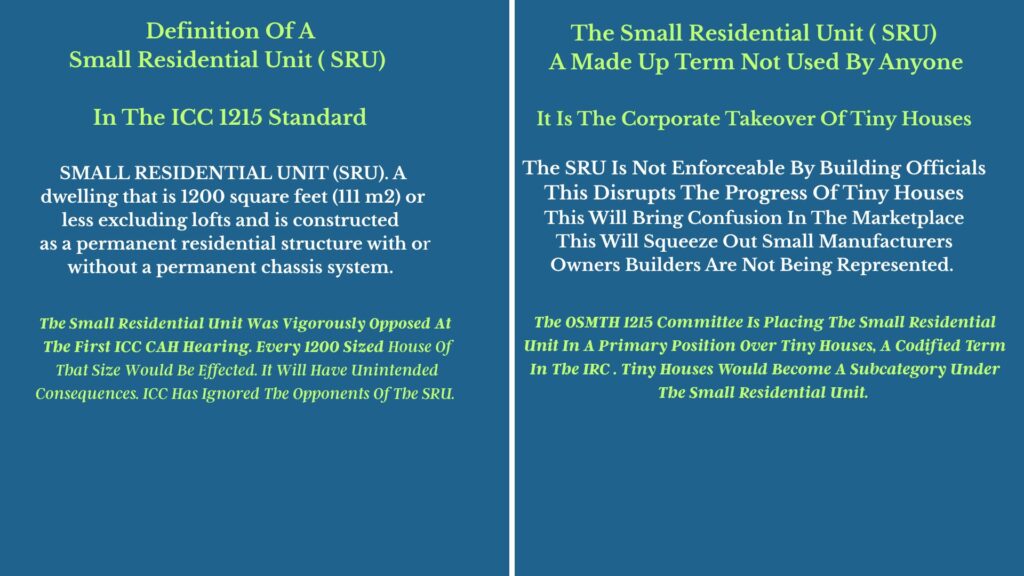
The Off-Site Modular Tiny Houses (IS-OSMTH) committee is actively progressing on the development of standard ICC 1215 Design, Construction, Inspection and Regulation of Small Residential Units (SRU) and Tiny Houses for Permanent Occupancy, which establishes minimum safety requirements for the built environment of tiny houses and SRUs with an anticipated completion date in Spring of 2026.
Link To Announcement In Building Safety Journal
My Complaint Regarding The Progress Update.
Approving Small Residential Dwelling Units: ADUs and Tiny Homes
Instructor: Ryan Colker
Some homeowners and renters are looking to go small to enhance affordability or generate additional income.
What does that mean for state and local jurisdictions that need to review and approve such structures? This session will review several emerging small dwelling units including accessory dwelling units (ADUs) and tiny houses, what provisions apply and how various jurisdictions are applying multiple strategies including building codes, zoning codes and other strategies to help support their use.
This expo is documented proof that the Small Residential Unit is the agenda of ICC And THIA.
My Complaint To AIA Regarding The Webinar
Tiny House Resources
The International Code Council has the resources and expertise to deliver the solutions needed to ensure safe, sustainable and resilient construction and use of tiny houses.
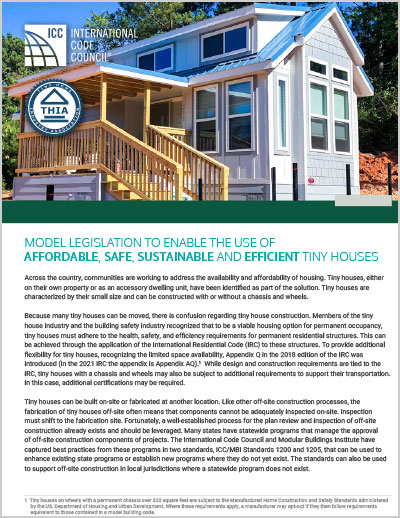
Model Tiny House Legislation provides model language for AHJs to ensure the use of affordable, safe, sustainable and efficient tiny homes.
Navigating Certification and Regulation for Tiny Houses resource outlines the applicability of existing codes, standards and other criteria that should be followed to create safe, sustainable and resilient tiny houses.
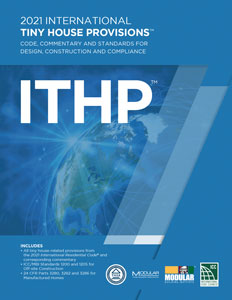
2021 International Tiny House Provisions outlines the existing codes, standards and compliance mechanisms available for tiny houses. Here is a guide to help navigate when specific requirements should apply to a tiny house.

The Tiny House Building It Right: From the Publisher of the Building Code is a fully illustrated guide for the planning, design, permitting, construction and inspection of tiny houses.
Navigating the Tiny Home Landscape
Principles for the Development of International Standards, Guides and Recommendations
The “Six Principles” were agreed upon by the TBT Committee in 2000 with a view to guiding Members in the development of international standards.
DECISION OF THE COMMITTEE ON PRINCIPLES FOR THE DEVELOPMENT OF INTERNATIONAL STANDARDS, GUIDES AND RECOMMENDATIONS WITH RELATION TO ARTICLES 2, 5 AND ANNEX 3 OF THE AGREEMENTd
The following principles and procedures should be observed, when international standards, guides and recommendations (as mentioned under Articles 2, 5 and Annex 3 of the TBT Agreement for the preparation of mandatory technical regulations, conformity assessment procedures and voluntary standards) are elaborated, to ensure transparency, openness, impartiality and consensus, effectiveness and relevance, coherence, and to address the concerns of developing countries.
The same principles should also be observed when technical work or a part of the international standard development is delegated under agreements or contracts by international standardizing bodies to other relevant organizations, including regional bodies.
1. Transparency
All essential information regarding current work programmes, as well as on proposals for standards, guides and recommendations under consideration and on the final results should be made easily accessible to at least all interested parties in the territories of at least all WTO Members. Procedures should be established so that adequate time and opportunities are provided for written comments. The information on these procedures should be effectively disseminated.
In providing the essential information, the transparency procedures should, at a minimum, include:
- the publication of a notice at an early appropriate stage, in such a manner as to enable interested parties to become acquainted with it, that the international standardizing body proposes to develop a particular standard;
- the notification or other communication through established mechanisms to members of the international standardizing body, providing a brief description of the scope of the draft standard, including its objective and rationale. Such communications shall take place at an early appropriate stage, when amendments can still be introduced and comments taken into account;
- upon request, the prompt provision to members of the international standardizing body of the text of the draft standard;
- the provision of an adequate period of time for interested parties in the territory of at least all members of the international standardizing body to make comments in writing and take these written comments into account in the further consideration of the standard;
- the prompt publication of a standard upon adoption; and
- to publish periodically a work programme containing information on the standards currently being prepared and adopted.
It is recognized that the publication and communication of notices, notifications, draft standards, comments, adopted standards or work programmes electronically, via the Internet, where feasible, can provide a useful means of ensuring the timely provision of information. At the same time, it is also recognized that the requisite technical means may not be available in some cases, particularly with regard to developing countries. Accordingly, it is important that procedures are in place to enable hard copies of such documents to be made available upon request.
2. Openness
Membership of an international standardizing body should be open on a non-discriminatory basis to relevant bodies of at least all WTO Members. This would include openness without discrimination with respect to the participation at the policy development level and at every stage of standards development, such as the:
- proposal and acceptance of new work items;
- technical discussion on proposals;
- submission of comments on drafts in order that they can be taken into account;
- reviewing existing standards;
- voting and adoption of standards; and
- dissemination of the adopted standards.
Any interested member of the international standardizing body, including especially developing country Members, with an interest in a specific standardization activity should be provided with meaningful opportunities to participate at all stages of standard development. It is noted that with respect to standardizing bodies within the territory of a WTO Member that have accepted the Code of Good Practice for the Preparation, Adoption and Application of Standards by Standardizing Bodies (Annex 3 of the TBT Agreement) participation in a particular international standardization activity takes place, wherever possible, through one delegation representing all standardizing bodies in the territory that have adopted, or expected to adopt, standards for the subject-matter to which the international standardization activity relates. This is illustrative of the importance of participation in the international standardizing process accommodating all relevant interests.
3. Impartiality and Consensus
All relevant bodies of WTO Members should be provided with meaningful opportunities to contribute to the elaboration of an international standard so that the standard development process will not give privilege to, or favour the interests of, a particular supplier/s, country/ies or region/s. Consensus procedures should be established that seek to take into account the views of all parties concerned and to reconcile any conflicting arguments.
Impartiality should be accorded throughout all the standards development process with respect to, among other things:
- access to participation in work;
- submission of comments on drafts;
- consideration of views expressed and comments made;
- decision-making through consensus;
- obtaining of information and documents;
- dissemination of the international standard;
- fees charged for documents;
- right to transpose the international standard into a regional or national standard; and
- revision of the international standard.
4. Effectiveness and Relevance
In order to serve the interests of the WTO membership in facilitating international trade and preventing unnecessary trade barriers, international standards need to be relevant and to effectively respond to regulatory and market needs, as well as scientific and technological developments in various countries. They should not distort the global market, have adverse effects on fair competition, or stifle innovation and technological development. In addition, they should not give preference to the characteristics or requirements of specific countries or regions when different needs or interests exist in other countries or regions. Whenever possible, international standards should be performance based rather than based on design or descriptive characteristics.
Accordingly, it is important that international standardizing bodies:
- take account of relevant regulatory or market needs, as feasible and appropriate, as well as scientific and technological developments in the elaboration of standards;
- put in place procedures aimed at identifying and reviewing standards that have become obsolete, inappropriate or ineffective for various reasons; and
- put in place procedures aimed at improving communication with the World Trade Organization.
5. Coherence
In order to avoid the development of conflicting international standards, it is important that international standardizing bodies avoid duplication of, or overlap with, the work of other international standardizing bodies. In this respect, cooperation and coordination with other relevant international bodies is essential.
6. Development Dimension
Constraints on developing countries, in particular, to effectively participate in standards development, should be taken into consideration in the standards development process. Tangible ways of facilitating developing countries’ participation in international standards development should be sought. The impartiality and openness of any international standardization process requires that developing countries are not excluded de facto from the process. With respect to improving participation by developing countries, it may be appropriate to use technical assistance, in line with Article 11 of the TBT Agreement. Provisions for capacity building and technical assistance within international standardizing bodies are important in this context.