
It Is In The Hands Of The Manufacturer
For most tiny house enthusiasts, the dream of simple living is often stifled by a complex regulatory “gray area.” You build a home with craftsmanship and care, only to find that local zoning boards view it as a recreational vehicle—a temporary shelter rather than a permanent dwelling. This “legality limbo” has long been the primary barrier to financing, insurance, and long-term peace of mind. However, an investigative look into federal housing statutes reveals that the barrier isn’t the law itself, but how it is navigated. A specific statutory exit ramp already exists within the Department of Housing and Urban Development (HUD) regulations that allows Tiny Homes on Wheels (THOWs) to be recognized as legitimate, permanent dwellings.
I will also cover the HUD RV exemption that affects tiny homes and I am sharing a HUD approved document that teaches housing counselors about the different types of housing and the different methods a tiny home can be built to.
A specific legal pathway exists for tiny homes on wheels (THOWs) to be recognized as dwellings under federal regulations. By following the procedures outlined in 24 CFR § 3282.12, manufacturers can elect to have these structures excluded from the coverage of the National Manufactured Housing Construction and Safety Standards Act. This exclusion effectively reclassifies the structures as modular homes rather than manufactured homes, provided they meet strict criteria regarding their foundation, design for permanency, and adherence to recognized national or local building codes. Success in this pathway relies entirely on the manufacturer’s certification and their ability to demonstrate that the unit is intended for permanent installation on a site-built foundation with its transport gear removed.
First you have to understand the statutory definition of a manufactured home.
Statutory Definition Of A Manufactured Home
Manufactured home means a structure, transportable in one or more sections, which in the traveling mode, is eight body feet or more in width or forty body feet or more in length, or, when erected on site, is three hundred twenty or more square feet, and which is built on a permanent chassis and designed to be used as a dwelling with or without a permanent foundation when connected to the required utilities, and includes the plumbing, heating, air-conditioning, and electrical systems contained therein. Calculations used to determine the number of square feet in a structure will be based on the structure’s exterior dimensions measured at the largest horizontal projections when erected on site. These dimensions will include all expandable rooms, cabinets, and other projections containing interior space, but do not include bay windows. This term includes all structures which meet the above requirements except the size requirements and with respect to which the manufacturer voluntarily files a certification pursuant to 24 CFR 3282.13 and complies with the standards set forth in 24 CFR part 3280.
Short Video Explainer
§ 3282.12 Excluded Structures—Modular Homes
(a) The purpose of this section is to provide the certification procedure authorized by section 604(h) of the National Manufactured Housing Construction and Safety Standards Act under which modular homes may be excluded from coverage of the Act if the manufacturer of the structure elects to have them excluded.
If a manufacturer wishes to construct a structure that is both a manufactured home and a modular home, the manufacturer need not make the certification provided for by this section and may meet both the Federal manufactured home requirements and any modular housing requirements.
When the certification is not made, all provisions of the Federal requirements shall be met.
(b) Any structure that meets the definition of manufactured home at 24 CFR 3282.7(u) is excluded from the coverage of the National Manufactured Housing Construction and Safety Standards Act, 42 U.S.C. 5401 et seq., if the manufacturer certifies as prescribed in paragraph (c) of this section that:
(1) The structure is designed only for erection or installation on a site-built permanent foundation;
(i) A structure meets this criterion if all written materials and communications relating to installation of the structure, including but not limited to designs, drawings, and installation or erection instructions, indicate that the structure is to be installed on a permanent foundation.
(ii) A site-built permanent foundation is a system of supports, including piers, either partially or entirely below grade which is:
(A) Capable of transferring all design loads imposed by or upon the structure into soil or bedrock without failure,
(B) Placed at an adequate depth below grade to prevent frost damage, and
(C) Constructed of concrete, metal, treated lumber or wood, or grouted masonry; and
(2) The structure is not designed to be moved once erected or installed on a site-built permanent foundation;
(i) A structure meets this criterion if all written materials and communications relating to erection or installation of the structure, including but not limited to designs, drawings, calculations, and installation or erection instructions, indicate that the structure is not intended to be moved after it is erected or installed and if the towing hitch or running gear, which includes axles, brakes, wheels and other parts of the chassis that operate only during transportation, are removable and designed to be removed prior to erection or installation on a site-built permanent foundation; and
(3) The structure is designed and manufactured to comply with the currently effective version of one of the following:
(i) One of the following nationally recognized building codes:
(A) That published by Building Officials and Code Administrators (BOCA) and the National Fire Protection Association (NFPA) and made up of the following:
(1) BOCA Basic Building Code,
(2) BOCA Basic Industrialized Dwelling Code,
(3) BOCA Basic Plumbing Code,
(4) BOCA Basic Mechanical Code, and
(5) National Electrical Code, or
(B) That published by the Southern Building Code Congress (SBCC) and the NFPA and made up of the following:
(1) Standard Building Code,
(2) Standard Gas Code,
(3) Standard Mechanical Code,
(4) Standard Plumbing Code, and
(5) National Electrical Code, or
(C) That published by the International Conference of Building Officials (ICBO), the International Association of Plumbing and Mechanical Officials (IAPMO), and the NFPA and made up of the following:
(1) Uniform Building Code,
(2) Uniform Mechanical Code,
(3) Uniform Plumbing Code, and
(4) National Electrical Code or
(D) The codes included in paragraphs (b)(3)(i)(A), (B), or (C) in connection with the One- and Two-Family Dwelling Code, or
(E) Any combination of the codes included in paragraphs (b)(3)(i)(A), (B), (C), and (D), that is approved by the Secretary, including combinations using the National Standard Plumbing Code published by the National Association of Plumbing, Heating and Cooling Contractors (PHCC), or
(F) Any other building code accepted by the Secretary as a nationally recognized model building code, or
(ii) Any local code or State or local modular building code accepted as generally equivalent to the codes included under paragraph (b)(3)(i), (the Secretary will consider the manufacturer’s certification under paragraph (c) of this section to constitute a certification that the code to which the structure is built is generally equivalent to the referenced codes. This certification of equivalency is subject to the provisions of paragraph (f) of this section) or
(iii) The minimum property standards adopted by the Secretary pursuant to title II of the National Housing Act; and
(4) To the manufacturer’s knowledge, the structure is not intended to be used other than on a site-built permanent foundation.
(c) When a manufacturer makes a certification provided for under paragraph (b) of this section, the certification shall state as follows:
The manufacturer of this structure, Name ____________________ Address ____________________ (location where structure was manufactured).
Certifies that this structure (Ser. No. ________) is not a manufactured home subject to the provisions of the National Manufactured Housing Construction and Safety Standards Act and is—
(1) designed only for erection or installation on a site-built permanent foundation,
(2) not designed to be moved once so erected or installed,
(3) designed and manufactured to comply with ______________ (Here state which code included in paragraph (b)(3) of this section has been followed), and
(4) to the manufacturer’s knowledge is not intended to be used other than on a site-built permanent foundation.
(d) This certification shall be affixed in a permanent manner near the electrical panel, on the inside of a kitchen cabinet door, or in any other readily accessible and visible location.
(e) As part of this certification, the manufacturer shall identify each certified structure by a permanent serial number placed on the structure during the first stage of production. If the manufacturer also manufactures manufactured homes that are certified under §§ 3282.205 and 3282.362(c), the series of serial numbers for structures certified under this section shall be distinguishable on the structures and in the manufacturer’s records from the series of serial numbers for the manufactured homes that are certified under §§ 3282.205 and 3282.362(c).
(1) If a manufacturer wishes to certify a structure as a manufactured home under §§ 3282.205 and 3282.362(c) after having applied a serial number identifying it as exempted under this section, the manufacturer may do so only with the written consent of the Production Inspection Primary Inspection Agency (IPIA) after thorough inspection of the structure by the IPIA at at least one stage of production and such removal or equipment, components, or materials as the IPIA may require to perform inspections to assure that the structure conforms to the Federal manufactured home standards. The manufacturer shall remove the original serial number and add the serial number required by § 3280.6.
(2) A manufacturer may not certify a structure under this section after having applied the manufactured home serial number under § 3280.6.
(f) All certifications made under this section are subject to investigation by the Secretary to determine their accuracy. If a certification is false or inaccurate, the certification for purposes of this section is invalid and the structures that have been or may be the subject of the certification are not excluded from the coverage of the Act, the Federal Manufactured Home Construction and Safety Standards, or these Regulations.
(1) If the Secretary has information that a certification may be false or inaccurate, the manufacturer will be given written notice of the nature of this information by certified mail and the procedure of this subparagraph will be followed.
(i) The manufacturer must investigate this matter and report its findings in writing as to the validity of this information to the Secretary within 15 days from the receipt of the Secretary’s notice.
(ii) If a written report is received within the time prescribed in paragraph (f)(1)(i) of this section, the Secretary will review this report before determining whether a certification is false or inaccurate. If a report is not received within 15 days from the receipt of the Secretary’s notice, the Secretary will make the determination on the basis of the information presented.
(iii) If the Secretary determines that a certification is false or inaccurate, the manufacturer will be given written notice and the reasons for this determination by certified mail.
(2) The Secretary may seek civil and criminal penalties provided for in section 611 of the Act, 42 U.S.C. 5410, if the party in question in the exercise of due care has reason to know that such certification is false or misleading as to any material fact.
Note: The document is a statute published in 1984, so it does not list all current building codes.
What Is A HUD Code Chassis?
There are multiple sources that refer to the manufactured home chassis, but currently the main beams are permanent and cannot be removed.
Chassis means the entire transportation system comprising the following subsystems: drawbar and coupling mechanism, frame, running gear assembly, and lights.
HUD General Information Chapter 1
Chassis: The structural system running beneath the manufactured home. Example: Pair of steel beams.
- B. Chassis Removal. The chassis of a manufactured home, under the Federal Manufactured Housing and Construction Safety Standards, is not to be removed.
Transportation Law
Chassis is defined as The load-supporting frame of a commercial motor vehicle, exclusive of any appurtenances which might be added to accommodate cargo.
49 CFR § 393.5 – Definitions.
Title 49 of the Code of Federal Regulations establishes a nationally uniform system for transportation safety, including motor vehicle design, chassis integrity, and operational requirements, administered by the U.S. Department of Transportation through NHTSA, FMCSA, and PHMSA. HUD’s statutory definition of a manufactured home expressly relies on transportation concepts—describing a structure in “traveling mode” and requiring construction on a permanent chassis—while federal transportation law defines a chassis as the load-supporting frame of a commercial motor vehicle under 49 CFR § 393.5. Motor vehicle safety standards, including the Federal Motor Vehicle Safety Standards (FMVSS), exist to ensure nationwide uniformity for chassis-based structures transported on public roads. Together, these frameworks reflect Congress’s intent that transportable, chassis-based dwellings be governed by federal transportation law for movement and safety, alongside HUD’s housing standards for the dwelling itself, rather than through fragmented state or privately constructed regulatory substitutes.
HUD Final Rule RV Exemption 2018
What This Means For Tiny Homes
The U.S. The Department of Housing and Urban Development (HUD) redefined and clarified the RV exemption from manufactured housing standards in 2018. The final rule went into effect on January 15, 2019. A lot of manufacturers build tiny homes to recreational vehicle standards and that is why this HUD final rule is important for clarity.
Below are a lot of supporting documents directly from HUD
- What HUD said the rule is doing
HUD framed this rule as a manufacturing-side clarification, not a lifestyle rule and was explicit about the legal effect.
HUD Stated:
“This rulemaking revises the exemption for the manufacture of recreational vehicles to clarify which recreational vehicles qualify for an exemption from HUD’s Manufactured Home Construction and Safety Standards and Manufactured Home Procedural and Enforcement regulations.”
“This final rule provides that the requirements of 24 CFR parts 3280 and 3282 do not apply to the manufacture of a ‘recreational vehicle’ as defined by this rule.”
“HUD is adopting a recommendation of the Manufactured Housing Consensus Committee (MHCC) but expanding the definition of recreational vehicle and modifying it to require certification with the updated ANSI standard, A119.5-15.”
- The “bright line” HUD created
HUD created a regulatory bright line focused on manufacturing standards, not occupancy.
In simple terms:
If a unit is:
not certified as a manufactured home, and
built and certified to NFPA 1192-15 or ANSI A119.5-15,
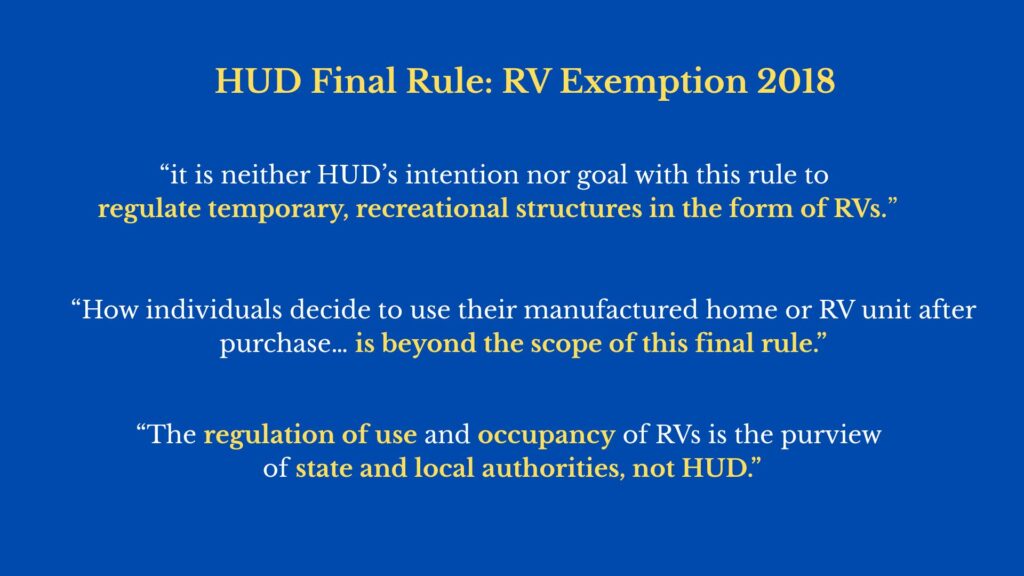
HUD treats it as exempt from the HUD Code and HUD’s enforcement regulations.
HUD explained the purpose of that line clearly.
The rule:
“better differentiate RVs from manufactured homes to ensure that HUD does not unnecessarily regulate RVs.”
And HUD stated its regulatory goal plainly:
“to establish a broad, easily applied exemption for purposes of its own regulatory activities.”
That phrase matters:
“purposes of its own regulatory activities.”
- HUD Wanted To Reduce The Confusion Between RVs And Manufactured Homes
HUD acknowledged the problem directly: The exemption had been criticized for:
“not drawing a clear enough distinction between RVs, which are designed for temporary, recreational use, and manufactured housing, which is designed for permanent, year-round dwelling.”
HUD explained how the confusion grew:
Manufacturers were producing larger units with:
“more features, such as porches built on the chassis, and that resemble manufactured homes,”
which created disputes over measurement and jurisdiction.
End measurement games around porches and chassis add-ons
HUD specifically identified Park Model RVs with screened porches built on the chassis, marketed for all-season use, as a driver of the rule.
Rather than endlessly litigating square-foot calculations, HUD pivoted to certification to established RV standards.
Keep HUD out of vehicle regulation
HUD recorded a clear consensus view:
“regulating RVs is outside the scope of HUD’s housing mission and is not contemplated by the National Manufactured Housing Construction and Safety Standards Act.”
And HUD noted that RVs are already:
“extensively regulated by the U.S. Department of Transportation and state motor vehicle and taxing authorities,”
and that HUD regulation would create conflicts.
Add consumer disclosure — not occupancy enforcement
For ANSI A119.5-15 Park Model RVs seeking exemption, HUD added a Manufacturer’s Notice.
HUD explained why:
“the Manufacturer’s Notice requirement is an important tool for ensuring that consumers are aware to what standard and purpose the units they are purchasing are built.”
HUD summarized the issues it was addressing as:
“(1) Identify which manufacturing standards apply to what structures; and (2) enhance consumer knowledge and confidence in their purchases.”
- What HUD said is beyond the scope of this rule
This is critical — especially for tiny homes.
HUD was explicit that use and occupancy are not HUD’s lane.
HUD stated:
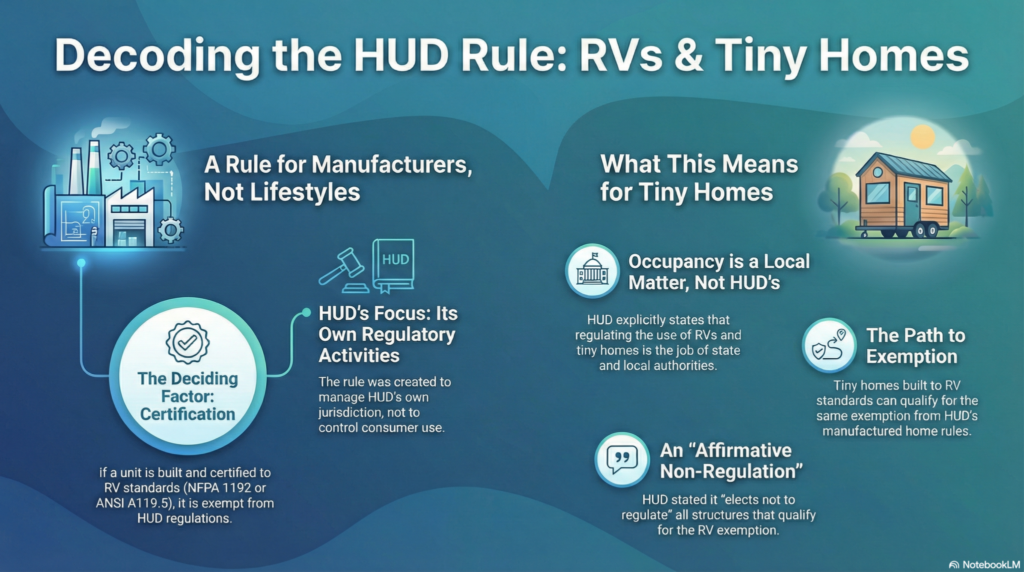
“how individuals decide to use their manufactured home or RV unit after purchase… is beyond the scope of this final rule.”
HUD was even clearer:
“The regulation of use and occupancy of RVs is the purview of state and local authorities, not HUD.”
And HUD reiterated:
“HUD is not regulating use of manufactured homes or RVs.”
“This rule does not affect the use of RVs by consumers.”
This is a manufacture-side classification rule, not an occupancy rule.
- The actual exemption HUD codified
“In § 3282.8, remove and reserve paragraph (g).”
“Add § 3282.15… Exemption for recreational vehicles.”
HUD’s exact regulatory definition
“A recreational vehicle is:
(1) A vehicle or vehicular structure not certified as a manufactured home;
(2) Designed only for recreational use and not as a primary residence or for permanent occupancy; and is either:
(i) Built and certified in accordance with either NFPA 1192… or ANSI A119.5…
or (ii) Any vehicle which is self-propelled.”
- What this meant for tiny homes (especially THOW)
HUD directly addressed tiny homes and drew three clear categories.
- Tiny homes that meet the statutory manufactured home definition. HUD stated:
“If a tiny home is a ‘manufactured home’ as defined by statute, then it can be regulated as manufactured housing, unless it also falls within HUD’s regulatory exemption for recreational vehicles as provided by this final rule.”
HUD also reminded manufacturers of the voluntary opt-in provision in the statute.
- Tiny homes HUD has no authority to regulate. HUD plainly stated:
“HUD lacks jurisdiction to regulate any tiny home that is less than eight body feet in width, 40 body feet in length, or 320 square feet, or any tiny home that is built on a foundation without a permanent chassis.”
That sentence alone explains why many tiny homes are simply outside HUD’s program.
- Tiny homes built to RV/ Park Model Recreational Vehicle Standards.
HUD acknowledged many tiny homes are built to RV-type standards and emphasized disclosure:
“HUD believes that consumers should be fully aware of the construction standard used to build a particular product at the time of purchase.”
HUD explicitly rejected the idea that this rule bans tiny homes:
“it is neither HUD’s intention nor goal with this rule to regulate temporary, recreational structures in the form of RVs.”
And reiterated:
“If a tiny home is not a ‘manufactured home’ as defined by statute, then HUD does not have authority to regulate its construction.”
- The missing but critical point: HUD can choose NOT to regulate
This is the hinge of the rule — and it is HUD’s own language.
HUD stated:
“HUD takes the opportunity in this final rule to emphasize that while it possesses statutory authority to regulate the manufacture of certain types of RV, it nevertheless believes that exercising such authority is currently unnecessary.”
HUD immediately reinforced that point:
“HUD believes that the non-permanent design intent of RVs favors that they be exempt from such regulation, even in cases where they fall within the statutory definition of ‘manufactured home.’”
And HUD made the discretionary nature unmistakable:
“HUD maintains statutory jurisdiction over the manufacture and installation of all structures falling within the statutory definition of ‘manufactured home,’ but it elects not to regulate all structures that qualify for the RV exemption.”
Those are HUD’s verbs:
“declines,” “elects not to regulate,” “believes exercising authority is unnecessary.”
This is not silence.
This is not lack of authority.
This is affirmative non-regulation.
- Congress vs. HUD — and where the confusion comes from (320 → 400)
Here is where people get confused.
The 320 square-foot figure has always been in the statute.
Congress did not newly add it later.
What Congress did do — through the 1980 conference report — was direct HUD to consider flexibility.
HUD explained:
“Relying on a conference report on the 1980 amendments that directed HUD to consider a more flexible standard for smaller manufactured homes (such as park models) whose square footage is between 320 and 400 square feet, HUD continued the exemption but expanded it to its current form.”
— 81 FR 9603 (Feb. 8, 2016)
HUD then codified that discretion by regulation:
“400 square feet or less when measured at the largest horizontal projections.”
— 24 CFR § 3282.15
That 400-square-foot threshold is HUD’s regulatory choice, not a congressional mandate.
Final Takeaway
Congress defined the outer boundary. HUD exercised discretion Congress explicitly contemplated.
And HUD stated — in its own words — that even when a structure fits the statutory definition, HUD may choose not to regulate it.
April 9, 2026