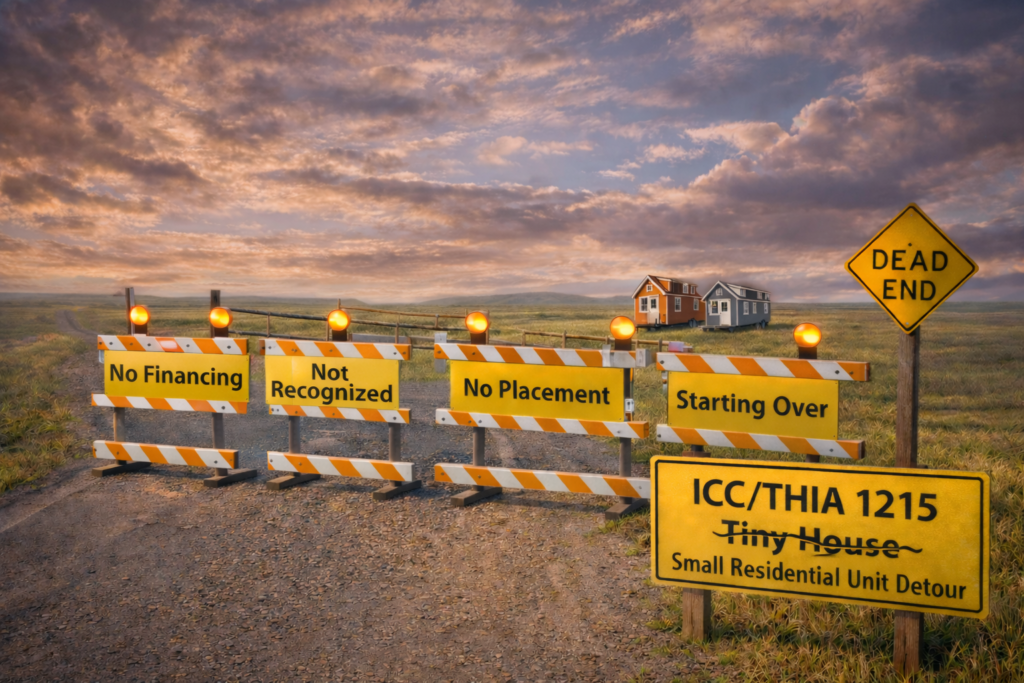
ICCNTA Has Dominated The ICC 1215 Committee
I participated in the development of the ICC 1215 standard for almost two years. I am going to monitor it, but I do not want to attend the meetings anymore because the ICC board is ignoring both motor vehicle preemption and HUD preemption and I feel the committee is looking for ways to get around federal law, which is blocking a legitimate path for the tiny house industry. It has also been hijacked by the Small Residential Unit. I will include related blog posts at the end that go in depth about the back story of these issues and detailed information regarding the subject matter.
The blog post is the documentation that ICC employees have dominated the ICC 1215 standard. ICC owns ICCNTA and ICC allowed David Tompos Sr. who not only was on the board of THIA at the time the committee was formed, but was employed by ICCNTA, and a voting member of ICC 1215 to dominant and there were three complaints to ICC that he was aggressive. This is a violation of ANSI Essential Requirements. There should be a firewall between ICC as a standard developer, the standards they develop, and their services that will gain by steering the committee in a direction that benefits them.
ANSI Essential Requirements
1.2 Lack of dominance
The standards development process shall not be dominated by any single interest category, individual or organization. Dominance means a position or exercise of dominant authority, leadership, or influence by reason of superior leverage, strength, or representation to the exclusion of fair and equitable consideration of other viewpoints.
ANSI Essential Requirements
Roster And Meeting Notes
ICC Complaint About David Tompos Sr.
Violation Of Code Of Ethics And ICC Consensus Procedures. David Tompos Sr. Compliance Guidelines And Conflict Of Interest Policy And ICC Consensus Procedures.
David Tompos Sr. is misleading the OSMTH 1215 with inaccurate information on why ICC/MBI 1200 and 1205 were disapproved at the 2024 IBC hearing 13 to 1. He has stated numerous times that it is because the building officials see tiny houses as RVs and that they do not like the term tiny house and have convinced the OSMTH committee to use the term Small Residential Unit ( SRU) and put a tiny house as a subcategory under a SRU.
27 Email Exchange Between David Tompos Jr And Janet Thome
David Tompos repeatedly asserts that permanent integrated chassis systems associated with park models, on-frame modulars, and similar structures are not subject to NHTSA motor-vehicle requirements because, in his view, they are not “motor vehicles” under certain NHTSA interpretations. However, his analysis does not fully acknowledge the significance of HUD’s 2018 Final Rule, which formally separated qualifying park model RVs from HUD-regulated manufactured homes and reinforced their treatment within the recreational-vehicle framework rather than the manufactured-housing framework. Despite this separation, park models continue to utilize VIN numbers, titles, MSOs/MCOs, and FMVSS-related certification systems associated with transportation regulation.
Additionally, while Mr. Tompos emphasizes that these structures are not subject to NHTSA trailer certification, he does not fully address HUD’s continued requirement for permanent chassis-based VIN-serial-number identification, including chassis stamping during the first stage of production under HUD regulations and Interpretive Bulletin H-2-77. As a HUD-approved IPIA participant, his position minimizes the significance of permanent chassis traceability and identifi
Complaint To HUD And MHCC
What Is A IPIA And DAPIA Agency?
Subpart H—Primary Inspection Agencies
§ 3282.351 General.
(a) This subpart sets out the requirements which must be met by States or private organizations which wish to qualify as primary inspection agencies under these regulations. It also sets out the various functions which will be carried out by primary inspection agencies.
(b) There are four basic functions which are performed by primary inspection agencies:
(1) Approval of the manufacturer’s manufactured home design to assure that it is in compliance with the standard;
(2) Approval of the manufacturer’s quality control program to assure that it is compatible with the design;
(3) Approval of the manufacturer’s plant facility and manufacturing process to assure that the manufacturer can perform its approved quality control program and can produce manufactured homes in conformance with its approved design, and
(4) Performance of ongoing inspections of the manufacturing process in each manufacturing plant to assure that the manufacturer is continuing to perform its approved quality control program and, with respect to those aspects of manufactured homes inspected, is continuing to produce manufactured homes in performance with its approved designs and in conformance with the standards (see § 3282.362(c)(1)).
IPIA's And DAPIA's
(c) There are two types of primary inspection agencies which perform these functions:
(1) Those which approve designs and quality control programs (Design Approval Primary Inspection Agencies—DAPIAs) and
(2) Those which approve plants and perform ongoing inspections in the manufacturing plants (Production Inspection Primary Inspection Agencies—IPIAs).
(d) States and private organizations whose submissions under this subpart are acceptable shall be granted provisional acceptance. Final acceptance shall be conditioned upon adequate performance, which will be determined through monitoring of the actions of the primary inspection agencies. Monitoring of all primary inspection agencies shall be carried out as set out in subpart J. HUD accepted agencies can perform DAPIA functions for any manufacturer in any State and IPIA functions in any State except those in which the State has been approved to act as the exclusive IPIA under § 3282.352.
(e) Primary inspection agencies approved under this subpart may contract with manufactured home manufacturers (see § 3282.202) to provide the services set out in this subpart. Any PIA which charges fees which are excessive in relation to the services rendered shall be subject to disqualification under § 3282.356.
§ 3282.358 Personnel
This is a continuation of § 3282.351 General, though I am skipping to § 3282.358 Personnel
(a) Each primary inspection agency shall have qualified personnel capable of carrying out all of the functions for which the primary inspection agency is seeking to be approved or disapproved. Where a State intends to act as the exclusive IPIA in the State, it shall show that it has adequate personnel to so act in all plants in the State.
(b) Each submission shall indicate the total number of personnel employed by the submitting party, the number of personnel available for this program, and the locations of the activities of the personnel to be used in the program.
(c) Each submission shall include the names and qualifications of the administrator and the supervisor who will be directly responsible for the program, and résumés of their experience.
ASTM541
(d) Each submission shall contain the information set out in paragraphs (d)(1) through (d)(9) of this section. Depending upon the functions (DAPIA or IPIA) to be undertaken by a particular primary inspection agency, some of the categories of personnel listed may not be required. In such cases, the submission should indicate which of the categories of information are not required and explain why they are not needed. The submission should identify which personnel will carry out each of the functions the party plans to perform. The qualifications of the personnel to perform one or more of the functions will be judged in accordance with the requirements of ASTM Standard E-541 except that the requirement for registration as a professional engineer or architect may be waived for personnel whose qualifications by experience or education equal those of a registered engineer or architect. The categories of personnel to be included in the submission are as follows:
(1) The names of engineers practicing structural engineering who will be involved in the evaluation, testing, or followup inspection services, and résumés of their experience.
(2) The names of engineers practicing mechanical engineering who will be involved in the evaluation, testing, or followup, inspection services and résumés of their experience.
(3) The names of engineers practicing electrical engineering who will be involved in the evaluation, testing, or followup inspection services and résumés of their experience.
(4) The names of engineers practicing fire protection engineering who will be involved in the evaluation, testing, or followup inspection services, and résumés of their experience.
(5) The names of all other engineers assigned to this program, the capacity in which they will be employed, and résumés of their experience.
(6) The names of all full-time and part-time consulting architects and engineers, their registration, and résumés of their experience.
(7) The names of inspectors and other technicians along with résumés of experience and a description of the type of work each will perform.
(8) A general outline of the applicant agency’s training program for assuring that all inspectors and other technicians are properly trained to do each specific job assigned.
(9) The names and qualifications of individuals serving on advisory panels that assist the applicant agency in making its policies conform with the public interest in the field of public health and safety.
(e) All information required by this section shall be kept current. The Secretary shall be notified of any change in personnel or management or change of ownership or State jurisdiction within 30 days of such change.
David Tompos Sr. Boycotted ASTME541 Standard In The Committee
David sent out this memo below to me and the entire ICC 1215 committee to create a boycott of ASTME541 standard. He insisted that the certification requirements had to be from ICC owned ICCMBI 1205. I tried to get ASTM4541 as least as an alternative choice to ICC/MBI 1205 through public comments but they ended up removing both choices. He boycotts the requirements that his 3rd party agency met by HUD. That is quite the contradiction.
HUD Memo
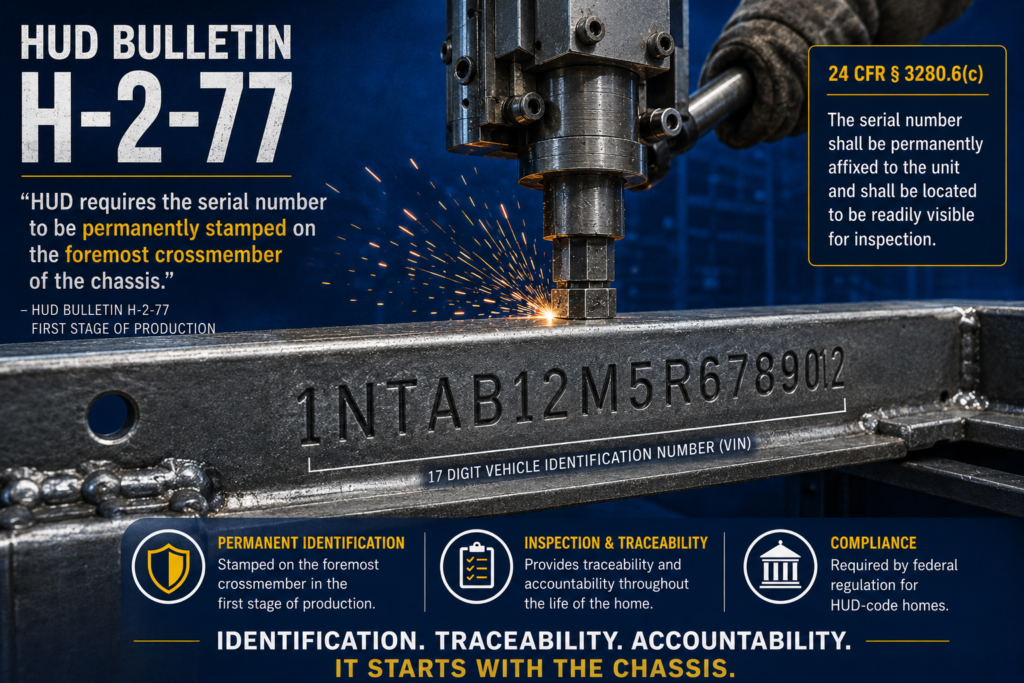
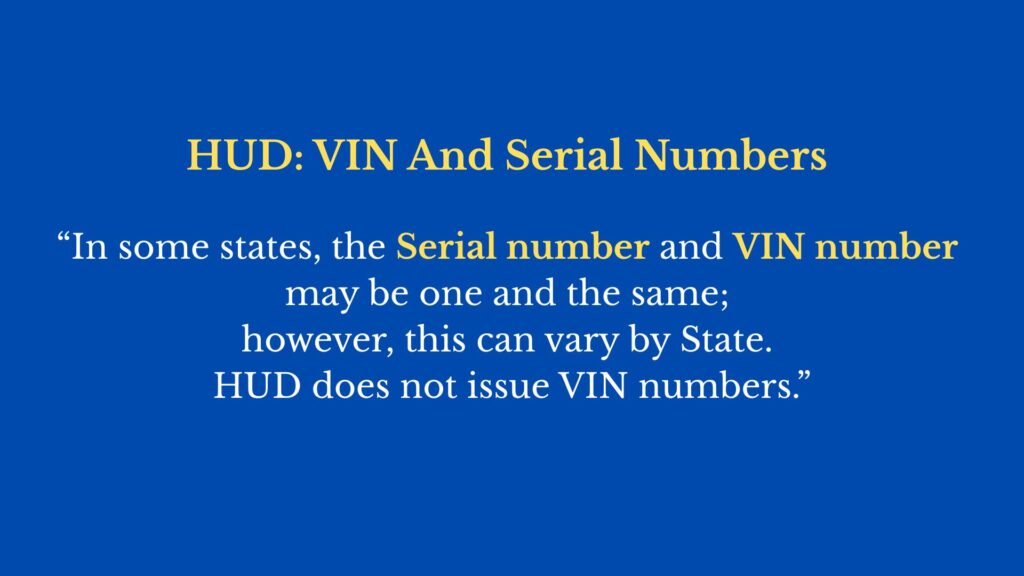
VIN/Serial Number Requirements For Manufactured Homes And Modulars On A Chassis
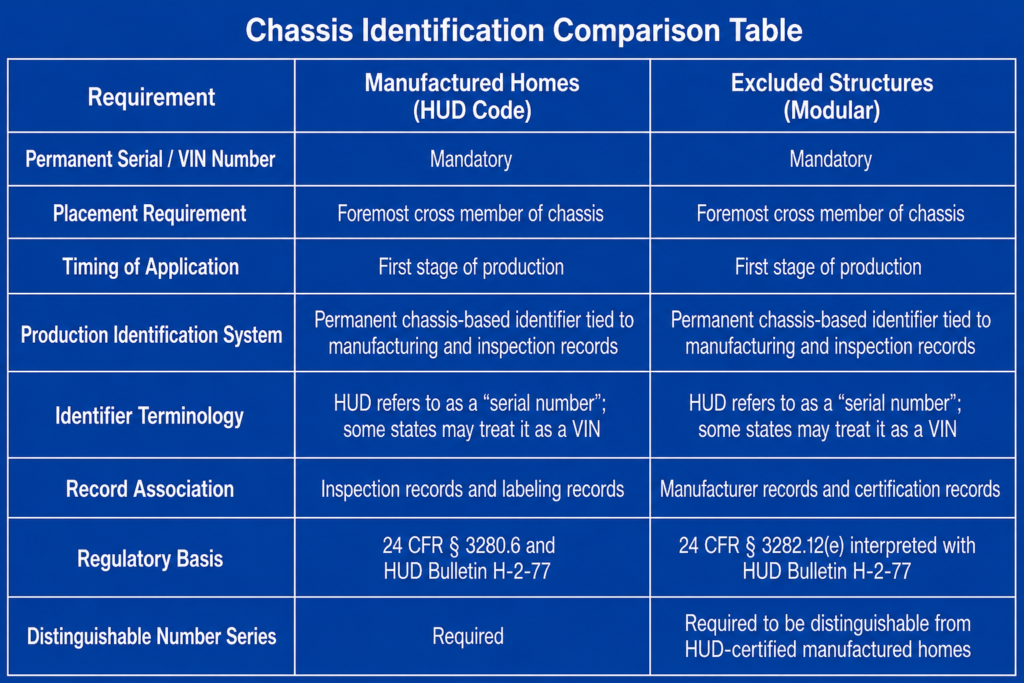
Manufactured Homes And Modular Homes On A Chassis Have The Same Requirements To Stamp The Cross Member Of The Chassis
Conclusion
The regulatory framework established by 24 CFR § 3280.6, 24 CFR § 3282.12, and HUD Bulletin H-2-77 confirms that permanent VIN- serial-number identification is tied to the chassis and must exist during the first stage of production for all transportable, chassis-based structures. IPIAs are required to enforce these identification standards, ensuring that every unit—whether it is manufactured home or modular—carries a permanent identifier on its foremost cross member that matches all associated inspection and certification records.
ICC NTA is a HUD-approved Inspection Primary Inspection Agency (IPIA) operating within the federal manufactured housing regulatory system. As part of that role, ICC NTA participates in inspection, serial-number verification, labeling oversight, and compliance functions established under HUD regulations for chassis-based manufactured housing systems. During the ICC/THIA 1215 discussions, representatives associated with ICC NTA repeatedly advised the committee to avoid entering “federal domains,” including FMVSS requirements, HUD applicability, and motor-vehicle classification issues. At the same time, the proposed standard incorporated transportation-related concepts involving chassis systems, axles, running gear, braking systems, transport loads, and other subjects historically governed within federal transportation and manufactured housing frameworks.
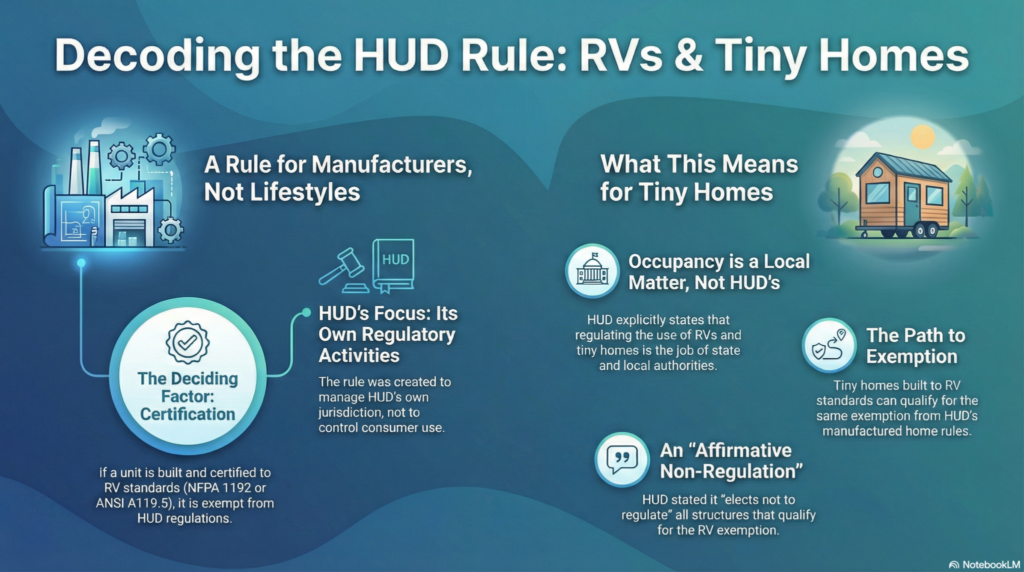
The resulting conflict is that a federally recognized inspection and compliance entity participating in the standards-development process encouraged avoidance of the very federal regulatory frameworks that traditionally govern transportable chassis-based structures. This has raised concerns regarding whether the committee’s approach sufficiently acknowledges existing federal transportation law, HUD procedural requirements, VIN/serial-number traceability systems, and the legal distinctions established by HUD’s 2018 Final Rule separating park model RVs from HUD-regulated manufactured homes.
A Contradiction
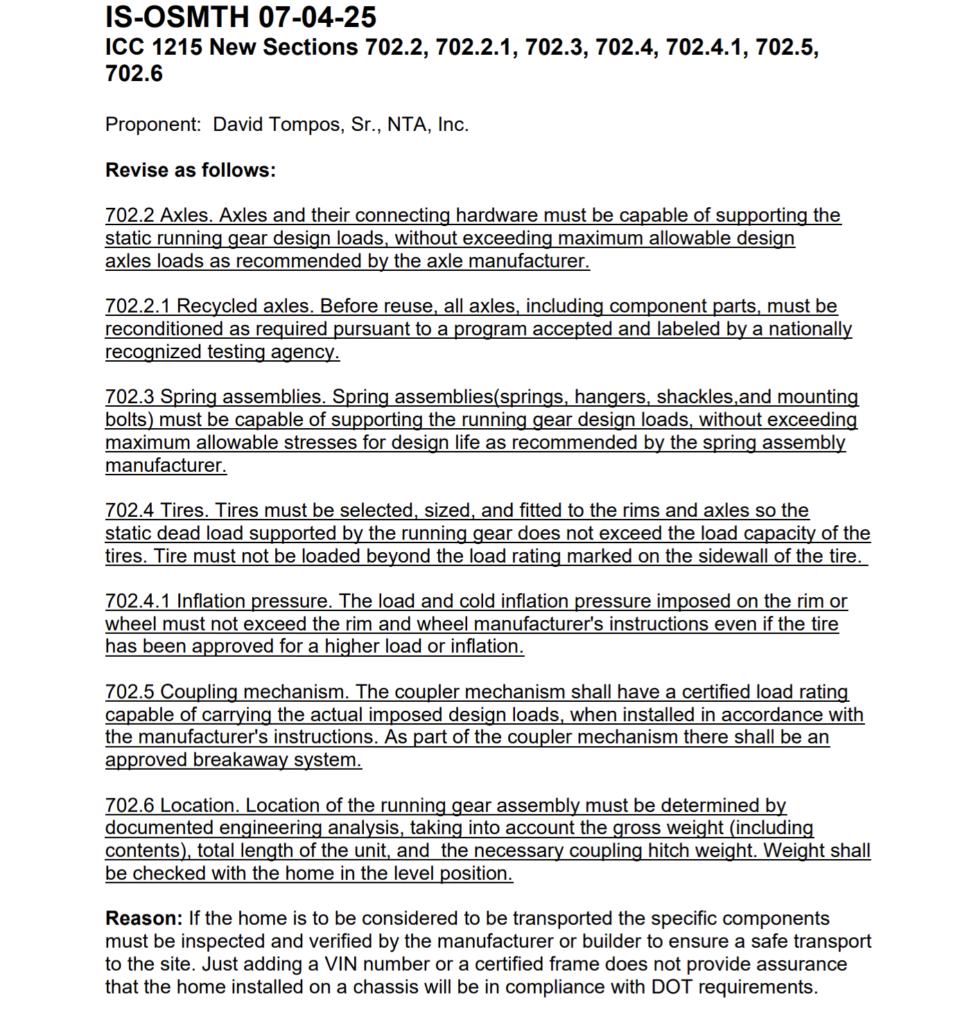
It would create a regulatory contradiction for a manufacturer to claim exclusion from HUD regulation for a modular structure built on a permanent chassis, while simultaneously adopting selected HUD transportation and chassis provisions as the governing framework for that same structure. Public comments submitted by David Tompos in ICC 1215 transportation section are referenced from the HUD Code, including chassis systems, running gear, axles, suspension systems, braking provisions, tires, rims, and transport design requirements associated with 24 CFR § 3280.904. At the same time, the position advanced throughout the committee discussions maintains that these structures are excluded from HUD manufactured housing regulation.
This creates a fundamental inconsistency: either the structure falls within a federally regulated HUD transportation framework, or it exists outside that framework and must instead rely upon other applicable transportation and motor-vehicle regulatory systems. Selectively incorporating HUD transportation provisions into an excluded structure while simultaneously disclaiming HUD applicability risks creating an undefined hybrid regulatory category that that is neither fully governed by HUD nor clearly aligned with existing federal transportation law.
Related Blog Posts

May 16, 2026