During the development of ICC/THIA 1215,Design, Construction and Regulation of Small Residential Units and Tiny Houses for Permanent Occupancy, questions of federal preemption are unavoidable. The standard reaches into areas governed by United States federal motor-vehicle and transportation law, making transparency and careful legal review essential. In that context, I submitted a written complaint raising federal preemption concerns and providing supporting documentation. What followed raised serious concerns—not about disagreement, but about how the preemption process and public record were handled.
ICC publicly posted only its reply to my complaint, identifying me by name, while withholding my actual complaint, my rebuttal clarifying the unresolved issues, and the ICC Board Committee’s refusal to answer my follow-up questions. This is particularly troubling in light of ICC Council Policy CP#49-21, Conforming Codes and Standards to United States Federal Law and International Law. CP#49-21 states that ICC’s Codes and Standards should conform to, and not conflict with, U.S. federal law, and it authorizes the ICC Board of Directors—acting on advice of counsel—to strike or modify provisions when it is more likely than not that federal law preempts them.
To find only their response go this page, click on documents on the right, go to Resources and then click on Preemption where you will find both of only their replies to both of my preemption inquiries.
That omission is not minor. In its April 22, 2026 letter responding to a preemption inquiry, the International Code Council (ICC) addressed the applicability of federal law while not engaging with arguments that ICC 1215 regulates chassis-based transportation elements such as weights, loads, highway movement, and structural transport systems—areas governed by federal motor vehicle law. Those laws establish uniform national standards, including VIN requirements and certification labeling. ICC 1215 instead relies on private data plates and internal serial systems, creating a separate compliance framework.
One Example Illustrates The Problem Clearly:
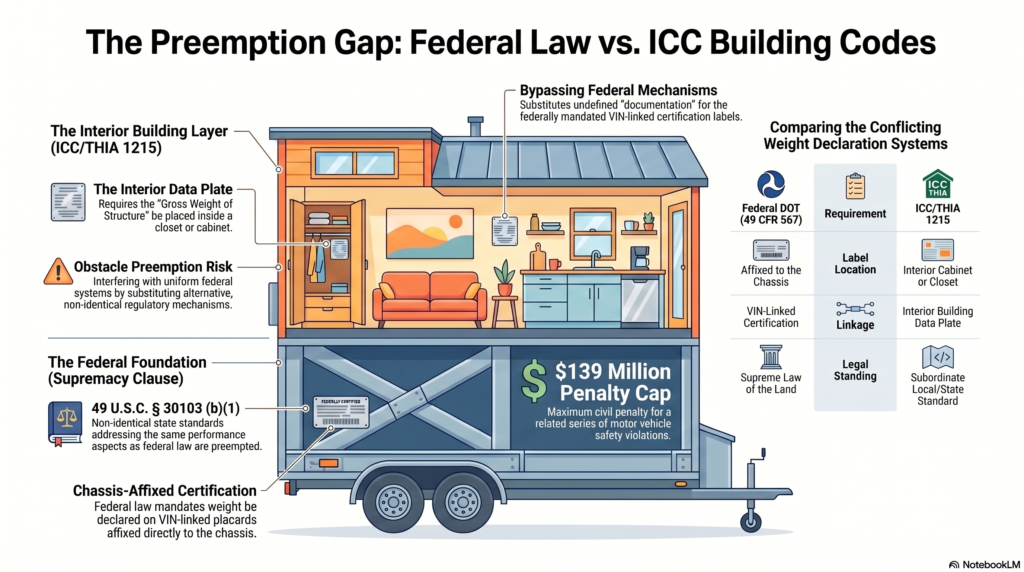
ICC 1215 requires a “Small Residential Unit Data Plate” placed inside the structure that includes the gross weight of the structure
Once mounted on a chassis and moved on public roads, that weight is no longer a building metric—it becomes regulated vehicle weight
Federal law governs that weight through VIN-linked certification labels, axle ratings, and tire/loading placards affixed to the chassis—not through an interior building plate
ICC 1215 then compounds the issue by requiring DOT compliance for loads and weights shown on this data plate—while omitting the federally required certification system entirely. That creates an impossible condition: compliance is required, but the lawful mechanism to prove it is removed.
The contradiction is direct. ICC claims these units fall outside motor vehicle jurisdiction, yet the standard regulates the very transportation elements federal law controls. You cannot disclaim jurisdiction while exercising it.
And The Record Goes Further
This is not a passive oversight or technical gap.
Documented communications show awareness of federal motor vehicle requirements—including VIN, FMVSS applicability, and HUD overlap—paired with recommendations to avoid those classifications while continuing to regulate transportation components.
That combination—knowledge of the federal framework alongside a deliberate shift to alternative mechanisms—transforms this from a drafting issue into a structural conflict with federal law.
Chassis-based dwellings do not begin as buildings—they begin as transportable products in interstate commerce, subject to federal identification, certification, and transportation requirements before they are ever placed on land. ICC 1215 skips that legal stage entirely.
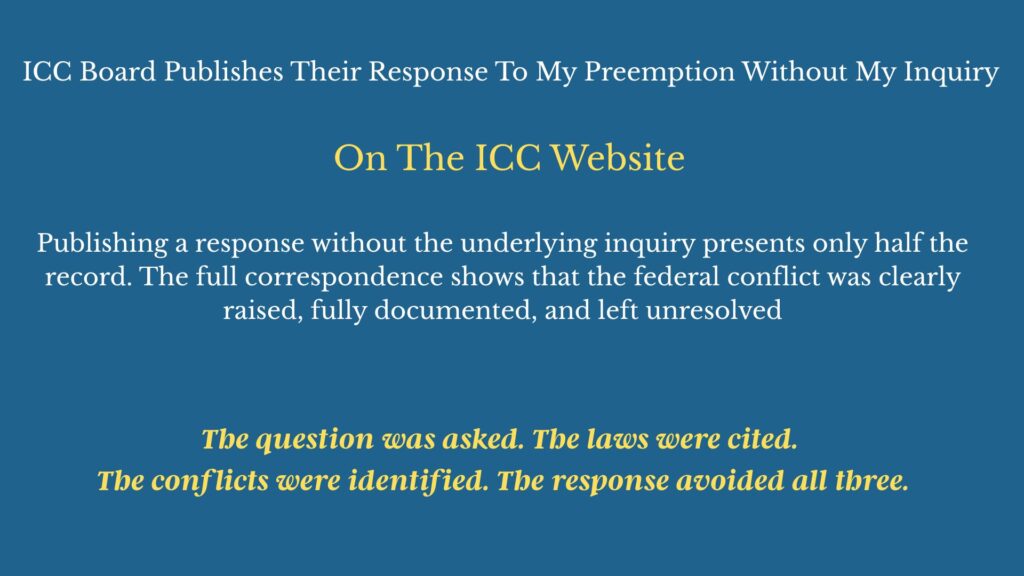
Publishing a response without the underlying inquiry presents only half the record. The full correspondence shows that the federal conflict was clearly raised, fully documented, and left unresolved.
The question was asked. The law was cited. The conflict was identified. The response avoided all three.
Uniting The Motor Vehicle Path With The Structure Path Is The Road To Legal Dwellings
For almost two years I have tried to get the ICC 1215 committee to recognize motor vehicle law. The duo nature of tiny houses on wheels must be recognized to create a legal dwelling to obtain a mortgage and to be accepted in jurisdictions. The path to compliance for tiny houses on wheels is to integrate the motor vehicle compliance path with requirements of a structure, so it meets both the requirements of the road, and for legal placement and for the structure to be recognized as real property. We also need to create provisions that allow tiny houses on wheels to be legally placed on leased land where the unit remains personal property. The ICC 1215 committee is blocking the very steps needed. Learn more.
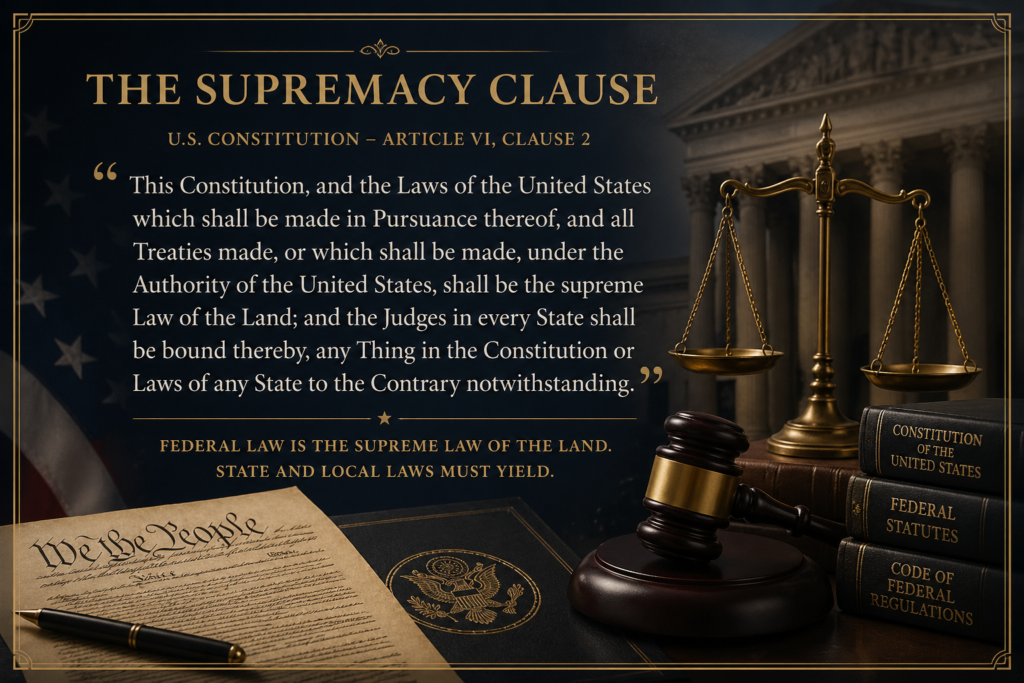
The Supremacy Clause
“This Constitution, and the Laws of the United States which shall be made in Pursuance thereof; and all Treaties made, or which shall be made, under the Authority of the United States, shall be the supreme Law of the Land; and the Judges in every State shall be bound thereby, any Thing in the Constitution or Laws of any State to the Contrary notwithstanding.”
ICC Stated
“You provided no support or authority for your assertion that once weight is invoked, federal transportation law governs.”
ICC Stated
“In summary, your letter did not provide any persuasive reason why the inclusion of the weight information on a data plate inside the structure was likely to be preempted by federal law.”
My Reply
“The law speaks for itself.”
U.S. Constitution — Article VI, Clause 2
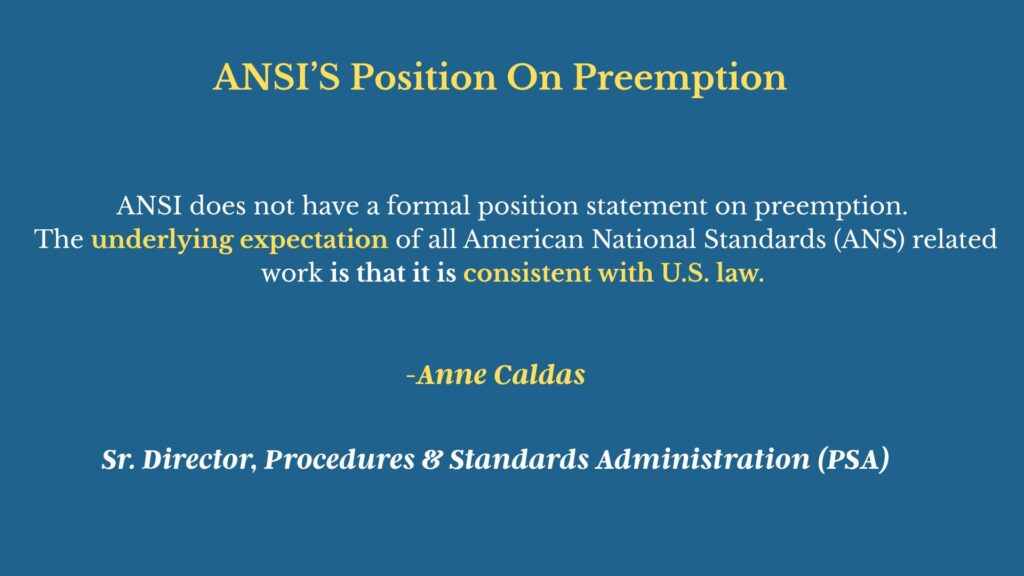
”ANSI does not have a formal position statement on preemption. The underlying expectation of all American National Standards (ANS) related work is that it is consistent with U.S. law. ANSI’s role in standards development is limited to procedural compliance issues as defined in the ANSI Essential Requirements. Appeals are similarly limited by the ANSI Essential Requirements and the standards developer’s ANSI-accredited procedures. And of course, use of ANS is voluntary.
There is a provision in the ANSI Essential Requirements that provides for the ANSI Board of Standards Review (BSR) to decide not to approve a standard as an ANS if there is sufficient evidence that demonstrates that a proposed or approved ANS is contrary to the public interest, contains unfair provisions or is unsuitable for national use. Any such concerns should be raised during the standards development process, if it is ongoing. ”
I Reached Out To ANSI Regarding Preemption
The prior statement is from Anne Caldas. I reached out to her regarding the subject of preemption. Serious issues remain.
ANSI does not address preemption formally.
Decisions regarding preemption from the ICC board are NOT appealable.
There is a clause in the forward of the standard that shifts all liability to the adopting jurisdiction.
This is a song I wrote about what the entire nation is facing because of corporate interests that have taken over housing and the battle for tiny houses on wheels.