Future Arrived- While Housing Waits
We live in a world where cars can drive themselves, watches monitor our heart rates in real time, robots assist in open-heart surgery, and billionaires casually launch commercial flights into space. AI drones can deliver packages to our doorstep in minutes, while autonomous technology continues to receive billions of dollars in global investment. Humanity has boldly stepped into the future.
Yet somehow, one simple concept still struggles to move forward smoothly: tiny houses on wheels.
Mars Has Zoning Before Tiny Houses On Wheels
Satire Song Based On The Contradiction Of Technology Advancing At Lighting Speed While Tiny Houses On Wheels Are Stalled
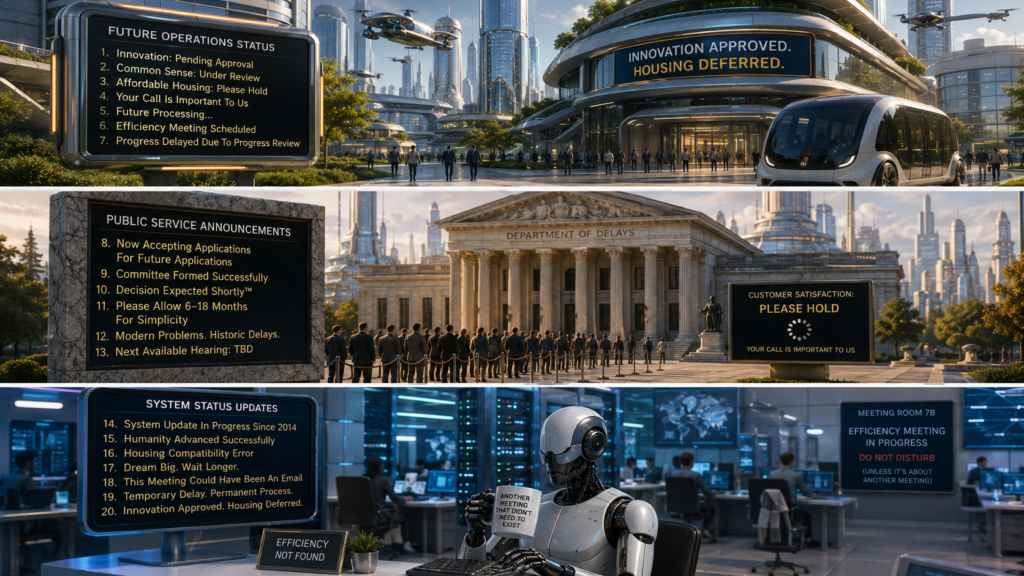
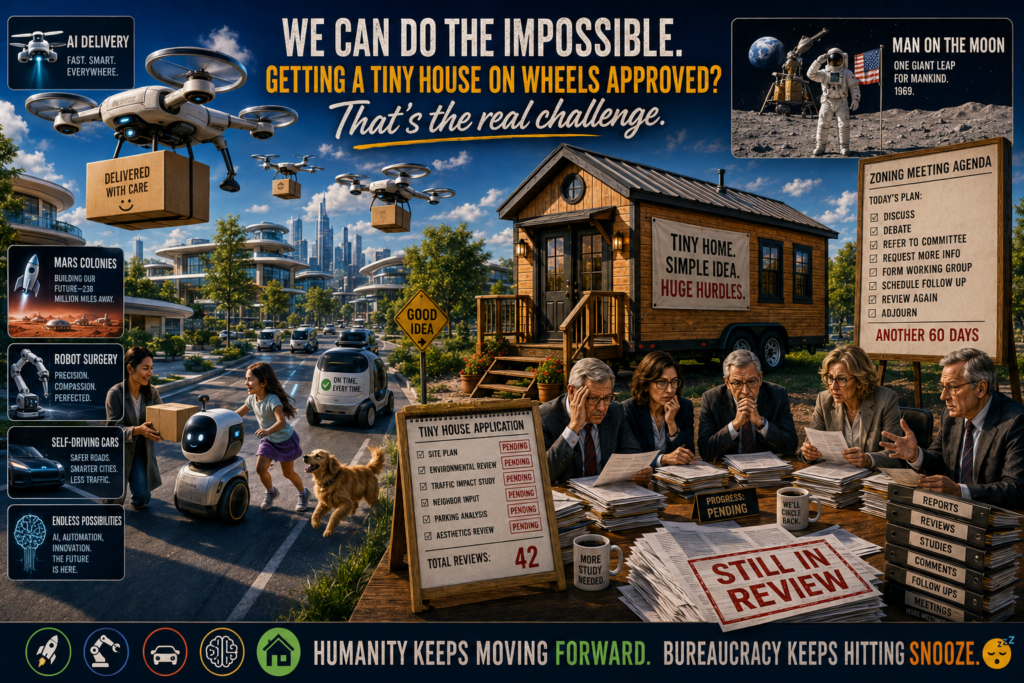
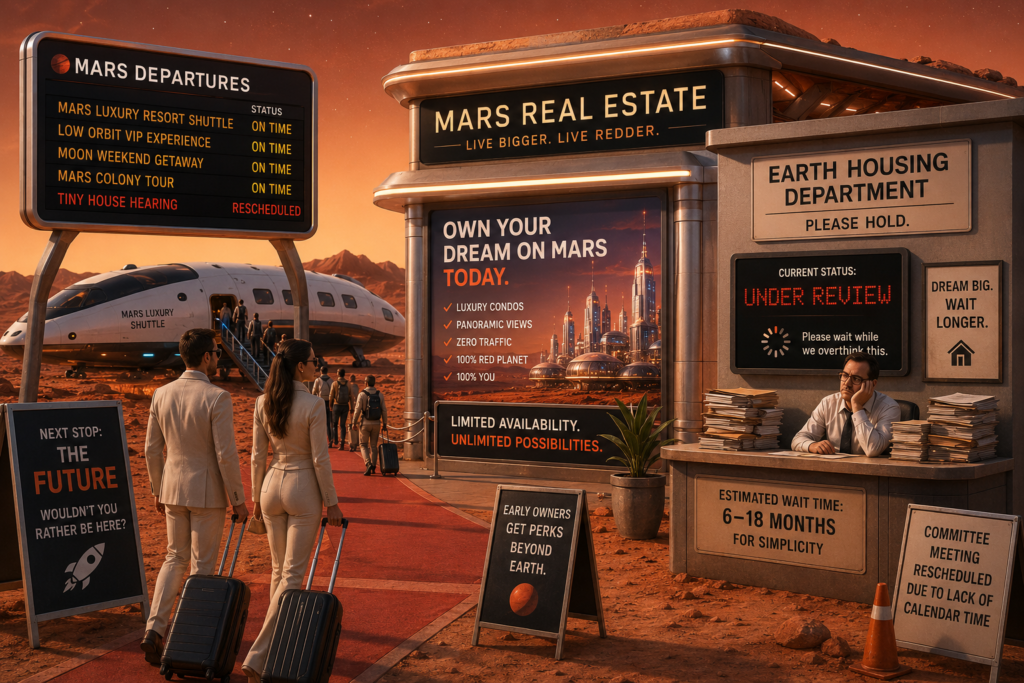
That contradiction became the inspiration behind this satirical song and image series. Through humor, irony, and futuristic visuals, we explored a strange reality — a world where society embraces advanced technology at lightning speed while affordable, flexible housing solutions continue to face endless meetings, delays, classifications, reviews, and confusion.
The satire is not meant to attack innovation. In fact, it celebrates it. The irony is that many of the same qualities praised in modern technology — mobility, efficiency, adaptability, sustainability, and freedom — are also qualities found in tiny houses on wheels.
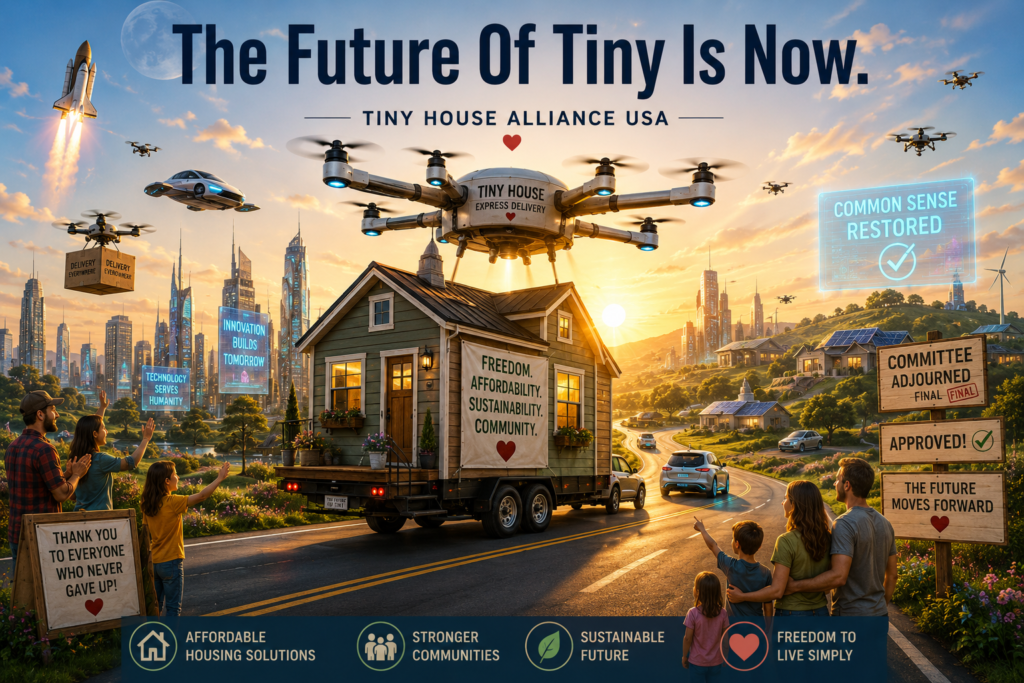
The Future Of Tiny Is Now
The images of Mars colonies, robot surgeons, flying delivery drones, autonomous vehicles, and AI-driven conveniences are intentionally exaggerated reflections of a real question many advocates continue asking:
If humanity can accomplish all of this… why is simple, attainable housing still so difficult to approve?
At the heart of this project is optimism, not cynicism. The goal is not to dwell on frustration, but to encourage conversation, innovation, and common-sense solutions for the future of housing.
Because despite the irony, one thing remains true:
The Future Of Tiny Is Now.
“Society invested more than $160 billion into autonomous transportation technology, yet tiny houses on wheels still face years of uncertainty over where and how they fit into modern codes.”
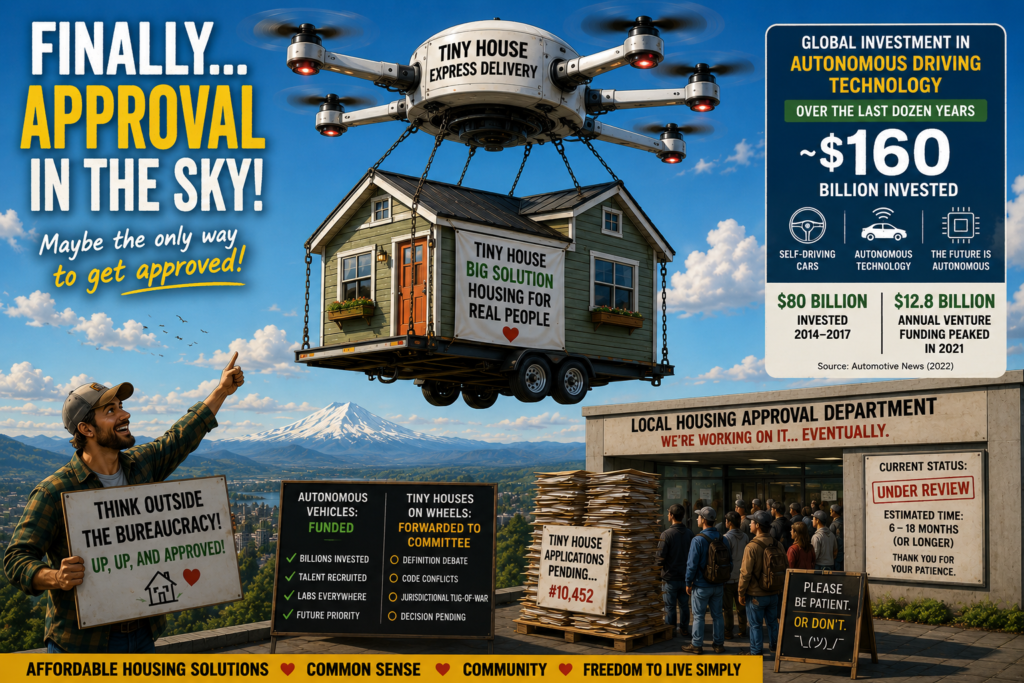
I Guess The Best Solution Is Tiny Houses On Wheels Become Autonomous -More Satire
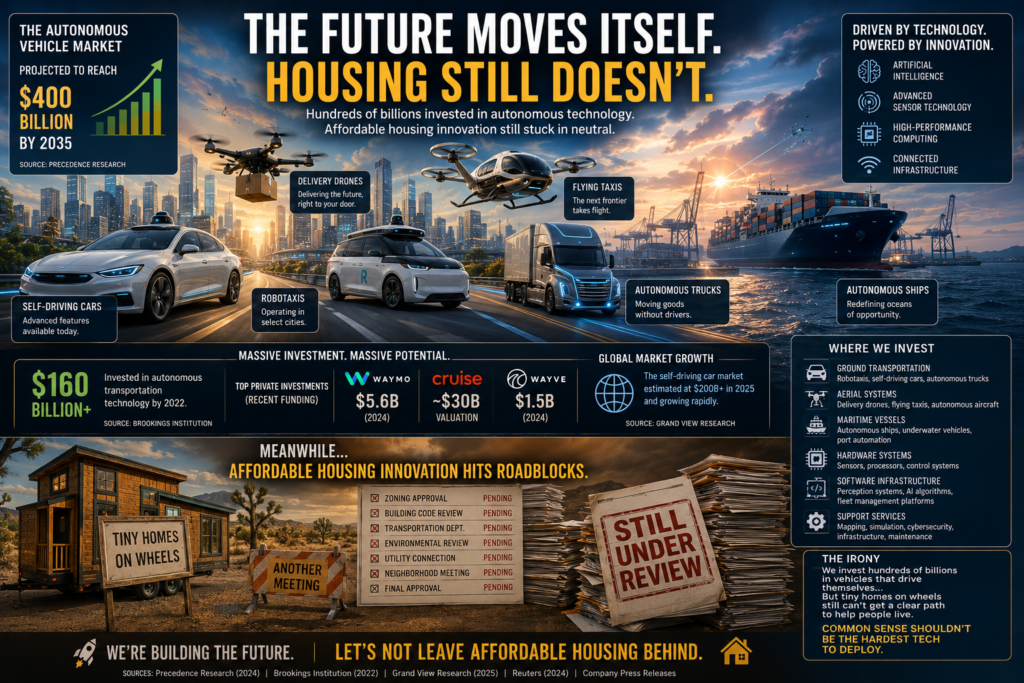
- By 2022, investors had poured roughly $160 billion into autonomous transport technology.
- The global self-driving car market was estimated at more than$200 billion in 2025 and is projected to keep growing rapidly over the next decade.
- Individual autonomous vehicle companies are raising funding rounds in the billions of dollars:
- Waymo raised $5.6 billion in 2024 alone.
- Cruise reached valuations around $30 billion after major investments from Microsoft, Honda, and GM.
- Wayve recently raised $1.5 billion backed by Microsoft, Nvidia, Uber, Mercedes-Benz, Nissan, and others.
- Companies and governments are investing not just in autonomous cars, but in:
- delivery drones,
- robotaxis,
- autonomous freight systems,
- flying taxis,
- and AI-driven transportation infrastructure.
Getting Starting In Autonomous Driving
Vehicles that can operate without human intervention, ranging from basic driver assistance to fully autonomous systems, represent a major investment opportunity across land, sea, and air transportation, including self-driving cars, robotaxis, drones, flying taxis, and autonomous ships. This market is expected to grow significantly, reaching $400 billion by 2035, driven by advances in artificial intelligence, sensor technology, and increasing demand for safer, more efficient transportation options. The technology is developing in stages, from today’s cars that can maintain speed and stay in their lanes, to future vehicles that could potentially operate completely independently, with companies like Mercedes-Benz already achieving advanced autonomous features and robotaxi services operating in select cities.
We may invest in autonomous vehicle opportunities through proprietary portfolios, individual stocks, or specialized investment vehicles. Our autonomous vehicle sector investments target breakthrough technologies across key segments: ground transportation (robotaxis, self-driving cars, autonomous trucks), aerial systems (delivery drones, flying taxis, autonomous aircraft), maritime vessels (autonomous ships, underwater vehicles, port automation), hardware systems (sensors, processors, control systems), software infrastructure (perception systems, AI algorithms, fleet management platforms), and support services. Our team seeks to identify opportunities in companies, derivatives, and investment products positioned to potentially capitalize on the growing autonomous vehicle market.
Learn More
The annual economic benefit of autonomous vehicle adoption may reach $3.5 trillion by 2050.
Follow The Money
Technology advances at lightning speed when powerful industries and major investment stand behind it. Billions of dollars continue flowing into autonomous vehicles, artificial intelligence, drones, robotaxis, flying taxis, and futuristic transportation systems because large industries see enormous financial opportunity in accelerating innovation.
The tiny house on wheels movement has often faced the opposite reality.
Instead of being propelled forward by powerful financial interests, tiny houses on wheels have frequently encountered resistance from entrenched industries determined to protect existing systems, classifications, and market control. While society rapidly embraces emerging technologies that once seemed impossible, affordable housing innovation continues to face delays, endless reviews, regulatory confusion, and institutional pushback.
The irony is difficult to ignore. Humanity can land on the moon, develop self-driving vehicles, automate transportation systems, and invest hundreds of billions into futuristic mobility — yet tiny houses on wheels still struggle to achieve clear and consistent acceptance within many regulatory frameworks.
May 17, 2026