
FMCSA Has Federal Statutes For Mobile Structure Trailers
I have written extensively about NHTSA compliant trailers which relate to the tiny house industry, now I want to focus on a few FMCSA requirements. NHTSA and FMCSA are relative to structures on wheels less than 10′ wide as well, but I wanted to share the statutes that include the term mobile structure trailer that address lighting which start at 10 wide. I will start by sharing the federal agencies and their role in federal transportation law, and relative definitions. Federal transportation laws already recognize dwellings with an integrated structure that can be used as a dwelling or for commercial use.
What Is NHTSA?
The National Highway Traffic Safety Administration (NHTSA) was established by the Highway Safety Act of 1970 (23 U.S.C. 401 note) to help reduce the number of deaths, injuries, and economic losses resulting from motor vehicle crashes on the Nation’s highways.
The Administration carries out programs relating to the safety performance of motor vehicles and related equipment; administers the State and community highway safety program with the FHWA; regulates the Corporate Average Fuel Economy program; investigates and prosecutes
odometer fraud; carries out the National Driver Register Program to facilitate the exchange of State records on problem drivers; conducts studies and operates programs aimed at reducing economic losses in motor vehicle crashes and repairs; performs studies, conducts demonstration projects, and promotes programs to reduce impaired driving, increase seat belt use, and reduce risky driver behaviors; and issues theft prevention standards for passenger and nonpassenger motor vehicles.
Regulations
NHTSA sets vehicle safety regulations, which can be found in title 49 of the Code of Federal Regulations, and highway safety regulations, which can be found in title 23 of the Code of Federal Regulations.
Vehicle Safety
Title 49, Code of Federal Regulations
Highway Safety
Title 23, Code of Federal Regulations
Code Of Federal Regulations 49 Transportation
Chapter V National Highway Traffic Safety Administration, Department of Transportation 500 -599
CFR 49 Federal Motor Vehicle Safety Standards ( FMVSS) 571.1-571.500
NHTSA Contracted With SAE
The National Highway Traffic Safety Administration (NHTSA) has contracted with the SAE International (SAE) to coordinate the assignment of manufacturer identifiers. Manufacturer identifiers will be supplied by SAE at no charge. All requests for assignments of manufacturer identifiers should be forwarded directly to: SAE International, 400 Commonwealth Drive, Warrendale, Pennsylvania 15096, Attention: WMI Coordinator. Any requests for identifiers submitted to NHTSA will be forwarded to SAE. Manufacturers may request a specific identifier or may request only assignment of an identifier(s). SAE will review requests for specific identifiers to determine that they do not conflict with an identifier already assigned or block of identifiers already reserved. SAE will confirm the assignments in writing to the requester. Once confirmed by SAE, the identifier need not be resubmitted to NHTSA.
SAE
What Is FMCSA ?
The Federal Motor Carrier Safety Administration (FMCSA) was established within the Department of Transportation on January 1, 2000, pursuant to the Motor Carrier Safety Improvement Act of 1999 (49 U.S.C. 113). Formerly a part of the Federal Highway Administration, the Federal Motor Carrier Safety Administration’s primary mission is to prevent commercial motor vehicle-related fatalities and injuries. Activities of the Administration contribute to ensuring safety in motor carrier operations through strong enforcement of safety regulations; targeting high-risk carriers and commercial motor vehicle drivers; improving safety information systems and commercial motor vehicle technologies; strengthening commercial motor vehicle equipment and operating standards; and increasing safety awareness. To accomplish these activities, the Administration works with Federal, State, and local enforcement agencies, the motor carrier industry, labor and safety interest groups, and others.
FMCSA
Activities
Code Of Federal Regulations 49 Transportation
Chapter 111 Federal Motor Carrier Safety Administration, Department of Transportation 300- 399
What Is A Mobile Structure Trailer?
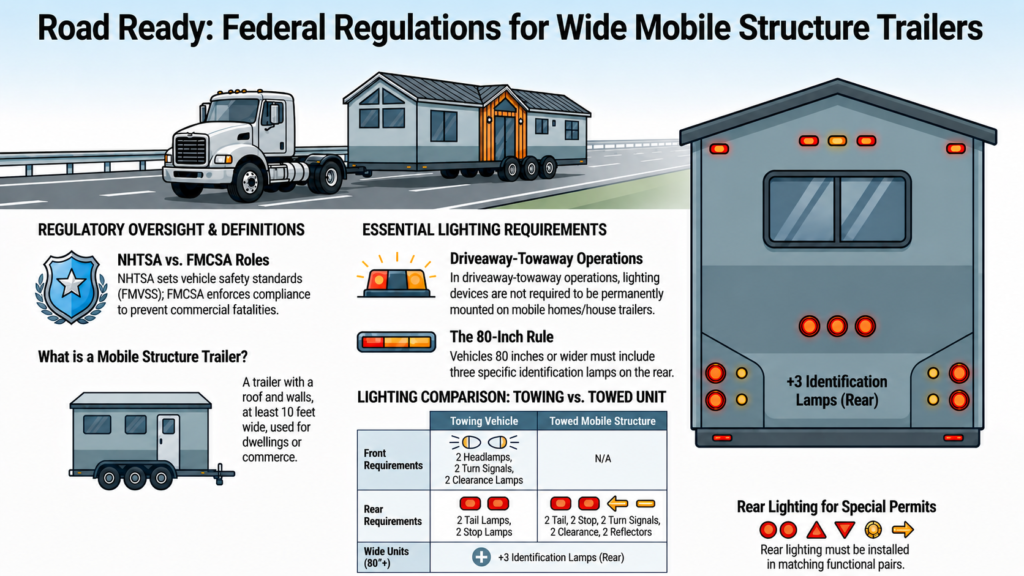
A mobile structure trailer means a trailer that has a roof and walls, is at least 10 feet wide, and can be used off road for dwelling or commercial purposes. The definition and the statute it is pertaining to is in full text is below.
§ 393.17 Lamps and reflectors—combinations in driveaway-towaway operation.
A combination of motor vehicles engaged in driveaway-towaway operation must be equipped with operative lamps and reflectors conforming to the rules in this section.
(a) The towing vehicle must be equipped as follows:
(1) On the front, there must be at least two headlamps, an equal number at each side, two turn signals, one at each side, and two clearance lamps, one at each side.
(2) On each side, there must be at least one side-marker lamp, located near the front of the vehicle.
(3) On the rear, there must be at least two tail lamps, one at each side, and two stop lamps, one at each side.
(b) Except as provided in paragraph (c) of this section, the rearmost towed vehicle of the combination (including the towed vehicles of a tow-bar combination, the towed vehicle of a single saddle-mount combination, and the rearmost towed vehicle of a double or triple saddle-mount combination) or, in the case of a vehicle full-mounted on a saddle-mount vehicle, either the full-mounted vehicle or the rearmost saddle-mounted vehicle must be equipped as follows:
(1) On each side, there must be at least one side-marker lamp, located near the rear of the vehicle.
(2) On the rear, there must be at least two tail lamps, two stop lamps, two turn signals, two clearance lamps, and two reflectors, one of each type at each side. In addition, if any vehicle in the combination is 80 inches or more in overall width, there must be three identification lamps on the rear.
Requirements If The Towed Vehicle In A Combination
Is A Mobile structure Trailer
If the towed vehicle in a combination is a mobile structure trailer, it must be equipped in accordance with the following lighting devices. For the purposes of this part, mobile structure trailer means a trailer that has a roof and walls, is at least 10 feet wide, and can be used off road for dwelling or commercial purposes.
(1) When the vehicle is operated in accordance with the terms of a special permit prohibiting operation during the times when lighted lamps are required, it must have on the rear—
(i) Two stop lamps, one on each side of the vertical centerline, at the same height, and as far apart as practicable;
(ii) Two tail lamps, one on each side of the vertical centerline, at the same height, and as far apart as practicable;
(iii) Two red reflex reflectors, one on each side of the vertical centerline, at the same height, and as far apart as practicable; and
(iv) Two turn signal lamps, one on each side of the vertical centerline, at the same height, and as far apart as practicable
(2) At all other times, the vehicle must be equipped as specified in paragraph (b) of this section.
(d) An intermediate towed vehicle in a combination consisting of more than two vehicles (including the first saddle-mounted vehicle of a double saddle-mount combination and the first and second saddle-mount vehicles of a triple saddle-mount combination) must have one side-marker lamp on each side, located near the rear of the vehicle.
Statute
Section § 393.25: Requirements for lamps other than head lamps.
Guidance Q And A
Question 1: Are lighting devices on mobile homes/house trailers required to be permanently mounted?
Guidance: No. The movement of mobile homes/house trailers is considered to be a driveaway-towaway operation.
FMCSA Source
Lighting Requirements for Trailers and Loads Exceeding 80 Inches (2,032 mm) in Width Applicable Regulations: 49 CFR Parts 393 (FMCSR) and 49 CFR Part 571 (FMVSS No. 108)
§ 393.11 Lamps and reflective devices.
Link to an amendment published at 91 FR 7873, Feb. 19, 2026.
(a)
(1) Lamps and reflex reflectors. Table 1 specifies the requirements for lamps, reflective devices and associated equipment by the type of commercial motor vehicle. The diagrams in this section illustrate the position of the lamps, reflective devices and associated equipment specified in Table 1. All commercial motor vehicles manufactured on or after December 25, 1968, must, at a minimum, meet the applicable requirements of 49 CFR 571.108 (FMVSS No. 108) in effect at the time of manufacture of the vehicle. Commercial motor vehicles manufactured before December 25, 1968, must, at a minimum, meet the requirements of subpart B of part 393 in effect at the time of manufacture.
(2) Exceptions: Pole trailers and trailer converter dollies must meet the part 393 requirements for lamps, reflective devices and electrical equipment in effect at the time of manufacture. Trailers which are equipped with conspicuity material which meets the requirements of § 393.11(b) are not required to be equipped with the reflex reflectors listed in Table 1 if—
(i) The conspicuity material is placed at the locations where reflex reflectors are required by Table 1; and
(ii) The conspicuity material when installed on the motor vehicle meets the visibility requirements for the reflex reflectors.
Conspicuity Systems. Each trailer of 2,032 mm (80 inches)
Or More Overall Width
(b) Conspicuity Systems. Each trailer of 2,032 mm (80 inches) or more overall width, and with a GVWR over 4,536 kg (10,000 pounds), manufactured on or after December 1, 1993, except pole trailers and trailers designed exclusively for living or office use, shall be equipped with either retroreflective sheeting that meets the requirements of FMVSS No. 108 (S5.7.1), reflex reflectors that meet the requirements FMVSS No. 108 (S5.7.2), or a combination of retroreflective sheeting and reflex reflectors that meet the requirements of FMVSS No. 108 (S5.7.3). The conspicuity system shall be installed and located as specified in FMVSS No. 108 [S5.7.1.4 (for retroreflective sheeting), S5.7.2.2 (for reflex reflectors), S5.7.3 (for a combination of sheeting and reflectors)] and have certification and markings as required by S5.7.1.5 (for retroreflective tape) and S5.7.2.3 (for reflex reflectors).
(c) Prohibition on the use of amber stop lamps and tail lamps. No commercial motor vehicle may be equipped with an amber stop lamp, a tail lamp, or other lamp which is optically combined with an amber stop lamp or tail lamp.
Lorem ipsum dolor sit amet, consectetur adipiscing elit. Ut elit tellus, luctus nec ullamcorper mattis, pulvinar dapibus leo.
49 CFR § 396.15 - Driveaway-towaway operations and inspections.
§ 396.15 Driveaway-towaway operations and inspections
(a) General. Every motor carrier, with respect to motor vehicles engaged in driveaway-towaway operations, shall comply with the requirements of this part. Exception: Maintenance records required by § 396.3, the vehicle inspection report required by § 396.11, and the periodic inspection required by § 396.17 of this part shall not be required for any vehicle which is part of the shipment being delivered.
(b) Pre-trip inspection. Before the beginning of any driveaway-towaway operation of motor vehicles in combination, the motor carrier shall make a careful inspection and test to ascertain that:
(1) The tow-bar or saddle-mount connections are properly secured to the towed and towing vehicle;
(2) They function adequately without cramping or binding of any of the parts; and
(3) The towed motor vehicle follows substantially in the path of the towing vehicle without whipping or swerving.
(c) Post-trip inspection. Motor carriers shall maintain practices to ensure that following completion of any trip in driveaway-towaway operation of motor vehicles in combination, and before they are used again, the tow-bars and saddle-mounts are disassembled and inspected for worn, bent, cracked, broken, or missing parts. Before reuse, suitable repair or replacement shall be made of any defective parts and the devices shall be properly reassembled.
Statute
§ 571.108 Standard No. 108; Lamps, reflective devices, and associated equipment
S1 Scope. This standard specifies requirements for original and replacement lamps, reflective devices, and associated equipment.
S2 Purpose. The purpose of this standard is to reduce traffic accidents and deaths and injuries resulting from traffic accidents, by providing adequate illumination of the roadway, and by enhancing the conspicuity of motor vehicles on the public roads so that their presence is perceived and their signals understood, both in daylight and in darkness or other conditions of reduced visibility.
S3 Application. This standard applies to:
S3.1 Passenger cars, multipurpose passenger vehicles, trucks, buses, trailers (except pole trailers and trailer converter dollies), and motorcycles;
S3.2 Retroreflective sheeting and reflex reflectors manufactured to conform to S8.2 of this standard; and
S3.3 Lamps, reflective devices, and associated equipment for replacement of like equipment on vehicles to which this standard applies.
Driveaway-Towaway Operation
Driveaway-towaway operation means an operation in which an empty or unladen motor vehicle with one or more sets of wheels on the surface of the roadway is being transported:
(1) Between vehicle manufacturer’s facilities;
(2) Between a vehicle manufacturer and a dealership or purchaser;
(3) Between a dealership, or other entity selling or leasing the vehicle, and a purchaser or lessee;
(4) To a motor carrier’s terminal or repair facility for the repair of disabling damage (as defined in this section) following a crash; or
(5) To a motor carrier’s terminal or repair facility for repairs associated with the failure of a vehicle component or system; or
(6) By means of a saddle-mount or tow-bar.
Statute
Motor Carrier
Motor carrier means a for-hire motor carrier or a private motor carrier. The term includes a motor carrier’s agents, officers and representatives as well as employees responsible for hiring, supervising, training, assigning, or dispatching of drivers and employees concerned with the installation, inspection, and maintenance of motor vehicle equipment and/or accessories. For purposes of this subchapter, this definition includes the terms employer, and exempt motor carrier.
Statute
Motor Vehicle
Motor vehicle means any vehicle, machine, tractor, trailer, or semitrailer propelled or drawn by mechanical power and used upon the highways in the transportation of passengers or property, or any combination thereof determined by the Federal Motor Carrier Safety Administration, but does not include any vehicle, locomotive, or car operated exclusively on a rail or rails, or a trolley bus operated by electric power derived from a fixed overhead wire, furnishing local passenger transportation similar to street-railway service.
Statute
Lamp
A device used to produce artificial light.
Statute
Related Blog Posts
How To Become A NHTSA Compliant Tiny House Trailer Manufacturer
Trailer Manufacturers Must Comply To NHTSA And DOT Regulations
When you decide to be a tiny house manufacturer, one of the top things to consider is whether you will buy a prefabricated trailer or build them as a manufacturer and learn how to issue Vin numbers for the trailer legally.
Third parties that certify that the manufacturers build to a certain code or standard usually are not involved in the chassis and components processes because trailers are considered a vehicle and must follow NHTSA and DOT regulations and NHTSA allows trailer manufacturers to self-certify.
I will share some helpful information if you want to follow the steps yourself to become a legal trailer manufacturer or how to find a legal trailer manufacturer and I am also introducing everyone to Chuck Bauman with Trailer USA, who is a very valuable resource with decades of experience that facilitates the federal licensing processes for trailer manufacturers and the steps for compliance.
May 28, 2026