
Would You Like To Know The Future Of The Tiny House Industry?
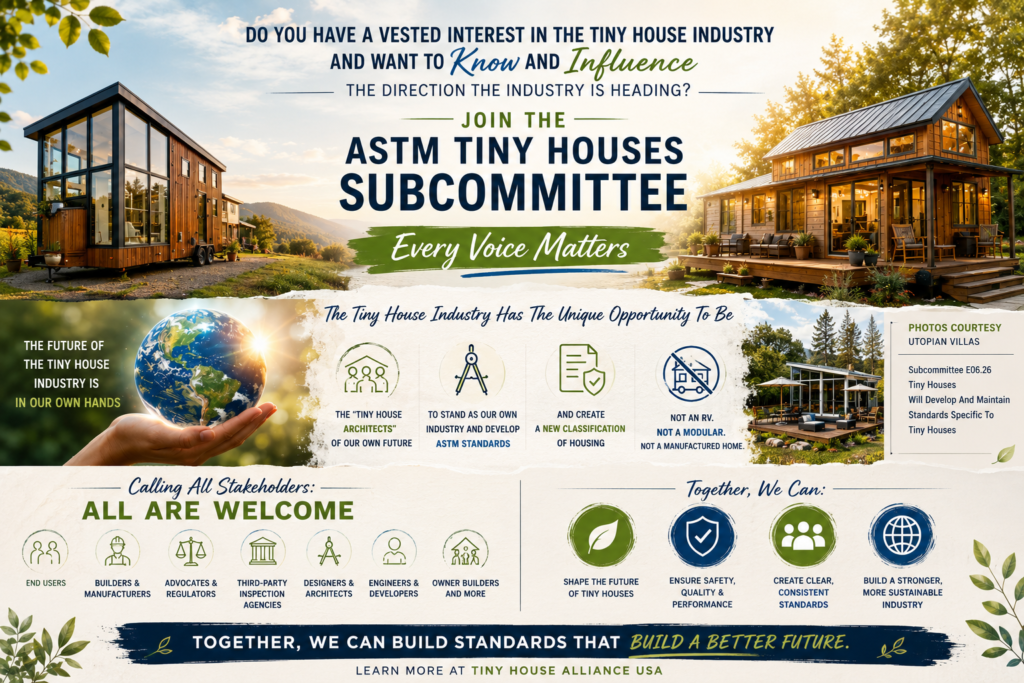
They say the best way to know the future is to create it. The tiny house industry has a chance to shape the industry toward a future we see through the ASTME06.26 Tiny Houses subcommittee within the E06 Performance Of Buildings committee.
About E06 Performance Of Buildings
ASTM Committee E06 on Performance of Buildings was formed in 1946. E06 meets twice a year, usually in April and October, with approximately 240 members attending three to four days of technical meetings. Committee E06 also periodically sponsors symposiums. The committee, with a current membership of 1090, has jurisdiction of 255 standards, published in the Annual Book of ASTM Standards, Volume 04.11 and 04.12. E06 has 18 technical subcommittees that maintain jurisdiction over these standards. Information on this subcommittee structure and E06‘s portfolio of approved standards and Work Items under construction are available from the Lists of Subcommittees, Standards and Work Items below. These standards have and continue to play a preeminent role in the building industry and address issues relating to the performance of buildings, their elements, components, and the description, measurement, prediction, improvement and management of the overall performance of buildings and building related facilities.
What Is An ASTM Standard?
ASTM International’s Regulations Governing ASTM Technical Committees ( “Green Book”) defines a standard as “A document that has been developed and established within the consensus principles of the Society and that meets the approval requirements of ASTM procedures and regulations.” This definition specifies both a process – the consensus-building, deliberative approach followed by committees – and a document, an actual standard.
Types Of ASTM Standards
Specification
An ASTM specification contains an explicit set of requirements to be satisfied by a material, product, system, or service.
Test Method
An ASTM test method is a document that can set out requirements and is a definitive procedure that produces a test result.
Practice
An ASTM practice is a document that can also set out requirements and contains a set of instructions for performing one or more specific operations that does not produce a test result. A practice underscores a general usage principle.
Guide
An ASTM guide is a compendium of information or series of options that do not recommend a specific course of action. It suggests an approach method or agreed way of measuring, testing, or specifying what is reliably repeatable in different circumstances and places, wherever it needs to be applied.
Classification
An ASTM classification is a systematic arrangement or division of materials, products, systems, or services into groups based on similar characteristics such as origin, composition, properties, or use.
Terminology
An ASTM terminology document is comprised of definitions of terms; explanations of symbols, abbreviations, or acronyms.
Common Misconceptions
I have heard some misconceptions that I would like to set the record straight on.
ASTM Has Never Done A Standard On A Residence : Incorrect
ASTM has published standards on every component of a house that is referenced in the IRC, IBC, the HUD code, local and state building codes, FEMA, Department of Housing and Urban Development (HUD) Minimum Property Standards, DOE and more. ASTM has developed standards on 3D printing houses, straw bales, cobb, aircrete, Hemp, earthen floors, etc……..
What Is An ASTM Building Standard?
ASTM’s building standards are instrumental in specifying, evaluating, and testing the dimensional, mechanical, rheological, and other performance requirements of the materials used in the manufacture of main and auxiliary building parts and components. These materials include construction sealants, structural members, insulation systems, and other facilities used in conjunction with the erection of the foundation, walls, roofs, ceilings, doors, and windows of both commercial and domestic building structures. These building standards are helpful in guiding manufacturers, construction companies, architectural firms, and other users of such parts and components in their proper fabrication and installation procedures, as well as the possible hazards involved during these processes.
Learn More
ASTM Only Does Performance Standards: Incorrect
ASTM standards can be both performance or prescriptive standards. It is up to the author and committee writing the standard.
What Is The Difference Of A Performance Standard As Compared To Prescriptive?
A prescriptive standard is like a cookbook recipe that dictates exactly how to do something (using specific materials and methods). A performance standard focuses on the end result or functional goal, giving you the freedom to choose how to get there as long as the criteria are me
How The IRC And ASTM Work Together
The International Residential Code, the IRC, references standards. The 2024 IRC included over 500 ASTM referenced standards and ASTM and ANSI or listed in the IRC code criteria as accepted standards referenced in the code.
We Are Working On Much Needed Standards
A primary goal of the ASTME06.26 subcommittee is develop a standard for a tiny house on wheels, though we have decided to develop simple one subject standards first that can be combined together. We raised 15K for structural engineering addressing the chassis, and we are about to register a new work item that focuses on the structural attachment of the structure to the chassis. We have gathered a team of structural engineers, architects, and experts on SIPS, wood and cold form steel framing.
ASTM Standard: Guide for Tiny House On Wheels Floor Assemblies
Scope: This guide covers the design and construction of floor assemblies for Tiny Houses on Wheels that are permanently structurally integrated with the trailer chassis.
It covers different trailer types in common use and the types of floor assemblies appropriate to each, including wood joist assemblies built above chassis crossmembers, steel joist assemblies where the crossmembers double as the floor joists, and hybrid assemblies.
It covers the purpose, design considerations, selection of materials, and installation considerations for each component of the floor assembly. For wood joist assemblies, it covers framing recommendations for structural soundness of the assembly in conjunction with the chassis deck frame.
It addresses design considerations for prevention of condensation and mold in the floor assembly and the interior floor surface through proper use of insulation, air sealing, and vapor retarders.
It addresses considerations for the use of the floor assembly for plumbing and mechanical runs. Limitations—It does not cover structural design requirements of the trailer chassis itself or structural connection of the floor to the chassis. As a guide, assemblies are described conceptually and are not prescriptive. The values stated in inch-pound units are to be regarded as standard. The values given in parentheses are mathematical conversions to SI units that are provided for information only and are not considered standard. This standard does not purport to address all of the safety concerns, if any, associated with its use. It is the responsibility of the user of this standard to establish appropriate safety, health, and environmental practices and determine the applicability of regulatory limitations prior to use. This international standard was developed in accordance with internationally recognized principles on standardization established in the Decision on Principles for the Development of International Standards, Guides and Recommendations issued by the World Trade Organization Technical Barriers to Trade (TBT) Committee.
Two Very Important Standards We Are Working On Are Listed Below
ASTM Standard: Specification for Trailer Compliance For Tiny House On Wheels Manufacturers For Road Use
Scope This specification provides the minimum requirements for trailer manufacturers and tiny house on wheels manufacturers that structurally integrate a structure to a chassis for the compliance for road and highway use if they manufacture or import units into the US.
The standard will include: Steps for a manufacturer to obtain a WMID Code to legally issue VIN numbers. Requirements for manufacturers that have a VIN responsibility. Registration with SAE and NHTSA. Requirements for complete, incomplete, and final stage manufacturers. Requirements for a manufacturer that is classified as an alterer and alters a prefab trailer, legally known as a completed trailer. The standard will reference definitions and relevant standards for compliance, including but not limited to FMVSS, SAE, and FMCSA. The standard will reference the North American Cargo Securement Standard where it applies. Self certification and label requirements for the manufacturers. A quality assurance program for manufacturers. A checklist for third parties, and building officials that must verify that the manufacturer complied with the requirements.
The standard will be beneficial for manufacturers that structurally attach any type of structure to the chassis. A checklist for inspection for state patrol. The standard will be an invaluable resource for structural and mechanical engineers that design trailers, and completed structures on a chassis, including tiny houses.
Resources for compliance. The standard will contribute to uniformity in the tiny house industry.
The standard will protect manufacturers from civil and criminal liabilities. The standard will clarify the steps for compliance where one authority begins and ends to prevent an overlap of authority and misplaced liability.
How To Join
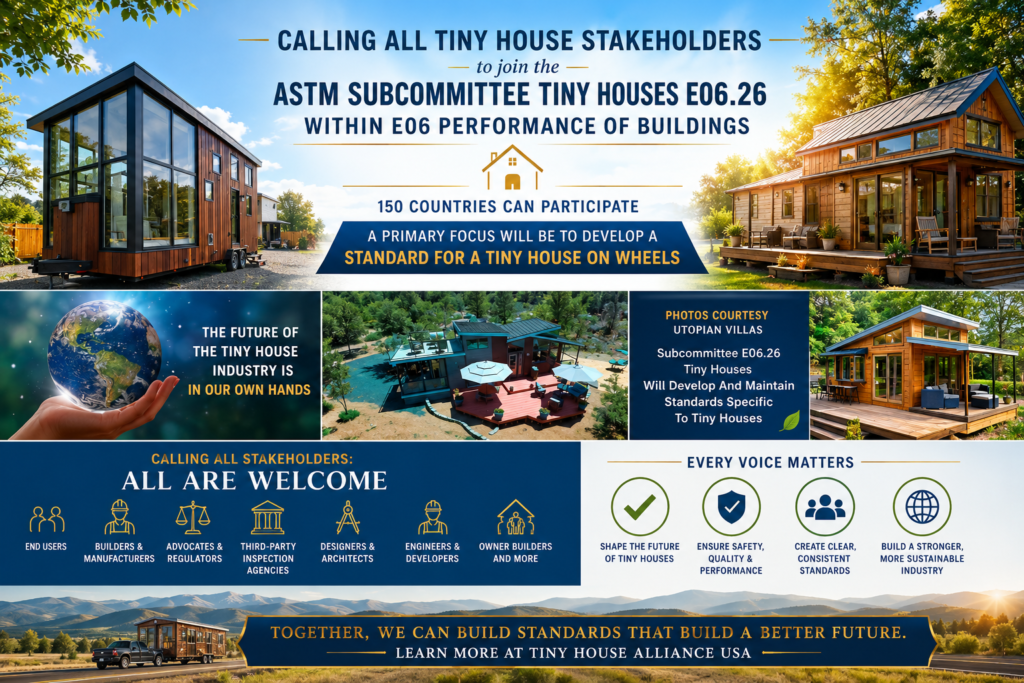
The Tiny Houses subcommittee is open to all and every voice matters. Please Join Us!
First You Join ASTM
Join E06 Performance Of Buildings Committee
Join E06.26 Tiny Houses Subcommitee
Learn More About ASTM Membership
Students Are Free!
Learn More About ASTM
June 3, 2026