A Picture Speaks A 1000 Words: Truer Words Have Never Been Spoken
America faces a severe shortage of affordable housing. Off-site construction—factory-built modules, panels, and systems delivered to the job site with a high degree of finish—has been repeatedly identified as one of the most promising tools for increasing supply, improving quality, and reducing cost and construction time. Federal interest in this approach is not new. In the late 1960s and early 1970s, HUD’s Operation Breakthrough attempted to demonstrate large-scale industrialized housing production. Today that interest has returned through two major HUD publications: the 2023 Offsite Construction for Housing: Research Roadmap and the 2026 HUD’s Past, Present, and Future Role in Accelerating U.S. Offsite Construction for Housing: A Comparative Study and Action Plan.
On May 2026 the International Code Council responded with its own report, Accelerating Off-Site Construction Through Collaboration. ICC presents its existing codes, standards, evaluation services, and third-party programs as the ready-made solutions to the priorities identified in the Action Plan. On the surface this appears to be ordinary standards-development work and ordinary policy advocacy. When the documents are examined together, however—along with the historical federal record, the funding path, the leadership overlaps, and the specific language directed at manufactured housing—a clearer and more consequential pattern emerges.
ICC’s May 2026 report is written as if it is simply responding to an independent federal plan—explaining how its existing tools already address what HUD has asked for. That framing makes the ask sound cooperative and neutral: “Here is how we can help deliver the Action Plan.” In reality, the sequence runs the other way. The Roadmap and Action Plan are recommendations to HUD, produced through a process that included ICC-connected participants and peer reviewers. ICC then takes those recommendations, maps every major priority onto its own standards, evaluation services, third-party programs, and subsidiaries, and asks HUD to fund, prefer, and operationalize that package. The federal documents become the public justification for accelerating ICC’s vertically integrated system. The report is not an independent technical response to a settled HUD policy. It is ICC treating the recommendations as the blueprint for its own expansion and asking the federal government to underwrite and preference that expansion. The language of collaboration and “supporting the Action Plan” obscures the fact that the Action Plan is being used as the vehicle for one organization’s preferred implementation path.
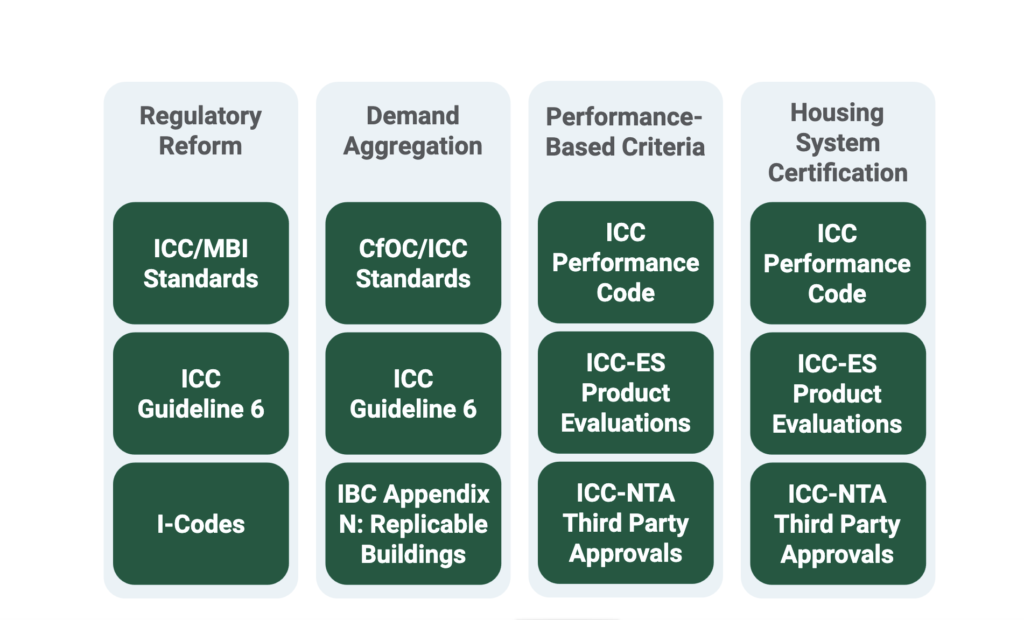
The 2023 Research Roadmap contains a statement by then-ICC President Cindy Davis suggesting that HUD could streamline the manufactured-home industry and remove regulatory barriers by adopting the ICC/MBI standards “for all offsite construction.” Those standards’ own forward explicitly excludes manufactured homes regulated under the HUD Code. The same Roadmap recommends investigating the relative merits of the HUD Code versus ICC codes for the potential regulation of manufactured housing and examining obstacles in the ICC Evaluation Service process. The 2026 Action Plan then advances standardized terminology, demand aggregation, performance-based criteria, and a housing-system certification framework. ICC’s May 2026 response maps nearly every major priority in that Action Plan onto tools it already owns or co-develops: the ICC/MBI 1200/1205/1210 standards, the forthcoming CfOC/ICC standards, the ICC Performance Code, ICC-ES product evaluations, ICC-NTA third-party approvals, ICC Guideline 6, and IBC Appendix N on replicable buildings. ICC asks HUD to participate in its standards-update process, to provide implementation and training grants, to give preferential treatment in HUD programs to states that adopt the standards, and to use those standards directly in federal programs.
This is not merely a list of available technical resources. It is a request that federal funding, grant criteria, program preferences, and agency adoption be used to accelerate one privately developed, vertically integrated network of codes, standards, evaluation, inspection, certification, and training.
Two further elements complete the picture. First, the contemporary framing largely omits the earlier federal work that already addressed systems evaluation and the qualification of independent agencies. Operation Breakthrough included producer evaluation and certification. The Coordinated Evaluation System produced model state documents for evaluation, approval, and inspection. Project LEAP developed criteria for laboratories and agencies performing systems analysis and compliance assurance; those criteria were transferred to ASTM and became ASTM E541 in 1975. ASTM E541 remains referenced today in the laws or administrative rules of eleven states and the Interstate Industrialized Buildings Commission, and it continues to appear in the HUD Code’s own personnel-qualification requirements at 24 C.F.R. § 3282.358. That existing framework is not mentioned as a living alternative in the current recommendations or in ICC’s response.
Second, the organizations that produced the Roadmap and Action Plan have documented leadership and process connections to ICC. NIBS managed both reports. MOD X principals authored them. ICC representatives participated in the Roadmap process, and senior ICC figures appear among the Action Plan’s project partners and peer reviewers. Several individuals have held overlapping board or executive roles at NIBS and ICC. NIBS itself operates under a 1974 statute that imposes public-interest board requirements, a duty to consult the Department of Justice, and sole-source contracting authority—authority that was used for the HUD-funded work that produced these recommendations.
Taken together, the record shows a pathway in which federally funded recommendations, shaped with input from overlapping networks, position a single vertically integrated organization as the primary vehicle for regulatory consistency, performance criteria, third-party evaluation, inspection, and system certification—including language that reaches toward the federally preempted manufactured-housing sector. Competing standards, independent evaluation agencies, existing state systems, and the historical ASTM-based qualification framework receive little attention. The practical effect of preferential federal support for one package could reduce meaningful choice for states, manufacturers, builders, lenders, insurers, and ultimately consumers, while channeling public funds and market demand toward that package.
NIBS was given a privileged federal position—sole-source contracting authority, a public-interest board mandate, and a duty to consult the Department of Justice—precisely so it would not become a vehicle for private interests. Instead, it has used that position to manage and subcontract the very reports that recommend expanding the role of an organization with which it shares overlapping leadership, then stood by while that organization mapped the recommendations onto its own codes, standards, and ICC-owned conformity-assessment services. That is not neutral facilitation. It is the exploitation of a statutory privilege.
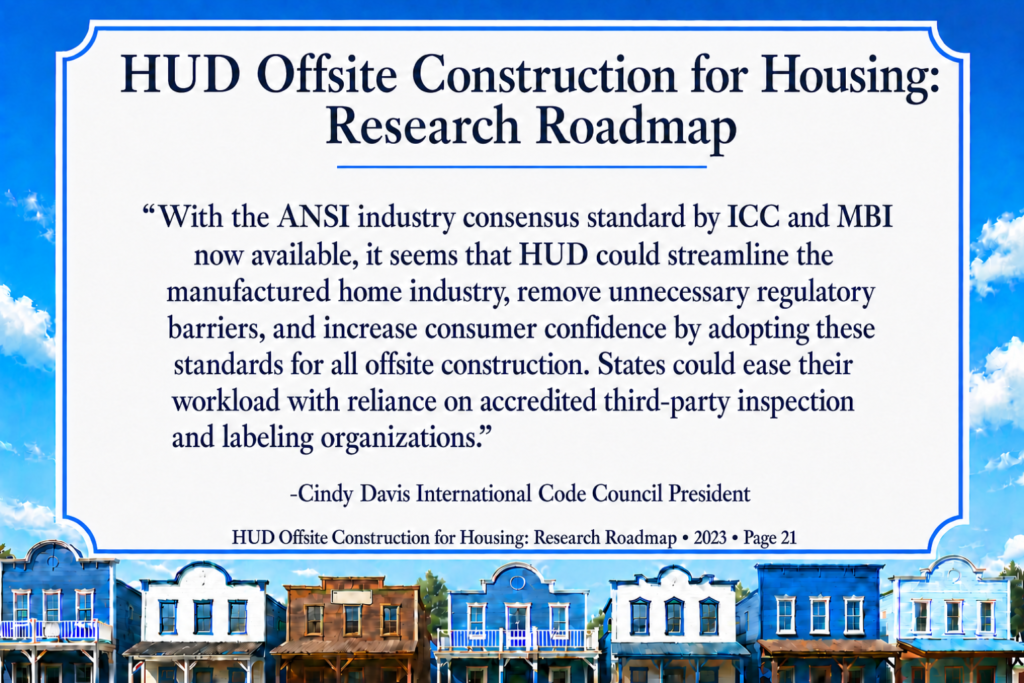
Why the quote is so crucial is because the ICC/MBI standards do NOT apply to manufactured homes. That is stated in the forward of the standards, so there is an obvious power grab being promoted to HUD from ICC that the standards would include all types of off-site housing for inspection and accreditation, but here’s the rub, manufactured homes have a federal program for third party agencies that are known as IPIA and DAPIA agencies that are approved by HUD.
It is the modular industry that has a patchwork of different regulations.
The reports that follow examine the primary documents in detail: the verbatim ICC references in the 2023 Roadmap, the Cindy Davis statement and its context, ICC’s May 2026 mapping of the Action Plan, the Operation Breakthrough–CES–LEAP–ASTM E541 record, the NIBS enabling statute and leadership overlaps, and the implications for manufactured housing and for open competition in off-site construction.
Accelerating Off-Site Construction Through Collaboration
My Response
ICC References In HUD'S Off-site Construction Roadmap
Operation Breakthrough Project Leap And ASTME541
NIBS ICC Statutory Violations
NIBS Enabling Legislation
ICC Is Positioning Itself To Replace The HUD Code With ICC Codes
Is The Chassis Removal Of A Manufactured Home A Win For
The Manufactuted Home Industry Or A Stepping Stone For ICC Replacing The HUD Code?
August 15, 2026