On May 21, 2026, Dr. Ivan Rupnik, PhD, testified before the House Select Committee on Small Business at a hearing titled “Building the Future: How Small Home Builders are Closing America’s Housing Gap,” chaired by Chairman Williams. His written testimony, titled “The Unfinished Breakthrough,” made one central recommendation: that Congress direct the National Institute of Building Sciences (NIBS) to begin developing a national housing system certification framework under authority Rupnik states Congress granted NIBS in 1974 — a framework he described as requiring no new appropriations and no new authority, only congressional direction to exercise a fifty-two-year-old mandate.
About Dr Ivan Rupnik
Dr. Rupnik identifies himself as an architect, researcher, and Founding Partner of MOD X (also referred to in his testimony as “MOD X Advisory”), and as Professor of Architecture at Northeastern University.
He describes MOD X as a firm that “has directly supported HUD’s offsite construction research since 2022 and advises industry and government on topics related to accelerating industrialized housing delivery in the United States.”
He also discloses, in his testimony’s endnotes, that MOD X currently advises JPI, a large multifamily developer whose internal, non-independently-verified operational data — including a projected 58 percent time-savings figure — supplies much of the testimony’s most concrete quantitative evidence for certification’s benefits.
What The Testimony Leaped Over
The testimony states plainly: “No housing system certification framework currently exists in the United States.”
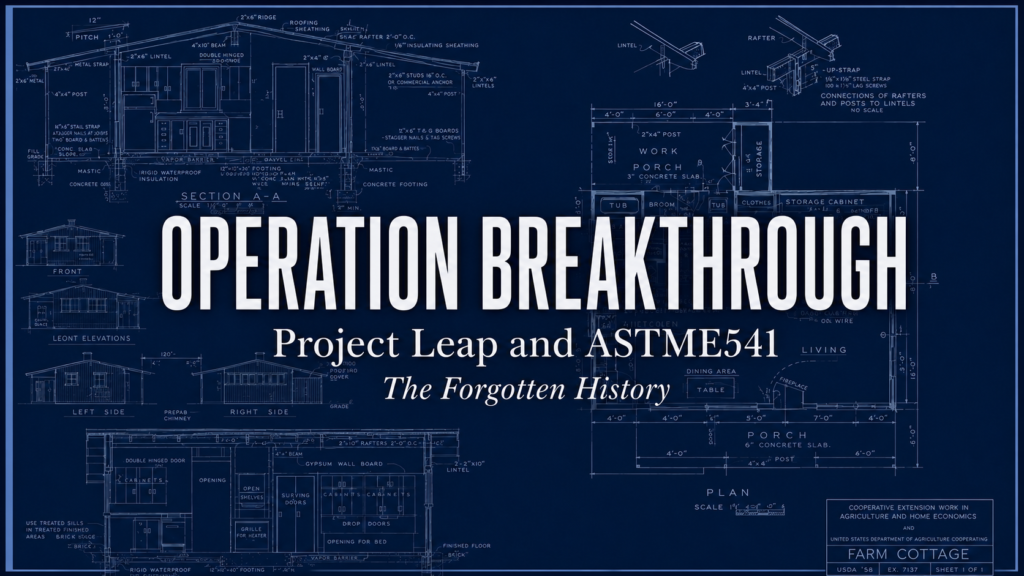
But the federal history Rupnik invokes does not end with Operation Breakthrough. Operation Breakthrough included Project LEAP and the standards-development work that produced ASTM E541. Operation Breakthrough addressed the evaluation and certification of housing systems and producers, while Project LEAP addressed the competence of the laboratories and agencies performing systems analysis, testing, inspection, and compliance assurance. NBS and NCSBCS then transferred the LEAP research to ASTM, where Committee E32 produced ASTM E541 by consensus in 1975.
That distinction matters. ASTM E541 is not identical to the broader system-level certification framework Rupnik is proposing; it is the agency-qualification layer beneath such a framework. Yet it represents a substantial part of the certification infrastructure that grew out of the same federal building-regulatory work surrounding Operation Breakthrough.
Leap: Sourced From 552
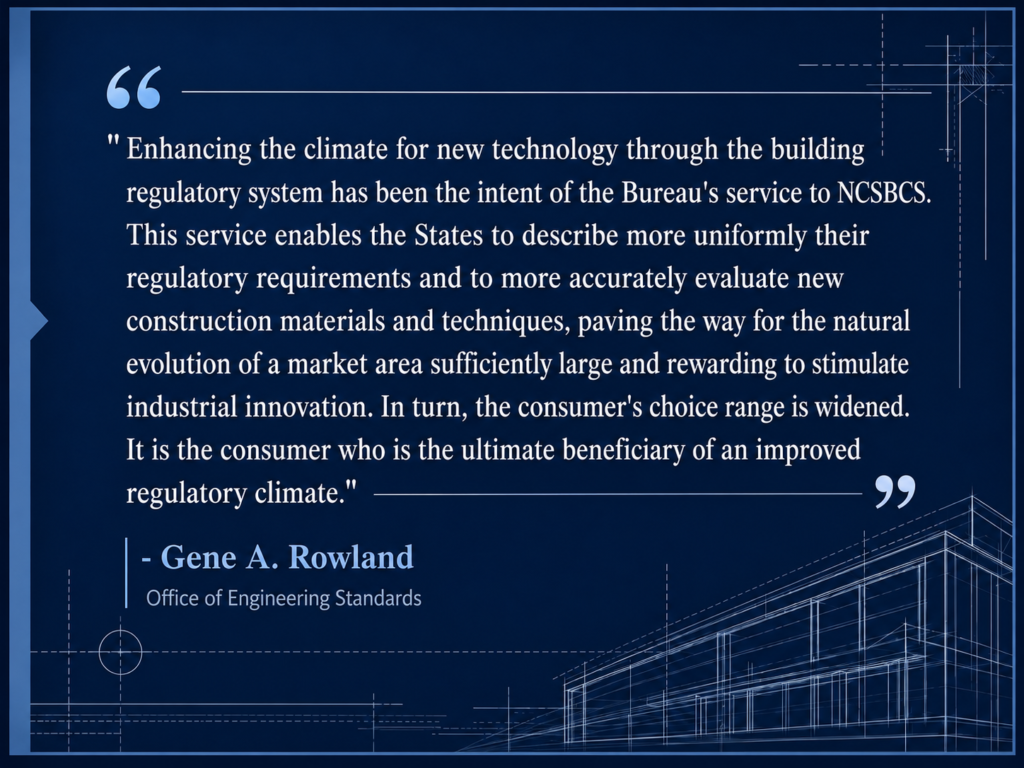
The Laboratory Evaluation and Accreditation Program had as its backdrop a trend toward greater industrialization through State-level certification of manufactured buildings and toward interstate reciprocity in the certification of buildings and components. Assurance to the building official of the caliber of the laboratories and agencies performing the evaluating and compliance assurance functions for manufactured buildings was subject to some question, however. A way of assessing the capabilities of these organizations on a uniform, interstate basis was needed if evaluations made by one State were to be confidently accepted by another.
lNCSBCS, in 1970, asked the Bureau to develop a program to accredit laboratories. The need for such a program was recognized, and NBS initiated LEAP in January 1971, to develop the criteria by which laboratories could be evaluated against ANSI Standard A119.1, “Standard for Mobile Homes.”
LEAP produced four research reports which NCSBCS and NBS turned over to ASTM for processing as national consensus standards. Two ASTM committees, E32, “Criteria for Evaluating Agencies Concerned with Systems Analysis, Testing, and/or Compliance Assurance of Manufactured Buildings,” and E36, “Criteria for the Evaluation of Testing and/or Inspection Agencies,” were established to process the documents. The E32 Committee produced a standard which in time (1975) was to win consensus agreement — ASTM E541, “Criteria for Evaluating Agencies Engaged in Systems Analysis and Compliance Assurance for Manufactured Buildings.” The E36 Committee, meanwhile, pressed ahead with the development of generic criteria for the evaluation of testing laboratories.
Using LEAP evaluation criteria and methodology, pilot efforts were undertaken by the State of Massachusetts to demonstrate the benefits of a LEAP approach to building regulation. The results of these demonstrations, along with the on-going deliberations of the ASTM committees, were expected to advance the industrialization of the building process. This project also laid the groundwork for the Department of Commerce’s Naval Facilities Engineering Command (NAVLAP) Program. NAVLAP is a voluntary program intended to serve the needs of industry, consumers, government and others by accrediting the Nation’s testing laboratories.
ASTM E541 remains active today as ASTM E541-22 and is cited in the current federal manufactured-housing regulation at 24 C.F.R. § 3282.358, and is documented in multiple state industrialized-building programs, including Virginia and Utah. The testimony does not mention Project LEAP, ASTM E541, or this existing infrastructure anywhere.
National Conference of States on Building Codes and Standards/National Bureau of Standards. BTI was involved in seminal work in the development of a regulatory system for factory produced housing in the early 1970s. This work, known as the Laboratory Evaluation and Accreditation Program (LEAP) and the Coordinated Evaluation System (CES), was performed under contract to the National Bureau of Standards and finally incorporated into ASTM E 541-75, “Standard Criteria for Agencies Engaged in System Analysis and Compliance Assurance for Manufactured Buildings.” Source
The Two HUD Publications Cited
Rupnik’s testimony rests almost entirely on two reports he co-authored, both published by HUD’s Office of Policy Development and Research:
Operation Breakthrough was not limited to the evaluation of housing systems themselves. Within the same federal building-regulatory effort, Project LEAP addressed the qualification of the laboratories and agencies responsible for systems analysis, testing, inspection, and compliance assurance. NBS and NCSBCS then transferred the LEAP research to ASTM, where Committee E32 produced ASTM E541 by consensus in 1975.
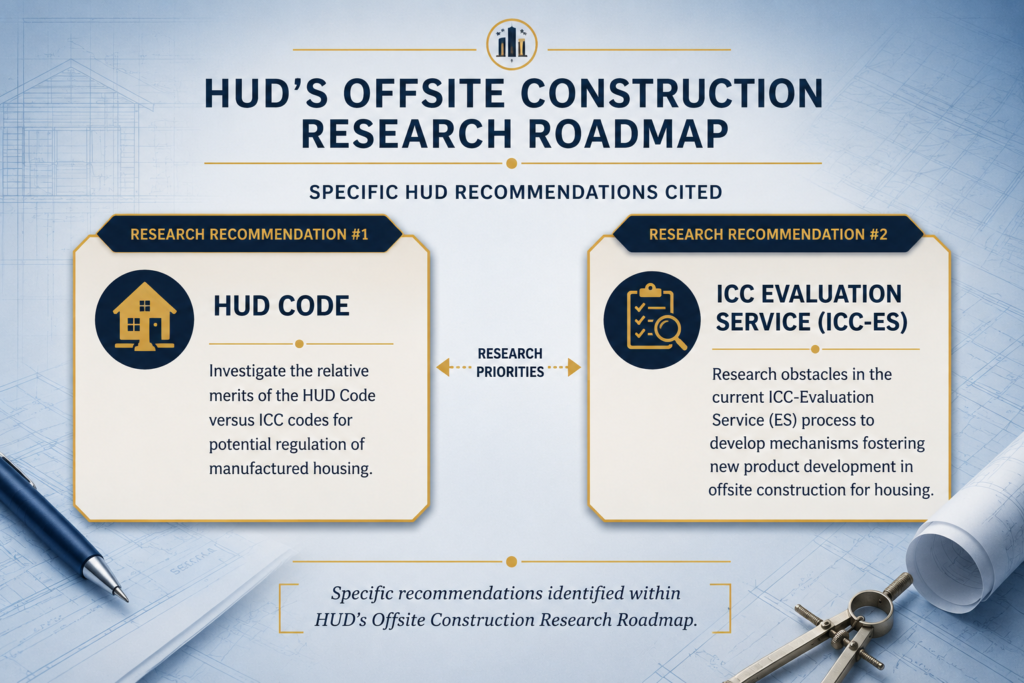
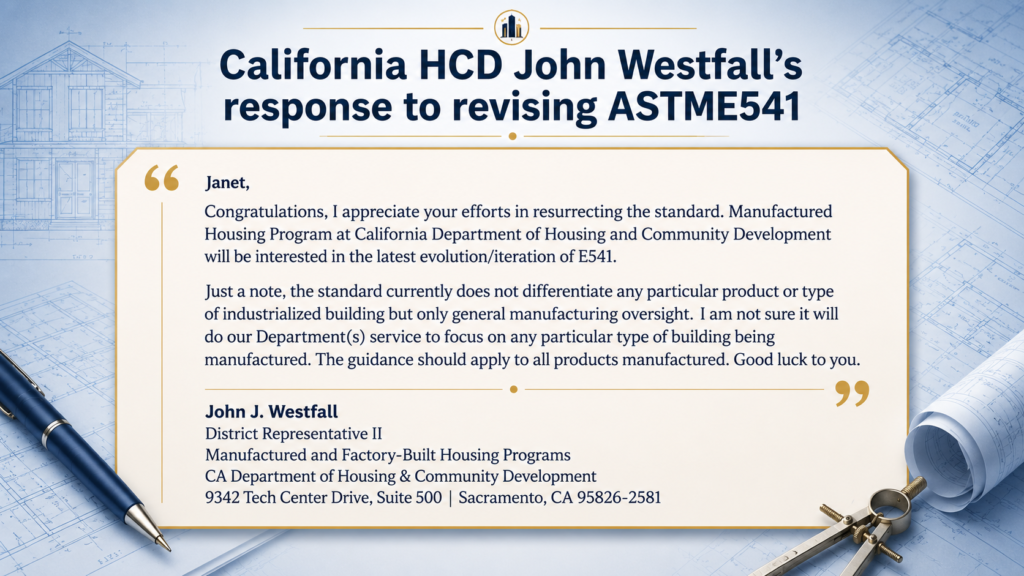
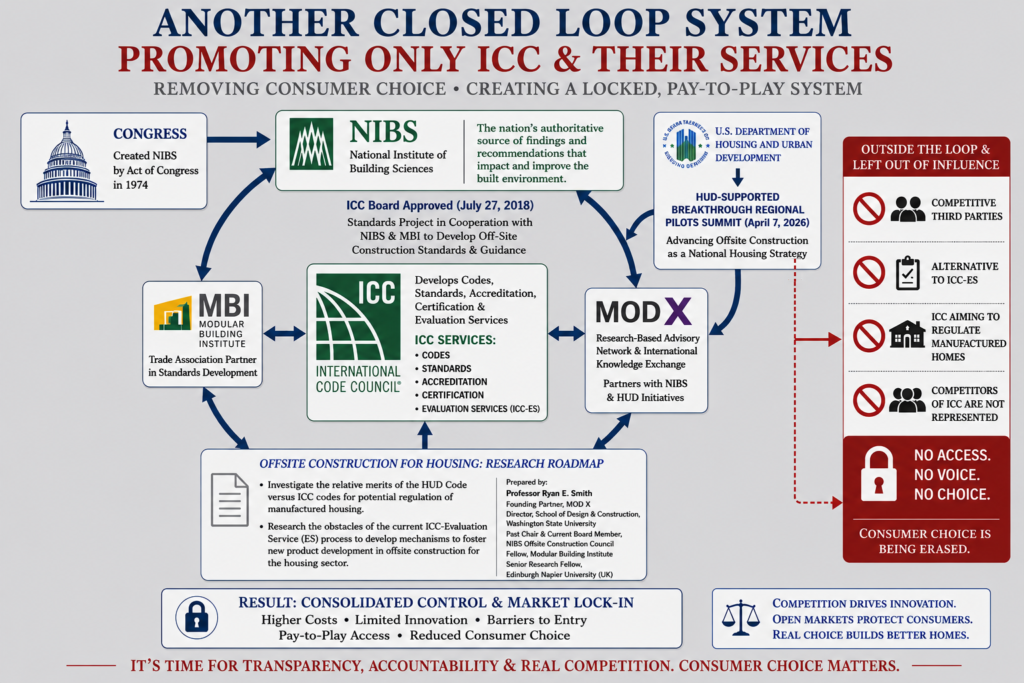
I care because we have a housing crisis with no end in sight and I feel what is being proposed here will raise the cost of housing. ASTME541 was accidentally withdrawn in 2019 and I advocated for its reinstatement and it was published in 2022. The first HUD publication, HUD’s Off-Site Construction Research Roadmap exclusively promoted the International Code Council framework, including ICC/MBI 1200 and 1205 standards, ICC-ES evaluation reports and funds were spent to investigate the relative merits of the HUD Code versus ICC codes for potential regulation of manufactured housing.
Below is an anonymous report from a third party in regards to the cost increase to change to ICC/MBI 1205.
Anonymous Third Party Comments And The Acquisition Of NTA , Now Referred To As
ICCNTA
ICC Has Tried To Force Their Voluntary Consensus ICC/MBI 1200 And 1205 Standards On The Tiny House Industry As 'Requirements'
ICC fought the formation of a ASTM committee on tiny houses for ONE YEAR with false claims of duplication, just so they could turn around and duplicate ASTM.
I was a proponent who spearheaded the tiny-house effort within ASTM, working collaboratively to establish the E06.26 Tiny Houses Subcommittee under the Committee on Performance of Buildings. I currently serve as Membership Secretary for the subcommittee.
Disclaimer: I do not represent ASTM International, and the views, findings, and conclusions expressed in this document are my own, based on my own experience, experience, public information and independent research. This submission is made in my individual capacity as President of Tiny House Alliance USA, in support of transparency, lawful compliance, and open participation in standards development.