
HUD and the Housing System Certification Illusion
Americans are surrounded, and they do not even know it. While families struggle to find affordable places to live, the housing crisis remains stubbornly unsolved. Assistant Secretary Of Energy Audrey Robertson ( EERE) recently stated that currently adopted state energy codes have driven up the cost of new construction by $70 billion since 2006
Join Me And Speak Up Send Your Comments To DOJ
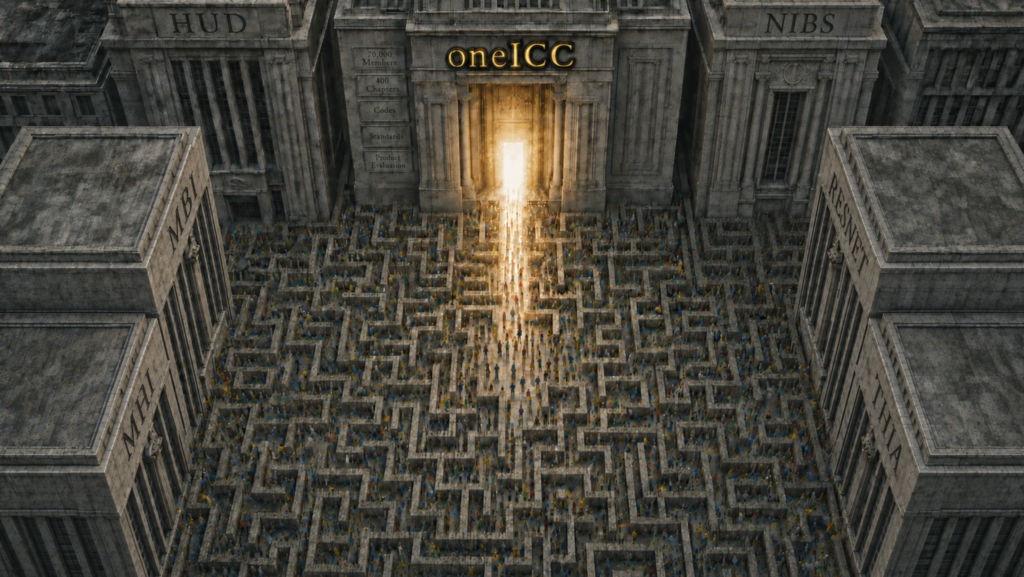
The American people are not choosing a path. They are walking predetermined routes. HUD funded the map. NIBS and MOD X drew it. Every corridor is a loop. There is only one lighted door. They already named it oneICC.
Meanwhile, the American people remain stuck in a massive, bureaucratic maze. We wander through a labyrinth of red tape with the illusion of free-market choice, but that choice has been systematically stripped away. Looking closely at the landscape, every path is blocked except one. There is only one open door, and it leads directly into the International Code Council. They openly flaunt their monopoly status throughout their strategic marketing, branding themselves as oneICC.
We are completely locked out of options because a network of massive institutions—HUD, NIBS, MOD X, MBI, MHI and RESNET—pretend to operate as separate, independent entities. In reality, they are working in perfect tandem. They have built a closed-loop fortress around the American home, funneling every manufacturer, factory, training, codes, standards, certification, accreditation, and every citizen through their family of solutions, and they are only getting started.
The Human Cost
The human cost of this synthetic crisis is a series of structural tragedies unfolding across our communities:
- Seniors are left with the brutal choice of buying food or paying their monthly housing costs.
- Veterans who sacrificed for the country are left sleeping on the streets, frozen out of the American Dream.
- Kids aging out of foster care are dropped directly into homelessness without a single viable path to a stable roof.
- Working class families are pushed out of their own neighborhoods by ballooning compliance and inspection fees.
- People are living in cars and vans just to survive, turning parking lots into makeshift neighborhoods.
- Babies are dying in their mothers’ arms on the street, a devastating consequence of a country completely frozen out of affordable shelter.
- Mental health crises and despair are skyrocketing as individuals lose the baseline safety and dignity of a locked door.
- Generational wealth is being erased as young adults are completely priced out of property ownership, forced into permanent rent cycles.
- Hardworking innovators and small manufacturers are forced to shut down their operations, unable to afford the pay-to-play compliance costs.
How Did The Maze Get Built
How did this network build the maze? It started with millions of federal tax dollars deployed under the guise of solving the housing crisis.
HUD poured nearly $4 million into a massive research grant cycle to study offsite construction. While that multi-million-dollar fund was spread across several recipients, the master keys were handed to a connected pipeline. The largest single slice of that money—$499,878—went straight to NIBS to design regional pilot programs and write the rulebooks.
The HUD Narrative Being Sold
Look directly at the text HUD uses to sell these two publications on their official platform.
Package Sold To The Public
This is the exact packaging being presented to the public. They are using the real-world promise of “production efficiencies” and “lower costs” to condition the industry into accepting “demand aggregation” and “systems certification” as the only path forward. It sounds completely neutral, but it lays the direct narrative groundwork to justify locking every alternative door in the maze with one door to oneICC through NIBS.
What Is Really In The HUD Off -Site Construction 'Research Roadmap?
- HUD Code — Investigate the relative merits of the HUD Code versus ICC codes for potential regulation of manufactured housing.
- New Products — Research obstacles in the current ICC-Evaluation Service (ES) process to develop mechanisms fostering new product development in offsite construction for housing.
- ICC Model Codes — The Roadmap repeatedly references the International Residential Code (IRC) and International Building Code (IBC) as the model-code framework for offsite construction.
- ICC Performance Code — The Roadmap discusses the ICC performance-based code pathway and its potential use for offsite construction.
- ICC/MBI 1200 — The Roadmap identifies the ICC/MBI 1200 standard for planning, design, fabrication, construction, and assembly of offsite projects and raises research questions about its effectiveness and implementation.
- ICC/MBI 1205 — The Roadmap identifies ICC/MBI 1205 for inspection and regulatory compliance of offsite construction, including third-party inspection and approval functions.
- ICC/MBI 1210 — The Roadmap identifies ICC/MBI 1210 among the ICC/MBI standards being developed for offsite construction.
- ICC Guideline G5-2019 — The Roadmap identifies ICC G5-2019 among the ICC standards and guidance documents applicable to offsite construction.
- ICC-ES Evaluation Reports — The Roadmap discusses ICC-ES reports as the preferred resource used by code officials to verify compliance of new and innovative products, while examining the cost, time, and market-entry barriers associated with the ICC-ES process.
- ICC Third-Party Inspection — The Roadmap specifically references ICC’s third-party inspection process for offsite construction.
- ICC NTA Remote Virtual Inspection — The Roadmap specifically cites ICC NTA’s remote virtual inspection process and related inspection practices.
- ICC/MBI Project Delivery Process — The Roadmap identifies ICC/MBI 1200 as a project-delivery guide and raises research questions about using that ICC/MBI framework to address traditional contracting and delivery challenges.
The Roadmap Goes Further
The Roadmap goes further. It prominently quotes Cindy Davis, then President of the International Code Council, advocating that HUD adopt the ICC/MBI standards for all offsite construction and rely on accredited third-party inspection and labeling organizations:
“With the ANSI industry consensus standard by ICC and MBI now available, it seems that HUD could streamline the manufactured home industry, remove unnecessary regulatory barriers, and increase consumer confidence by adopting these standards for all offsite construction. States could ease their workload with reliance on accredited third-party inspection and labeling organizations.”
Conflicts of Interest and Overlapping Leadership
ICC employed connected individuals have served in NIBS governance, NIBS councils, Roadmap stakeholder roles, Project Technical Committee roles, and later peer-review roles of the HUD publications. The same MOD X principals authored both the 2023 Roadmap and the 2026 Action Plan, while NIBS managed both efforts. These overlapping roles raise direct conflict-of-interest and self-review concerns because organizations helping shape the federal research agenda are also positioned to benefit from its implementation.
Vertical Integration and Antitrust Concerns
ICC writes widely adopted model codes and standards, and their subsidiaries provide product evaluation, inspection, certification, and accreditation services tied to those same codes, standards, evaluation reports, and more. Federal research, grants, preferences, and implementation that steer toward that same network raise serious antitrust concerns because they can entrench one vertically integrated private system at the expense of smaller competitors, independent third parties, and alternative standards systems.
OMB Circular A-119 Concerns
OMB Circular A-119 requires federal agencies to consider antitrust, conflicts of interest, small-business impact, competition, innovation, economic effects, and available alternatives. It expressly warns that improper use of standards can suppress free and fair competition and exclude safer or less expensive products. A federal research program that repeatedly points toward one private standards and conformity-assessment system while alternatives are absent raises a serious compliance concern under that Circular.
Moving From Research Into Implementation
HUD-funded regional pilots are now developing models intended to be replicated nationally through the forthcoming HUD Breakthrough Pilot Handbook. That makes review especially important before these recommendations are embedded into a federal technical-assistance model and disseminated nationwide.
Significant Omissions
The 2023 Research Roadmap omits the existing federal history and competing compliance-assurance framework developed through Operation Breakthrough, Project LEAP, the Coordinated Evaluation System (CES), and ASTM E541. ASTM E541 remains referenced in multiple states and continues to appear in HUD’s own third-party personnel requirements. By omitting that framework, the Roadmap deprives the reader of a fair comparison between the ICC-centered pathway being advanced and an existing independent framework that grew out of prior federal work.
The Housing System Certification
The HUD Narrative Continues
August 20, 2026- The Office Of Policy Development And Research published an article titled Studying the Impacts of Offsite Construction on Housing Supply.
This article is part of a series discussing the current research activities of the Affordable Housing Research and Technology Division within the Office of Policy Development and Research.
A new report, “HUD’s Past, Present, and Future Role in Accelerating U.S. Offsite Construction for Housing: A Comparative Study and Action Plan,” examines the role of offsite construction in meeting the nation’s housing needs. The March 2026 report, funded by the Office of Policy Development and Research and coauthored by the National Institute of Building Sciences and MOD X, recounts HUD’s past work in advancing industrialized housing, compares the U.S. experience with the offsite construction of housing with that of other countries, and identifies steps that could expand offsite construction in the United States.
Then ICC Responses To The HUD Publications
Accelerating Off-Site Construction Through Collaboration
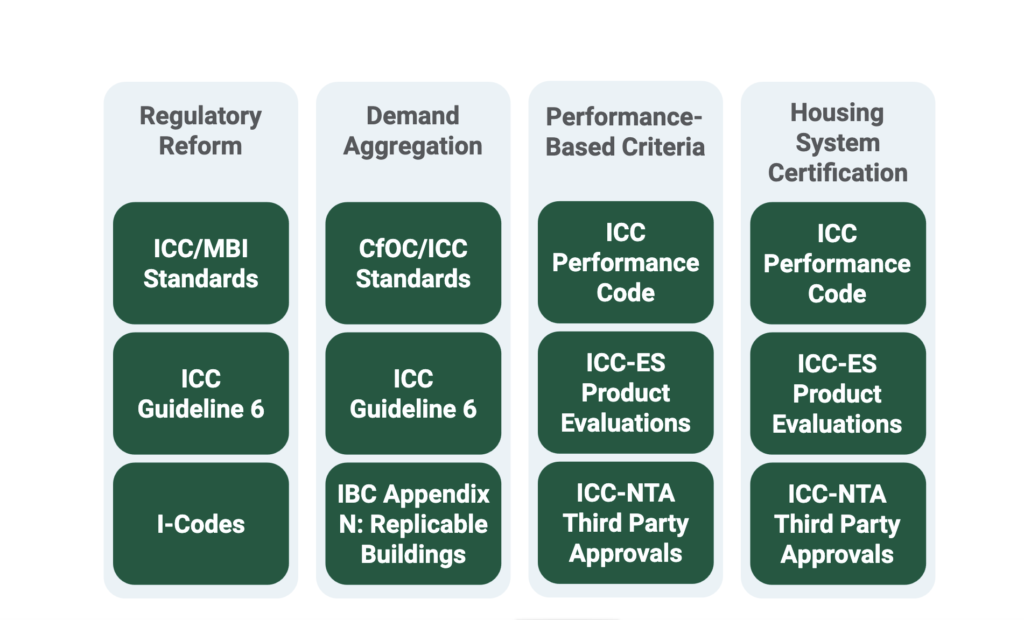
In May 2026, the International Code Council responded with its own report, Accelerating Off-Site Construction Through Collaboration. ICC presents its existing codes, standards, evaluation services, and third-party programs as the ready-made solutions to the priorities identified in the Action Plan. On the surface, this appears to be ordinary standards-development work and ordinary policy advocacy. When the documents are examined together, however—along with the historical federal record, the funding path, the leadership overlaps, and the specific language directed at manufactured housing—a clearer and more consequential pattern emerges.
What ICC Is Asking For In Their Report
ICC is using its position as the dominant U.S. model-code writer to lock in an end-to-end compliance stack for off-site construction and then asking HUD to give that stack official preference. That is vertical integration of rule-writing, evaluation, inspection, and market access.
ICC already writes the I-Codes and standards, Its subsidiaries (ICC-ES for product evaluation, ICC-NTA for third-party plan review and factory inspection) sit downstream of those same codes. It then co-developed ICC/MBI 1200/1205/1210 with the Modular Building Institute (a trade association) and is now writing additional CfOC/ICC 1220/1230 standards with an academic center. The document explicitly maps every HUD Action Plan pillar—regulatory consistency, demand aggregation, performance criteria, and “housing system certification”—back onto this same ICC-controlled toolkit (standards, Guideline 6, IBC Appendix N, ICCPC rewrite, ICC-ES, ICC-NTA.
The ask to the federal government is not generic support for off-site construction. It is:
- Participate in ICC’s own standards-update process.
- Give grants and preferential treatment in HUD programs to states that adopt the ICC/MBI standards.
- Use those standards as award and verification criteria in HUD (and other agency) projects.
That combination—private associations writing the criteria, their own subsidiaries performing the reviews and inspections, then requesting federal preference and funding for exactly those criteria—creates a closed loop. Manufacturers and jurisdictions that want to sell or approve off-site housing at scale are steered toward one organization’s documents and one organization’s subsidiaries. Alternatives become slower, more expensive, or simply non-compliant with the “coordinated set of criteria” ICC is promoting.
This is the classic vertical-integration pattern in a regulated market: control the specification, control the certification, then enlist government to make the specification the default. When trade associations and a standards body jointly petition an agency to bless their particular ecosystem, it raises the usual concerted-action and exclusion concerns under antitrust principles. Federal agencies are also supposed to rely on private standards without creating de-facto exclusive franchises; the document itself cites OMB Circular A-119 and the NTTAA while simultaneously asking HUD to pick winners inside that framework.
Conflicts Of Interest And Regulatory Capture
ICC's References In HUD's Offite Construction Research Roadmap
What Is Housing System Certification
ACCELERATING OFF-SITE CONSTRUCTION THROUGH COLLABORATION
oneICC
August 20, 2026