Taxpayer Dollars Fast-Tracking ICC-ES & ICC/MBI 1200/1205 Monopoly
HUD is fast-tracking ICC/NIBS/MODX dominance with millions in taxpayer-funded reports —Offsite Construction for Housing: Research Roadmap. U.S. Department of Housing and Urban Development, Office of Policy Development and Research , 2023, and HUD’s Past, Present, and Future Role in Accelerating U.S. Offsite Construction for Housing: A Comparative Study and Action Plan. U.S. Department of Housing and Urban Development, Office of Policy Development and Research, 2024–2025.2024–2025 Action Plan. These documents, managed by NIBS and authored by MOD X, recommend a new federally sanctioned housing system certification program that expands ICC-ES evaluation services and routes approvals through ICC/MBI 1200 and 1205 standards.
Two HUD Publications
Sit back, grab your sweet tea — or better yet, pour yourself some straight whiskey — and get comfortable in that chair.
Because what you’re about to read is HUD, the very agency charged with regulating manufactured housing, essentially writing the instructions for how to hand the keys of the industry over to the ICC/NIBS machine. In it’s words.
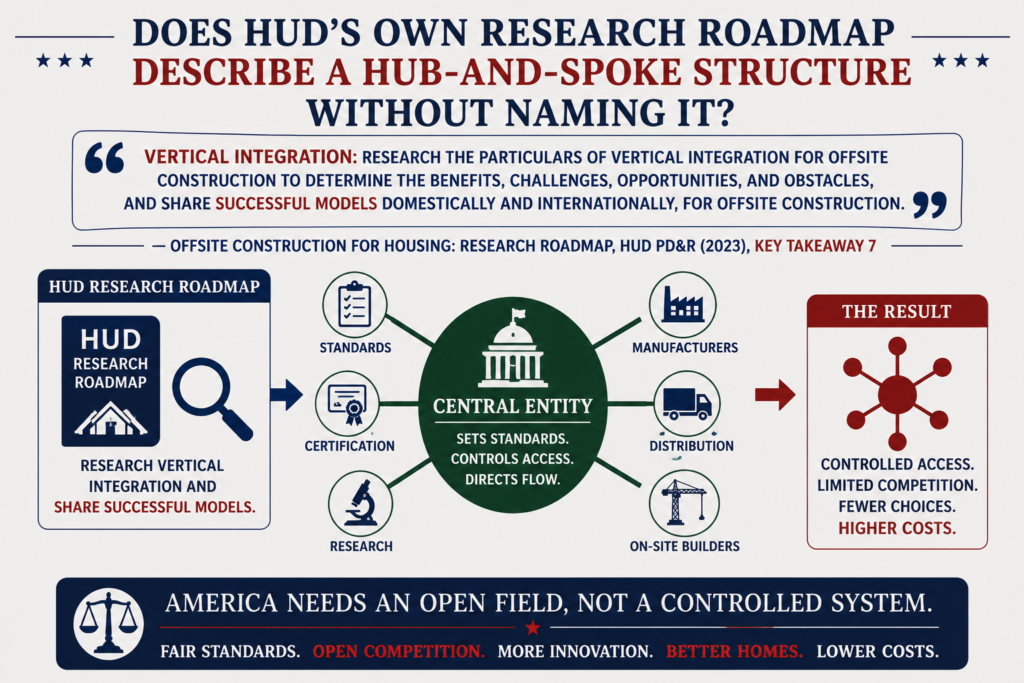
No conspiracy theories. No smoke and mirrors. Just HUD’s own Research Roadmap spelling out a vertical integration plan that funnels manufacturers, developers, and everyone else into a hub-and-spoke structure with ICC at the center — all while HUD holds the federal steering wheel.
They didn’t call it a hub-and-spoke. They didn’t have to. The pattern is so blatant it screams from the page.
This isn’t innovation. This is regulatory capture in plain English, dressed up as “efficiency” and “progress.”
Now keep reading…. and let their own words damn them.
Let's Even The Playing Field
ICC Vies to Regulate Manufactured Homes with I-Codes
Replacing the HUD Code
ICC is vying to regulate manufactured homes with I-Codes as an alternative to the HUD Code. Through ICC/MBI 1200 and 1205 standards, ICC-ES evaluation services, and its control of ICC-NTA as DAPIA/IPIA, the network is actively blurring the line between manufactured and modular construction. This closed-loop approach expands ICC’s proprietary certification monopoly while eroding chassis requirements, federal preemption, and consumer choice for independent manufacturers.
How HUD's Path To Accelerating The US Off-Site Construction Market Is A Trojan Horse To Fast Track ICC's Market Dominance:
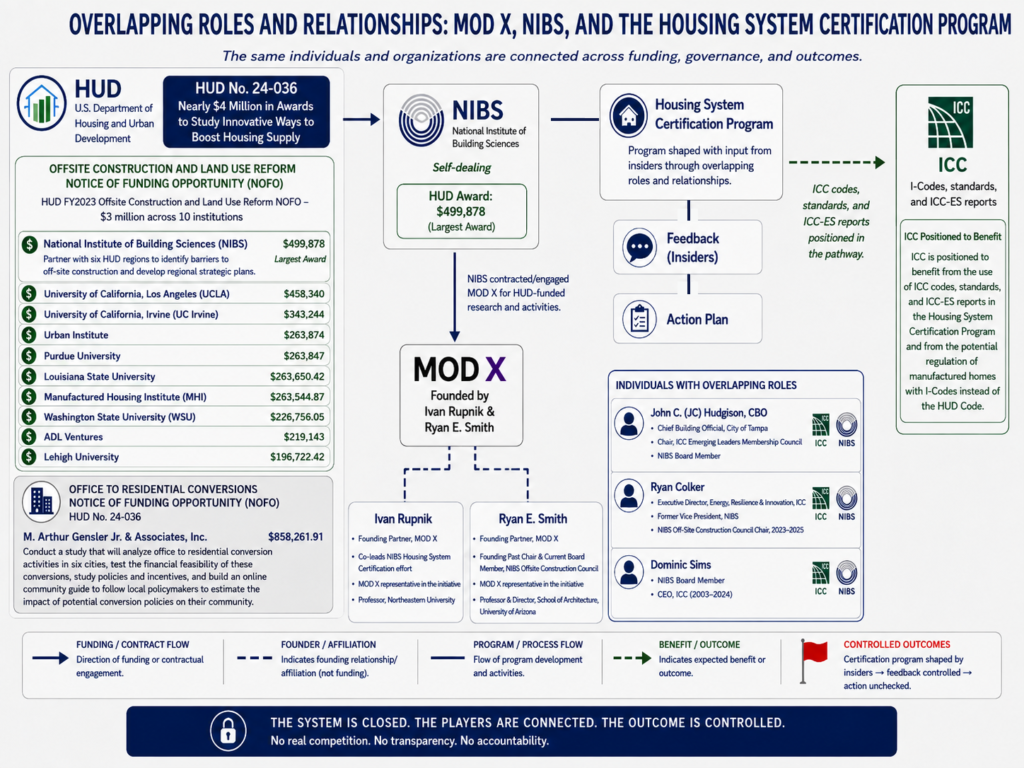
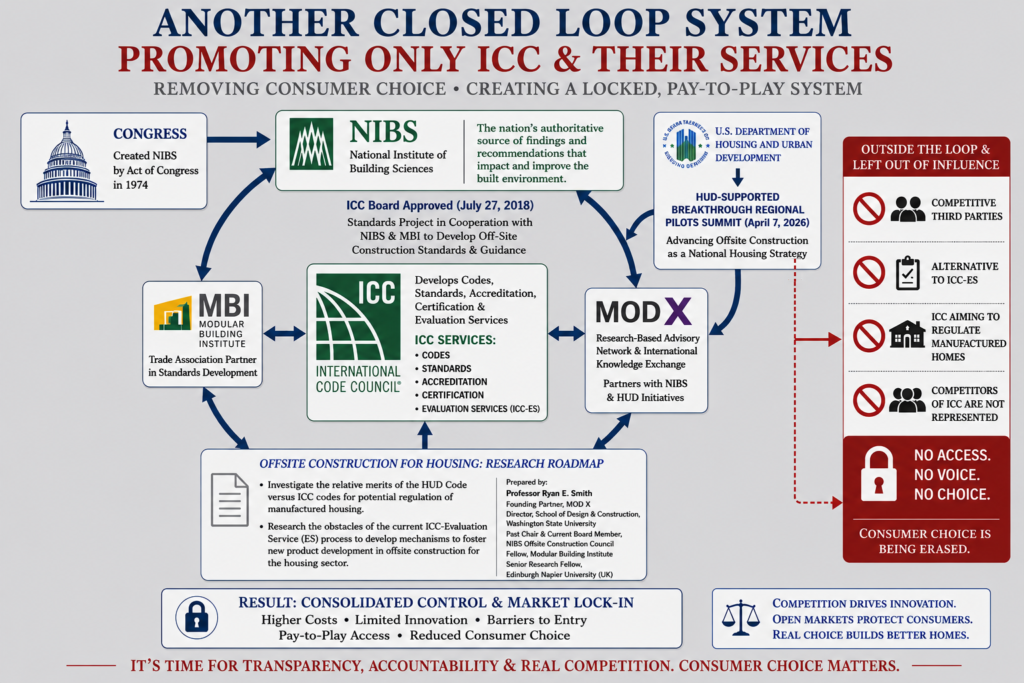
Connecting HUD, ICC, NIBS, And A MODX Interlock Funded By HUD
Predatory Power Grab
How ICC Is Tied To Congress Through NIBS
Sole-Source Statutory Advantage Enables Non-Competitive Awards
NIBS benefits from Public Law 93-383 (12 U.S.C. §1701j–2(g)(3)) — a congressional grant of sole-source contracting authority for building-related work. This exempts HUD from standard competitive bidding (FAR Part 6.302-5). positioned to bid.
This statutory edge, combined with personnel overlaps, funnels public money into a self-reinforcing network.
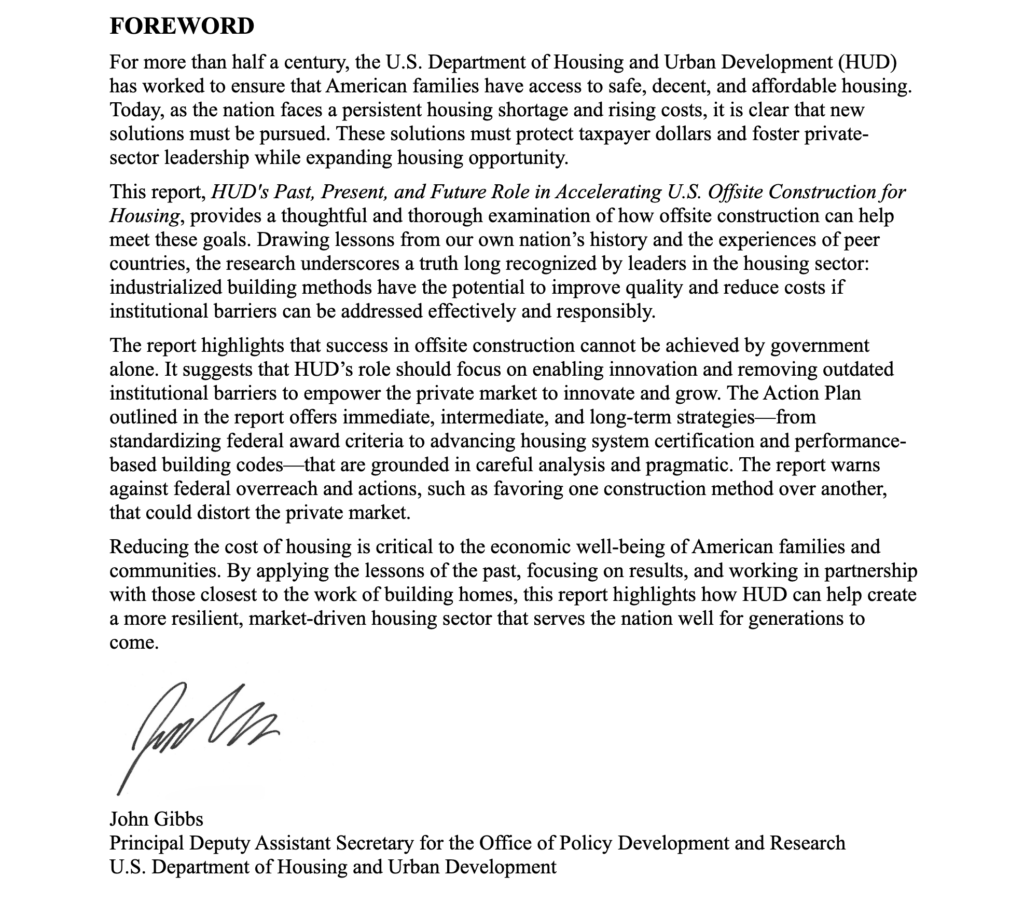
Forward Of HUD's Past, Present, And Future Role In Accelerating
US Off-Site Construction Housing
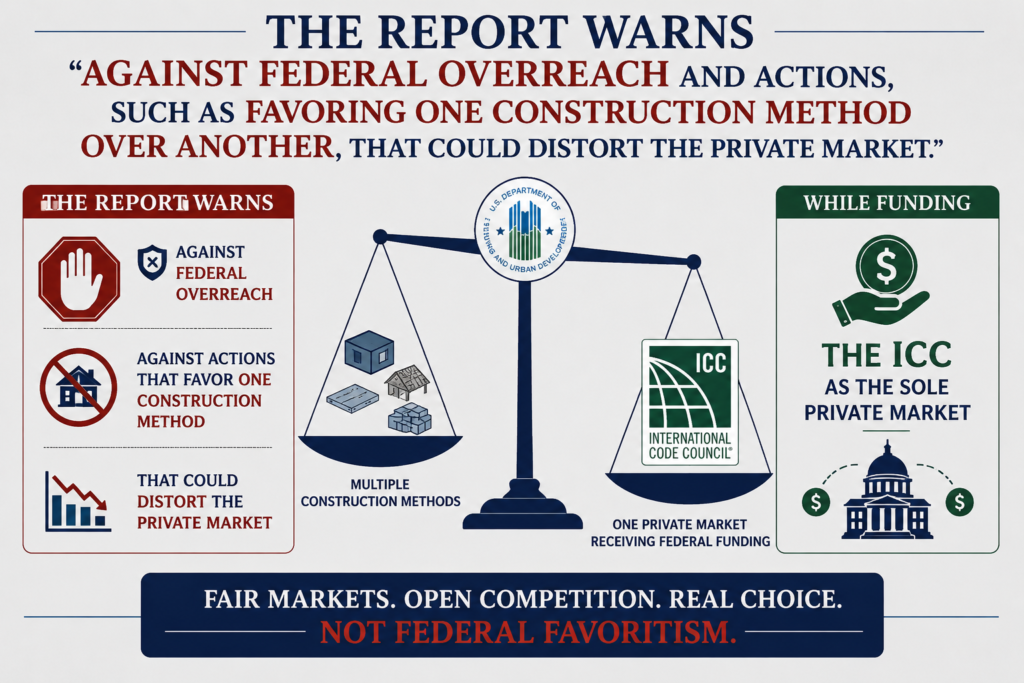
"Pious Warnings, Predatory Power Grab: The HUD Offsite Construction Housing Foreword Exposed"
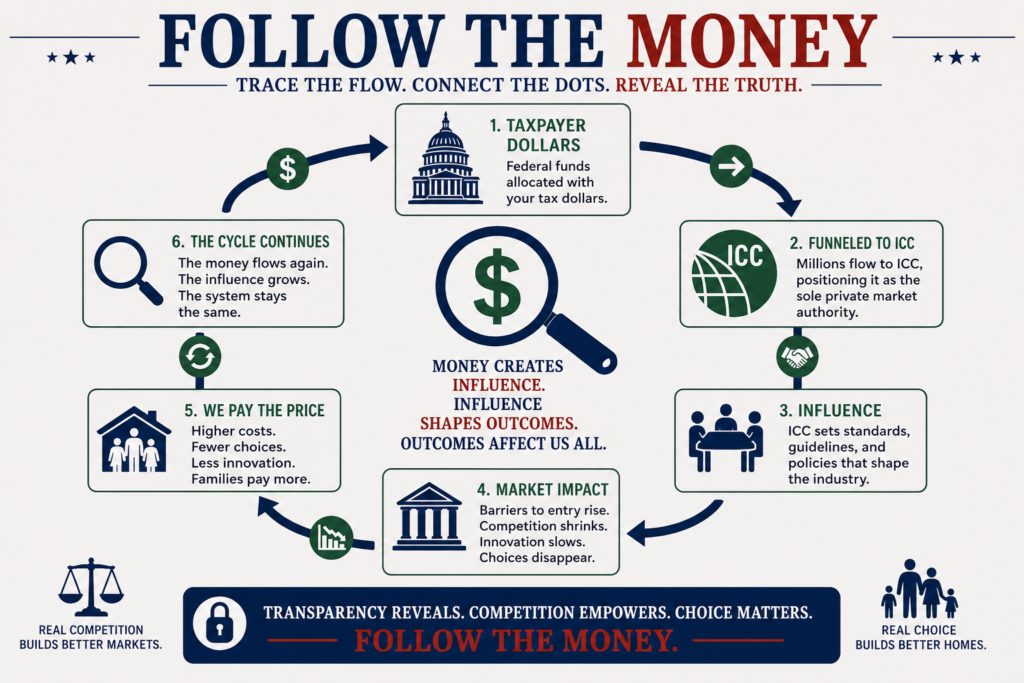
Follow The Money
TAXPAYER FUNDS FUNDING ICC/NIBS SELF-DEALING
HUD disbursed $2,998,999 across 10 recipients under the FY23 Offsite Construction and Land Use Reform NOFO. Prominent awards include:
- National Institute of Building Sciences (NIBS): $499,878 — the largest single award — to design pilot programs, identify barriers to off-site construction, and develop a pilot handbook.
- Washington State University (WSU): $226,756.05 — home of Ryan E. Smith (MOD X Founding Partner and NIBS Offsite Construction Council board member).
- Manufactured Housing Institute (MHI): $263,544.87.
- Purdue University: $263,847 — specifically to study ICC/IBC code revisions and their impact on supply/affordability.
These awards were announced in HUD press release 24-036 (Feb. 23, 2024) and detailed in Federal Register 90 FR 39492. NIBS and entities closely tied to its network received a disproportionate share of the funding and influence.
These HUD awards represent approximately $3 million in federal taxpayer dollars (plus the related Office to Residential Conversions NOFO).
Ryan E. Smith, founder of MOD X, benefits directly:
- His institution, Washington State University, received $226,756 in HUD funds.
- He is founding past chair and current board member of the NIBS Offsite Construction Council.
- NIBS selected his private firm, MOD X (co-founded with Ivan Rupnik), to author both major HUD-funded reports.
HUD Awards Nearly $4 Million to Study Innovative Ways to Boost Housing Supply Including Office-to-Residential Conversion: Feb 23, 2024
Hud Archive
HUD Announces Research Grant Opportunity to Study Off-site Construction and Land Use Reforms: June 21, 2023
ICC’s Leadership Deeply Embedded in the Loop
- Dominic Sims — Former CEO of ICC; now on the NIBS Board.
- John (JC) Hudgison — Senior ICC Board Member and NIBS Board Member.
- Ryan M. Colker — Vice President of Innovation at ICC and former NIBS Vice President who directed the Offsite Construction Council. Colker was appointed Chair of the NIBS Off-Site Construction Council while in his senior ICC role (2023).
Indicators of Self-Dealing and Conflict of Interest
- Reciprocal benefits: HUD funds NIBS → NIBS/MOD X produce reports recommending more NIBS-led programs → NIBS gains further influence and potential future contracts.
- Undisclosed or downplayed overlaps: Reports do not disclose the full extent of ICC/NIBS board and staff interconnections (e.g., Sims, Hudgison, Colker, Davis).
- Market narrowing: Emphasis on a single “federally sanctioned” pathway through the funded network, while ignoring multiple accredited competitors, reduces choice for manufacturers and consumers.
- Precedent alignment: Mirrors earlier 2018 ICC Board actions benefiting its certification business while simultaneously expanding into offsite standards with NIBS.
ICC Board Meeting Minutes July 27, 2018
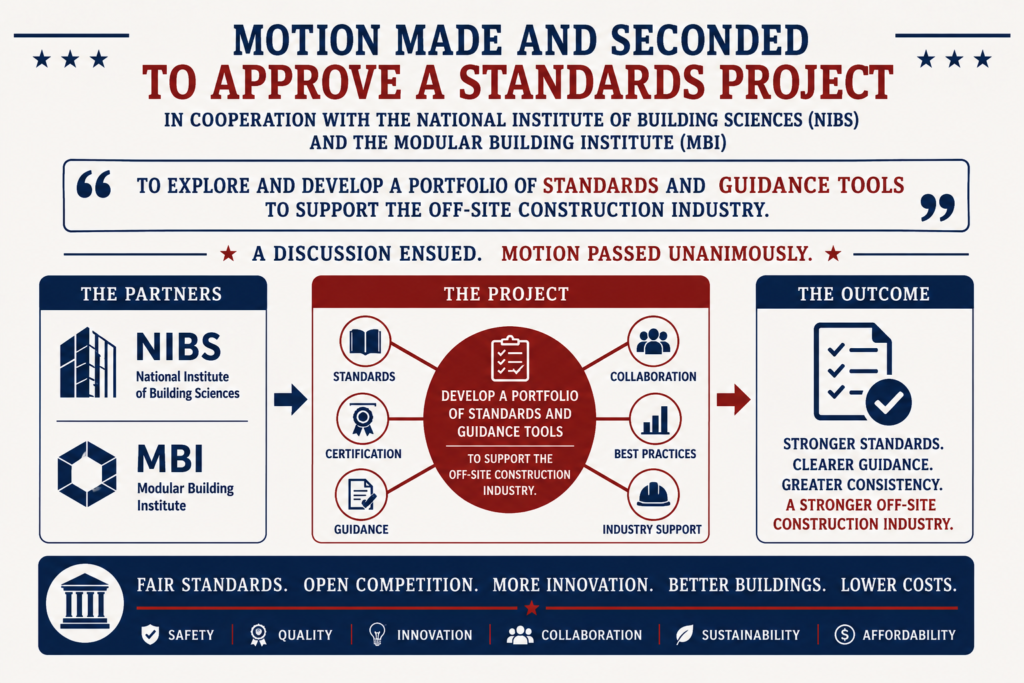
Motion made and seconded to approve a Standards Project in cooperation with the
National Institute of Building Sciences (NIBS) and the Modular Building Institute (MBI) to
explore and develop a portfolio of Standards and Guidance tools to support the off-site
construction industry
CEO Sims provided an update on The U.S. Department of Housing and Urban
Development’s (HUD) new rule to eliminate the HUD-inspector list and rely on ICC-
certified inspectors to perform HUD inspections.
The Chassis End-Run: Protecting the “Ghost Trailer” / Independent Carrier System (ICC 1215)
This funding and personnel overlap enables ICC’s push to erode the permanent chassis requirement that defines HUD-Code manufactured housing. Through standards like ICC 1215 (Standard for Off-Site Construction), the network is advancing “independent carrier” or “ghost trailer” systems that are never in the NHTSA/DOT system.
HUD Favors Clayton Homes Which Is Represented On The MHCC
The June 25, 2026 HUD 26-08-AC letter to Clayton Homes explicitly approves multi-story manufactured homes with chassis-free upper stories, relying on ICC-NTA as the IPIA DAPIA agency, before the current rule making has even completed.
HUD Seeks Comments Removal Of Upper Floor Chassis
This Is Taxpayer- Funded Regulatory Capture In Action
This is taxpayer-funded regulatory capture in action. Public money supports the research and policy that protects and expands these chassis-eroding pathways, benefiting the ICC/NIBS/MOD X network at the expense of the independent manufactured housing sector, consumer choice, and true affordability.
Documented Organizational and Personnel Interlocks
- NIBS served as project manager for both major HUD-funded reports (Research Roadmap 2023 and Action Plan 2024–2025), subcontracting authorship to MOD X (Ryan E. Smith and Ivan Rupnik).
- ICC connections run deep:
- ICC Board approved the 2018 NIBS/MBI offsite standards partnership (minutes from July 27, 2018, with Cindy Davis present and voting).
- Former ICC CEO Dominic Sims joined NIBS Board (Jan. 2019).
- Senior ICC figures (John Hudgison, Ryan Colker) hold NIBS board/staff roles.
- Cindy Davis listed as ICC Board President in the HUD Research Roadmap while contributing to the work and later appearing in NIBS/MOD X certification steering committee materials.
- MOD X (founded 2018) authored the reports under NIBS management and co-leads the follow-on Housing System Certification Program Standard work group with NIBS (press releases Feb.–March 2026).
This creates a hub-and-spoke structure where HUD funds flow to NIBS, which directs work to MOD X (its own council members), while key personnel overlap with ICC — the dominant standards and evaluation service provider.
Let's Even The Playing Field
We Need To Step Up To The Plate
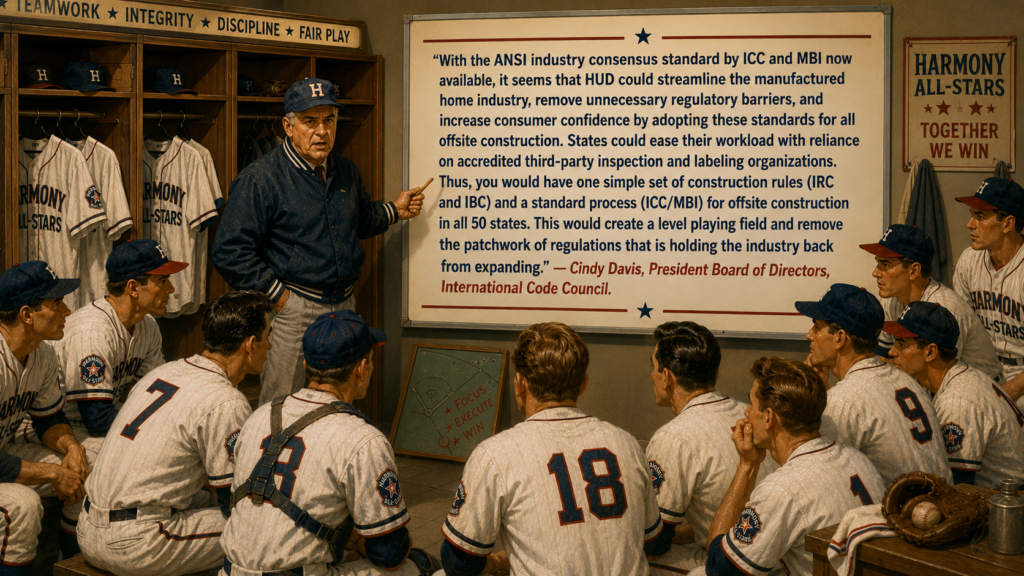
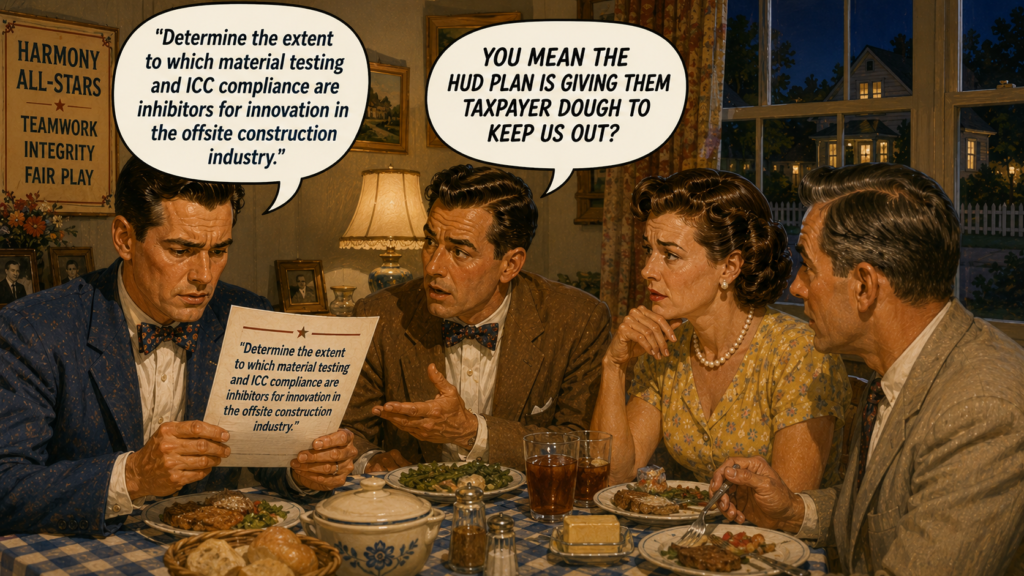
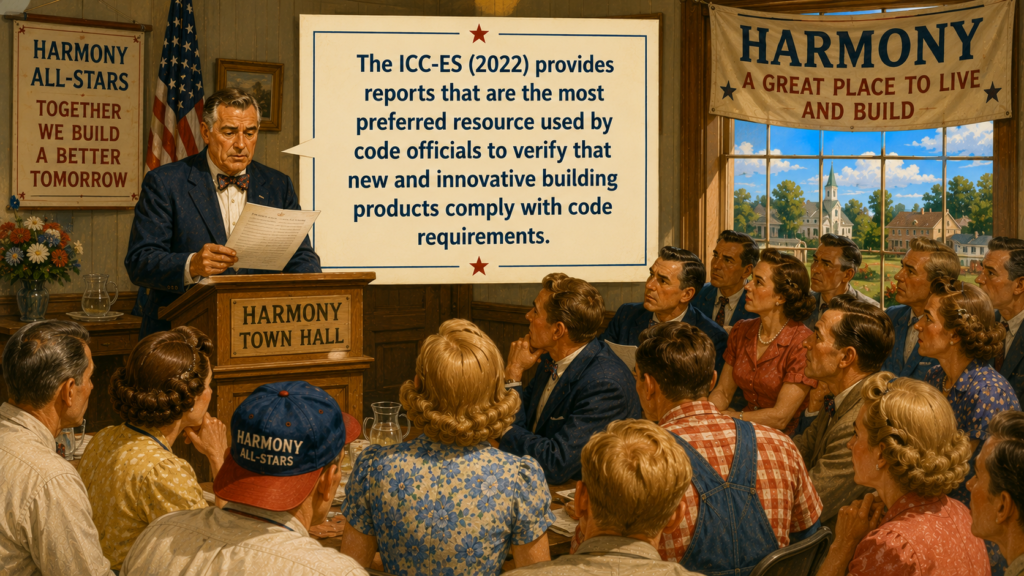
We chose a series of images to explain these serious issues with baseball analogy because baseball is one of the few games everyone understands. Before a game begins, the rules are known, the bases are the same distance apart, the strike zone is the same for both teams, and every player has an opportunity to step up to the plate. Success is earned through preparation, talent, perseverance, and fair competition—not by changing the rules to favor one team over another.
That is the principle we believe should guide housing and construction in America. Builders, manufacturers, innovators, and standards developers should all have the opportunity to compete on an even playing field. When one organization or one pathway is elevated above all others through policy or preferential treatment, competition is diminished, innovation slows, and consumers ultimately pay the price through higher costs and fewer choices.
Our use of the baseball metaphor is not about winners and losers—it is about fairness. We believe every qualified participant deserves the chance to step up to the plate, swing for the fences, and earn success through merit. Open competition has always been one of America’s greatest strengths, driving better ideas, better products, and greater affordability. Just as every baseball game begins with the same field, the same rules, and the same opportunity, we believe the housing industry should remain open to competition, innovation, and consumer choice for everyone.
That’s why the chorus ends with “Step Up to the Plate.” It’s more than a baseball phrase—it’s an invitation. An invitation to open the gates, create a level playing field, and ensure that every dream has the opportunity to compete fairly. Because when everyone gets a chance to play, consumers win, innovation thrives, and the American dream becomes more attainable for all.
How HUD's Offsite Construction Plan Is Accelerating ICC's Proprietary ICC-ES
Every passage below is exact text, quoted verbatim, from Offsite Construction for Housing: Research Roadmap (HUD PD&R, 2023). No paraphrasing. Passages are given in the order they appear in the document.
The Two HUD Publications
Offsite Construction for Housing: Research Roadmap. U.S. Department of Housing and Urban Development, Office of Policy Development and Research, 2023.
HUD’s Past, Present, and Future Role in Accelerating U.S. Offsite Construction for Housing: A Comparative Study and Action Plan. U.S. Department of Housing and Urban Development, Office of Policy Development and Research, 2024–2025.
1. Key Takeaway 7 — HUD-Directed Research Item (p. vi)
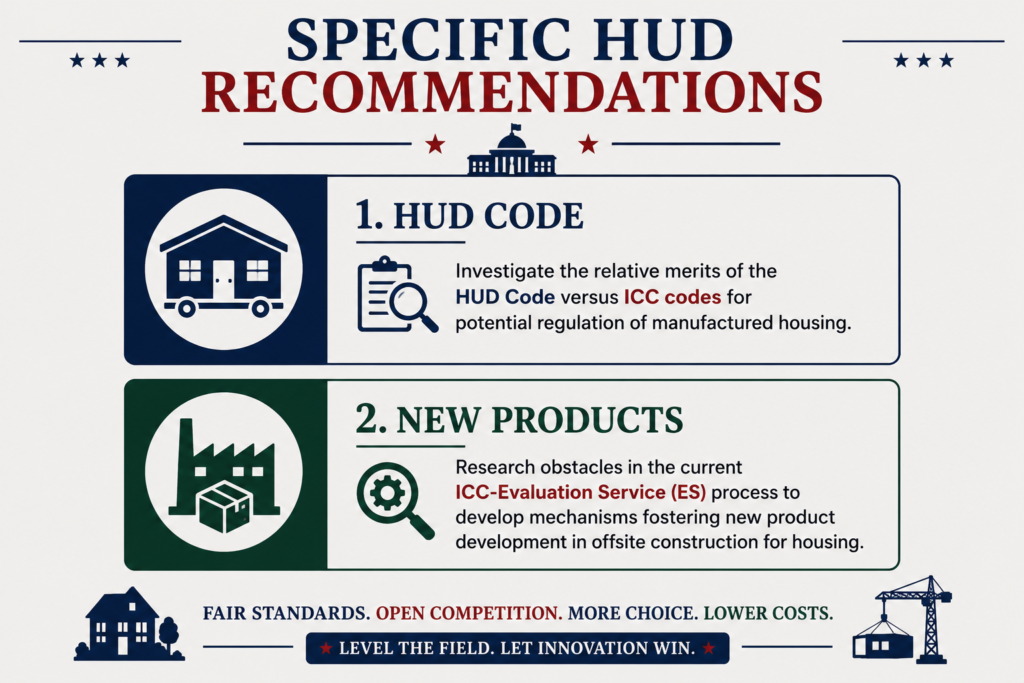
“New Products: Research the obstacles of the current ICC-Evaluation Service (ES) process to develop mechanisms to foster new product development in offsite construction for the housing sector.” — Research Roadmap, p. vi
2. Cindy Davis Pull-Quote, Section 3.1 Opening (p. 21)
“With the ANSI industry consensus standard by ICC and MBI now available, it seems that HUD could streamline the manufactured home industry, remove unnecessary regulatory barriers, and increase consumer confidence by adopting these standards for all offsite construction. States could ease their workload with reliance on accredited third-party inspection and labeling organizations. Thus, you would have one simple set of construction rules (IRC and IBC) and a standard process (ICC/MBI) for offsite construction in all 50 states. This would create a level playing field and remove the patchwork of regulations that is holding the industry back from expanding.” — Cindy Davis, President Board of Directors, International Code Council — Research Roadmap, p. 21
3. Lisa Podesto Pull-Quote, Section 3.2 Opening (p. 31)
“The Code Compliance Research Report process wasn’t intended for multifaceted components or a system of products that can be used together in a sub-assembly. Using it for this is like putting a square peg in a round hole. The industrialized off-site industry needs a code compliance verification system that is robust enough to demonstrate code equivalent performance, flexible enough to address a complete building system platform and nimble enough to adapt with each generation of product improvement.” — Lisa Podesto, Lend Lease — Research Roadmap, p. 31
4. Section 3.2 Narrative — ICC Evaluation Service Process Named as a Hindrance (p. 32)
“A discussion involving the current testing process of materials and assemblies, as related to ICC compliance, was closely linked to the PTC and workshop participant discussions involving the permitting and inspection process of offsite construction and the impact of performance-based codes. The current ICC Evaluation Service (ES) process and associated cost and time were noted as significant hindrances to fostering innovation, standardization, and competitiveness within the housing industry. The current process was also described as a deterrent to developing a functional research and development (R&D) culture that has been the hallmark of other successful manufacturing industries.” — Research Roadmap, p. 32
5. Research Subtopic Header (p. 34)
“Determine the extent to which material testing and ICC compliance are inhibitors for innovation in the offsite construction industry.” — Research Roadmap, p. 34
6. Full ICC-ES Subtopic Narrative (p. 34)
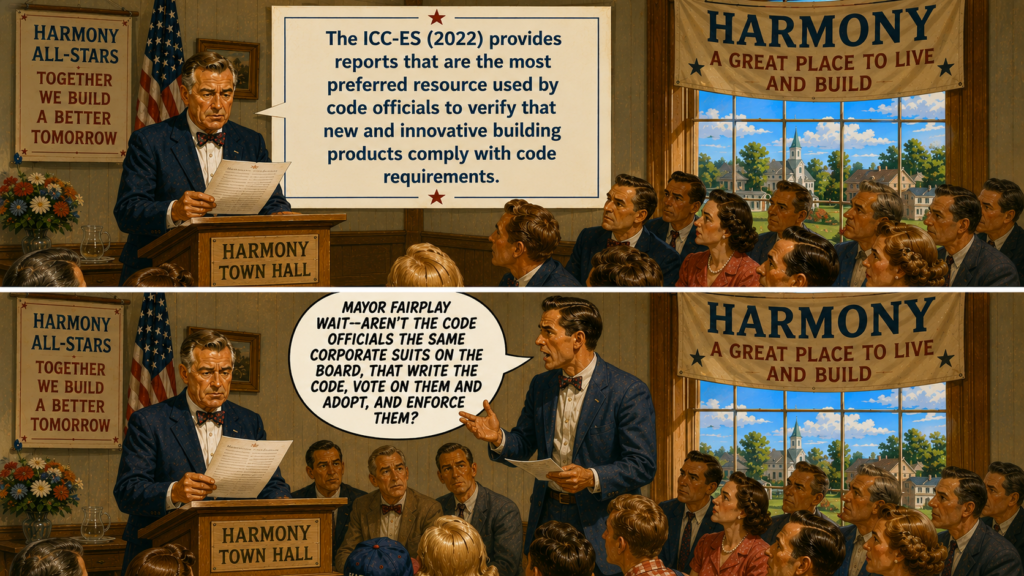
“The ICC-ES (2022) provides reports that are the most preferred resource used by code officials to verify that new and innovative building products comply with code requirements. The ICC-ES provides information about what code requirements or acceptance criteria were used to evaluate the product, how the product should be installed to meet the requirements, how to identify the product, etc. ICC-ES reports also require evidence through testing from an ICC-certified standards laboratory (i.e., ANSI, ASTM, UL, etc.) and how the product complies or is a suitable alternative to the requirements of the applicable code. Obtaining an ICC-ES Report is a process that is both time-consuming and expensive, and participants report that it does not foster innovation or competitiveness for small businesses and inventors, and it further reinforces prescriptive specifications. The ICC-ES process has encountered difficulty accommodating larger subassemblies (i.e., 2D enclosed panels or 3D volumetric modular) in offsite construction that integrate various material products for performance outcomes. The extent to which the current ICC-ES process is an obstacle to offsite construction and small business innovation needs to be researched. Additional information related to ICC-ES reports is available at the following website: https://icc-es.org/” — Research Roadmap, p. 34
ICC is A One Stop Shop Single Firm Monopoly
ALL ICC Competitors Were Left Out Of The HUD Plan
Neither HUD-funded report — Offsite Construction for Housing: Research Roadmap or HUD’s Past, Present, and Future Role in Accelerating U.S. Offsite Construction for Housing: A Comparative Study and Action Plan — names a single ICC-ES competitor anywhere in its text, despite other companies already providing the same kind of building-product evaluation reports.
For HUD’s offsite construction plans to actually foster an open and fair marketplace rather than reinforce a single provider, both documents should name these companies alongside ICC-ES wherever the evaluation-report process is discussed. Doing so would create an even playing field for manufacturers choosing where to obtain a compliance report, instead of directing federal research and policy attention toward improving one company’s proprietary process alone.
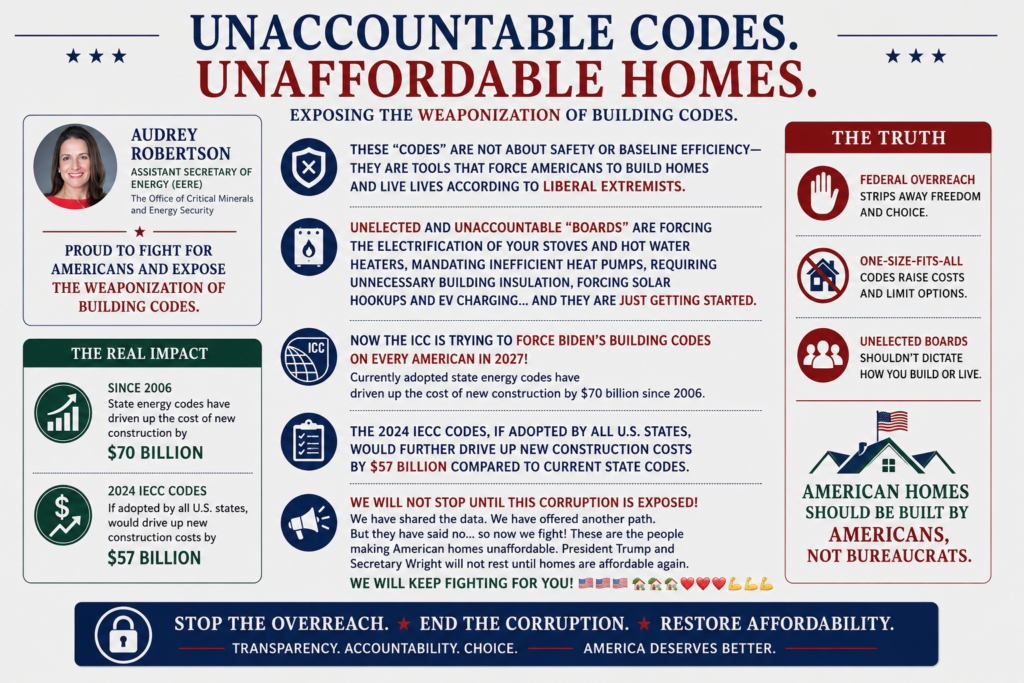
We Have To Join Audrey, She Is Ready To Fight ICC
We Have To Create A Better Future For Our Children
We Are Heading To Washington Boys!
- Why This Is Our Business — reframes the whole thing in plain taxpayer terms: nearly $3M of public money, almost $500K to one sole-source nonprofit with documented ICC overlap
- What We’re Asking For — five specific, concrete asks (full spending accounting, conflict-of-interest review, confirmation on whether competitors were ever invited to bid, a public commitment to name competitors going forward, Congressional/IG review of the sole-source authority)
- What You Can Actually Do — real, actionable steps: contacting reps with a specific question, filing a FOIA request, filing with HUD’s OIG, submitting public comments, sharing primary sources instead of just conclusions
- What This Isn’t — deliberately pulls back from personal accusation, keeps it about the process and the public’s right to know
- Closing — ties back to your six years, but reframes it forward: this shouldn’t take one person, it should take public pressure
Call To Action
How The ICC/HUD/NBIS/MODX Off -Site Consolidation Is Eliminating Competition And Comsumer Choice
The Encirclement – ICC’s Coordinated Campaign to Dominate Evaluation, Certification, and Offsite Construction Standards
The CfOC-ICC Alliance – A New Deployment in the Standards Campaign
Summary: How the ICC/HUD Ecosystem Leaves Competitive Standard Developers Completely Out of the Loop
Does HUD's Own Research Roadmap Describe a Hub-and-Spoke Structure Without Naming It?
June 12, 2026