To understand why tiny houses have come full circle back to ASTM, it is necessary to look at what interrupted that path. The formation of an ASTM committee for tiny houses was delayed for ONE YEAR after objections from the International Code Council and Tiny Home Industry Association, based on claims about regulatory authority and the role of standards. Yet when those claims are examined alongside statutory definitions, code development history, and the widespread use of ASTM standards within the I-Codes, they do not reflect the full regulatory framework already in place.
Listen To The Recent ICC PCH Hearing
Proponents submitted public comments at the ICC PCH that would have added chassis provisions to Appendix BB Tiny Houses. It was turned down.
Now I am focusing on two points from the 2022 letter from the ICC CEO that disrupted the final approval for the ASTM Tiny House committee.
First Point From ICC CEO
If a unit is built on wheels and a permanent chassis, and if one of the following conditions is met— greater than or equal to 8 feet wide, greater than or equal to 40 feet in length, or 320 square feet or more—then the HUD Manufactured Home Standards must be followed unless the manufacturer elects to proactively construct the unit as a modular home. In that case, it must comply with requirements based on a nationally recognized code or equivalent requirements recognized by the HUD Secretary. The codes currently recognized are the predecessors to the IRC. The requirement specifically calls for a code (not a standard) or equivalent requirements, which by nature would mean duplication of the content covered in the IRC.
My Rebuttal
Without referencing it, what ICC is referring to is § 3282.12 – Excluded structures—modular homes.
ICC is only referencing select parts of the statute and leaves out the part where an ASTM standard applies.
First -You Must Understand The Statutory Definition Of A Manufactured Home
Manufactured home means a structure, transportable in one or more sections, which in the traveling mode, is eight body feet or more in width or forty body feet or more in length, or, when erected on site, is three hundred twenty or more square feet, and which is built on a permanent chassis and designed to be used as a dwelling with or without a permanent foundation when connected to the required utilities, and includes the plumbing, heating, air-conditioning, and electrical systems contained therein.
Calculations used to determine the number of square feet in a structure will be based on the structure’s exterior dimensions measured at the largest horizontal projections when erected on site. These dimensions will include all expandable rooms, cabinets, and other projections containing interior space, but do not include bay windows.
This term includes all structures which meet the above requirements except the size requirements and with respect to which the manufacturer voluntarily files a certification pursuant to 24 CFR 3282.13 and complies with the standards set forth in 24 CFR part 3280.
ICC Chassis Provisions Turned Down 3 Times ( 10 Years)
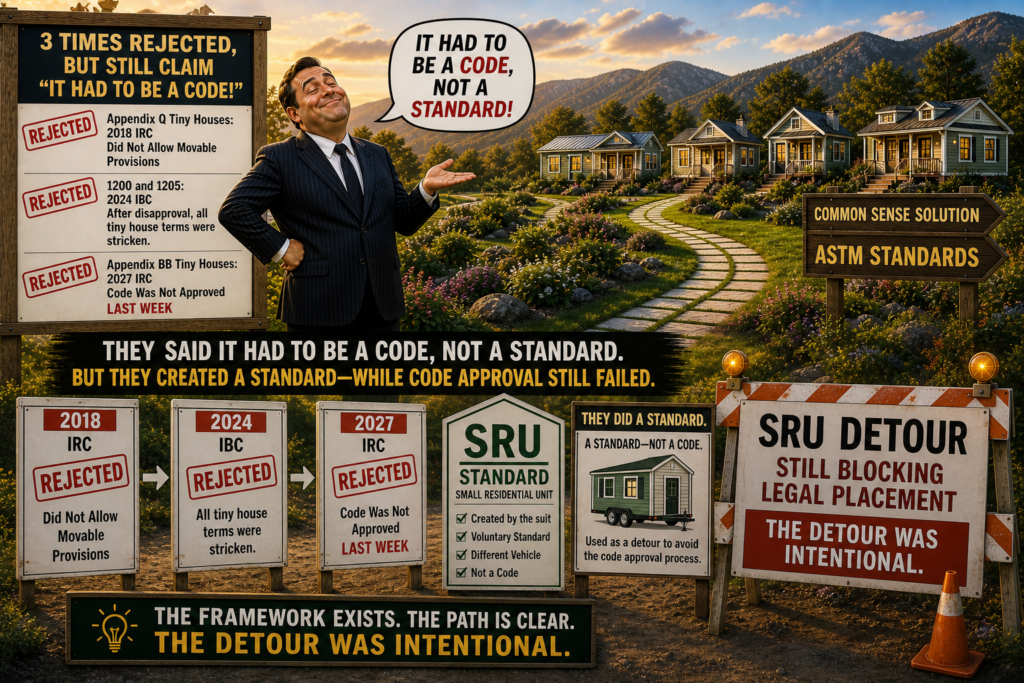
An ICC Code That Would Have Included Chassis Provisions For Tiny Houses In The IRC Or IBC Have Failed Three Times In 10 Years
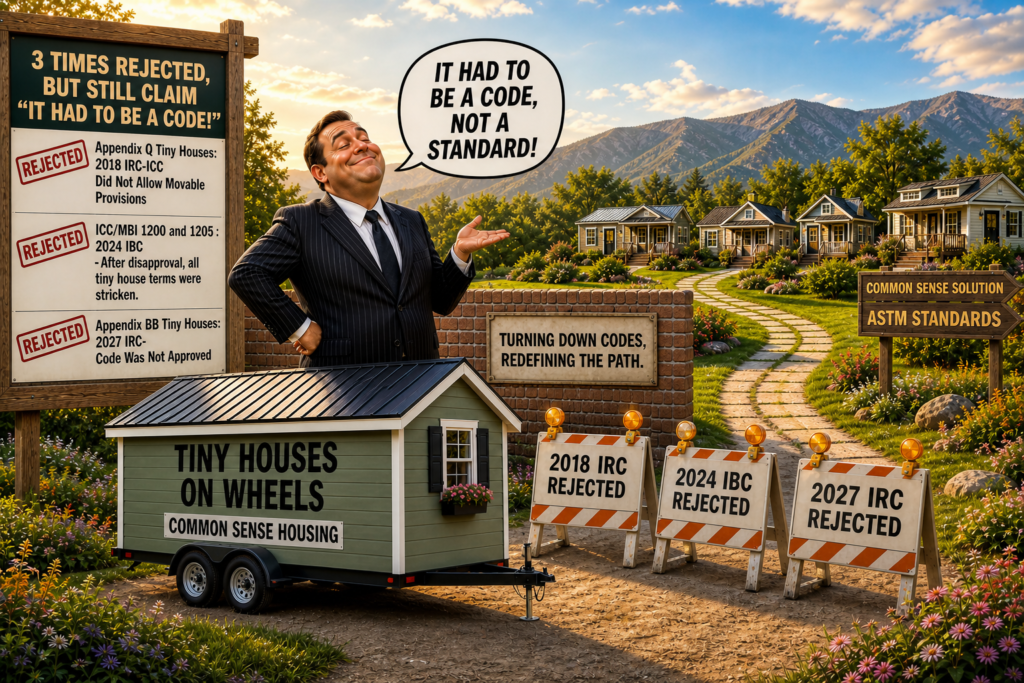
Appendix Q Tiny Houses: 2018 IRC-ICC Did Not Allow Movable Provisions ICC/MBI 1200 and 1205 : 2024 IBC -After disapproval, all tiny house terms were stricken. Appendix BB Tiny Houses: 2027 IRC- Code Was Not Approved
ICC stated it could not be a standard, it had to be a code. ICC duplicated ASTM and created a standard, while the code was turned down.
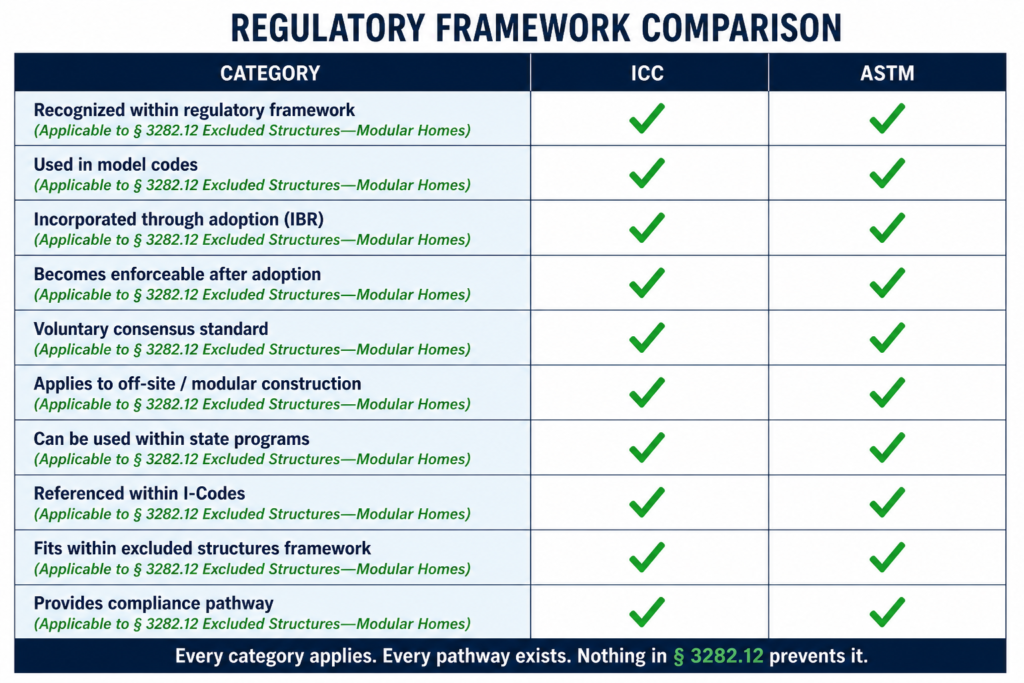
How ASTM applies to 3282.12 – Excluded structures—modular homes
ASTM standards are adopted into local codes through a legal process known as Incorporation by Reference (IBR), where a local legislative body formally passes an ordinance or regulation that makes the standard part of the law. This means that a voluntary standard becomes mandatory for compliance within that jurisdiction, often by referencing specific ASTM standards within model codes.
Example: Wa. state adopted Appendix AQ Tiny House (2021 IRC) and also referenced ASTM standards.
The air leakage rate for tiny houses shall not exceed 0.30 cfm at 50 Pascals of pressure per square foot of the dwelling unit enclosure area. Testing shall be conducted in accordance with RESNET/ICC 380, ASTM E 779 or ASTM E 1827 and reported at a pressure of 0.2 inch w.g. (50 Pascals). Where required by the code official, testing shall be conducted by an approved third party.
ICC has listed ASTM in CP#28-05 – Code Development as stated; Standard Promulgation: The standard shall be developed and maintained through a consensus process such as ASTM or ANSI.
Source
ICC stated -Access over 500 ASTM standards referenced in the 2021 I-Codes. Source
ASTM standards clearly become a part of model codes and adopted into state and local codes.
Tiny houses on wheels are built off site in a factory, and an ASTM standard could become a part of a modular or factory built program and the manufactucturer could self certify to be excluded from HUD regulation.
Second Point From ICC CEO
If built off-site, ICC/MBI Standards 1200 and 1205 govern the process for plan review, inspection, quality assurance, and certification. These standards apply to all forms of off-site construction characterized as closed construction, meaning the final product cannot be fully inspected at the job site without damage or destruction.
Since off-site tiny houses qualify as closed construction, these standards apply.
ICC/MBI Standard 1200 addresses planning, design, fabrication, and assembly, including fire and smoke protection, mechanical, electrical, and plumbing systems, structural design, manufacturing processes, transportation, storage, and installation. ICC/MBI Standard 1205 covers inspection and regulatory compliance, including plan approvals, inspections, third-party review agencies, compliance assurance programs, authority oversight, and certification insignia and data plates.
ICC does not have the authority to police or in force compliance to their own codes and standards. They chose to remove all tiny home terms from the standard after the IBC disapproval. They are voluntary consensus standards that become enforcreable after they are adopted.
My Rebuttal
ICC does not have the authority to police or in force compliance to their own codes and standards. They chose to remove all tiny home terms from the standard after the IBC disapproval. They are voluntary consensus standards that become enforcreable after they are adopted.
The first question that was asked at the IBC hearing when they were turned down was: ”Tom, by design, by adopting this particle standard, you intend to disrupt the certification programs that are in the 30 states that have their own program.”
At the time of the ICC objection, I had advocated for the revision and reinstatement of ASTME541 that had been withdrawn by accident that has now been published in 2022 that is in over state statutes in over 10 states and referenced by that would supersede an adopted standard, even as a withdrawn standard. HUD also references ASTME541 for their 3rd party requirements that certify manufactured homes.
ICC does not exclusively ‘govern certification’ as they stated, there are alternatives that have been in place long before ICC/MBI 1205 was developed.
Summary
This analysis exposes a fundamental contradiction in the International Code Council’s position and actions.
ICC asserted that chassis provisions for tiny houses could not be addressed through a standard and had to be implemented through a code. However, over a ten-year period, ICC failed three separate times to secure approval for those provisions within the IRC and IBC.
After those repeated rejections, ICC proceeded to develop a standard addressing the same subject matter it claimed could only exist in code. At the same time, ASTM standards are already embedded throughout the regulatory framework and are routinely incorporated into model codes through adoption.
ICC itself recognizes and references hundreds of ASTM standards within the I-Codes, and its own policies acknowledge ASTM as a valid consensus standards developer. These standards become enforceable once adopted and are already used in practice within state and local programs. In contrast, ICC’s own standards are voluntary and only gain authority upon adoption, existing alongside other compliance pathways rather than replacing them.
Within the statutory framework for excluded structures, there is a clear and established path for alternative compliance, including the use of adopted standards. ASTM standards fit squarely within that structure and are already applied in real-world code enforcement. Taken together, this reflects not just inconsistency, but a disregard for how the system is actually structured and operates. The pathway for ASTM has always existed, has always been recognized, and has always been in use.
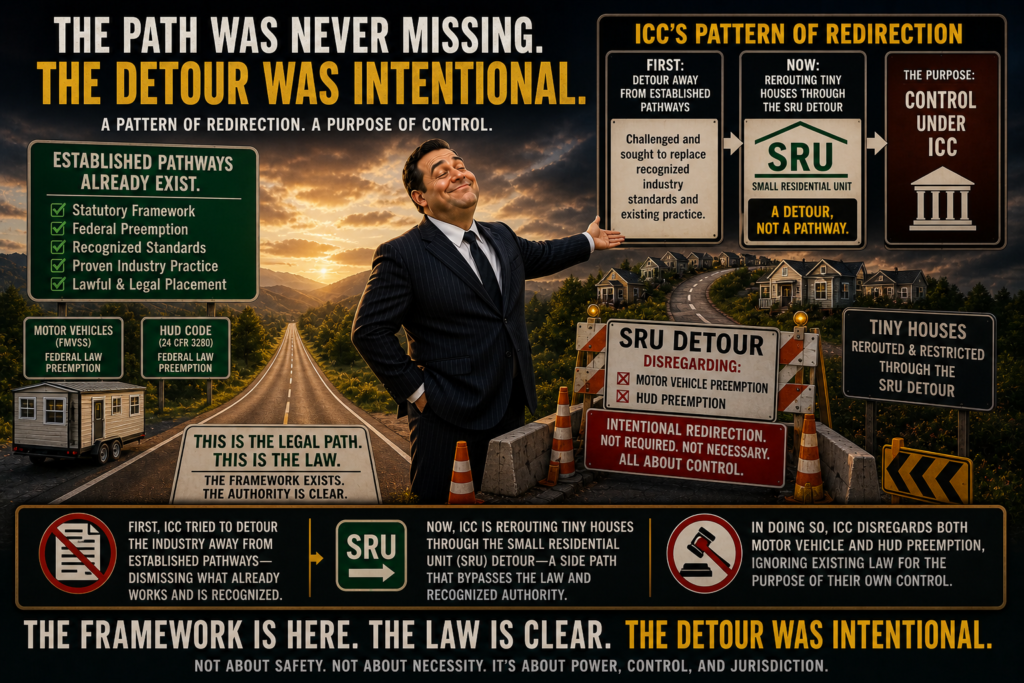
The pattern is no longer subtle. Established pathways were first sidelined by challenging ASTM, a framework already recognized and in use, and now tiny houses are being rerouted through the Small Residential Unit (SRU) detour—despite existing statutory structures and clear federal preemption under both motor vehicle law and HUD. This is not a matter of filling a regulatory gap; it is the redirection of an industry away from lawful, established pathways and into a system defined and controlled by ICC. This is the same tactic used by hiding crucial steps needed for the industry in the foreward of the ICC1215 that adds another step that benefits ICC. Learn more.
In light of that, ASTM standards are not only applicable, they are more relevant than ever.
I was a proponent who spearheaded the tiny-house effort within ASTM, working collaboratively to establish the E06.26 Tiny Houses Subcommittee under the Committee on Performance of Buildings. I currently serve as Membership Secretary for the subcommittee.
Disclaimer: I do not represent ASTM International, and the views, findings, and conclusions expressed in this document are my own, based on my own experience, public information and independent research. This submission is made in my individual capacity as President of Tiny House Alliance USA, in support of transparency, lawful compliance, and open participation in standards development.