
The Regulatory Capture Of Tiny Houses By ICC

The 1,200-Square-Foot "Tiny" House: Inside the Controversial Rebranding of a Movement

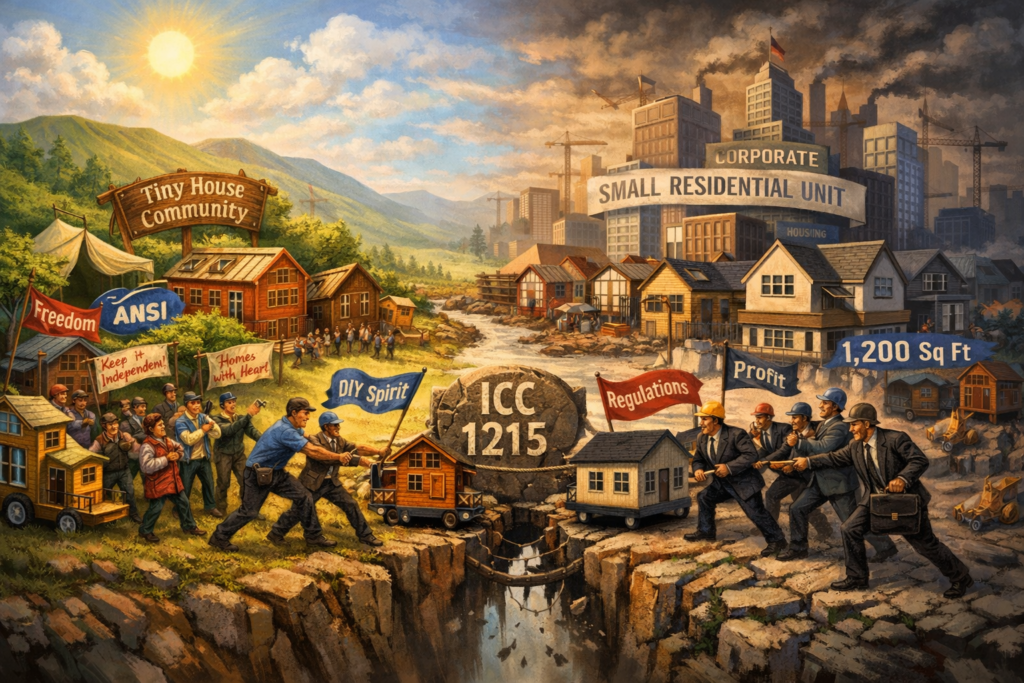
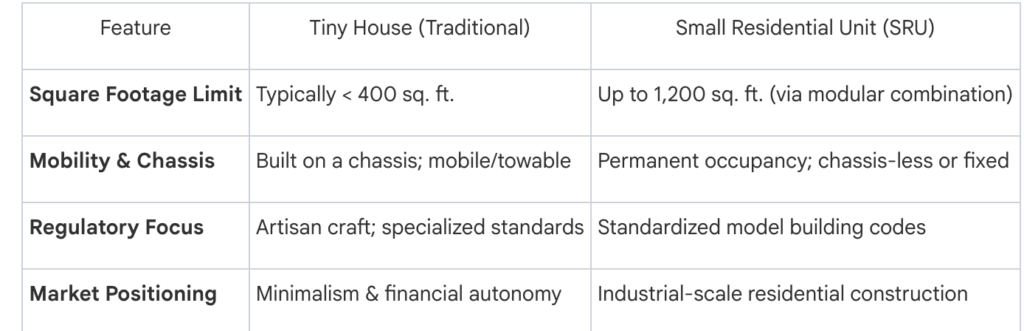
The tiny house movement was born from a radical ethos of simplicity, mobility, and an uncompromising footprint typically under 400 square feet. This artisan-led ideal, however, is currently being dismantled by a calculated bureaucratic pivot. At the center of this transformation is the ICC 1215 standard, a regulatory framework that has evolved from a legitimization effort into a “radical expansion” of scope.
The central thesis is clear: the movement is being hijacked by corporate-backed interests. By redefining the very boundaries of what constitutes a “tiny” home, the International Code Council (ICC) is steering the market toward permanent, large-scale industrial construction. This shift signals a move away from the mobile, minimalist dwellings of the movement’s pioneers and toward a standardized, corporate-friendly product designed to satisfy institutional appetites.

Short Video Explainer About The Blog Post

The Great Expansion: From 400 to 1,200 Square Feet

The introduction of the Small Residential Unit (SRU) label is a masterstroke of category control. By expanding the allowable square footage to 1,200 feet, the ICC has effectively redefined the “tiny” market to accommodate traditional suburban scales. This is not merely an increase in size; it is a “strategic repositioning” that permits modular combinations—allowing three 400-square-foot units to be tethered together to create a 1,200-square-foot residence while remaining under the privileged regulatory umbrella of the new standard.
The "Inflammatory" Label: Why the Name is Changing
The ICC 1215 committee’s decision to abandon the term “Tiny House” in favor of “Small Residential Unit” is a calculated effort to scrub the movement of its counter-cultural identity. This rebranding functions as a market-shaping mechanism designed to appease “polite bureaucratic society” through three specific avenues:
Zoning Pushback: Erasing the “tiny” label helps bypass local resistance from officials who associate the term with transient populations or lower property values.
Social Stigma: Rebranding as a “Unit” reframes the dwelling as a legitimate architectural product, distancing it from the “DIY” or “homeless-adjacent” stigmas often weaponized by NIMBY interests.
Regulatory Friction: The clinical “SRU” designation allows these structures to slide more easily into existing bureaucratic silos that struggle to classify mobile artisan dwellings.
The irony is profound: a standard ostensibly created to provide the tiny house movement with a seat at the table has responded by demanding the movement leave its identity at the door.

Regulatory Capture: The ICC and THIA Alliance

The ICC is not a government agency; it is a 501(c)(6) trade association. Its current trajectory regarding ICC 1215 provides a textbook study in regulatory capture—a phenomenon where a standard-developing body begins to prioritize the interests of a specific industry over the public interest.
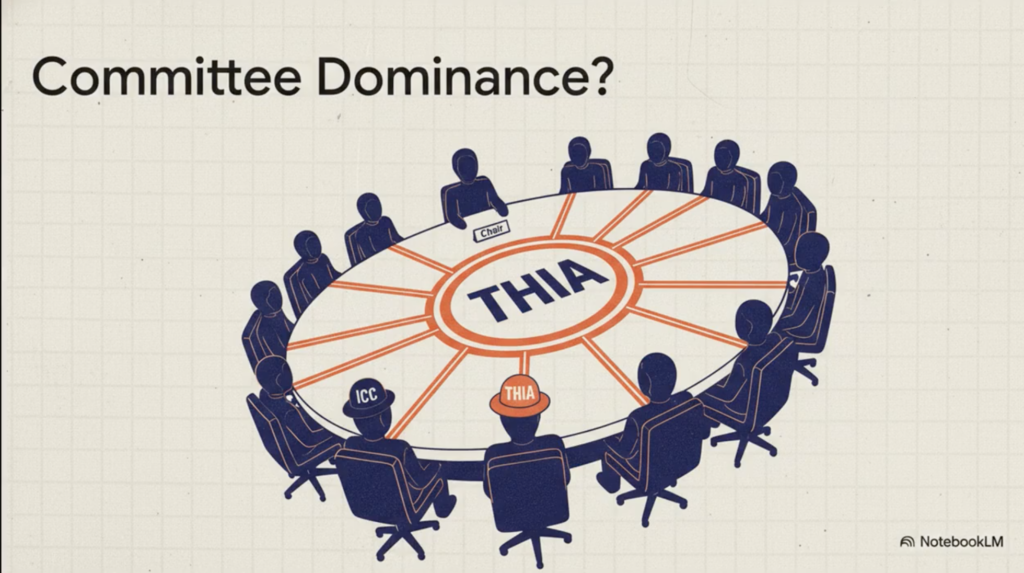
The “co-branded” alliance between the ICC and the Tiny Home Industry Association (THIA) serves as the backbone of this capture. Evidence of this market protectionism includes:
Marketing Integration: The ICC maintains an exclusive marketing landing page for THIA, blurring the line between a neutral standards body and a trade advocate.
Joint Model Legislation: The two entities collaborate on drafting legislation for local adoption, effectively hand-delivering a pre-packaged market to preferred vendors.
The Revolving Door: Committee chairs often hold dual leadership roles in both the ICC and THIA, creating a closed-loop of influence.
Market Guarding: The ICC spent a year successfully blocking an ASTM tiny house committee, an act of “market protectionism” designed to ensure that no competing, perhaps more flexible, standards could challenge the ICC’s dominance.

The "Family of Solutions": Vertical Integration and Market Control

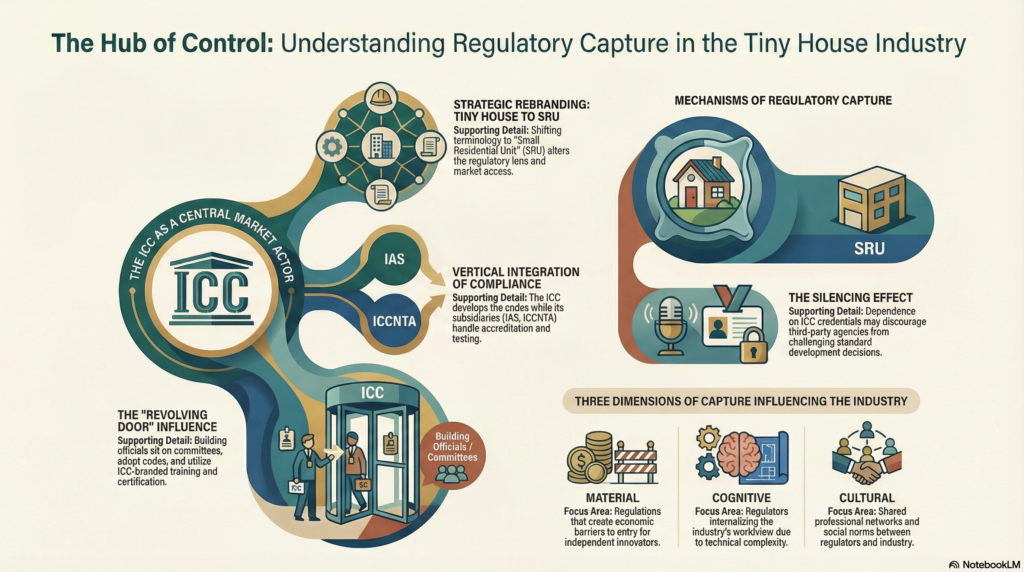
The ICC maintains a “hub-and-spoke” structure that grants it control over the entire lifecycle of a building project. This vertical integration allows the ICC to act as a central market actor rather than a mere publisher. Through its “Family of Solutions,” the ICC oversees rulemaking and compliance via the following subsidiaries:
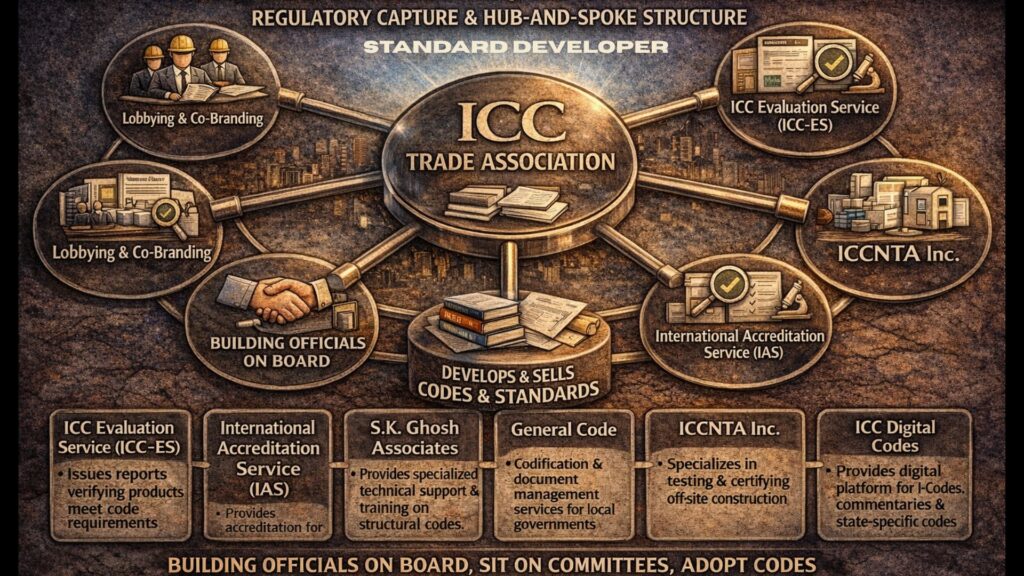
IAS (International Accreditation Service): Provides the accreditation necessary for testing and inspection firms.
ICCNTA (formerly NTA): Specializes in the actual testing and certification of off-site construction.
ICC-ES (Evaluation Service): Issues the reports that verify products meet code requirements.
ICC Digital Codes: Controls the digital platform through which these codes, commentaries, and state-specific standards are accessed and purchased.
S.K. Ghosh Associates & General Code: Provide technical training and codification services to local governments.
The Silencing Effect: This structure creates a dangerous economic dependency. Because third-party agencies and inspectors rely on IAS/ICC-ES accreditation for their very survival, they are effectively neutralized. Openly objecting to ICC standard-development decisions carries a perceived professional and economic risk that chills dissent within the industry.
6. The Mechanics of Capture: Material, Cognitive, and Cultural
Regulatory capture in this sector is achieved through three overlapping forces that transform the ICC from a publisher into a market gatekeeper:
Material Capture: ICC 1215 creates economic advantages for industrial-scale incumbents. The complexity and cost of compliance under the SRU banner create expensive barriers to entry, systematically excluding independent, small-scale artisan builders.
Cognitive Capture: Due to the extreme technical complexity of building codes, regulators and local officials suffer from information asymmetry. They internalize the worldview of the ICC “experts” simply because they lack the independent resources to challenge the industry-dictated narrative.
Cultural Capture: Shared professional networks and the “revolving door” between industry associations and regulatory bodies create a shared social norm. To those within the hub, institutional consolidation is seen not as a threat, but as “progress.”

Economic and Legal Implications

The reclassification of tiny houses as SRUs is a form of regulatory arbitrage. By strategically redrawing classification boundaries, the ICC alters how these structures interact with federal preemption doctrines and vehicle classifications. This move is designed to shift the houses into more favorable (and more expensive) regulatory environments that favor industrial production over mobile artisan craft.
Legal and Regulatory Risks:
Antitrust Scrutiny: This intersection of commercial interests and regulatory authority triggers potential scrutiny under the Sherman Act, Clayton Act, and FTC Act. When a dominant body uses vertical integration to limit market alternatives, it risks being labeled a monopoly.
The SDO Shield: The Standards Development Organization Advancement Act of 2004 provides limited protections to SDOs, but these protections are contingent upon following strict “due process.” If the ICC 1215 process is found to be unbalanced or captured by specific industrial interests, those legal protections may evaporate.

Conclusion: The Future of the Movement

The struggle over ICC 1215 is not a debate about safety; it is a battle for the soul of the movement. The transition from the “Tiny House” to the “Small Residential Unit” represents a shift from a community-driven philosophy to a vertically integrated, corporate-regulated industry.
The issue is not that standards exist, but who defines them and whether those definitions serve the public or a 501(c)(6) trade association. To protect the public interest, housing standards must remain open, balanced, and competitive. Without structural independence and a return to genuine ANSI due process, the artisan spirit of the tiny house will be completely consumed by the 1,200-square-foot “Unit.” The “Small Residential Unit” may be a house, but for the movement’s pioneers, it is no longer a home.

A Tiny House Poem

Related Blog Posts

Feb. 12, 2026
Leave a Comment

Your email address will not be published. Required fields are marked *