For years, the “Tiny House” has represented a specific cultural ideal: simplicity, mobility, and a rejection of the “more is better” housing philosophy. To the public, a tiny house is a structure capped at 400 square feet, often built on wheels to allow for a nomadic or flexible lifestyle. However, a bureaucratic shift is currently rewriting that definition entirely.
The ICC 1215 standard, originally touted as a way to provide a clear regulatory path for tiny houses, has undergone a radical transformation. What began as an effort to legitimize 400-square-foot artisan dwellings has been “hijacked” by a corporate-backed concept: the Small Residential Unit (SRU). This isn’t just a name change; it is a fundamental restructuring of the market that favors permanent, larger-scale construction while pushing the original, mobile spirit of the movement to the margins.
The Tiny House Just Tripled In Size
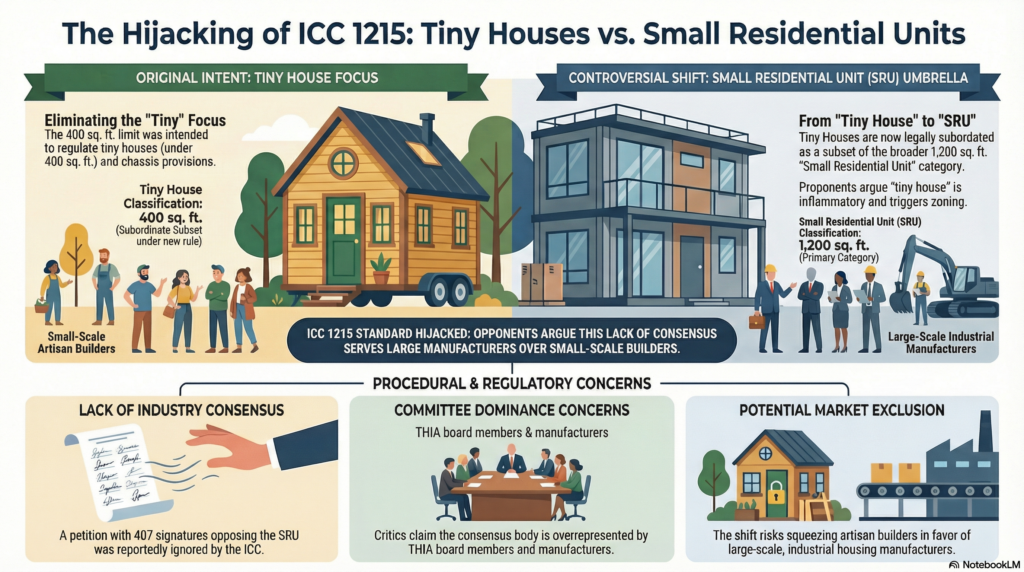
The most striking shift in the ICC 1215 draft is the expansion of what constitutes a “small” home. While the industry has long recognized a 400-square-foot cap, the new standard introduces the Small Residential Unit (SRU), which balloons the limit to 1,200 square feet.
This is not merely a “size bump”; it is a strategic repositioning. By the new definitions, the “Tiny House” is no longer the primary focus, but rather a subordinate subset of the SRU. This framework allows for modular combinations—such as connecting three 400-square-foot units—to create a 1,200-square-foot residence that technically remains “small” under the new rules, but functionally erases the minimalism that defined the movement.
This transition introduces the “Small Residential Unit” (SRU) as a primary umbrella category, subordinating the “Tiny House” as a subset. While proponents argue this change avoids the social stigma of the term “tiny house” and allows for greater design flexibility, opponents allege that the process has been “hijacked” by institutional interests.
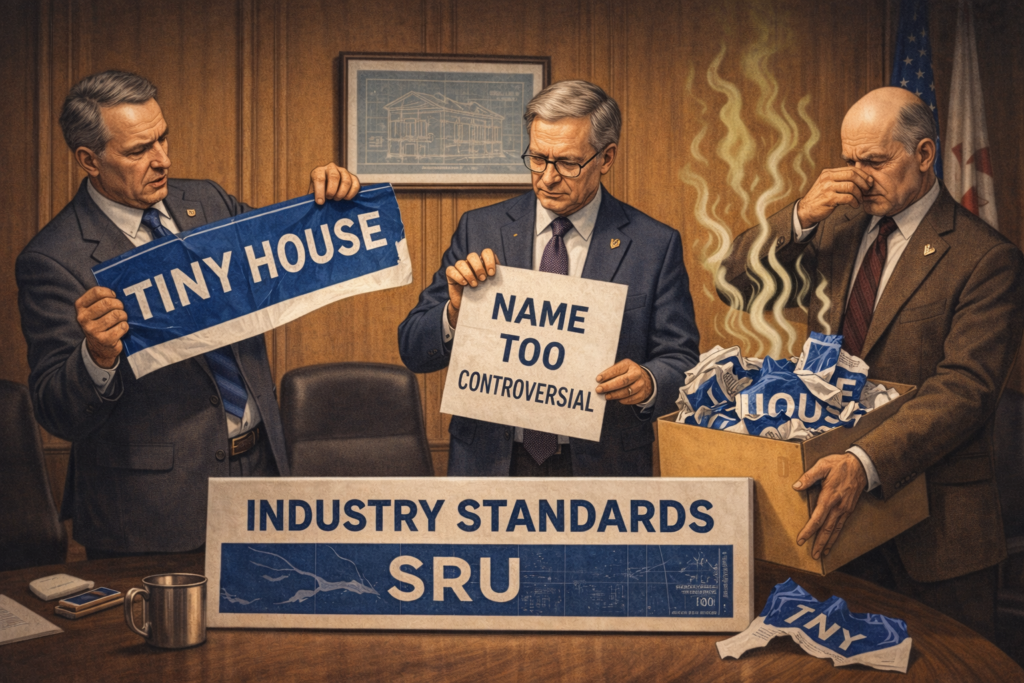
The Term "Tiny House" is Now Considered "Inflammatory"
In a bizarre twist of logic, the ICC 1215 committee has moved to distance itself from the very term that gave the standard its purpose. The committee claims the phrase “Tiny House” has become a liability among local regulators, citing several “inflammatory” associations:
The irony is thick: an industry standard created to regulate and legitimize the movement is now attempting to abandon its name because the movement’s identity is deemed too controversial for polite bureaucratic society.
A journalist recently asked me to steel man the Small Residential Unit approach, as supported by THIA. While he had heard my concerns about the standard, he reasonably observed that it must rest on plausible motivations — or at least be presented as such by those advocating for it.
Short Video Explainer: Tiny Houses Have Been Hijacked
I will start with what I personally heard and experienced as an interested party that attended the meetings and share what was said by the voting committee to justify the need to use the term small residential unit and end with my perspective, including a complaint to ICC that an ICC employee misled the committee in a myth to justify using the term. The post includes ICC videos of hearings, to further document the opposition of the small residential unit and the reason two ICC/MBI standards were turned down at the 2024 IBC hearing that was falsely blamed on the term tiny house and as been a primary justification to use the term small residential unit.
Reasons The ICC 1215 Gave To Support The Small Residential Unit
Their View On The Term ”Tiny House”
Removes size caps like 400 sq. ft.
The term ”tiny house” is inflammatory
Avoids tying the concept to only wheels
Is associated in some jurisdictions with homelessness or emergency housing
Triggers resistance from local officials
Raises concerns about transience or non-permanent occupancy
Invites zoning pushback
The 400 sq. ft. framing is too restrictive
Buyers increasingly want expandable units
Connecting three 400 sq. ft. modules into a 1,200 sq. ft. home is functionally residential, not “tiny”
The term “small residential unit” allows growth without rewriting definitions later
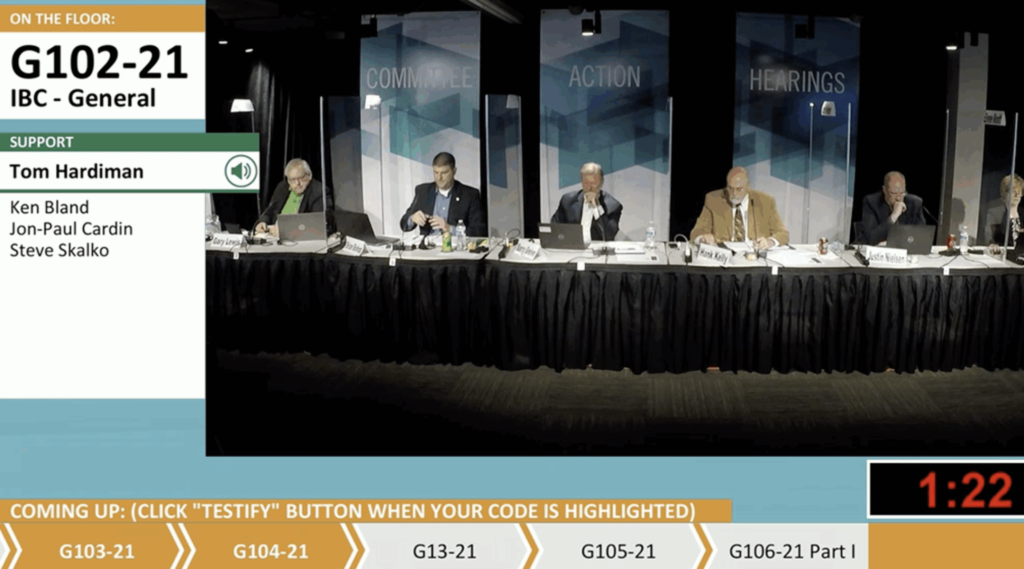
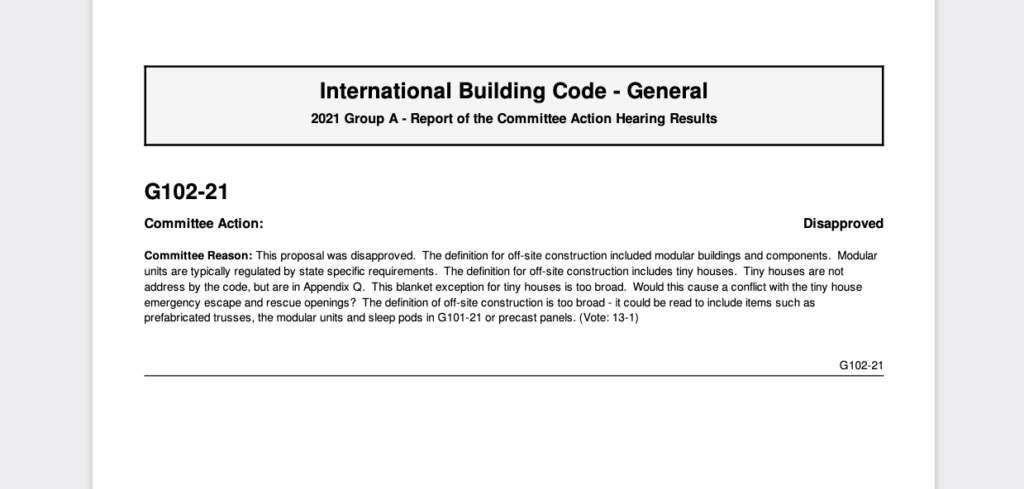
Listen To The 2024 Hearing: Off Site Standards Included Tiny Houses
After the disapproval of ICC/MBI 1200 and 1205 all tiny house terms were removed
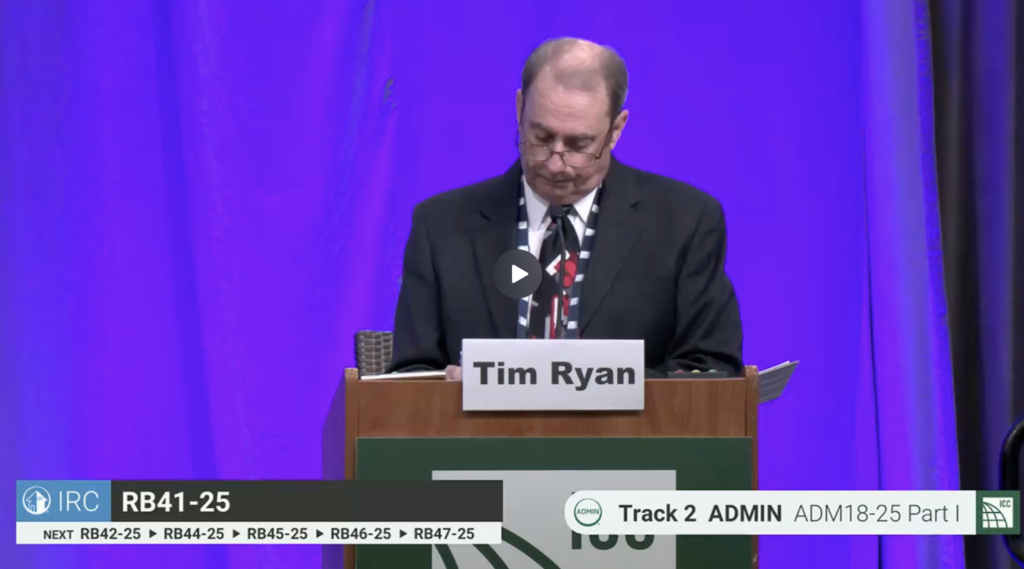
ICC Employee stated ICC/MBI 1200 AND 1205 were turned down at 2024 IBC hearing because of the term tiny house to justify using the term small residential unit.
A building official stated that he liked the term, because there was also going to be a large residential unit in the energy code.
Why THIA Supports The Small Residential Unit
THIA Is Co-branding the standard with ICC
ICC has given THIA their own exclusive marketing page on ICC
ICC and THIA have jointly published several publications including model legislation.
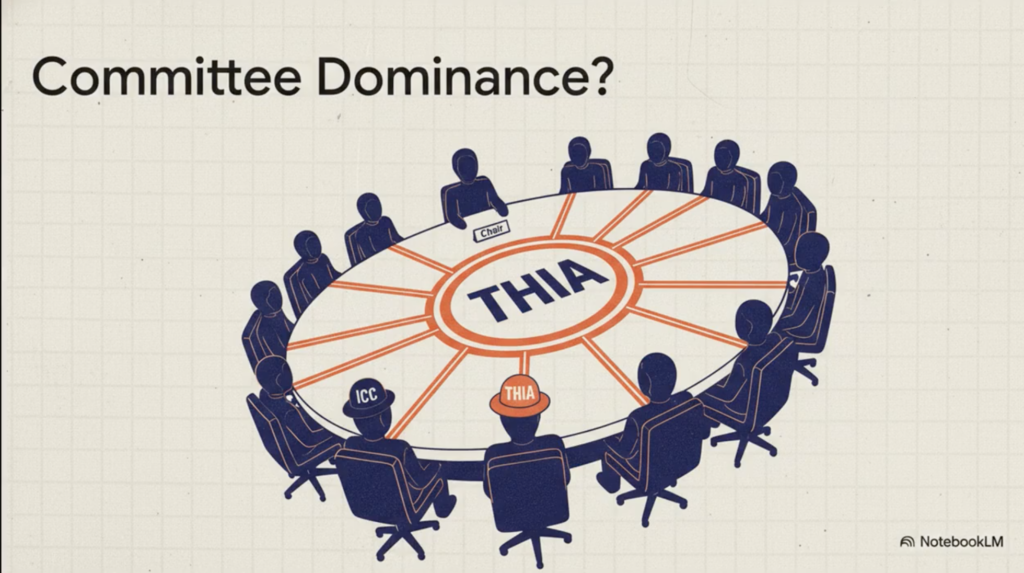
The committee is dominated by THIA board members
The chair is a board member of THIA
An ICC paid employee was also on the board of THIA, was on the voting committee, and represented the interest category of the standard developer.
ICC And THIA fought the formation of a ASTM tiny house committeee for ONE YEAR.
The Question Remains- Is This A Consensus Document?
Those are the stated reasons for the justification of using the term small residential unit and placing the term in a primary position over a tiny house, in a subordinate position. The question, however, is not whether these motivations exist, but whether the scope of the standard was properly followed, whether the ANSI Essential Requirements were observed, whether antitrust safeguards were respected, and whether the resulting document reflects true consensus.
Definitions In ICC 1215 Standard
SMALL RESIDENTIAL UNIT (SRU). A dwelling unit that is 1,200 square feet or less constructed as a permanent residential structure with or without a PERMANENT CHASSIS system.
TINY HOUSE. A SMALL RESIDENTIAL UNIT 400 square feet or less with or without a PERMANENT CHASSIS system
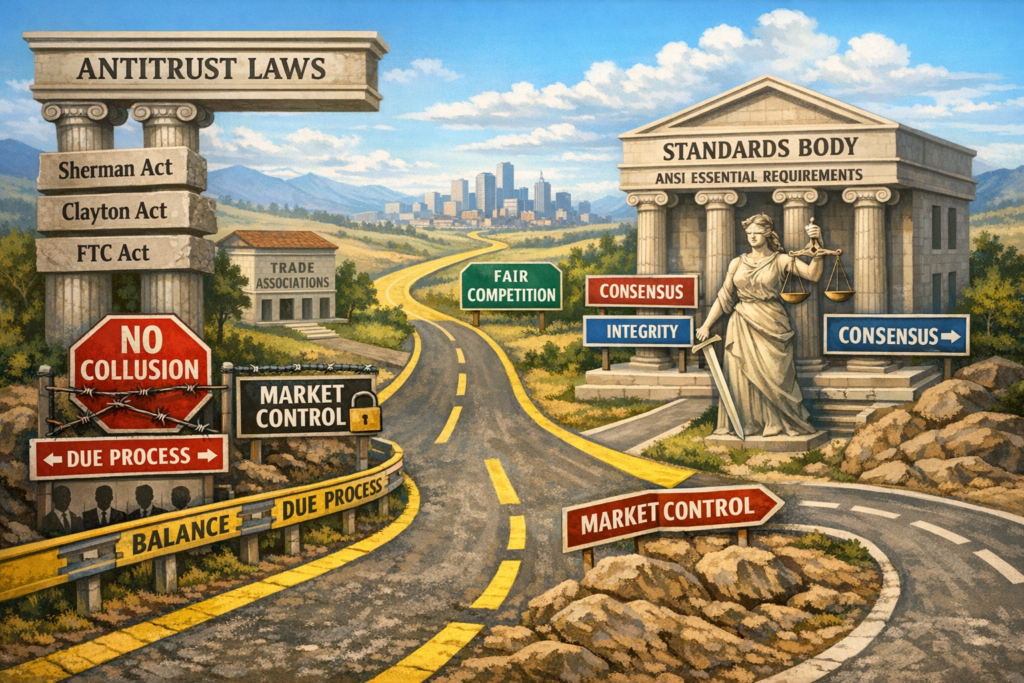
Standard Development Operates Within Legal And Procedural Guardrails
Standard development operates within defined legal and procedural guardrails. It must comply with federal antitrust law — including the Sherman Act, the Clayton Act, and the Federal Trade Commission Act — which prohibit agreements that restrain trade or distort competitive markets. In addition, the Standards Development Organization Advancement Act of 2004 provides limited antitrust protections to qualifying standards bodies, but only when they operate in accordance with principles of openness, balance, due process, and transparency.
Trade associations participating in standards development are similarly bound by antitrust constraints. Courts have long recognized that collaboration among competitors within trade groups must not become a vehicle for coordinated market control, exclusionary conduct, or category manipulation that affects competition.
For that reason, adherence to the ANSI Essential Requirements — including balanced representation and true consensus — is not optional. It is foundational to preserving both the legitimacy of the standard and the integrity of the marketplace.
The First ICC Hearing Attracted Small Residential Unit Opponents
ICC ignored the opponents at the hearing.
The Small Residential Unit was vigorously opposed at the CAH hearing, and ICC did not listen. They had a chance to get the standard back into compliance with the approved title, scope, and intent of the standard, and the primary purpose to add chassis provisions to tiny houses, adopted into the IRC, but instead tiny houses have been hijacked by the Small Residential Unit.
It is clearly an agenda of ICC and they have an overreach in their involvement as a Standard Developer that is dominating the standard in violation of ANSI Essential Requirements that prohibit dominance.
The standards development process shall not be dominated by any single interest category, individual or organization. Dominance means a position or exercise of dominant authority, leadership, or influence by reason of superior leverage, strength, or representation to the exclusion of fair and equitable consideration of other viewpoints.
Collective PINS Complaint — OSMTH 1215 (ICC/THIA 1215) and the “Small Residential Unit” takeover of a Tiny House standard
This complaint concerns ICC’s development of ICC/THIA 1215, originally approved and presented as a Tiny House standard intended to advance safe, consistent regulation of tiny houses for permanent occupancy, including filling gaps left by IRC Appendix Q / Appendix BB and adding chassis-related provisions needed for tiny houses on wheels.
Over the course of committee work and workgroups, ICC and THIA shifted the project away from its approved mission by introducing a new umbrella category, the Small Residential Unit (SRU), and repositioning tiny houses as a subset under SRU. This is not a minor editorial refinement. It is a substantive change that alters the title, scope, market impact, stakeholder universe, and adoption pathway—yet ICC did not timely follow ANSI PINS safeguards or ICC consensus procedures during the period when SRU became the project’s primary focus.
Key timeline and process failures
Jan 31, 2024 (first OSMTH 1215 meeting): SRU-related reframing began early in public calls/workgroups, but ICC did not file a revised PINS at that time.
Sept 2024 onward: repeated requests for a revised PINS and scope alignment were denied/ignored.
Oct 15, 2024: ICC released a draft for public comment that already reflected SRU takeover while the project remained operating under the original approved title/scope framework.
Mar 19, 2025: a motion removed “chassis” from the tiny house definition (a core issue for tiny houses on wheels), which should have been treated and disclosed as a substantive change.
May 16, 2025: ANSI Standards Action published ICC’s revised PINS changing the proposed title to: “Design, Construction, Inspection and Regulation of Small Residential Units and Tiny Houses for Permanent Occupancy.” This revision did not adequately disclose or list substantive changes, justify SRU in “Project Need,” or provide clear notice that tiny houses would be subordinated as “included” stakeholders and a subset under SRU. Note: the term chassis is back under the definition, not sure when that occurred.
Core concerns
SRU is a substantive change and a category takeover. SRU is not an IRC-codified housing term, yet ICC/THIA are placing “Tiny House” (an IRC-recognized term) under SRU, effectively redefining the marketplace and adoption narrative.
The standard’s primary mission is being displaced. The original purpose—advancing tiny house recognition and adding chassis provisions—has been sidelined by ongoing SRU disputes and scope drift.
Noncompliance with ANSI due process (PINS) and ICC consensus procedures. ICC’s delayed and incomplete PINS handling deprived stakeholders of timely notice and participation aligned to the true scope and intent of the project.
Committee dominance, imbalance, and exclusion of key stakeholders. The consensus body lacks balanced representation (notably absence of on-site/owner-builder stakeholders), while manufacturers and THIA-associated interests are overrepresented. ICC has declined to correct dominance/imbalance concerns.
Failure to promptly consider and respond to objections and denial of appeal rights. Written objections, agenda requests, and procedural complaints have not been addressed as required, and the ability to appeal procedural actions/inactions has been denied or functionally blocked.
Competition and antitrust concerns. The SRU reframing and related decisions function as market-structuring choices that risk squeezing small artisan tiny house builders in favor of large-scale manufacturers and ICC-aligned compliance ecosystems. Additional concerns include attempted or effective market exclusion of competitive standards (e.g., ASTM E541) and the appearance of tying ICC-owned materials/services into a standard development pathwa
Regarding Collective PINS Complaint: OSMTH 1215
My complaint was submitted along with 407 signatures that signed my petition opposing the small residential unit. Our complaints were ignored.
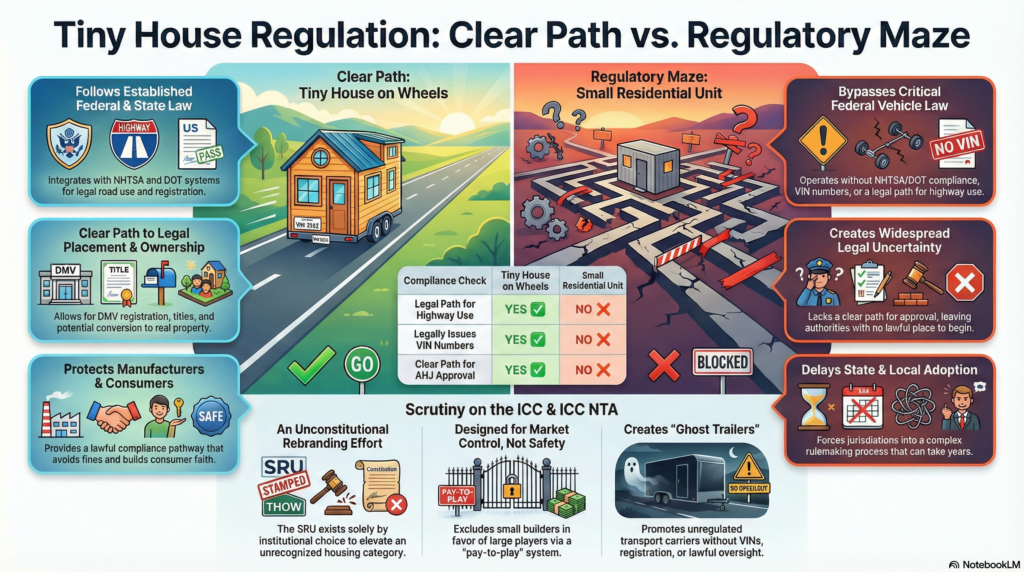
After these procedural and governance concerns emerged, my concerns deepened when the committee began signaling its intent to override or sidestep established federal frameworks, including motor vehicle classifications and HUD preemption principles. At that point, it became clear that the introduction of the Small Residential Unit (SRU) was not merely a definitional refinement, but a structural shift with broader regulatory implications.
The creation of SRU risks destabilizing existing housing classifications and triggering industry-wide conflict and uncertainty. Instead of bringing clarity to tiny house regulation, this approach threatens to reset and disrupt the broader housing ecosystem—creating confusion for jurisdictions, manufacturers, and consumers alike.
Hola! I’ve been following your web site for a long time
now and finally got the courage to go ahead and give you a
shout out from Kingwood Texas! Just wanted to tell you keep up the great
work!
Wow, awesome blog layout! How long have you been blogging for?
you make blogging look easy. The overall look of your web site
is magnificent, as well as the content!



Hola! I’ve been following your web site for a long time
now and finally got the courage to go ahead and give you a
shout out from Kingwood Texas! Just wanted to tell you keep up the great
work!
No need to be shy. Thank you!
I like the valuable info you provide in your articles. I’ll bookmark your blog and check again here frequently.
I’m quite sure I’ll learn a lot of new stuff right here!
Good luck for the next!
Thank you.
Wow, awesome blog layout! How long have you been blogging for?
you make blogging look easy. The overall look of your web site
is magnificent, as well as the content!
Thank you, about 9 years.