ICC 1215: Reroutes The Rules For The Road For Tiny Houses
ICC/THIA 1215, Design, Construction and Regulation of Small Residential Units and Tiny Houses for Permanent Occupancy is being jointly promulgated by the International Code Council (ICC) and the Tiny Home Industry Association.
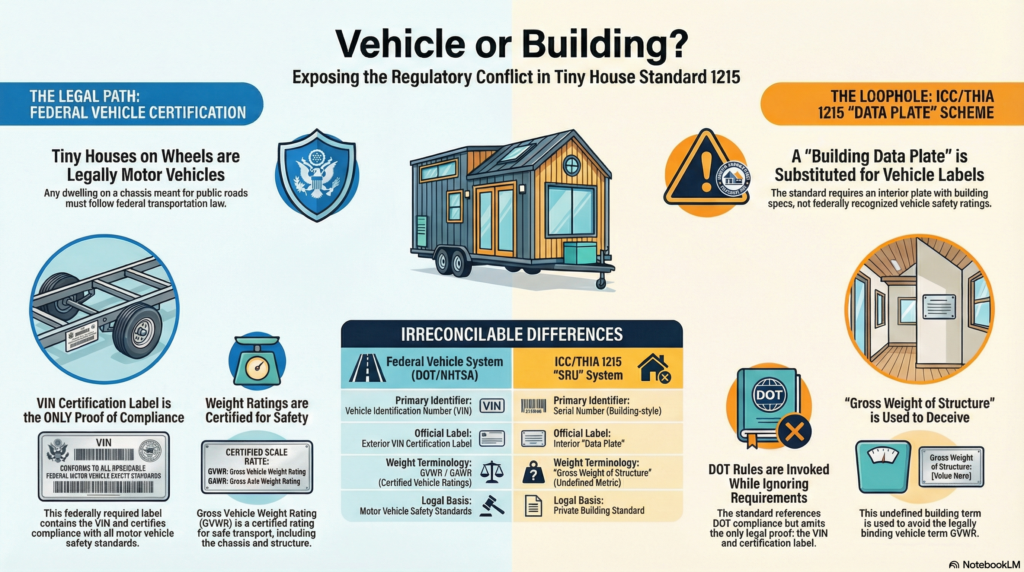
What began as a narrow, voluntary standard intended to address tiny houses was deliberately transformed into a private regulatory regime built around the fabricated “Small Residential Unit.” Rather than integrating the federally mandated motor-vehicle and personal-property compliance pathway for the chassis with the International Residential Code requirements governing the structure, ICC/THIA 1215 deliberately reroutes the lawful compliance path—reclassifying chassis-based, transportation-capable dwellings as real property at the point of manufacture while denying their status as personal property and motor vehicles during highway transport.
This rerouting bypasses established federal motor vehicle law and replaces a uniform national framework with a privately constructed pathway that fragments compliance, shifts risk downward, and dislocates responsibility from the entities that created the framework to those forced to adopt or operate under it.
How A Tiny House Standard Bypasses Federal Safety Law
What ICC/THIA 1215 Is Doing
- Reclassifying chassis-based dwellings as real property at the point of manufacture to avoid federally required motor-vehicle and personal-property identification, certification, and enforcement
- Denying personal-property and motor-vehicle status during highway transport while still permitting movement on public roads
- Using silence and purposeful omission as a strategy, excluding VINs, FMVSS certification, registration, inspection, and traceability
- Creating a “ghost trailer” condition, where transportable units operate outside both NHTSA/DOT and HUD accountability systems
- Inventing the “Small Residential Unit” to displace established federal and state housing, transportation, lending, titling, and appraisal classifications
- Selective borrowing of HUD Manufactured Housing transportation concepts while avoiding HUD Code applicability, certification labels, and oversight
- Invoking transportation metrics such as gross weight without triggering the federal taxation, registration, and enforcement regimes that attach by law
- Constructing a parallel, state-by-state compliance pathway in place of a nationally uniform federal framework
- Shifting all enforcement, compliance, and liability downstream to states, AHJs, manufacturers, carriers, lenders, and owners
- Disclaiming ICC responsibility while retaining institutional control over the standard and its adoption
Consequences
The result is regulatory failure by design. ICC/THIA 1215 leaves tiny houses with no lawful lending pathway, no consistent zoning or land-use classification, no reliable titling or taxation treatment, and no recognized method to convert from personal property to real property.
Federal motor-vehicle law and FMVSS become inoperable in practice, while compliance resets state by state with no reference point, no uniform enforcement, and no federal backstop. All legal risk and liability are transferred to adopting states, local jurisdictions, builders, carriers, and owners—while ICC disclaims accountability. The cumulative effect is the destruction of small, independent tiny-house artisan builders and a forced regulatory reset that favors large, institutionally positioned industry players capable of absorbing regulatory chaos.
The ‘Silence’ Strategy Exposed By The ‘Gross Weight’ Of Their Own Text
ICC/THIA 1215 operates not by clarity, but by calculated silence. It selectively invokes the Department of Transportation to legitimize transport while deliberately omitting any acknowledgment of FMVSS applicability, a silence that is not accidental but strategic. By refusing to say what federal law plainly requires, 1215 creates a compliance vacuum—one then “solved” by rerouting tiny houses through the fabricated Small Residential Unit construct. This maneuver strips chassis-based dwellings of their motor-vehicle obligations during transport while simultaneously assigning them dwelling status before they are land-based, effectively erasing both federal transportation law and property law in the same stroke. What is left is not harmonization, but a privately engineered detour around federal oversight, achieved not through authority, but through omission.
See ICC Reply At The End Declaring ‘Silence’
ICC/THIA 1215 Transportation Conflict With Transportation Section, DATA Plate, Disregarding Preemption
Initial Complaint To ICC
ICC Letter To Janet Thome
Janet Thome Rebuttal to ICC
Related Blog Posts
January 23, 2026