ICC Replied To My Complaint Regarding ICC 1215
On Dec. 9, 2025, I received a reply from the International Code Council regarding a complaint that I sent to them regarding that ICC 1215 was trying to override federal laws for the chassis in the standard and was in conflict with federal laws and ICC policy #49. A copy of my initial complaint and their reply to me is included after my letter.
A Public Open Letter to the International Code Council (ICC)
To The Leadership of the International Code Council:
I submit this open letter to formally address a growing and deeply concerning pattern surrounding the development of ICC 1215 – Design, Construction and Regulation of Small Residential Units and Tiny Houses for Permanent Occupancy.
I will also touch on the fact that ICC edited and omitted my public comments on the reason section supporting my public comments in response to the first draft of ICC 1215 on several comments. I will be sending a complaint to both ICC and ANSI regarding this matter.
At the center of this controversy is the transportation chassis — the very foundation that allows these structures to travel on public roads — and ICC’s persistent and strategic silence around it. Your reply addressed my complaint inaccurately, I have never stated that the modular structure is a motor vehicle, just the chassis whether it is integral to the chassis or a temporary chassis and you avoided answering the violations I pointed out, backed up with NHTSA interpretations and federal and state laws.
This silence is not harmless.
It is not procedural.
And it is not accidental.
Across multiple drafts, committee discussions, written correspondence, and now in your December 9, 2025 response to my preemption concerns, ICC has consistently avoided acknowledging the most fundamental truth in this entire process:
Trailers are motor vehicles.
Yet ICC 1215 treats this chassis as if it exists in a regulatory vacuum — exempt from VIN requirements, exempt from NHTSA registration, exempt from FMVSS, exempt from certification labels, and exempt from every federal safety obligation normally required for trailers traveling on public roads.
This is not just silence.
This is an omission with consequences.
Thank you for your December 9, 2025 reply to my preemption inquiry regarding the Transportation section of the ICC 1215 draft standard. I recognize that ICC considers this matter closed.
However, the issues raised in your response—and the broader pattern of omissions surrounding chassis compliance—remain unresolved and of significant consequence. These matters cannot simply be closed by procedural determination. They involve federal safety law, public-roadway compliance, and the foundational integrity of the standards-development process, and therefore they must be addressed transparently and comprehensively.
In its December 9, 2025 response, ICC presented multiple federal statutes, NHTSA interpretations, and court cases, but none of the authorities they cited actually address the substance of your complaint — which was about the chassis, the trailer, the motor-vehicle requirements, and the federal obligations for VINs, labeling, registration, and FMVSS compliance.
Instead, every citation ICC used pertains to the modular structure, or a manufactured home, or park model, not the chassis.
Instead, ICC re-framed my argument as if I were saying the “home” requires a VIN — a statement I never made.
My complaint was about the vehicle under the home.

NHTSA Interpretation Letter : nht72-5.49
DATE: 02/03/72
FROM: AUTHOR UNAVAILABLE; Richard B. Dyson; NHTSA
TO: Wickes Manufactured Housing
TITLE: FMVSR INTERPRETATION
TEXT: This is in reply to your letter of December 13, 1971, concerning your conversation with Michael Peskoe regarding “the provisions of Section 566.5, Manufacturer Identification.” You ask two questions, which concern that regulation, the Certification regulations, and regulations concerning “Vehicles Manufactured in Two or More Stages” (49 CFR Parts 567, 568).
Your first question is whether, “as a manufacturer of Modular Homes, which are built in a factory and then transported on a low-bed type trailer to the job site, are we required to label our units the same as a mobile home?” The requirements for labeling are found in Parts 567 and 568, and are part of the requirement that manufacturers certify compliance with all motor vehicle safety standards applicable to the particular vehicle or item of motor vehicle equipment they manufacture. Modular homes are not motor vehicles under the National Traffic and Motor Vehicle Safety Act (15 U.S.C @ 1381 et seq.) and accordingly there are no requirements that they be certified or labeled.
Your second question is as follows: ” . . . we do manufacture some of these low-bed trailers, they are strictly for our own use in transporting our modular homes, and in this case are we required to submit this report and also label any trailers we would build in the future?” Trailers are motor vehicles under the National Traffic and Motor Vehicle Safety Act and are required to comply with applicable standards. They are also required to be certified by the manufacturer in accordance with the Certification regulations (Part 567), and as a manufacturer of trailers you are required to submit the information specified in Part 566.
A copy of the National Traffic and Motor Vehicle Safety Act, and Parts 566, 567, and 568 are enclosed, as is a notice describing how to obtain a copy of the motor vehicle safety standards.
THE CENTRAL ISSUE: ICC Cannot Redefine a Motor Vehicle Out of Existence
Your response asserts that an “integrated chassis” beneath a small residential unit or tiny home is not a “motor vehicle” because the structure is “primarily for residential use.” But federal law does not define motor vehicles based on the final use of the structure mounted on top. Federal law defines a motor vehicle based on design, construction, and intended use on public roads.
Under:
49 U.S.C. § 30102(a)(7)
49 CFR 565 (VIN requirements)
49 CFR 567 (manufacturer certification)
49 CFR 568 (incomplete vehicle rules)
49 CFR 571 (FMVSS)
…any towable chassis equipped with axles, brakes, lighting, safety chains, and a coupler—regardless of the cargo it carries—is a motor vehicle or trailer.
That means it requires:
a VIN assigned through the SAE WMI process,
manufacturer registration with NHTSA,
FMVSS-compliant components,
a certification label riveted to the chassis,
complete federal recordkeeping,
and state titling and registration.
These requirements are not optional, subjective, or dependent on how ICC chooses to categorize the structure. They are federal law. No private standards organization has the authority to redefine a motor vehicle out of federal jurisdiction.
THE GHOST TRAILER SYSTEM: A 50-Year Regulatory Loophole
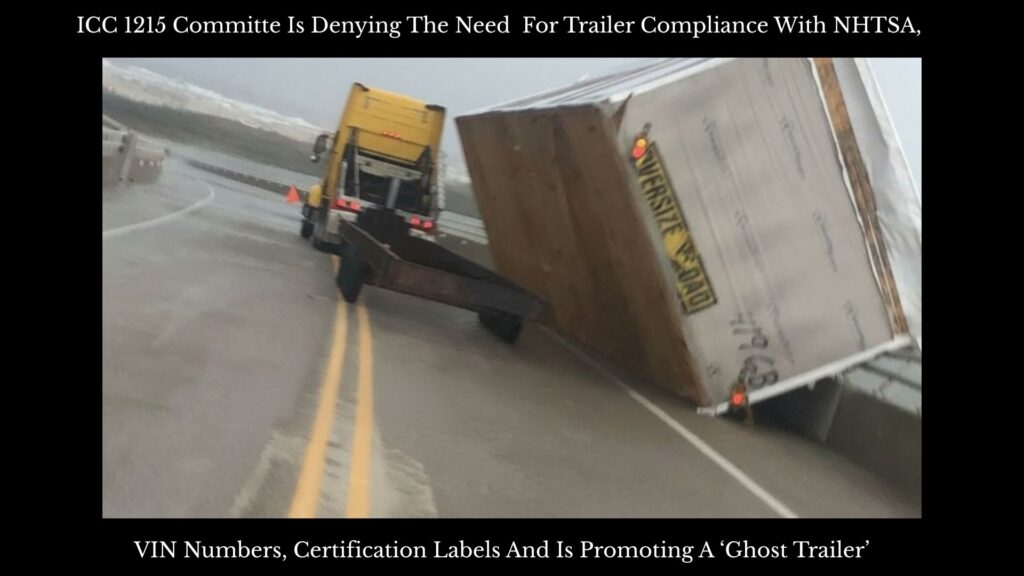
For decades, modular-unit manufacturers have transported structures on unregulated carriers—that I refer to as ghost trailers—that:
have no VIN,
are not registered with NHTSA,
are not certified,
use axles not manufactured or rated for highway use
bypass FMVSS,
and exist entirely outside the legal framework for motor-vehicle manufacturing.
This system operates in violation of federal law and has been enabled and normalized through long-standing industry practice—and ICC-NTA certification structures.
Your letter’s insistence that ICC 1215 “is silent” on transportation systems when an independent carrier is used is not a procedural gap; it is a regulatory strategy. Under Council Policy 49, acknowledging transportation would require ICC to strike provisions preempted by federal law. Silence is being used to preserve an unlawful system—not to protect public safety.
But silence does not erase federal law.
And silence does not protect consumers, builders, or building officials.
THE SRU TAKEOVER: A Redirection of Purpose
ICC 1215 began with a clear objective:
to add chassis provisions needed to legitimize Tiny Houses on Wheels and advance Appendix BB Tiny Houses.
Instead, the standard was overtaken by the creation of the Small Residential Unit (SRU)—a made-up, undefined, 1,200 sq. ft. classification with no historical use or demand in the tiny-house movement.
This shift:
dilutes the definition of “tiny house,”
expands ICC’s jurisdictional reach,
marginalizes Appendix BB Tiny Houses.
and diverts attention from the actual issue—chassis compliance and transportation safety.
The SRU takeover has functioned as a distraction while the chassis issue remains studiously avoided.
WHAT THIS PATTERN REVEALS
When viewed collectively—the redefinition of chassis, the long-standing ghost-trailer system, the SRU scope expansion, the reliance on “silence” as a legal defense, and the alteration of public comments—a clear pattern emerges:
A pattern of avoiding federal law.
A pattern of circumventing jurisdiction.
A pattern of protecting entrenched certification markets.
A pattern of suppressing dissent through selective omission.
A pattern of rewriting transportation reality through their own provisions instead of compliance.
A chassis does not stop being a motor vehicle because ICC chooses not to acknowledge it.
And a private standards body cannot use silence to sidestep federal law.
A CALL FOR CLARITY, ACCOUNTABILITY, AND FULL COMPLIANCE
1. A transparent explanation of why ICC 1215 is silent on chassis compliance despite explicit federal requirements.
2. Recognition of NHTSA’s statutory jurisdiction over towable chassis and motor-vehicle manufacturing.
3. Correction of altered or omitted public-comment submissions in the official record.
4. Removal of the exception of the temporary carrier system that acts as a trailer during transport of modular homes that they have falsely stated does not need to follow NHTSA or DOT requirements.
5. Reaffirmation that no ICC standard may override, redefine, or conflict with federal law.
The public deserves a standard grounded in law, truth, and safety—not silence, procedural maneuvering, or definitional constructs created to avoid federal oversight.
“The Identity-Fluid Chassis Doctrine”
ICC’s position essentially boils down to this:
a trailer is only a motor vehicle if it chooses to identify as one.
They argue that a fully road-going chassis — with a frame, axles, brakes, a hitch, a tow rating, lighting, and a manufacturer — magically ceases to be a “vehicle” because a house is built on top of it. Their interpretation suggests a kind of regulatory identity fluidity:
On the highway, it identifies as a trailer.
On arrival, it identifies as a house.
Therefore, federal law no longer applies.
This would be amusing if it weren’t being used to justify the largest unregulated, VIN-less, uncertified ghost-trailer system in the country.
If ICC’s theory were valid, then:
a semi-trailer could “identify” as a shed
a bus could “identify” as a meeting room
a fifth-wheel trailer could “identify” as a cabin
…and all of them could instantly escape VIN, FMVSS, certification, and NHTSA oversight.
This is not interpretation — it is a deliberate dismantling of federal safety law to preserve ICC-NTA’s commercial ecosystem and the 50-year ghost-trailer loophole.
ICC Cited Court Cases And NHTSA Interpretations That Do NOT Support Their Position.
Citing this one court case does not support ICC’s position or my complaint. That is one court case. The case conflicts with Georgia law that states a manufactured home is a motor vehicle, the manufacturer of the manufactured home is Merit Manufacturer Home with a Vehicle Identification number FLHML2P357Y21978A/B (“Manufactured Home”). The manufacturer is based in Florida and Florida statute states include the following to obtain a loan. The requirements acknowledge it has a VIN number and surrendering the title. CFR § 3280.903 requires a road test witnessed by an independent registered professional engineer or architect, manufacturer’s IPIA or DAPIA, or by a recognized testing organization.
The lender should record the following documents in the official records of the clerk of court in the
county in which the real property is located:
1) The original title to the manufactured home, including a description of the manufactured home,
model year, make, width, length, and Vehicle Identification Number (VIN), and a statement by
any recorded lienholder on the title that the security interest in the home has been released,
or that such security interest will be released upon retirement of the title;
2. The legal description of the real property, and in the case of a leasehold interest,32
a copy of the lease agreement;
3. A sworn statement by the owner of the real property, as shown on the real property deed
or lease, that he or she is the owner of the manufactured home and that the home is
permanently affixed to the real property in accordance with Florida law.33
The application to retire the Certificate of Title may be found here:
The clerk of court, upon receipt of these documents, must record said documents against the real
property and provide a copy of the recorded title to the owner of the real property with a copy of
all the documents.34
A manufactured home whose title has been retired must be conveyed by deed or real estate contract
and must only be transferred together with the property to which it is affixed, unless procedures
for the issuance of a new title are followed.35
Further, if the title of a manufactured home has been retired, for purposes of perfecting, realizing,
and foreclosure of security interests, a separate security interest in the manufactured home must
not exist, and the manufactured home must only be secured as part of the real property through
a mortgage or deed or trust.
CONCLUSION: WHY ICC USES SILENCE AS POLICY
ICC remains silent because silence accomplishes the following:
✔ Avoids triggering preemption
✔ Avoids acknowledging federal jurisdiction
✔ Protects ICC-NTA’s commercial interests
✔ Shields ICC from liability
✔ Prevents public scrutiny
✔ Avoids damaging admissions
✔ Allows ICC to regulate unlawfully by omission
✔ Maintains the ghost trailer system
✔ Preserves building-official adoption
✔ Masks conflicts of interest
✔ Neutralizes my arguments without responding to them
Silence is ICC’s most powerful regulatory weapon.
They use it consistently, strategically, and deliberately.
ANTITRUST IMPLICATIONS — Sherman Act & Clayton Act
Because ICC is a market-controlling standards organization, altering comments is not just procedural misconduct — it is anticompetitive behavior when:
dissent is suppressed
competing viewpoints are erased
standards are shaped to favor select manufacturers or certification bodies
regulatory narratives are controlled by a commercial entity
This behavior supports:
monopolization (Sherman Act §2)
restraint of trade (Sherman Act §1)
market foreclosure
unfair competitive advantage
Your comments relate to safety, compliance, VIN requirements, and federal law — removing them distorts the regulatory landscape and protects the ICC-NTA ecosystem.
This is not trivial — it is evidence of a coordinated suppression of competing regulatory viewpoints.
David Tompos Sr. Has Submitted New Comments To ICC 1215
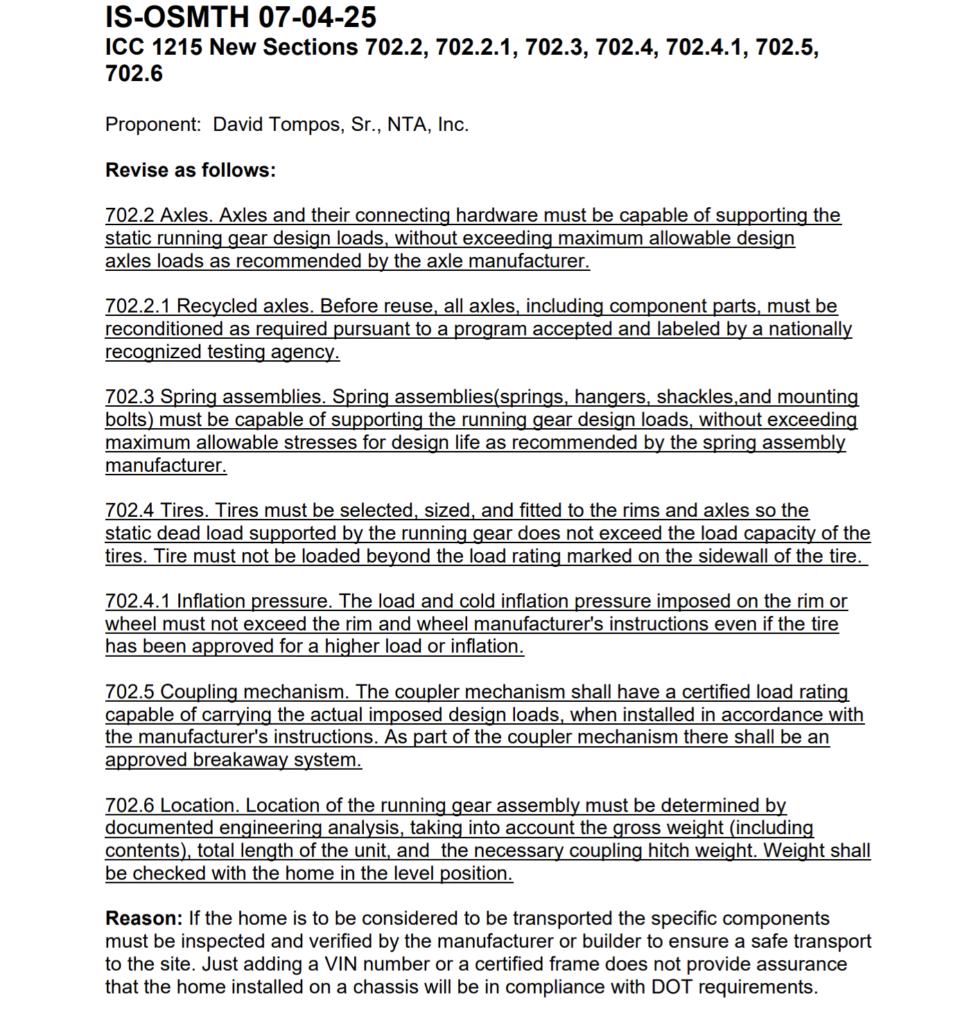
In its December 9, 2025 response, ICC asserts that the Transportation section of ICC 1215 is not preempted because units with an “integrated chassis” are not “motor vehicles,” and because the standard is allegedly “silent” on transportation requirements for temporary carrier systems. That assertion is now directly contradicted by the submission of new transportation provisions through public comments by David Tompos Sr., ICC-NTA staff and voting member of the ICC 1215 committee.
David has submitted a new section with provisions on axles, tires, recycled axles, spring assemblies,tires, coupling mechanism, and location of the running gear. and other chassis components under the transportation section. The provisions submitted look like they are loosely based on the HUD code. This section was included with almost the same language in the initial draft for public comment, and then removed in the draft for public comment.
NHTSA, FMVSS, and FMSCA already have federal laws on every component that David listed, in fact if components,. such as an axle tire unit of motor vehicles, which include trailers, are sold separately, and not as a completed trailer, it is deemed a trailer and requires its own VIN number and certification requirements as explained in – NHTSA interpretation letter -ID 12217.DRN
This responds to your request for an interpretation of vehicle identification number (VIN) requirements for trailers. You wish to know whether a trailer, consisting of a gooseneck, a deck, a 2-axle (or 3-axle) bogie and two separate sets of an axle unit attached to tires, is one or several trailers.
As explained below, the answer depends on whether the bogie and axles are sold as one unit or separately. If sold with the gooseneck, deck, and bogie, the axle-tire unit is part of a trailer and would not have a separate VIN. If sold separately, each axle-tire unit is a trailer. Each trailer must have a distinct VIN and must meet the National Highway Traffic Safety Administration’s (NHTSA) certification requirements.
Your letter stated that the axles with tires can separate from each other and from the bogies to form different trailer configurations. In a telephone conversation with Dorothy Nakama of my staff, you explained that the customer may first buy the trailer with the bogie only, and later buy one or both axle-tire units. Each axle-tire unit consists of a load bed, an axle, and tires. To lessen confusion, especially when the bogie is sold or used separately from each axle-tire unit, you wish to assign separate VINs to the bogie and each axle-tire unit.
Although you ask about VIN requirements (specified at 49 CFR Part 565 Vehicle Identification Number Requirements), please be aware that NHTSA’s vehicle certification requirements, at 49 CFR part 567 Certification, also apply. The “VIN Data Plate” you refer to describes information required for the trailer’s certification label, including the gross vehicle weight rating (GVWR) and gross axle weight rating (GAWR). In answering your questions, I will describe both your VIN and certification responsibilities.
This Is Not Silence
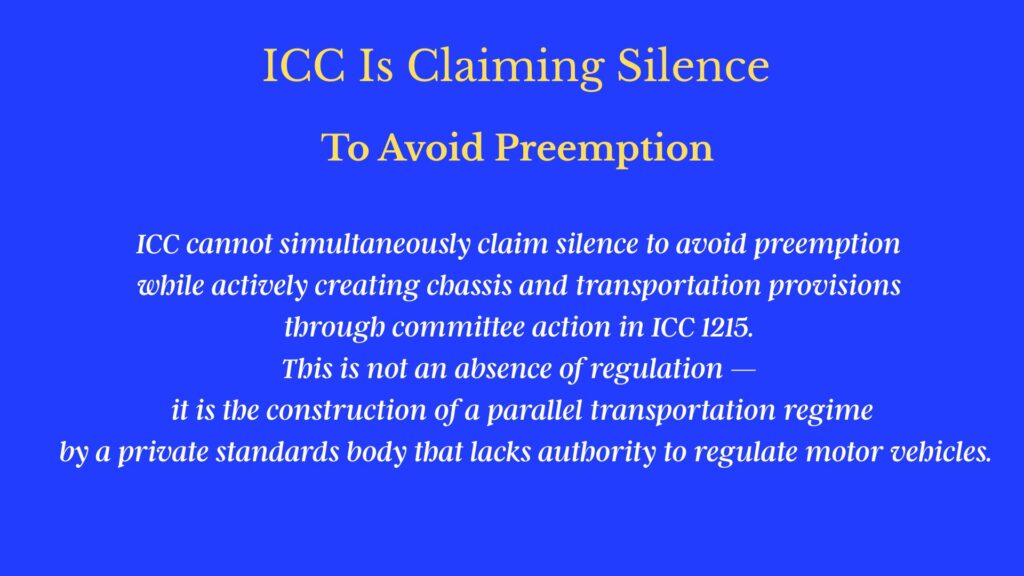
ICC cannot simultaneously claim silence to avoid preemption while actively creating chassis and transportation provisions through committee action in ICC 1215. This is not an absence of regulation — it is the construction of a parallel transportation regime by a private standards body that lacks authority to regulate motor vehicles.
More Supportive Information
What is disturbing is that public comments were presented that included FMVSS and were considered by Workgroup 3 as stated below and when the draft came out for public comments, the Federal Motor Vehicle Safety Standards refernce was omitted.
CHASSIS. A floor framing and transport system designed to transfer
structural loads to the permanent foundation. It is an integral
component of the structure and cannot be removed without
substantial structural alteration. The chassis includes such
transportation and safety features as the drawbar and coupling
mechanism, frame, running gear assembly, and complies with Federal
Motor Vehicle Safety Standards.
Closing Thoughts
ICC 1215 presents a critical question:
Is the continued silence on chassis compliance an oversight—or a regulatory coverup?
Given the omissions, altered comments, and misclassification of federally regulated systems, the answer appears increasingly clear.
ICC stated-
”Because a tiny home or small residential unit that is built on an integrated carrier chassis that remains part of the dwelling after it is transported is not a “motor vehicle,” the federal laws regarding labeling or certification requirements you cited do not apply to such structures. As a result, the Board does not believe the current draft standard is likely to be preempted by the federal laws you cited. ”
I never stated in my complaint that the ‘ structure‘ itself would require labeling or certification. The structure would have a serial number, a Data Plate, and an Insignia from the 3rd party. I have only been referring to the integrated carrier chassis, which is a trailer. The final manufacturer will either purchase a prefabricated trailer or build both the trailer, and in both cases, the structure will become integrated to the trailer.
ICC is ignoring that although that components or all of the chassis will remain with the dwelling and is integral to the floor assembly, during transit, the chassis is both a frame structure and load supporting for movement on the roads and highways.
From NHTSA– To be considered “load supporting,” the frame structure has to support a load when the trailer is performing its function. Generally, this means that the structure would have to contribute to supporting the cargo load when the trailer is in transit.
To be considered part of the frame structure, a structural member must be either an integral part of the overall frame structure, or be connected with other frame structural members in a way that is necessary to the structural integrity of the trailer. One factor the agency considers in deciding whether a structural member is part of the frame is its size and strength. Frame structural components often are the major structures defining the shape of the trailer. Although frame structure is not limited to the largest frame components (i.e., the frame rails for most trailers), generally frame components are substantial and have strength similar to other frame components.
The agency also considers the purpose and function of the structural member in supporting the trailer and its load.
ICC Stated-
”The Transportation section is silent as to transportation requirements for modular homes transported by temporary carrier systems and therefore does not impose any requirements that could be preempted by federal law. ”
ICC purposely put an exception provision ( To Support Their Silence So It Would Not Trigger Preemption) in the transportation section in ICC 1215 for the temporary carrier system ( the chassis) so this type of chassis does not have to meet DOT or any other requirements of the ICC 1215 standard which shines a very bright light and blows holes in their argument about incidental use. The temporary carrier system ( chassis) is fabricated strictly for the use of transporting modular structures and is the sole purpose of its use. The exception was added after I pointed out to them that it is an illegal ‘ghost trailer’ never in the NHTSA/DOT system and their silence will help continue this practice and is an intentional coverup.
A code or standard cannot lawfully avoid federal preemption through silence or omission. Where federal law occupies the field or establishes mandatory requirements, any subordinate standard that creates an alternate compliance pathway—without acknowledging or reconciling those requirements—is preempted, arbitrary, and procedurally defective as a matter of law.
ICC 1215 is addressing transportation in the standard with known federal and state laws in place, this is a due-process violation, not a neutral drafting choice to choose silence by omission.
I urge ICC leadership and committee members to address these issues openly, in good faith, and in alignment with federal law. Silence on chassis compliance is not only indefensible—it is dangerous, adding more illegal trailers on the road and setting up manufacturers for hefty fines for non compliance.
Sincerely,
Janet Thome
Founder & President
Tiny House Alliance USA
ICC's Reply To Janet Thome Dec. 9, 2025
Janet Thome's Complaint To ICC
Related
NHTSA Presentation
Dec. 11, 2025