Denying NHTSA/DOT/FMVSS/FMCSA And VIN Numbers
ICC/THIA 1215 Standard, “Design, Construction and Regulation of Small Residential Units and Tiny Houses for Permanent Occupancy,” attempts to redefine and override existing federal and state laws governing motor vehicles, including trailers. By omitting all reference to the federal framework that regulates the design, manufacture, labeling, and certification of trailers under the National Traffic and Motor Vehicle Safety Act (49 U.S.C. 30101 et seq.), the standard creates a dangerous and unlawful regulatory gap.
ICC 1215 Is Avoiding The Very Path That Is Needed For Compliance
Why this is such a serious matter is because part of the path for compliance for tiny houses on wheels is to know where one authority begins and ends so no one is taking on added liability that they thought they would have to take on. At the recent second ICC CAH hearing, there were several building officials that voiced their opposition to public comment 1 of RB42-25 that added chassis provisions to Appendix BB Tiny Houses primarily for perceived liability they thought they would be required to take on.
The public comment was disapproved. Link to hearing.
ICC Is Avoiding Federal Laws By Purposeful Omission
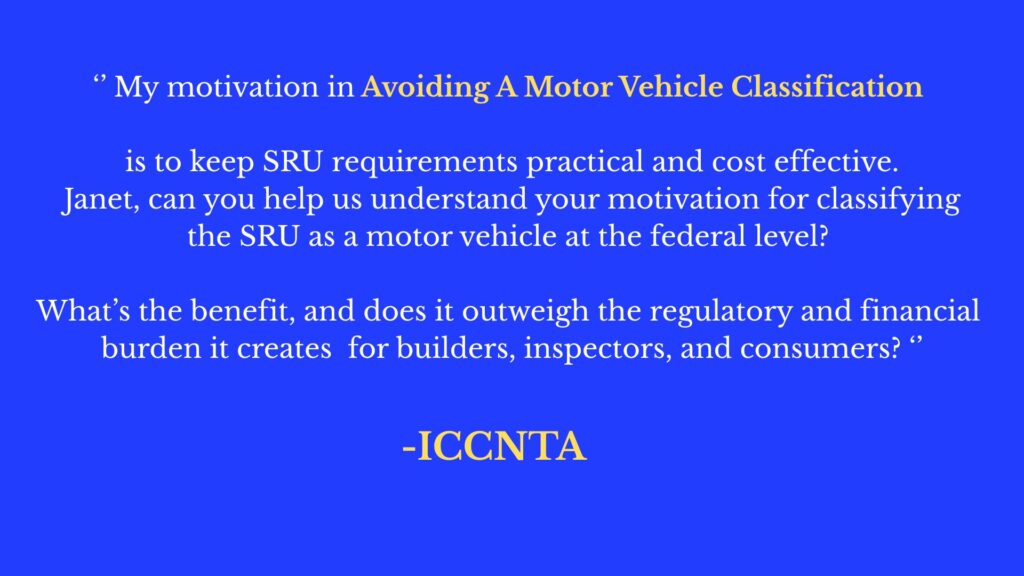
My answer- federal laws trump codes and standards, it is NOT that I want an SRU to be classified as a motor vehicle, it is the path to compliance for trailers. I have simply pointed out the laws-which they want to ignore.
ICC 1215 Is Violating CP#49-21 – Conforming Codes and Standards to United States Federal Law And International Law
1.0 Statement of Policy: It is the policy of ICC that its Codes and Standards should conform to, and should not conflict with, the law and requirements of the United States government. Additionally, it is the goal of ICC that its Codes and Standards should not any provisions that would preclude the Codes and Standards from being adopted internationally.
NHTSA Requires Trailer Manufacturers To Affix Certification Labels
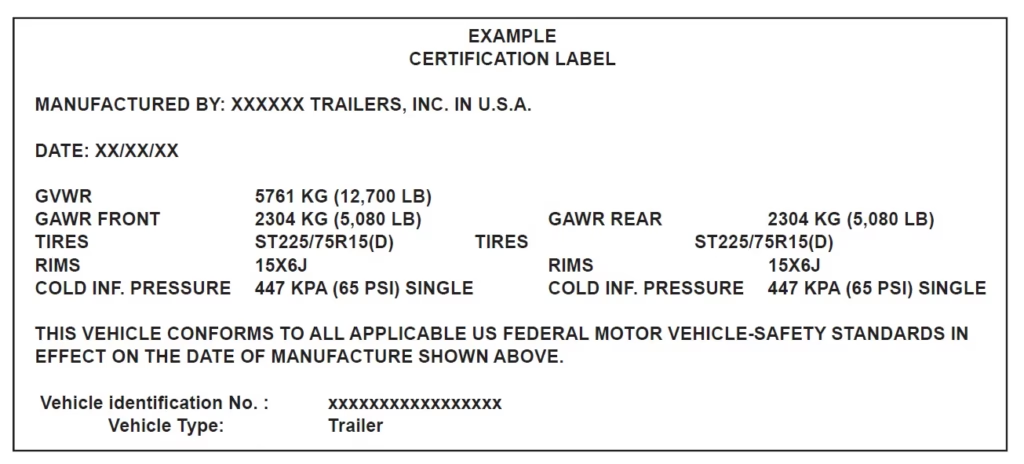
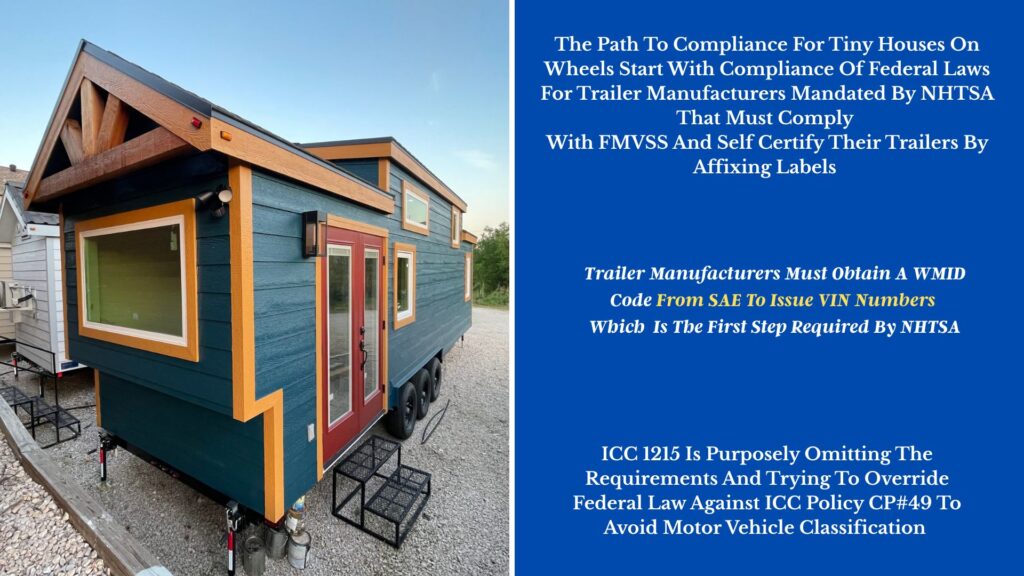
Under federal law, any trailer capable of being towed on public roads is defined as a motor vehicle subject to the jurisdiction of the National Highway Traffic Safety Administration (NHTSA). Manufacturers must comply with the Federal Motor Vehicle Safety Standards (FMVSS), obtain a World Manufacturer Identifier (WMI) through SAE International, assign a Vehicle Identification Number (VIN), and affix a permanent certification label verifying compliance. None of these mandatory safety and identification requirements are acknowledged or referenced in the ICC 1215 draft.
The Redefinition Conflicts With Federal Law
Instead, the standard reclassifies a “movable tiny house” or “unit with a chassis” as a type of building, effectively erasing its federal transportation status. This redefinition not only conflicts with federal law but invites state and local building officials—many of whom sit on the ICC 1215 voting committee—to adopt and enforce a standard that directly contradicts NHTSA’s authority. This dual role presents a structural conflict of interest: building officials who help write the standard will also be responsible for approving units built under it within their jurisdictions.
Disservice To The Tiny House Industry
Such a framework does a profound disservice to manufacturers, consumers, and building officials alike.
- Manufacturers are misled into believing they can build towable units without VINs, FMVSS certification, or NHTSA registration.
- Consumers are exposed to unsafe, untraceable trailers that cannot be legally titled, insured, or registered for highway use.
- Building officials are placed in legal jeopardy by approving transportable structures that violate federal motor vehicle law.
ICC 1215 Disregards The Motor Vehicle's Safety Act's Purpose
In short, ICC 1215 disregards the Motor Vehicle Safety Act’s purpose—to ensure the safety, identification, and lawful operation of motor vehicles in interstate commerce—and replaces it with a privately created standard that nullifies federal oversight. This omission undermines decades of established motor vehicle regulation and threatens both public safety and regulatory integrity.
The ICC/THIA 1215 standard acts as “shadow regulation,” unlawfully avoiding federal laws with the chassis requirements.
Notice of Public Comment Period
The first draft of the ICC/THIA 1215 Standard — Design, Construction and Regulation of Small Residential Units and Tiny Houses for Permanent Occupancy has now been released for public comment.
The deadline to submit comments is November 24, 2025.
Because this draft directly conflicts with federal transportation and motor-vehicle safety laws, every building official, owner builder, manufacturer, third party agency, consumers, architects, engineers, and AHJ must review these issues carefully before any adoption or endorsement in the future and submit your own comments.
Trailers Are Motor Vehicles
Whether the chassis is temporary (detachable carrier) or integrated into the dwelling, the chassis remains a motor-vehicle, a trailer under federal law:
Definitions In Federal Law
- 49 U.S.C. § 30102(a)(7) – “Motor vehicle” means a vehicle driven or drawn by mechanical power and manufactured primarily for use on public streets, roads, and highways.
- 49 CFR 565.2 – Defines “trailer” as a motor vehicle designed for carrying property or persons and for being drawn by another motor vehicle.
- 49 CFR 393.5-Chassis. The load-supporting frame of a commercial motor vehicle, exclusive of any appurtenances which might be added to accommodate cargo.
ICC 1215 is avoiding the motor vehicle definition and using a definition for the chassis primarily from the HUD code, which is not appropriate because the standard is beyond the scope of manufactured homes and they cannot override federal definitions.
From ICC 1215
CHASSIS. The entire transportation system comprising of the drawbar and coupling mechanism, running gear assembly (wheels, tires, axles, brakes and suspension) and may include running and lights and/or an integral frame.
An integrated chassis is subject to all VIN, labeling, and certification requirements.
The Modular structure itself (Tiny House Or SRU) would not be classified as a motor vehicle, however the chassis would be whether it is a temporary chassis acting as a carrier system or integrated with the structure, and must follow all federal laws for trailers.
How Has The ‘Ghost Trailer’ Been Used Without Detection For 50 Years?
The ‘Ghost Trailer’ has fallen in between the cracks because of a disconnect where one authority begins and ends, and at transport, they are using the serial number of the modular structure and not the required VIN Data Plate that is affixed by the manufacturer to the trailer as required by NHTSA.
The Lack Of Vin Makes The Temporary Carrier System Untraceable
The VIN system is the legal backbone of the U.S. motor vehicle economy. It connects NHTSA manufacturing compliance to every downstream requirement — titling, taxation, insurance, financing, and resale. By eliminating VINs for a so-called “independent carrier chassis,” ICC 1215 standard facilitates a shadow fleet of unregistered, untaxed, not properly insured, and unfinanceable motor vehicles. These ‘Ghost Trailers’ undermine federal safety law, consumer protection, and the fiscal integrity of both state and federal tax systems.
The ICC 1215 “independent carrier chassis” exemption unlawfully bypasses the federal manufacturer-identification and VIN-issuance system established under 49 CFR Parts 565–566 and 567. Because SAE International administers the World Manufacturer Identifier (WMI) system under contract with NHTSA, any chassis builder operating without an SAE-issued WMI and VIN is manufacturing and selling unregistered, untraceable motor vehicles. This eliminates federal oversight, recall accountability, and tax tracking—effectively creating a class of “ghost trailers” invisible to both NHTSA and IRS.
Complaint To NHTSA
Complaint To ICC CEO
Related Blog Posts
November 13, 2025