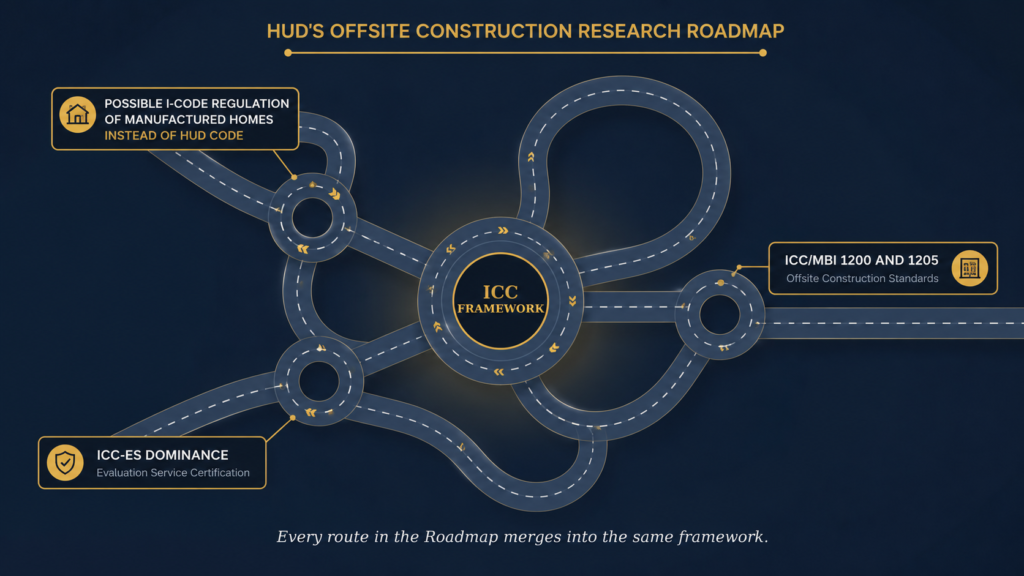
I previously wrote an extensive article on two HUD publications called HUD Funds Fast Track ICC/NIBS/MODX Monopoly. I want to narrow the focus here to the ICC-ES references and the extent of ICC’s influence within those documents, and specifically to what the study suggests HUD should do next.
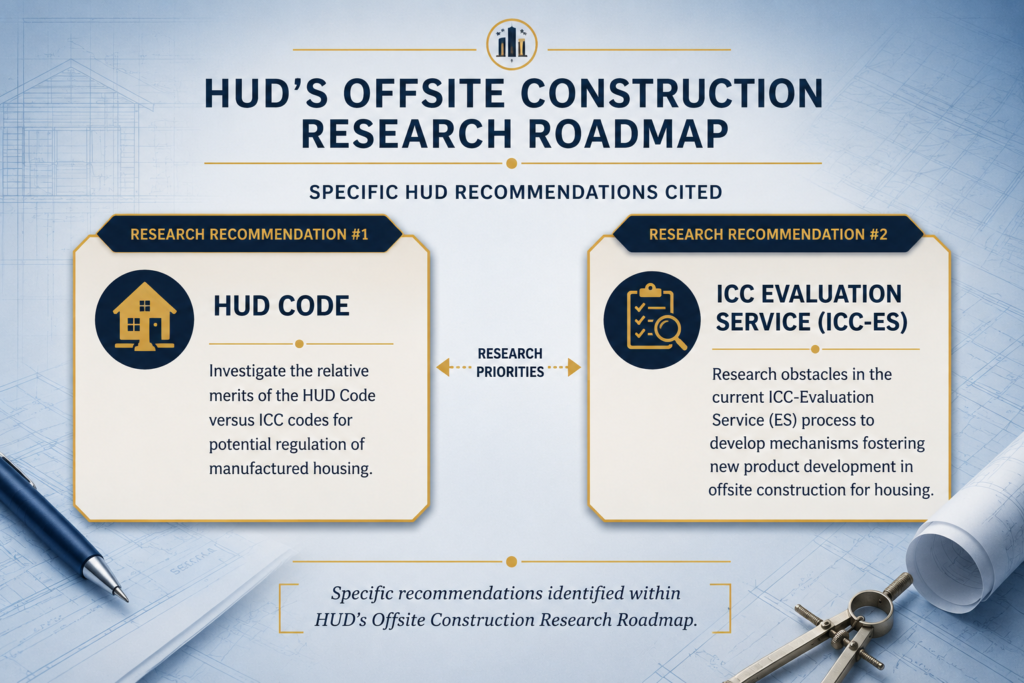
Specific HUD Recommendations Cited
HUD Code — Investigate the relative merits of the HUD Code versus ICC codes for potential regulation of manufactured housing.
New Products — Research obstacles in the current ICC-Evaluation Service (ES) process to develop mechanisms fostering new product development in offsite construction for housing.
Video Explainer
Both recommendations treat ICC and ICC-ES as the reference point for the entire evaluation and regulatory conversation — the first frames the code question as HUD Code versus ICC codes, with no third option considered, and the second frames the fix for slow product innovation as improving ICC-ES’s internal process, rather than asking whether the market already has other accredited paths for getting new products evaluated. Neither recommendation acknowledges that the “obstacles” identified in the ICC-ES process are specific to one company’s internal procedures — not to the ISO/IEC 17065 accreditation framework itself, which multiple other agencies operate under successfully.
What This Means for Consumers, Competition, and the Market
When a federal agency’s research and funding flow exclusively through one company’s process, the effects reach beyond that one program.
Consumer choice narrows — builders and manufacturers get steered toward the evaluation path that federal guidance describes and legitimizes, even when equally accredited alternatives exist.
Open competition breaks down — a fair marketplace depends on multiple qualified providers competing for the same work on the same terms, not one provider being studied, funded, and improved with taxpayer dollars while others are ignored.
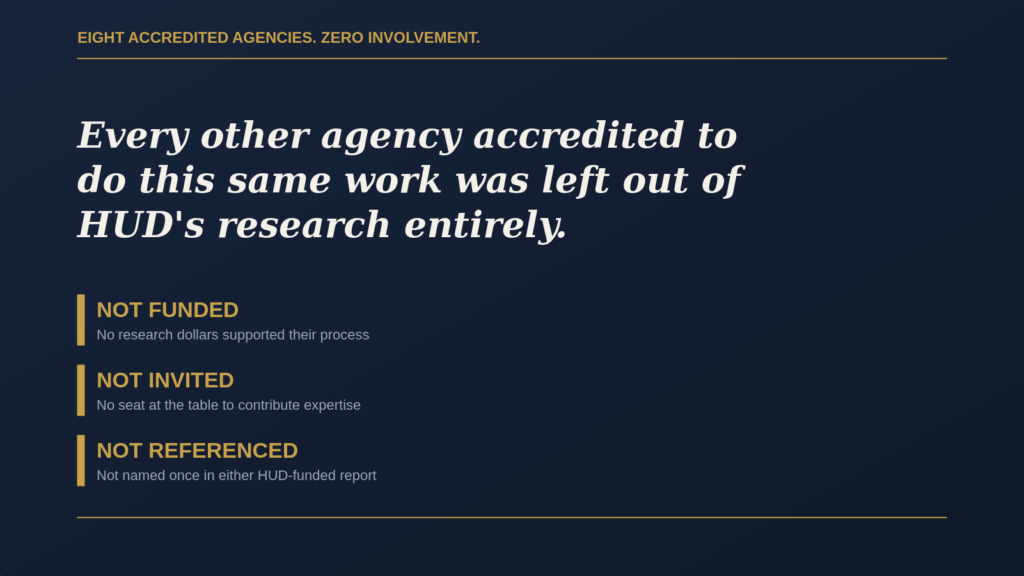
No other agency was invited to participate — none were asked to contribute their perspective on obstacles in the evaluation process, or asked to weigh in on how offsite construction should be regulated.
No other agency was funded — public research dollars went toward improving one company’s internal process, not toward understanding the accredited system as a whole.
No other agency was included in the conversation — not because they lack accreditation or capability, but because the HUD-funded documents never considered them part of the picture.
All Competitors Of ICC Were Left Out Of The HUD Plan
List Of Third Party Agencies That Offer Evaluation For Building Materials
This in not an extensive list. Please contact us to be included.
IAPMO Uniform Evaluation Service (IAPMO UES) Intertek PFS-TECO RADCO DrJ Engineering QAI Laboratories CSA Group UL Solutions (Underwriters Laboratories)
Conclusion
What this produces, over time, is market consolidation dressed up as research. A federal agency’s own documents effectively function as an endorsement of one company’s process, discouraging competition rather than fostering it. That should be disturbing regardless of where anyone stands on the underlying housing policy: a federal agency partnering, in effect, with a private entity to help cement that entity’s market dominance — using public research dollars to do it — runs counter to the fair, competitive marketplace HUD’s own mission is supposed to protect.
Antitrust Concerns
Beyond the fairness and competition issues already raised, this pattern raises specific antitrust concerns:
Restriction of trade — steering federal research, funding, and technical assistance toward a single certification provider can function as a de facto barrier to entry for competing, equally accredited agencies.
Tying and bundling — when code compliance, product evaluation, and now offsite/modular system compliance are all funneled toward one company’s process, it begins to resemble tying separate services together rather than allowing each to be selected competitively.
Hub-and-spoke arrangements — the structure connecting HUD, NIBS, and MOD X, with personnel overlapping into ICC’s orbit, mirrors what antitrust law describes as a hub-and-spoke conspiracy: a central player (the “hub”) coordinating parallel arrangements with multiple “spokes” that reinforce a shared market advantage.
Vertical and horizontal effects — vertically, HUD funding flows down through NIBS to MOD X in a way that shapes the market from the top; horizontally, this narrows the field of evaluation-service competitors who might otherwise compete for the same manufacturers’ business.
An Admission Buried in the Data
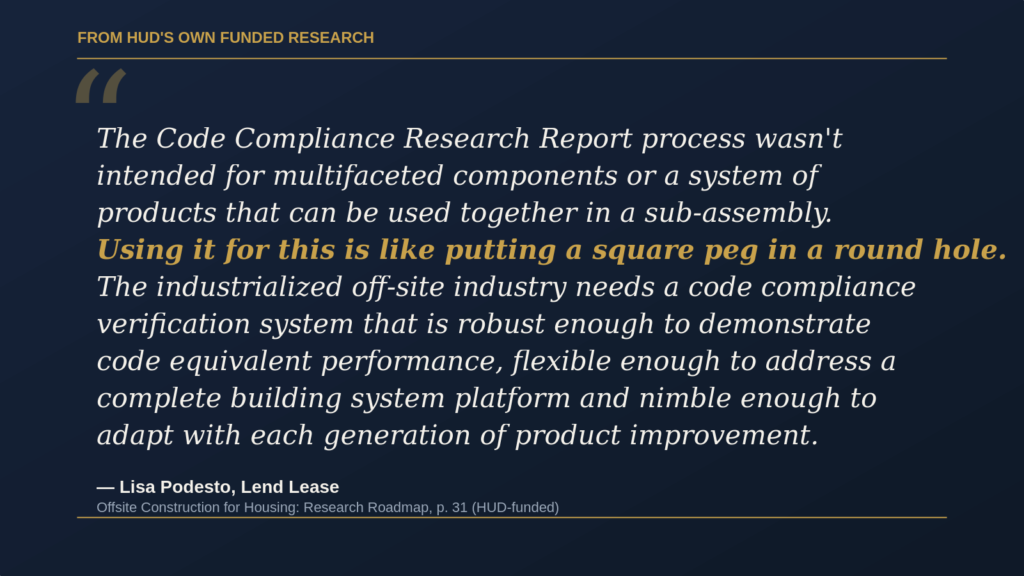
One passage from the Research Roadmap (p. 31), attributed to Lisa Podesto of Lend Lease, is worth quoting directly:
“The Code Compliance Research Report process wasn’t intended for multifaceted components or a system of products that can be used together in a sub-assembly. Using it for this is like putting a square peg in a round hole. The industrialized off-site industry needs a code compliance verification system that is robust enough to demonstrate code equivalent performance, flexible enough to address a complete building system platform and nimble enough to adapt with each generation of product improvement.” — Lisa Podesto, Lend Lease; Research Roadmap, p. 31
Translation
Look at HUD’s own recommendations together and a pattern shows up: HUD is asked to weigh HUD Code against ICC codes (not against any other option), to fix problems inside ICC-ES’s evaluation process (not to look at other accredited agencies already doing this work), and — per its own consultant’s admission that no current piecemeal process is robust, flexible, and nimble enough for offsite construction — to treat the entire ICC framework, codes, ICC/MBI 1200/1205 standards, and ICC-ES certification together, as the only system capable of covering a complete building platform, rather than individual pieces handled by different accredited providers; taken together, that’s not three separate fixes, it’s one trajectory where the whole ICC framework, not just pieces of it, becomes positioned as the single, necessary infrastructure offsite construction runs through, funded by the federal agency that’s supposed to regulate the industry, not hand its framework to one company’s complete, bundled system.
ICC -ES References In HUD's Off-Site Construction Roadmap
Scaling Factory-Built Housing: Only Mentioning ICC-ES
Related Article: From HUD Office Of Policy And Development
Although prefabricated and factory-built housing has promised faster construction times, many systems remain limited by specialized engineering requirements, proprietary installation methods, restrictive zoning classifications, and inconsistent permitting pathways. In response to these challenges, Fornidos designed its panels to align with standard stick-built construction rather than functioning as a separate housing construction category. The International Code Council Evaluation Service (ICC-ES) certified the company’s 24 factory-built panels as an ICC-compliant construction system capable of meeting both International Building Code and International Residential Code standards. Companies including Insulspan, sPanel, and Premier Building Systems, for example, have also received ICC-EScertification for structural panels that can be used in residential construction. This status eases the construction’s approval across markets that may have varying building codes but that recognize ICC-compliance. Article July 16, 2026
Original Song:Dadgum Ink
This is very disturbing to see the federal government partnering with ICC, a trade association and fast tracking an already integrated system to have complete market control.