The Ghost Trailer Is Never In The NHTSA/DOT System
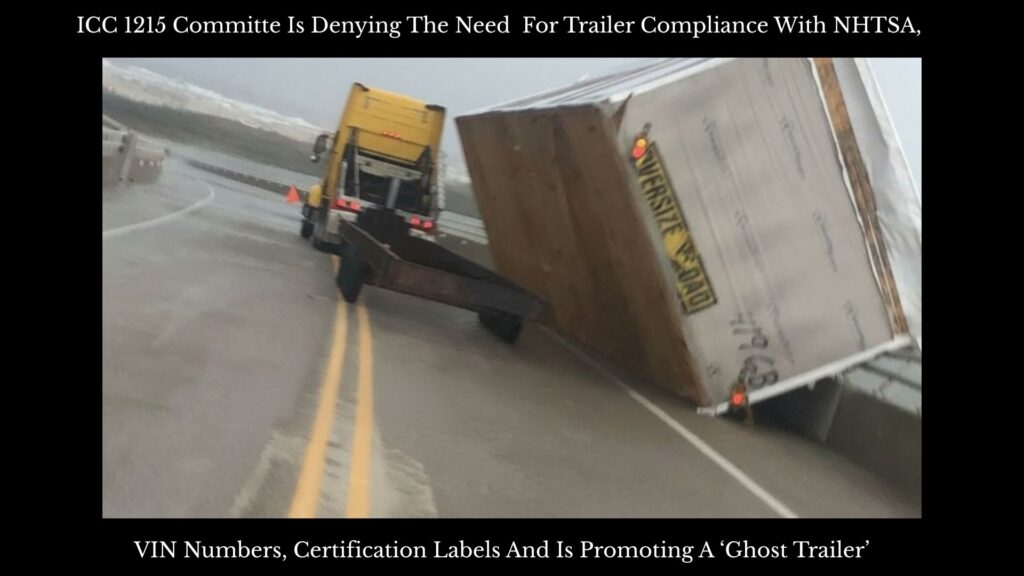
I am getting ready to submit my comments to the first draft of the ICC standard called ICC/THIA Design, Construction And Regulation Of Small Residential Units And Tiny Houses For Permanent Occupancy and I have a lot to say about the Transportation section that is promoting a trailer and asking for an exception to any compliance requirements that is never in the NHTSA/DOT system, does not have a VIN number, it is not labeled, or certified by the manufacturer, is not titled, and is essentially a ‘Ghost Trailer’.
I do not support the Small Residential Unit ( SRU), A made up term that no one uses that places a tiny house, a codified term in the IRC as a subcategory under the SRU, a 1200 square foot house with or without a chassis.
To get caught up to speed for in depth reasons of my opposition to the SRU, read this blog post first OSMTH ICC 1215 First Draft For Public Comment
Chapter 7 Transportation
I was involved as an interested party for over a year and the whole time certain people from the committee denied there a need for VIN numbers, and to comply with NHTSA/DOT and FMVSS for trailers. There were vigorous discussions in the open public meetings, work group meetings, and in emails. What I discovered was that the modular industry has been using a carrier system that acts like a temporary chassis that is never in the NHTSA/DOT system. This method has been used for over 50 years undetected.
Key Definitions In ICC 1215
SMALL RESIDENTIAL UNIT (SRU). A dwelling unit that is 1,200 square feet or less constructed as a
permanent residential structure with or without a PERMANENT CHASSIS system.
TINY HOUSE. A SMALL RESIDENTIAL UNIT 400 square feet or less with or without a PERMANENT
CHASSIS system
CHASSIS. The entire transportation system comprising of the drawbar and coupling mechanism, running
gear assembly (wheels, tires, axles, brakes and suspension) and may include running and lights and/or
an integral frame
INTEGRAL CHASSIS. A chassis that is designed to be a permanent component of the building and
provides all or part of the structural floor system.
DATA PLATE. A plate attached by the MANUFACTURER or BUILDER, to a SMALL RESIDENTIAL UNIT, or
component that contains identifying information allowing code officials or end users to determine if the
structure is suitable for installation in their jurisdiction, location, project or special conditions
Key Federal Definitions That ICC Is Ignoring
49 U.S.C. § 30102(a)(7):
“Motor vehicle” means a vehicle driven or drawn by mechanical power and manufactured primarily for use on public streets, roads, and highways.
49 CFR 565.2:
Defines “trailer” as a motor vehicle designed for carrying property or persons and for being drawn by another motor vehicle.
The Modular structure itself (Tiny House Or SRU) would not be classified as a motor vehicle, however the chassis would be whether it is a temporary chassis acting as a carrier system or integrated with the structure, and must follow all federal laws for trailers.
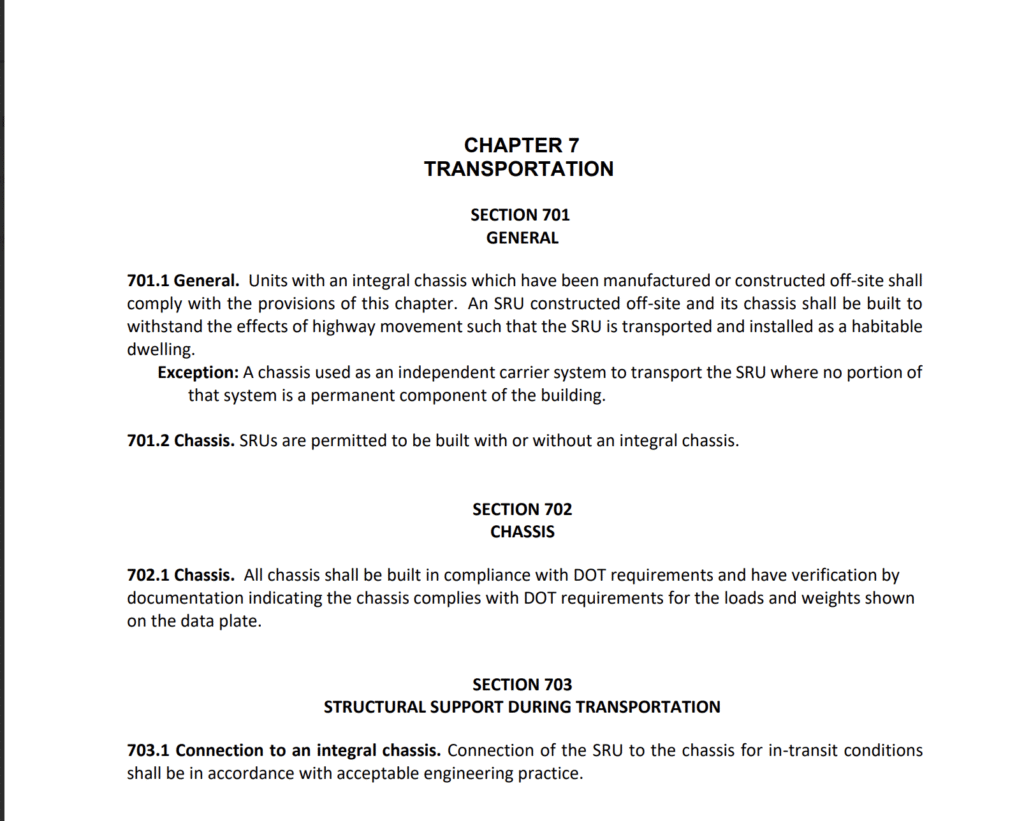
From ICC 1215: Chapter 7 Transportation Section 701 General
701.1 General. Units with an integral chassis which have been manufactured or constructed off-site shall
comply with the provisions of this chapter. An SRU constructed off-site and its chassis shall be built to
withstand the effects of highway movement such that the SRU is transported and installed as a habitable
dwelling.
Exception: A chassis used as an independent carrier system to transport the SRU where no portion of
that system is a permanent component of the building.
701.2 Chassis. SRUs are permitted to be built with or without an integral chassis.
SECTION 702
CHASSIS
702.1 Chassis. All chassis shall be built in compliance with DOT requirements and have verification by
documentation indicating the chassis complies with DOT requirements for the loads and weights shown on the data plate.
My Comments
Exception: A chassis used as an independent carrier system to transport the SRU where no portion of that system is a permanent component of the building.
701.2 Chassis. SRUs are permitted to be built with or without an integral chassis.
SECTION 702
CHASSIS
702.1 Chassis. All chassis shall be built in compliance with DOT requirements and have verification by
documentation indicating the chassis complies with DOT requirements for the loads and weights shown
I have stricken the exception provisions of 701. 1 without replacement.
Reason: The committee is trying to get an exception for the independent carrier system and not have to comply to federal laws that states must follow and they are ignoring and trying to override multiple laws and ICC policy. I have stricken the section without replacement for the following reasons.
Short Summary Of My Objection
For those of you who are already rolling your eyes and do not want to read a volume of information and want me to get right to it – I understand so read below- this is for you below. Keep reading if you want more of the details.
I am objecting to the exception in Chapter 7, Section 701.1 of the ICC/THIA 1215 standard, which allows an “independent carrier system” to transport Small Residential Units (SRUs) without compliance with federal motor-vehicle safety requirements. This provision effectively removes this type of chassis from the NHTSA and DOT safety and registration system, creating what I call a ‘Ghost Trailer-‘ a carrier system that acts as a temporary chassis with no VIN, no certification labels, and no FMVSS compliance. For more than fifty years this loophole has enabled untraceable, untaxed, not properly insured trailers to operate on public highways outside of federal oversight with all the liability on the transporter. By institutionalizing this exception, ICC 1215 legitimizes an illegal practice, undermines federal safety law, invites tax evasion, and poses a direct risk to public safety.
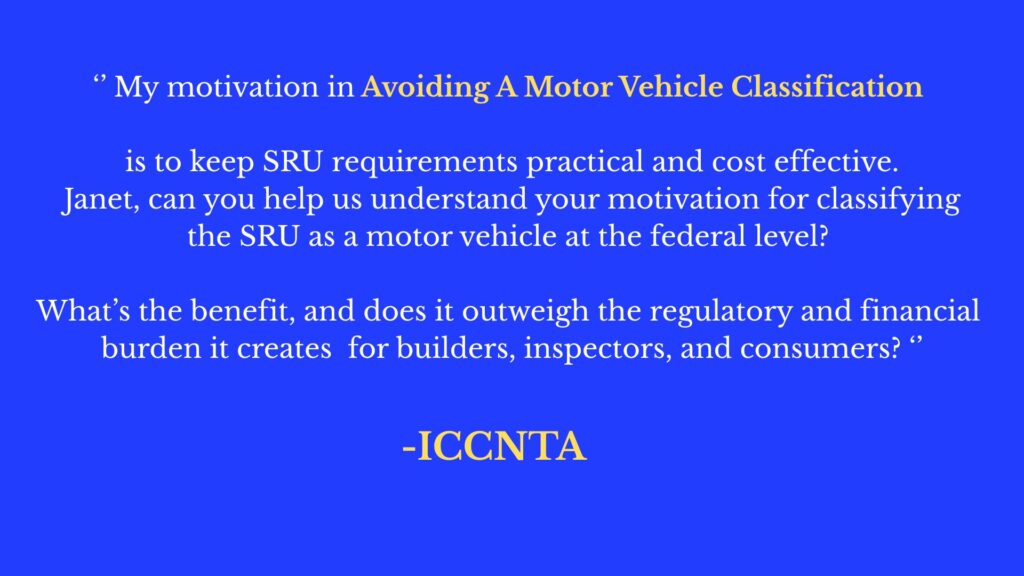
My answer- federal laws trump codes and standards, it is NOT that I want an SRU to be classified as a motor vehicle, it is the path to compliance for trailers. I have simply pointed out the laws-which they want to ignore.
The Exception Conflicts With ICC Policies And Multiple Laws
What is disturbing is the makeup of the committee is one third building officials that have a duty to follow federal laws and they voted for this exemption. The committee also consists of an ICCNTA employee that has had an overreach in the standards development with a dominating, bullying influence that everyone defers to. There have been 3 official complaints on his behavior. ICCNTA certifies the manufacturers that are utilizing the ‘Ghost Trailer’ as the temporary carrier system.
ICC 1215 Is Violating CP#49-21 – Conforming Codes and Standards to United States Federal Law And International Law
1.0 Statement of Policy: It is the policy of ICC that its Codes and Standards should conform to, and should not conflict with, the law and requirements of the United States government. Additionally, it is the goal of ICC that its Codes and Standards should not any provisions that would preclude the Codes and Standards from being adopted internationally.
2.0 Board Authority: In accordance with this Council Policy, the ICC Board of Directors shall have the authority to strike any provision of any Code or Standard, or the application thereof, when the Board, acting on the advice of counsel, determines that it is more likely than not that federal law preempts the provision or application. In addition the Board may identify or move provisions in light of preemption or adoption concerns.
I have sent an official complaint to the ICC CEO regarding that ICC 1215 is ignoring federal laws. Staff Of ICCNTA has continuously stated that we should avoid federal laws and have denied the federal compliance that is already in place for trailers that states must follow.
Building Officials On ICC 1215 are Violating The Color Of Law
Building officials serving on the ICC/THIA 1215 committee act under color of state law when they use their governmental positions to influence, vote on, or later adopt private standards that shape housing regulations. When those actions advance private or monopolistic interests, suppress lawful market participation, or deprive citizens of fair and equal access to housing, they may constitute violations of 18 U.S.C. § 242 and 42 U.S.C. § 1983. This is especially egregious where the same officials later enforce those privately-written rules at the state level, effectively converting private corporate policy into public law without democratic process.
Public Law Concerns
When the same building officials who serve on ICC boards adopt and enforce ICC codes as state law, they are effectively delegating public power to a private corporation, raising issues under the Non-Delegation Doctrine, Color of Law (18 U.S.C. § 242), and Equal Protection principles.
Specific Acts Potentially Violating Color-of-Law Protections
Conflict of Interest / Self-Dealing
Public officials are leveraging their state authority to legitimize and enforce a privately developed standard that benefits a small group of corporate interests (ICC, THIA, affiliated code consultants).
This violates federal and state ethics rules and may constitute deprivation of public rights under § 242.
Deprivation of Economic Rights and Equal Protection
By redefining “tiny houses” into the “Small Residential Unit (SRU)” and excluding chassis-based dwellings from legitimacy, these officials deprive small builders and homeowners of equal access to housing markets — a potential equal protection violation when done under color of authority.
Suppression of Due Process Violating The ANSI Essential Requirements
The vote stacked committee of ICC 1215 standard, enforced by the states, denies citizens the public due-process safeguards normally afforded in lawmaking or administrative rulemaking.
Misuse of State Positions in Private Governance
When a building official acts within ICC as both a voting regulator and a market participant, they blur the line between government and private enterprise — functioning as a regulator for personal or institutional gain, which is precisely what “color of law” was intended to prevent.
Supportive Legal Doctrine
Screws v. United States, 325 U.S. 91 (1945) — established that misuse of power possessed by virtue of state law, and made possible only because the wrongdoer is clothed with the authority of state law, constitutes action “under color of law.”
Monroe v. Pape, 365 U.S. 167 (1961) — confirmed that “color of law” extends to misuse of power, not just lawful actions.
Lugar v. Edmondson Oil Co., 457 U.S. 922 (1982) — held that private parties acting jointly with state officials may also be liable under § 1983.
H.R.3419 - Motor Carrier Safety Improvement Act of 1999
The Motor Carrier Safety Improvement Act of 1999 is a federal law (Public Law 106-159) that created the FMCSA and requires states to align their commercial motor vehicle safety programs — including VIN enforcement for trailers — with federal standards under Title 49 U.S.C. States must enforce federal VIN and FMVSS rules under the Motor Carrier Safety Improvement Act of 1999, making ICC’s proposed transportation provisions legally incompatible and unenforceable at the state level.
Public Law 106-159, 49 U.S.C. § 31100 et seq.
(Created the Federal Motor Carrier Safety Administration – FMCSA)
Purpose of the Act
Congress enacted H.R. 3419 to improve commercial motor vehicle safety, reduce fatalities and injuries involving large trucks and buses, and to ensure that federal and state authorities enforce uniform safety standards.
It established the Federal Motor Carrier Safety Administration (FMCSA) and required states to implement and enforce compatible laws through the Motor Carrier Safety Assistance Program (MCSAP).
State Responsibilities Under the Act
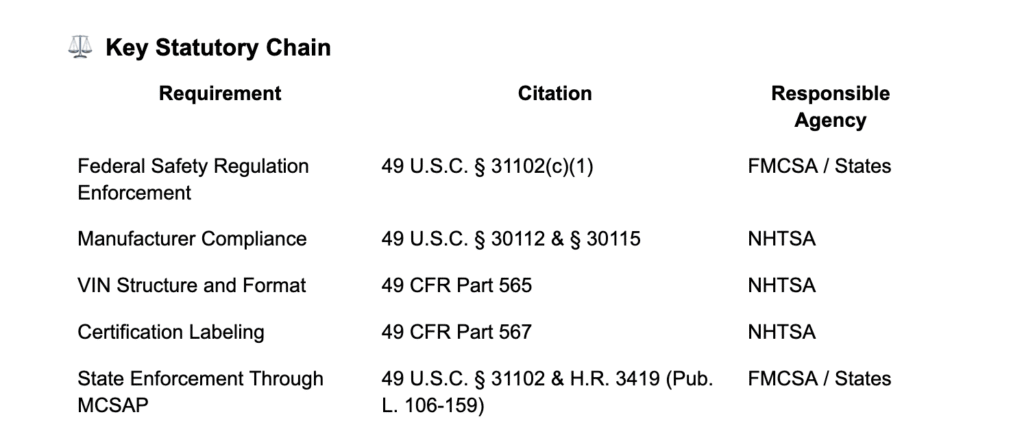
1. Adopt and Enforce Compatible Federal Safety Regulations
49 U.S.C. § 31102(c)(1)
“A State may not adopt or enforce a law or regulation on commercial motor vehicle safety that is incompatible with a regulation prescribed by the Secretary under this chapter.”
This means states must adopt and enforce federal regulations that apply to commercial motor vehicles, which include trailers and semitrailers as defined in 49 CFR 390.5.
49 CFR 390.5
2. Participation in MCSAP Requires Compliance
States that receive federal highway safety funds under MCSAP must ensure that their laws, inspection programs, and vehicle-registration systems are consistent with federal motor carrier safety regulations (FMCSRs).
Non-compliance can result in loss of federal funding or decertification of the state program.
3. Federal VIN Requirements Incorporated by Reference
Although H.R. 3419 itself doesn’t create VIN standards, it requires states to enforce existing federal safety regulations, which include:
- 49 U.S.C. § 30112(a) – Prohibits manufacturing or selling any motor vehicle or trailer that doesn’t comply with Federal Motor Vehicle Safety Standards (FMVSS).
- 49 U.S.C. § 30115 – Requires each manufacturer to affix a certification label showing compliance with all applicable safety standards.
- 49 CFR Part 565 – Specifies the Vehicle Identification Number (VIN) system for all motor vehicles, trailers, and semitrailers.
- 49 CFR Part 567 – Specifies manufacturer’s certification labeling requirements.
Under H.R. 3419, states must ensure that vehicles they register or inspect are in compliance with these federal standards—including VIN structure and certification labels.
4. Registration and Enforcement Duties of the States
Because VIN compliance is a federal safety requirement, states cannot title, register, or permit operation of a commercial trailer that lacks a valid, NHTSA-compliant VIN and certification label.
This ensures that:
- Only federally compliant, identifiable vehicles operate in interstate commerce.
- Law enforcement and FMCSA inspectors can trace, identify, and verify compliance for safety, insurance, and recall purposes.
- States maintain eligibility for federal safety-program funding.
In Plain Terms
- FMCSA (created by H.R. 3419) sets nationwide safety standards.
- States must adopt and enforce those standards to stay in the federal safety-funding program.
- Those federal standards include the VIN and manufacturer-certification requirements administered by NHTSA.
- Therefore, states are legally obligated to ensure that commercially manufactured trailers and motor vehicles registered or operated within their jurisdiction bear compliant VINs issued under 49 CFR Part 565 and labels under Part 567.
Violation of the “Non-Delegation Doctrine”
States and local governments cannot delegate legislative authority to a private, for-profit entity without oversight.
By adopting ICC 1215 standards wholesale, officials are outsourcing lawmaking to a private corporation—unconstitutional delegation under state and federal separation-of-powers principles.
Fraudulent Misrepresentation / Consumer Deception
Marketing this carrier system that is a temporary chassis as “compliant” or “approved” while exempting them from FMVSS, VIN, and insurance frameworks constitutes false representation under 15 U.S.C. § 45 (FTC Act) and state consumer-protection statutes.
Homeowners purchasing modular homes delivered on the “Ghost Trailer ” would be misled into believing they’re federally compliant when they’re not—grounds for consumer fraud or product liability claims.
Financial And Tax Angles
a. IRS Form 637 Manufacturer Registration
Manufacturers producing taxable trailers or chassis must register with IRS under Form 637, Activity M to qualify for excise-tax exemption or reporting.
“Ghost Trailer” builders bypass both the WMI registration and IRS manufacturer registration, creating a tax-evasion pattern across multiple agencies.
b. Highway-Use Reporting to FHWA
States must report vehicle registrations by VIN and class to FHWA for federal highway-fund allocation.
Missing VINs = under-reporting = false data submissions under 23 U.S.C. § 307, jeopardizing state funding accuracy.
1. Federal Legal and Oversight Angles
The ICC and its public-member participants (state officials) are functioning like de facto regulators—creating rules that later have the force of law.
Under the APA (5 U.S.C. §§ 551–559), any rule with binding effect must go through notice-and-comment rulemaking, economic impact analysis, and public review.
ICC bypasses all of this, turning private rulemaking into public law via adoption—thus circumventing due process and violating fundamental administrative law principles.
The ICC/THIA 1215 standard acts as “shadow regulation,” unlawfully avoiding APA transparency and federal oversight with the chassis requirements.
Federal Laws Potentially Violated By The 'Ghost Trailer' Exception And Omission Of Federal Requirements
1) 49 U.S.C. § 30112(a) – Prohibition on manufacturing or selling non-compliant motor vehicles
“A person may not manufacture for sale, sell, offer for sale, introduce or deliver for introduction in interstate commerce, or import into the United States any motor vehicle or motor vehicle equipment manufactured on or after the date an applicable motor vehicle safety standard takes effect unless the vehicle complies with the standard.”
✅ Violation:
By declaring the transport chassis exempt, ICC 1215 would allow the manufacture and use of motor vehicles (trailers) that do not comply with Federal Motor Vehicle Safety Standards (FMVSS)—specifically braking systems, couplings, lighting, and structural integrity requirements under 49 CFR Part 571.
2. 49 U.S.C. § 30115 – Certification of Compliance
Manufacturers must certify that each motor vehicle complies with all applicable FMVSS and affix a permanent label.
✅ Violation:
The “ghost trailer” would lack a manufacturer certification label, meaning there is no legal attestation of compliance with any safety standard.
3. 49 CFR Part 565 – Vehicle Identification Number (VIN) requirements
Every motor vehicle, including trailers and semitrailers, must have a unique VIN assigned by a registered manufacturer with an SAE-issued WMI (World Manufacturer Identifier).
✅ Violation:
By claiming the chassis “does not need a VIN,” ICC 1215 exception clause would cause systemic non-compliance with Part 565, producing untraceable vehicles with no manufacturer of record.
4. 49 CFR Part 567 – Certification labeling requirements
The label must display the VIN, manufacturer, GVWR/GAWR, and FMVSS compliance statement.
✅ Violation:
No VIN → no label → violation of both Part 565 and 567. This makes it impossible for NHTSA, DOT, or state DMV to verify legality or safety of the chassis.
5. 49 CFR Part 571 (FMVSS) – Federal Motor Vehicle Safety Standards
Covers essential safety systems for trailers:
Lighting (108)
Brakes (121)
Tires (119)
Couplings (223/224 underride protection)
Structural performance
✅ Violation:
By classifying the transport chassis as outside NHTSA’s jurisdiction, ICC 1215 effectively authorizes production of trailers without FMVSS compliance, a direct federal safety violation.
6. 49 U.S.C. § 30117 & § 30118 – Recordkeeping, recall, and defect reporting
Manufacturers must maintain records and notify owners of safety defects.
✅ Violation:
Because “ghost trailers” have no VINs or manufacturer identification, defects cannot be tracked or recalled, violating NHTSA’s defect-reporting provisions.
7. 49 U.S.C. § 30122(b) – Making safety devices inoperative
No person may knowingly make inoperative any part of a motor vehicle compliance system.
✅ Violation:
By design, the ICC clause renders FMVSS enforcement inoperative for these chassis — effectively nullifying federal oversight.
8. 49 U.S.C. § 31102(c)(1) (Motor Carrier Safety Improvement Act of 1999)
“A State may not adopt or enforce a law or regulation on commercial motor vehicle safety that is incompatible with a regulation prescribed by the Secretary.”
✅ Violation:
If states adopt the ICC 1215 exception, they would be enforcing a rule incompatible with federal law, placing them in non-compliance with H.R. 3419 / FMCSA requirements and risking federal funding.
Why This Poses A Problem?
Section 701.1 effectively tries to create a new, non-federal transportation category — letting ICC and THIA set standards for chassis-based dwellings without following federal VIN or FMVSS requirements.
That violates:
49 U.S.C. § 30112(a): prohibiting the sale or introduction of a non-compliant motor vehicle into interstate commerce.
H.R. 3419 (49 U.S.C. § 31102): requiring states to enforce compatible laws — not conflicting or duplicative ones.
If a state adopts this ICC 1215 exception clause, it would be out of alignment with federal law, because:
States cannot register or permit highway transport of a unit that lacks a federally assigned VIN.
ICC has no federal authority to define or regulate a ‘transport chassis.’
Tax Related Violations
Federal Excise Tax (26 U.S.C. § 4051 & § 4221)
Imposes a 12% excise tax on the first retail sale of trailers and truck chassis.
✅ Violation:
Unregistered “ghost trailers” evade this excise tax because they do not exist in federal or state databases as taxable equipment.
State Motor Vehicle Registration and Use Taxes
Each state levies:
Title/registration fees
Ad valorem or property taxes on trailers
Fuel and highway-use taxes
✅ Violation:
Since the chassis is not titled or VIN-registered, states cannot collect taxes or fees, constituting state-level tax evasion and interstate commerce fraud if the units cross s
Federal Heavy Highway Vehicle Use Tax (HVUT)
The Federal Heavy Highway Vehicle Use Tax (HVUT) — a separate federal road tax administered by the IRS.
This tax applies to any highway motor vehicle with a gross weight of 55,000 pounds or more that is registered for highway use (including trailers, semitrailers, and chassis designed to carry loads).
How HVUT Connects To The ' Ghost Trailer'
Federal Heavy Highway Vehicle Use Tax (HVUT)
Statutory Authority:
26 U.S.C. § 4481–4483
IRS Form 2290 (Heavy Highway Vehicle Use Tax Return)
Requirements
Every person who registers a highway motor vehicle with a taxable gross weight of 55,000 pounds or more must pay an annual federal use tax to the IRS.
The vehicle must have a VIN to file Form 2290.
Proof of payment is required before a state can renew or issue registration (per 26 U.S.C. § 4481(c) and 23 CFR 669.21).
The 'Ghost Trailer' Violation
If ICC 1215 classifies the chassis as “NOT a motor vehicle” and excludes it from VIN or registration requirements, then: No VIN → No Form 2290 filing No registration → No HVUT payment No reporting → IRS revenue loss
This means every chassis built and used under this “exception” avoids the federal highway-use tax, even though it physically uses public roads and contributes to highway wear.
That’s federal tax evasion under:
26 U.S.C. § 7201 (Tax Evasion)
26 U.S.C. § 7203 (Willful Failure to File)
18 U.S.C. § 371 (Conspiracy to Defraud the United States)
Enforcement Connection
The HVUT is jointly enforced by:
The IRS (for tax collection),
The Federal Highway Administration (FHWA) (for compliance), and
State DMVs (who must verify IRS Form 2290 payment before registration).
Because the “ghost trailer” lacks a VIN and is not titled or registered, it completely bypasses the enforcement system, preventing both tax assessment and highway safety verification.
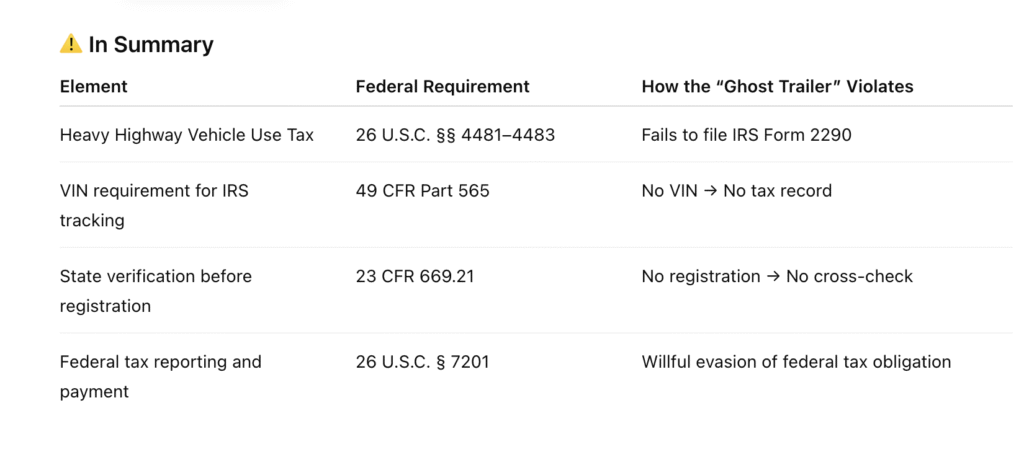
The ICC 1215 “independent carrier system ” exemption facilitates evasion of the Federal Heavy Highway Vehicle Use Tax (26 U.S.C. § 4481), which applies to all highway vehicles exceeding 55,000 pounds. Since the chassis are unregistered and lack VINs, they cannot be reported on IRS Form 2290, resulting in systematic tax evasion and violation of federal highway-use and registration laws.
Potential Criminal and Civil Implications
18 U.S.C. § 1001 – False statements to a federal agency (if documentation claims compliance).
18 U.S.C. § 1343 / 1341 – Wire or mail fraud (marketing or transporting unregistered chassis).
18 U.S.C. § 371 – Conspiracy to defraud the United States (if done knowingly to avoid FMVSS and tax obligations).
Title 49 U.S.C. (Motor Vehicle Safety, Motor Carrier, and Highway Safety Acts) and Title 26 U.S.C
The independent carrier system that is acting like a temporary chassis is a ‘Ghost Trailer’ concept promoted through the ICC/THIA 1215 exception constitutes an unlawful circumvention of federal motor-vehicle safety, certification, and tax laws. By exempting an “independent carrier chassis” from VIN, labeling, FMVSS, and registration, it violates multiple sections of Title 49 U.S.C. (Motor Vehicle Safety, Motor Carrier, and Highway Safety Acts) and Title 26 U.S.C. (federal excise taxes), resulting in untraceable, untaxed, and unsafe highway equipment operating outside the bounds of federal jurisdiction.
Manufacturer Identification and VIN Issuance Requirements
Federal Authority
Under 49 U.S.C. § 30115 and 49 CFR Part 565, every motor-vehicle manufacturer — including those that build trailers, semitrailers, and chassis — must:
Register as a manufacturer with NHTSA before producing any motor vehicles; and
Obtain a World Manufacturer Identifier (WMI) code from the Society of Automotive Engineers (SAE International), the private standards body contracted by NHTSA to administer that system worldwide.
This WMI becomes the first three characters of every Vehicle Identification Number (VIN).
Legal Chain of Authority
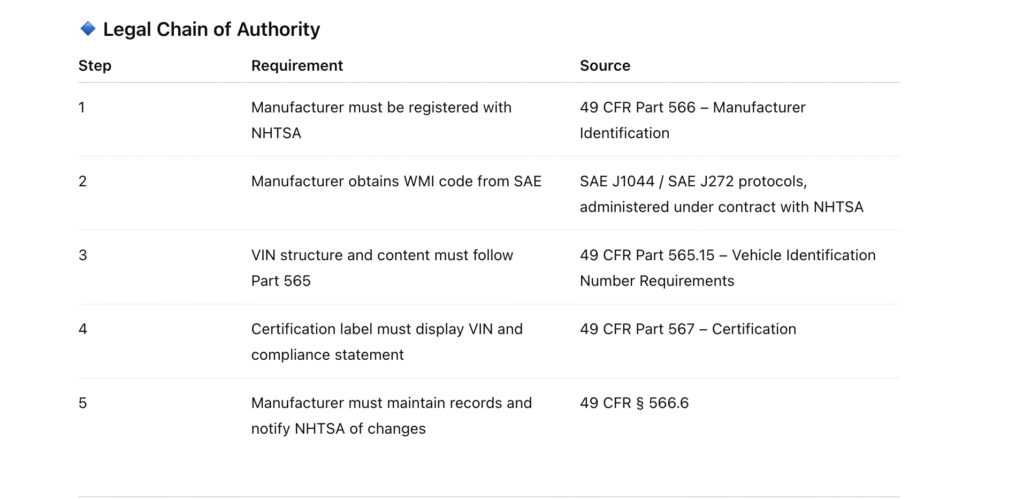
What ICC 1215 Is Attempting to Bypass With The Exception And Ignoring Federal Laws By Omission
The “independent carrier chassis” exception in Chapter 7 claims that such chassis:
Need no VIN,
Need no NHTSA registration,
Need no certification label, and
Are not motor vehicles.
That position directly undermines the federal identification chain, because:
Without WMI registration, the builder is not a recognized manufacturer under federal law.
Without a WMI, a VIN cannot legally exist.
Without a VIN, no certification label or safety tracking is possible.
Without certification, sale, transport, or introduction into commerce violates 49 U.S.C. § 30112(a).
Resulting Violations
49 CFR Part 566 – Failure to register manufacturer information with NHTSA.
49 CFR Part 565 – Failure to obtain an SAE-issued WMI and assign legal VINs.
49 CFR Part 567 – Failure to affix certification labels referencing those VINs.
49 U.S.C. § 30112(a) – Introduction of non-compliant vehicles into interstate commerce.
49 U.S.C. § 30115 – Failure to certify compliance with applicable FMVSS.
Each violation can trigger civil penalties under 49 U.S.C. § 30165, reaching tens of thousands of dollars per vehicle.
The ICC 1215 “independent carrier chassis” exemption unlawfully bypasses the federal manufacturer-identification and VIN-issuance system established under 49 CFR Parts 565–566 and 567. Because SAE International administers the World Manufacturer Identifier (WMI) system under contract with NHTSA, any chassis builder operating without an SAE-issued WMI and VIN is manufacturing and selling unregistered, untraceable motor vehicles. This eliminates federal oversight, recall accountability, and tax tracking—effectively creating a class of “ghost trailers” invisible to both NHTSA and IRS.
The Functional and Legal Importance of a VIN Number
Federal Purpose of the VIN
The Vehicle Identification Number (VIN) is not merely a serial code; it is the federally mandated identity of a motor vehicle.
It enables registration, taxation, titling, insurance, and recall tracking.
It is the foundation of interstate commerce, ownership, and safety accountability for all vehicles — including trailers, semitrailers, and chassis.
Legal Basis
49 CFR Part 565 – Requires a unique VIN for every motor vehicle, including trailers.
49 CFR Part 566 – Requires manufacturer registration with NHTSA and recordkeeping.
49 CFR Part 567 – Certification label must display VIN, weight ratings, and FMVSS compliance.
49 U.S.C. § 30112(a) – Prohibits sale, introduction, or use of any motor vehicle without compliance with these standards.
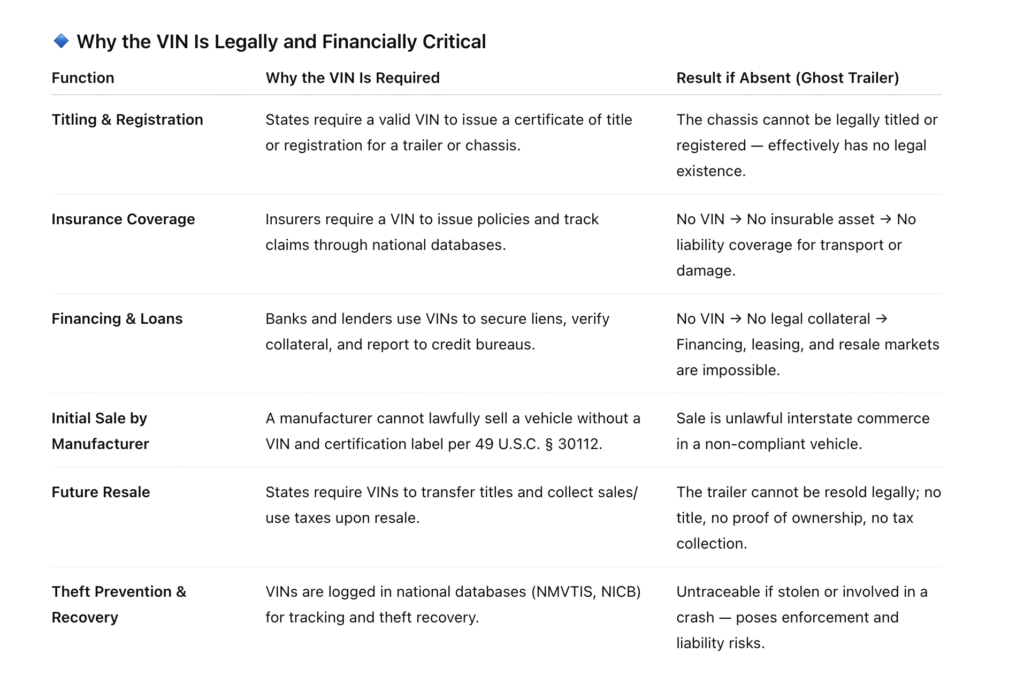
Why The VIN Number Is Legally And Financially Critical
Broader Impact of Removing the VIN
By promoting a chassis that “does not need a VIN, registration, or certification,” ICC 1215 framework would:
Erase legal ownership chains between manufacturer, dealer, and consumer.
Nullify consumer protections under federal and state vehicle codes.
Block states from collecting title, sales, excise, and use taxes.
Prevent insurance underwriting, shifting all risk to buyers and transporters.
Undermine financial markets, as no legitimate lender can finance or repossess an unregistered asset.
Create untraceable units operating on public highways, posing safety and liability risks to the public.
The VIN system is the legal backbone of the U.S. motor vehicle economy. It connects NHTSA manufacturing compliance to every downstream requirement — titling, taxation, insurance, financing, and resale. By eliminating VINs for a so-called “independent carrier chassis,” ICC 1215 standard facilitates a shadow fleet of unregistered, untaxed, not properly insured, and unfinanceable motor vehicles. These ‘Ghost Trailers’ undermine federal safety law, consumer protection, and the fiscal integrity of both state and federal tax systems.
Highlighting The Role Of NHTSA'S Role And States Regarding VIN Numbers/ MSOs And Titles
National Highway Traffic Safety Administration (NHTSA) does not have jurisdiction over vehicle titles and Manufacturer Statements of Origin (MSOs/MCOs)
- NHTSA’s Role: NHTSA is a federal agency responsible for vehicle safety standards (Federal Motor Vehicle Safety Standards – FMVSS), investigating safety defects, and enforcing recalls. Its authority generally relates to the manufacture and performance of vehicles and equipment to meet safety standards.
- State’s Role: The titling and registration of motor vehicles for operation on public roads is the responsibility of individual states, typically through their Departments of Motor Vehicles (DMVs) or equivalent agencies. States are the entities that require an MSO/MCO (Manufacturer’s Certificate/Statement of Origin) to issue the initial vehicle title when a new vehicle is first sold and registered.
- MSOs/MCOs: These documents are not federally required, but are original ownership documents provided by the manufacturer or dealer that are surrendered to the state to obtain a title. NHTSA does not offer guidance on obtaining these documents; consumers and manufacturers with questions are directed to their State’s DMV or the American Association of Motor Vehicle Administrators (AAMVA).
A MSO/MCO Must Have A VIN Number Associated With The Trailer To Obtain A Title
A Manufacturer’s Certificate/Statement of Origin (MCO/MSO) is required to get a title for a new vehicle, including trailers because it proves the manufacturer’s ownership and contains all the necessary information, including the Vehicle Identification Number (VIN). The MCO/MSO is surrendered to the state to issue the vehicle’s first title, and it must include the VIN, year, make, model, and other details
What Is A MSO?
There is a lot of confusion surrounding the terms MSO and MCO related to new vehicles, but there is no need to wonder any longer about these vague abbreviations. These terms simply refer to the vehicle’s Certificate of Origin and aren’t that complicated once you understand what they do.
MSO stands for the Manufacturer’s Statement of Origin. MCO is the Manufacturer’s Certificate of Origin. Both phrases refer to the same document, one which carries information about the automobile’s production like its country of origin. An MSO/MCO is usually similar in appearance to a Certificate of Title and includes the manufacturer, vehicle identification number and the year of manufacture. You will find an MSO is included with many things, not just vehicles. For example, aircraft, motorboats and trailers come with them as well.
Incident Examples
In one case, a portion of a modular home was blown off its trailer on the Marc Basnight Bridge in North Carolina during transport, when 65-70 mph winds detached the home from the trailer. News 3 WTKR Norfolk
In another instance a modular home being transported on Highway 97 in Canada ended up “on the road” after coming off its carrier system. Global News
Also, a trucking company shared a video of a modular home dropping from its transport load on Highway 97 after a hard brake application caused the load’s brackets to fail and the dolly to slide out.
Why The Incident Matters?
These events demonstrate that units with integral chassis or large modular units mounted on carrier systems are subject to transport hazards and thus those chassis/systems must meet transport safety and registration standards.
If a chassis is unregistered, lacks a VIN, is uncertified and is permitted to travel on highways without meeting safety standards (as would be the case under the “ghost trailer” exception), then:
It’s unable to be traced if something goes wrong.
It’s more likely to fail or separate (as illustrated) because it may not meet the rigorous standards of axle, drawbar, hitching, braking, and structural integrity required for road transport.
Victims of accidents will have limited recourse because the trailer may be unidentified, uninsured, untitled.
Repair, recall and manufacturer-liability processes break down when there’s no VIN and no certified manufacturer registration.
- The liability falls mainly on the transporter.
Recent incidents in which modular homes or transport structures have detached from carrier/trailer systems during highway travel further underscore the critical need for chassis/trailer systems to be fully subject to federal motor vehicle safety regulations, manufacturer registration, VIN issuance, titling, registration and insurance. The proposed exception in Chapter 7, Section 701.1 of the ICC/THIA draft would permit transport systems that are inherently hazardous to travel public highways unsafely and without accountability.
Moving On To My Next Objection In The ICC 1215 Standard
Section 702 Chassis
702.1 Chassis. All chassis shall be built in compliance with DOT requirements and have verification by documentation indicating the chassis complies with DOT requirements for the loads and weights shown on the data plate.
I am both striking and adding language.
My Comment
702.1 Chassis. All chassis shall be built in compliance with federal laws for motor vehicles, which include trailers. Manufacturers shall obtain a WMI Code from SAE to legally issue VIN numbers on the trailers for sale and follow all NHTSA, FMVSS, FMCSA, standards, and requirements, and any additional state requirements. Manufacturers shall self-certify the trailers which is required by NHTSA and requires labeling of the trailer. Manufacturers shall follow all state requirements for trailers that include, but are not limited to the issuing of MSCs/MCOs, bill of sale, registration, titling, and a possible inspection by the state patrol.
Manufacturers of trailers that build trailers in two or more stages shall comply with CFR Title 49 PART 568—VEHICLES MANUFACTURED IN TWO OR MORE STAGES—ALL INCOMPLETE, INTERMEDIATE AND FINAL-STAGE MANUFACTURERS OF VEHICLES MANUFACTURED IN TWO OR MORE STAGES
Owner builders shall follow all state laws to obtain a VIN number and for compliance.
Reason
My previous long comment from the first comment applies with a few more additional comments. The committee is trying to override federal requirements and create their own requirements for the data plate. Listing only DOT, is an omission of the rest of the federal requirements that preempt all codes and standards.
There are federal specific laws that exist for manufacturers that build trailers in two or more stages and they cannot be denied by purposely omitting them,
The VIN Number Is On The Trailer Data Plate
The Vehicle Identification Number (VIN) serves as the official Data Plate of a trailer—it is the federally mandated identifier that links the chassis to its manufacturer, certification, and safety compliance record. Under 49 CFR Part 565 and 49 CFR Part 567, every trailer must have a VIN and certification label permanently affixed to the trailer frame by the original manufacturer. The label must be riveted, welded, or otherwise permanently attached to a non-removable portion of the chassis, typically on the left-front side of the frame near the tongue or drawbar, where it is visible for inspection. This plate must display the manufacturer’s name, date of manufacture, VIN, Gross Vehicle Weight Rating (GVWR), and a statement of compliance with all applicable Federal Motor Vehicle Safety Standards (FMVSS). Any trailer lacking this permanent Data Plate cannot be legally identified, titled, insured, or certified for road use under federal law.
SAE And The World Manufacturer Identifier (WMI) System
Under 49 CFR Part 565 and Part 566, every manufacturer of a motor vehicle—including trailer and semitrailer manufacturers—must register with the National Highway Traffic Safety Administration (NHTSA) before beginning production.
As part of that process, the manufacturer must obtain a World Manufacturer Identifier (WMI), which forms the first three characters of the Vehicle Identification Number (VIN).
The Society of Automotive Engineers (SAE International) administers the WMI system under contract with NHTSA, maintaining the global database of assigned manufacturer identifiers.
To comply:
Application: The manufacturer submits a WMI request to SAE, identifying the company name, address, and vehicle type (trailer, semitrailer, motorhome, etc.).
Assignment: SAE issues a three-character WMI unique to that company.
Registration: The manufacturer then files NHTSA Manufacturer Identification Form (49 CFR § 566.5) citing its WMI, production type, and contact information.
Use in VIN: The WMI becomes the first section of the 17-character VIN required by Part 565.15, allowing traceability of every chassis built.
Legal Note:
Only manufacturers with an active WMI issued by SAE and registered with NHTSA may lawfully assign VINs to vehicles. Any entity producing chassis or trailers without a valid WMI and corresponding NHTSA registration is manufacturing unregistered motor vehicles in violation of 49 U.S.C. §§ 30112 and 30115 and 49 CFR Parts 565 and 566.
My Next Objection In The Transport Section
SECTION 703 Structural Support During Transport
703.1 Connection to an integral chassis. Connection of the SRU to the chassis for in-transit conditions shall be in accordance with acceptable engineering practice.
Adding additional text to the section and a new section.
703.1 Connection to an integral chassis. Connection of the SRU to the chassis for in-transit conditions shall be in accordance with NHTSA, FMVSS, FMCSA, additional state laws and in accordance with acceptable engineering practices.
703.1 Temporary connection of the temporary chassis system to the Modular structure shall be in compliance with the FMCSA standards and all DOT requirements for cargo securement.
Reason
Once again my previous reasons back up my comments, the committee is trying to override federal requirements of trailers that are already in existence.
Cargo securement regulations, primarily set by the FMCSA, require that cargo on large commercial vehicles be firmly immobilized or secured to prevent shifting, falling, or spilling during transit. This involves using a combination of strong structures, tiedowns, bracing, blocking, and other restraints to withstand specific forces. Regulations specify minimum numbers of tiedowns, requirements for different cargo types, and rules for inspecting the load at regular intervals.
With all the wrecks that have occurred because of the ‘Ghost Trailers’, it is crucial that there is no exception for this type of trailer. The standard is trying to keep this method so it is undetected and to continue this illegal transport.
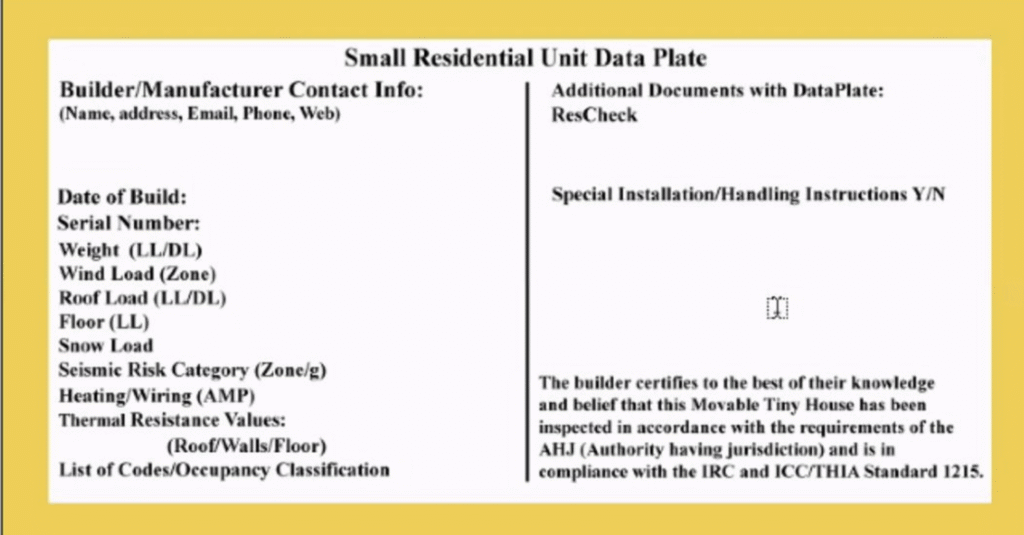
Appendix B
SMALL RESIDENTIAL UNIT DATA PLATE
Small Residential Data Plates shall display information pertinent to the structures constructed
for use by AHJ’s. Data required shall include but not be limited to:
● BUILDER NAME (MANUFACTURER)
● BUILDER CONTACT INFORMATION (MAN. SITE)
● WIND LOAD
● ROOF LIVE/DEAD LOAD
● SNOW LOAD
● FLOOR LIVE LOAD
● SEISMIC/RICHTER CATEGORY
● HEATING/COOLING THERMAL DESIGN ZONE
● GROSS WEIGHT OF STRUCTURE
● BUILD DATE
● SERIAL NUMBER
● LIST OF CODES/OCCUPANCY CLASSIFICATION
● ELECTRICAL PANEL BOX RATING
Location. Small Residential Unit Data Plate shall be placed on the interior of the structure, near
the distribution panel on a closet wall or in a cabinet under the kitchen sink in the unit.
Material. Small Residential Unit Data Plate shall be constructed of material durable to water,
Statement Regarding Movable Tiny Homes On Data Plate
The statement is on the bottom right of the DATA Plate
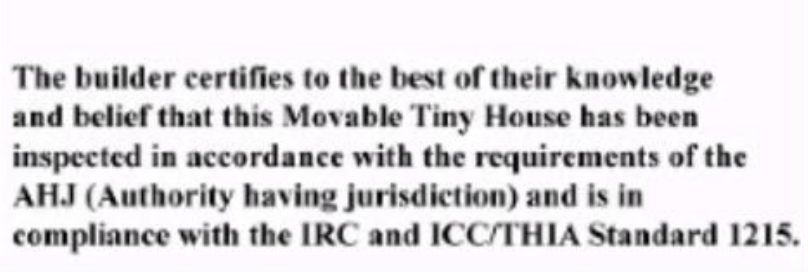
This statement is not appropriate to the standard. No where in the standard is the term Movable Tiny House is defined or found in text anywhere else in the standard. They are obviously referring to a tiny house on wheels with an integrated trailer. The tiny house that is delivered on the temporary carrier system or the ‘Ghost Trailer’ does not have a permanent chassis.
My Questions
- They statement is basically giving the builder the ability to self -certify that the Movable Tiny House Is Inspected, but What Agency Inspects Them?
- How could a Movable Tiny House comply to the IRC, if Movable Tiny Houses are not in the code?
- How can a Movable Tiny House be inspected by the requirements of an AHJ, if they are only guided by ICC 1215, that has denied most federal requirements that states are mandated to follow?
What I See Wrong With This Statement
ICC’s Attempt to Override Federal Law for Movable Tiny Houses
The International Code Council (ICC) — through its ICC/THIA 1215 “Small Residential Unit” standard — is attempting to override long-established federal laws governing vehicles and trailers, including mandatory VIN (Vehicle Identification Number) and NHTSA (National Highway Traffic Safety Administration) compliance requirements. By inserting a self-certifying statement that claims a Movable Tiny House (a house built on wheels) is inspected under the IRC and “in accordance with the AHJ,” ICC is asserting authority it does not have. This is a direct conflict with federal jurisdiction, as any structure built on a chassis with wheels is legally classified as a vehicle or trailer, not a building under state or local building codes.
In essence, ICC is trying to reclassify a federally regulated vehicle as a dwelling under its proprietary code system — effectively creating its own regulatory regime outside federal oversight. This Data Plate language allows builders to “certify” compliance to ICC/THIA 1215 without any federal recognition, bypassing DOT, FMVSS, and NHTSA safety standards, including the VIN system, lighting, axle, and braking requirements that ensure public safety and traceability.
By Doing This, ICC Is
Usurping federal regulatory authority reserved for NHTSA and DOT under Title 49 of the U.S. Code;
Creating a private monopoly where compliance equals purchase of ICC standards and services;
Deceiving consumers and AHJs into believing these homes meet lawful federal trailer standards; and
Compromising public safety and consumer protection, since units built under ICC/THIA 1215 are not registered, traceable, or federally certified.
This is not just regulatory confusion — it’s a systematic attempt to rewrite federal definitions and controls to consolidate ICC’s power over the tiny-house market, using a misleading label to replace the federally mandated Data Plate and VIN that define legitimate compliance under U.S. law.
The Disservice to Builders
This scheme profoundly harms honest builders who are being misled and deprived of critical education about the legitimate path to federal compliance. Instead of being instructed to obtain proper VINs, certification labels, and FMVSS compliance, they are funneled into ICC’s pay-to-play system, where their work is labeled as “compliant” without ever meeting federal law. This not only places the builder in potential legal jeopardy but also undermines their credibility and liability protections, exposing them to lawsuits, recalls, and loss of consumer trust. ICC’s approach robs builders of their right to accurate information and transparent guidance — effectively weaponizing confusion for profit.
Conflict of Interest and Corruption of Process
Equally disturbing is that the very building officials who approved this misleading language are voting members of the ICC 1215 committee. These officials are sworn to uphold lawful standards and public safety — yet they have endorsed a document that circumvents federal law and misrepresents authority. Their dual role as both regulators and ICC participants constitutes a clear conflict of interest, violating the principles of fair, open, and balanced standard development. This is not a neutral technical standard — it is a political and commercial power grab cloaked in procedural legitimacy.
The Broader Consequences
Through ICC/THIA 1215, the ICC is:
Usurping federal regulatory authority reserved for NHTSA and DOT under Title 49;
Misleading builders and consumers into believing they are compliant under law;
Creating a private monopoly where compliance is contingent on purchasing ICC standards;
Compromising safety and traceability by eliminating federally mandated VINs and Data Plates; and
Allowing conflicted officials to legislate through committees, blurring the line between enforcement and profit.
This is not a matter of interpretation — it is a direct violation of federal jurisdiction, due process, and ethical governance. ICC’s actions attempt to rewrite federal law through private certification, eroding both builder rights and public trust in the regulatory system that protects all road-going vehicles and consumers.
NHTSA already has federal laws for certification labels for trailers with required statements and provisions that ICC is choosing to override and ignore.
The statement: “This vehicle conforms to all applicable Federal Motor Vehicle Safety Standards in effect on the date of manufacture shown above”
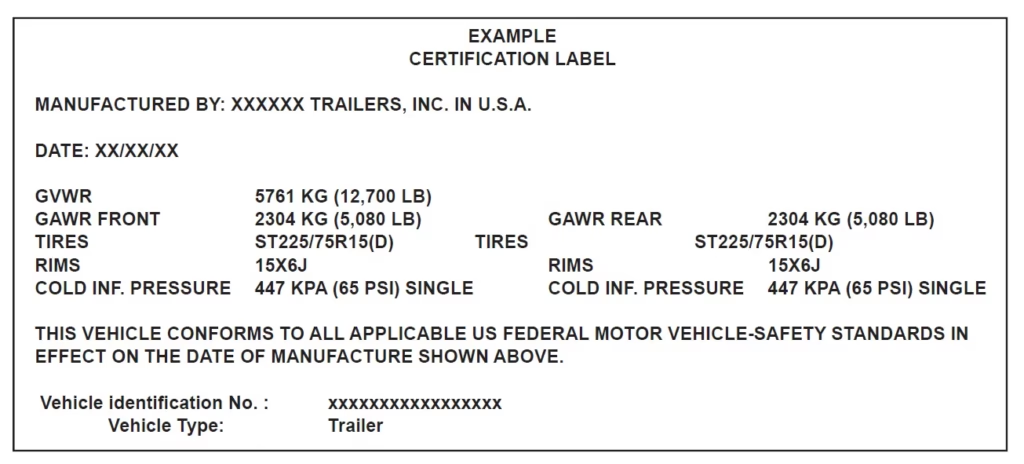
Photo Courtesy NATM
The label shall contain the following statements, in the English language, lettered in block capitals and numerals not less than three thirty-seconds of an inch high, in the order shown:
Name of manufacturer
Month and year of manufacture
Gross Vehicle Weight Rating or “GVWR”
Gross Axle Weight Rating or “GAWR”
The Type of Tires
The Type of Rims
Inflation Pressure – KPA (PSI)
The statement: “This vehicle conforms to all applicable Federal Motor Vehicle Safety Standards in effect on the date of manufacture shown above”
Vehicle identification number
The type of classification of the vehicle (e.g., truck, MPV, bus, trailer)
Evidence of Concealment and Coordinated Cover-Up
Through extensive correspondence with the leadership of the ICC-NTA division — the very entity responsible for certifying manufacturers of modular homes that use the ‘Ghost Trailer’ — it became clear that there was an intentional effort to suppress discussion and referencing of federal compliance obligations under NHTSA and VIN regulations. Over the course of multiple email exchanges, it was revealed that the certification body has long supported a “ghost trailer system”—a 50 year old practice used to bypass federal vehicle identification, manufacturing, and safety requirements.
When federal compliance issues were raised, instead of addressing the legal conflict, the response was a deliberate attempt to avoid, silence, or divert attention from NHTSA’s jurisdiction. This concealment directly undermines transparency in the standards process and misleads both builders and consumers into believing that ICC or ICC-NTA certification constitutes lawful compliance, when it does not.
Moreover, this cover-up extends to voting manipulation within ICC’s standards development process. By stacking the voting membership with building officials aligned with ICC’s agenda, they ensure predetermined outcomes that protect their commercial interests rather than public safety or federal alignment. This conduct reflects a systemic effort to preserve a monopoly over the compliance pathway — even at the expense of federal law, fair competition, and the educational duty owed to builders who are seeking legitimate compliance.
NHTSA Cautions Buyers that Trailers Must Meet Federal Safety Regulations
The National Highway Traffic Safety Administration today warned that noncompliant trailers that may pose a safety risk are increasingly marketed and sold to small businesses throughout the United States. These trailers are often marketed as food trucks or vending stations.
These trailers are only permitted under U.S. law if they are certified as meeting Federal Motor Vehicle Safety Standards. In addition to the potential safety risk posed by noncompliant trailers, people attempting to import them into the country or title and register them with local authorities can incur significant expenses, only to face potential forfeiture of the noncompliant trailers.
NHTSA warns anyone purchasing a trailer to avoid falling victim to sellers of illegal trailers. Trailers that do not comply with Federal regulations may not be safe and are not allowed to enter the United States.
Please be aware that trailers must comply with Federal standards to ensure that they are equipped with appropriate critical safety components, such as lighting, tires and wheels. Only companies registered with NHTSA may manufacture trailers compliant with these standards.
Please use caution when shopping for these trailers, especially if you are considering online listings for trailers that must be imported into the United States. A compliant trailer will have an affixed label indicating it meets all applicable Federal Motor Vehicle Safety Standards.
In addition, potential trailer buyers should consult the Vehicle Product Information Catalog and Vehicle Listing Manufacturer Portal to determine whether the manufacturer is listed with NHTSA before purchasing a trailer.
Quick Reference To NHTSA Requirements
NHTSA: The Importation Of Trailers And Motor Vehicles