While Certifying Tiny House Manufacturers Compliance?
The tiny house industry has attracted an incredible group of advocates who are working tirelessly to have tiny houses recognized as legitimate housing. We need every tool in our toolbox to reach that goal. Just as importantly, we need a clear understanding of the full landscape—how laws, regulations, and standards intersect, and how large organizations and industry groups influence the direction these policies take and where their authority begins and ends. Informed advocacy is what enables continued progress.
Manufacturer compliance with RV standards and lobbying are separate activities, but when carried out by the same organization, they raise legitimate concerns about role boundaries—particularly when certification and advocacy affect the same manufacturers and market.
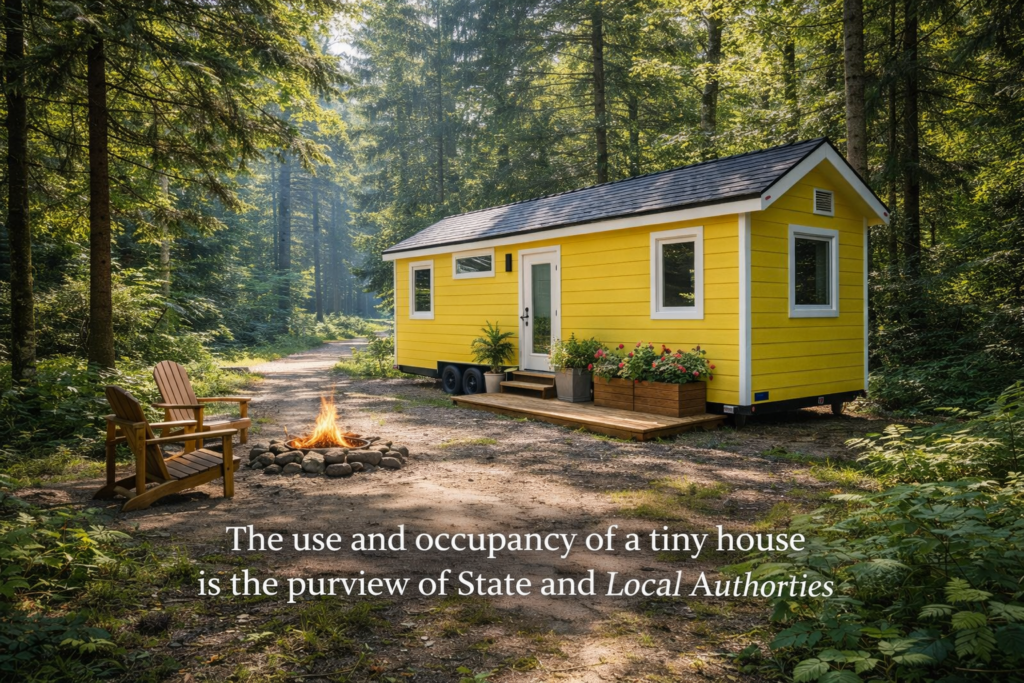
Use And Occupancy Of Tiny Homes Is The Purview Of State And Local Authorities
HUD considers how individuals decide to use their manufactured home or RV unit after purchase—and, in some cases, after receiving a Manufacturer’s Notice about the unit’s compliance with RV standards—is beyond the scope of this final rule of the RV Exemption in 2018. The regulation of use and occupancy of RVs is the purview of state and local authorities, not HUD.
The Tiny House Industry Needs To Take The Wheel
Currently standards are being developed for tiny houses on wheels unique to the tiny house industry, though I feel tiny house manufacturers will always still want to build to the RV standards as an option, and I support that. People live in RVs all across the country, and often are the only type of home they can afford. I personally want to support all housing types.

RVIA Article 2019 : Affordable Housing Efforts Threaten RV Industry
In an effort to increase affordable housing, some policymakers across the country have begun to look to tiny homes as a solution. Unfortunately, these efforts have led some legislators, officials and other interest groups to attempt to co-opt RV and PMRV standards and definitions to use them for permanent-use tiny home standards. Washington state was the most active in this effort this year.
Although both NFPA 1192 and ANSI A119.5 specifically state that these standards are for temporary-use vehicles, bills in Washington would have incorrectly defined all types of RVs and used the RV and PMRV standards to define permanent structures.
Defending these standards and definitions to protect our members and keep RVs, including PMRVs, defined as vehicles is a priority issue for the state affairs team. Working directly with Washington state legislators and stakeholders we were able to preserve already existing code and remove incorrect RV and PMRV definitions, while, at the same time, preventing incorrect uses of the RV and PMRV standards.
This push to co-opt RV standards and definitions and apply them to permanent use tiny homes will likely continue to grow in the future. Washington was the most active in this issue area during the 2019 legislative session, but it was not the only state with this type of legislation. It is expected that this push by affordable housing advocates to find some type of permanent use tiny home definition will continue. The state team will continue to defend against these kinds of bills to ensure RVs are not confused with any type of permanent housing.
RVIA Article
RVIA Statement On Their Website
RVs, or recreational vehicles, are not permanent or residential housing. Recreational vehicles are designed, engineered, and assembled for temporary, seasonal, and recreational use.
An RV is a vehicle that combines transportation and temporary living quarters for travel, recreation, and camping. RV Industry Association manufacturing members must comply with the nationally recognized standards for RVs – NFPA 1192 Standard on Recreational Vehicles and ANSI A119.5 Park Model Recreational Vehicle Standard – which specifically state that the standards are for temporary, recreational, and seasonal use vehicles.
The RV Industry Association seal that is affixed to RV Industry Association member produced RVs certifies compliance with those standards. Furthermore, a recreational vehicle is regulated by the National Highway Traffic Safety Administration as a motor vehicle and recreational vehicles must comply with applicable Federal Motor Vehicle Safety Standards. Recreational vehicles should not be confused with, or defined as, any product which could be used for permanent habitation. Additionally, the nationally recognized standards for recreational vehicles – NFPA 1192 Standard on Recreational Vehicles and ANSI A119.5 Park Model Recreational Vehicle Standard – should not be used in legislation as a standard for any vehicle or structure characterized as being “permanent”, “residential”, or described with any similar language.
RVIA Article
This statement describes RVIA’s position on the intended application of RV standards. Matters relating to housing classification and residential use are governed by other legal frameworks, rather than voluntary vehicle standards.
1. What RVIA Says Its Role Is
RVIA states in its article Affordable Housing Efforts Threaten RV Industry that its priority is “defending these standards and definitions to protect our members and keep RVs, including PMRVs, defined as vehicles.” RVIA frames its advocacy as protecting vehicle standards, not regulating housing.
2. RVIA States RV Standards Are Not Housing Standards
RVIA expressly acknowledges that “both NFPA 1192 and ANSI A119.5 specifically state that these standards are for temporary-use vehicles.” RVIA further warns against efforts to “co-opt RV and PMRV standards and definitions to use them for permanent-use tiny home standards.”
3. RVIA Opposes Using RV Standards for Permanent Housing
RVIA states that it works to prevent “incorrect uses of the RV and PMRV standards” and emphasizes that its goal is to ensure RVs “are not confused with any type of permanent housing.” This is RVIA’s own description of the limits of its standards.
Short Video Explainer Of This Blog Post
HUD Final Rule RV Exemption 2018
Manufactured Home Procedural and Enforcement Regulations; Clarifying the Exemption for Manufacture of Recreational Vehicles: Jan.15, 2019
The U.S. The Department of Housing and Urban Development (HUD) redefined and clarified the RV exemption from manufactured housing standards in 2018. The final rule went into effect on January 15, 2019. A lot of manufacturers build tiny homes to recreational vehicle standards and that is why this HUD final rule is important for clarity.
Below are a lot of supporting documents directly from HUD.
HUD Defined This Rule as Manufacturing-Side Only
HUD stated in the Final Rule:
“This rulemaking revises the exemption for the manufacture of recreational vehicles to clarify which recreational vehicles qualify for an exemption from HUD’s Manufactured Home Construction and Safety Standards and Manufactured Home Procedural and Enforcement regulations.”
HUD Confirmed the Legal Effect Is Limited to Manufacture
HUD further stated:
“This final rule provides that the requirements of 24 CFR parts 3280 and 3282 do not apply to the manufacture of a ‘recreational vehicle’ as defined by this rule.”
The rule governs manufacturing jurisdiction, not housing use.
HUD Created a Bright Line to Unnecessarily Regulate RVs
HUD explained the purpose of the exemption was “to better differentiate RVs from manufactured homes to ensure that HUD does not unnecessarily regulate RVs.” HUD also stated its goal was “to establish a broad, easily applied exemption for purposes of its own regulatory activities.”
HUD Explicitly Rejected Occupancy Regulation
HUD was unambiguous:
“How individuals decide to use their manufactured home or RV unit after purchase… is beyond the scope of this final rule.”
HUD Assigned Use and Occupancy to States and Localities
HUD stated plainly:
“The regulation of use and occupancy of RVs is the purview of state and local authorities, not HUD.”
HUD reiterated:
“This rule does not affect the use of RVs by consumers.”
The Actual RV Exemption HUD Codified
HUD defined a recreational vehicle as one that is:
“(1) A vehicle or vehicular structure not certified as a manufactured home;
(2) Designed only for recreational use and not as a primary residence or for permanent occupancy; and is either
(i) Built and certified in accordance with NFPA 1192 or ANSI A119.5; or
(ii) Any vehicle which is self-propelled.”
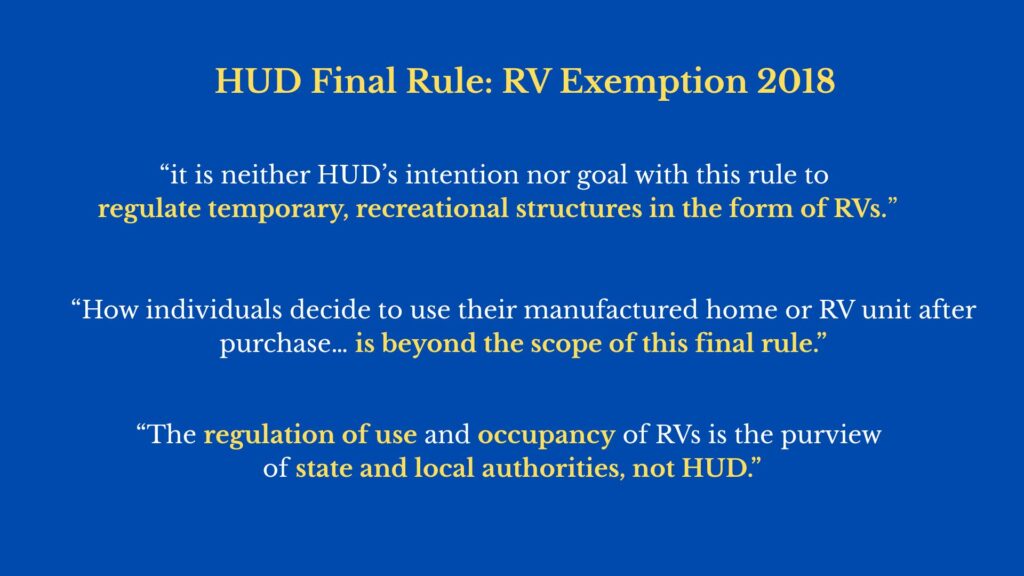
HUD Response: HUD respectfully disagrees with the various fundamental premises and conclusions of these commenters about secondary effects. Initially, as stated in this preamble, HUD is not regulating use of manufactured homes or RVs. More specifically, how individuals decide to use their manufactured home or RV unit after purchase—and, in some cases, after receiving a Manufacturer’s Notice about the unit’s compliance with RV standards—is beyond the scope of this final rule. The regulation of use and occupancy of RVs is the purview of state and local authorities, not HUD.
Because this rule does not prohibit or regulate the use of manufactured homes or RVs, including tiny homes, the secondary consequences described by certain commenters are moot, and HUD does not believe that there exists a need to address them individually. HUD also states that this rule does not dictate the minimum square footage of a home, nor does it require modular homes to be “as stable” as foundation-built homes. It also does not require manufacturers to obtain RVIA certification to claim the RV exemption. HUD reiterates that when it first codified the RV exemption in 1976, it unequivocally stated that RVs were not designed to be used as permanent dwellings. This final rule does not alter that underlying rationale for the exemption. Moreover, as noted above, both the ANSI and NFPA standard descriptions underscore the need to distinguish RVs from permanent housing.
HUD Addressed Tiny Homes Directly
HUD stated:
“If a tiny home is not a ‘manufactured home’ as defined by statute, then HUD does not have authority to regulate its construction.”
HUD also emphasized:
“It is neither HUD’s intention nor goal with this rule to regulate temporary, recreational structures in the form of RVs.”
HUD Affirmatively Chose Not to Regulate
HUD stated:
“While it possesses statutory authority to regulate the manufacture of certain types of RV, it nevertheless believes that exercising such authority is currently unnecessary.”
HUD further stated it “elects not to regulate all structures that qualify for the RV exemption.”
HUD's RV Exemption Criteria
(24 CFR § 3282.15(b)), an RV qualifies for the HUD RV exemption only if it meets all three of these criteria:
Not certified as a manufactured home
It must be “a vehicle or vehicular structure not certified as a manufactured home.”
Design intent is recreational, not residential
It must be “designed only for recreational use and not as a primary residence or for permanent occupancy.”
It fits one of the two “how it’s built” paths
Either it is built and certified to one of the national RV standards: NFPA 1192 (2015) or ANSI A119.5 (2015), OR it is self-propelled.
Changes Made at the Final Rule Stage
After considering public comments received on the February 9, 2016, proposed rule, and after further review, HUD makes the following changes at the final rule stage.
1. In the final rule, HUD elects not to revise the definition of “manufactured home,” found at 24 CFR 3280.2, to ensure that the regulatory definition of “manufactured home” tracks with its statutory definition.
2. In § 3282.15(b)(1), HUD removes the term “factory built,” in response to public comment. HUD agrees with commenters who stated that some RV manufacturers do not produce their products in a factory, but nevertheless should qualify for the exemption if they meet all other exemption criteria.
3. In § 3282.15(b)(1), HUD adds the term “vehicle” to the definition of a recreational vehicle in response to public comment. HUD agrees with commenters who stated that “vehicle” is also a term of art used by state and local governments in regulating RVs.
4. In § 3282.15(b)(3), HUD makes a technical correction to remove the term “Recreational Park Trailer Standard” and replace it with the term “Park Model Recreational Vehicle Standard,” in response to public comment and to reflect the standard’s proper title.
5. In § 3282.15(c), HUD makes several changes; to remove the term “Notice” and replace it with the term “Manufacturer’s Notice” for clarity; and to specify that in all cases where the exemption is based on the unit being certified to the ANSI A-119.5-15 standard, the Manufacturer’s Notice must be provided to the consumer prior to the completion of the sales transaction, as defined in this final rule. Finally, HUD adds a definition of “completion of sales transaction” in this final rule, because the cross-reference to § 3282.252(b), in the proposed rule, was inapplicable.
Why RVIA Lobbying Against Housing Bills Exceeds Its Scope
RVIA’s own article states that RV standards are vehicle standards and should not be used for permanent housing. HUD’s Final Rule states that use and occupancy are not federally regulated under the RV exemption. When RVIA lobbies against state or local housing bills because they allow residential use, rather than correcting misuse of RV standards, it steps beyond standards protection and into housing policy — a role HUD expressly disclaimed and RVIA itself says is not the purpose of its standards.
NFPA Compliance Statement
”The NFPA has no power, nor does it undertake, to police or enforce compliance with the contents of NFPA Standards. Nor does the NFPA list, certify, test, or inspect products, designs, or installations for compliance with this document. Any certification or other statement of compliance with the requirements of this document shall not be attributable to the NFPA and is solely the responsibility of the certifier or maker of the statement. ”
The above statement is a common statement regarding police and
enforcement compliance to ANSI standards.
Resources
Author’s Disclaimer
This blog post is my interpretation to the best of my ability. HUD is the best and only authority. Please research the sources I included for your own due diligence.
HUD Is The Only Authority For Interpreting The HUD Code
Related Blog Posts
ICC 1215 Forward Clash With HUD’s Authority On Tiny Houses
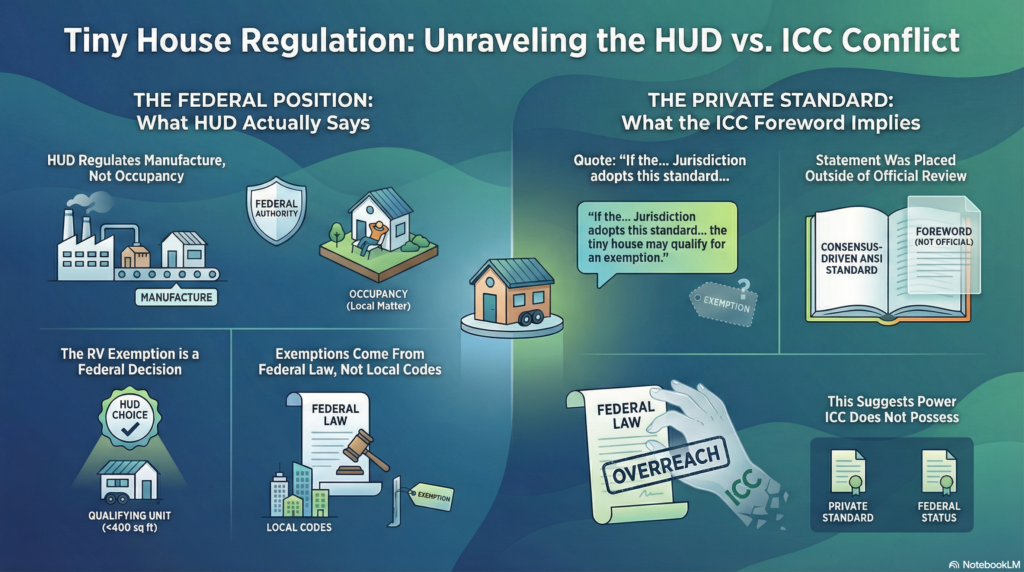
The tiny house industry needs to be aware of statements that are included in the first draft of the ICC 1215 tiny house standard that has been hijacked by the small residential unit that could have consequences for the industry.
Learn More
HUD Final Rule RV Exemption 2018
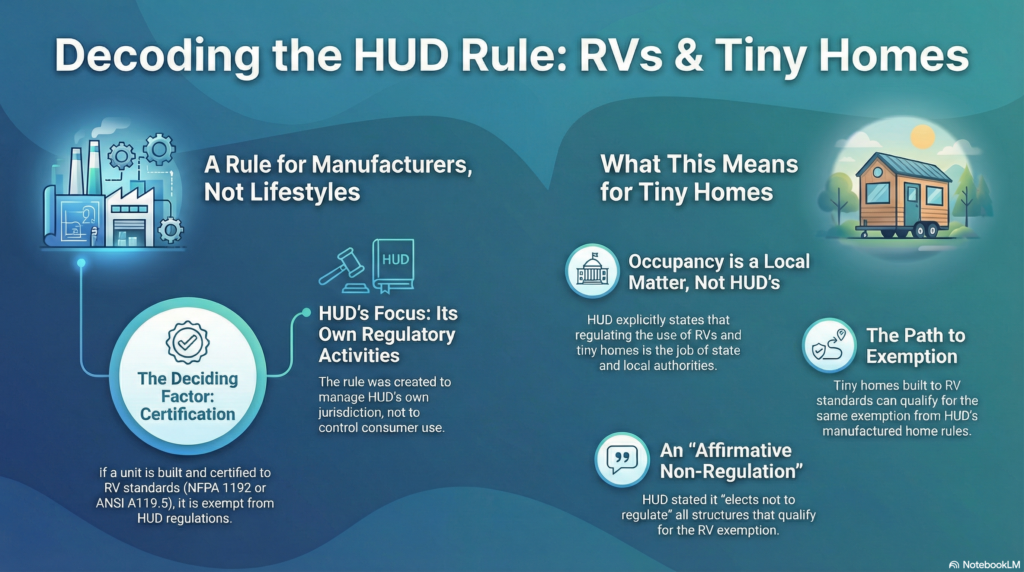
The U.S. The Department of Housing and Urban Development (HUD) redefined and clarified the RV exemption from manufactured housing standards in 2018. The final rule went into effect on January 15, 2019. A lot of manufacturers build tiny homes to recreational vehicle standards and that is why this HUD final rule is important for clarity.
Learn More
Manufacturers Notice
The Manufacturer’s Notice, required for an ANSI-certified PMRVs to be exempt from HUD manufactured housing regulation, imposes a negligible or nonexistent burden on industry and provides informational benefit to consumers
Feb 8, 2026