Tiny Houses On Wheels Left On The Side Of The Road- Now For The Third Time At ICC
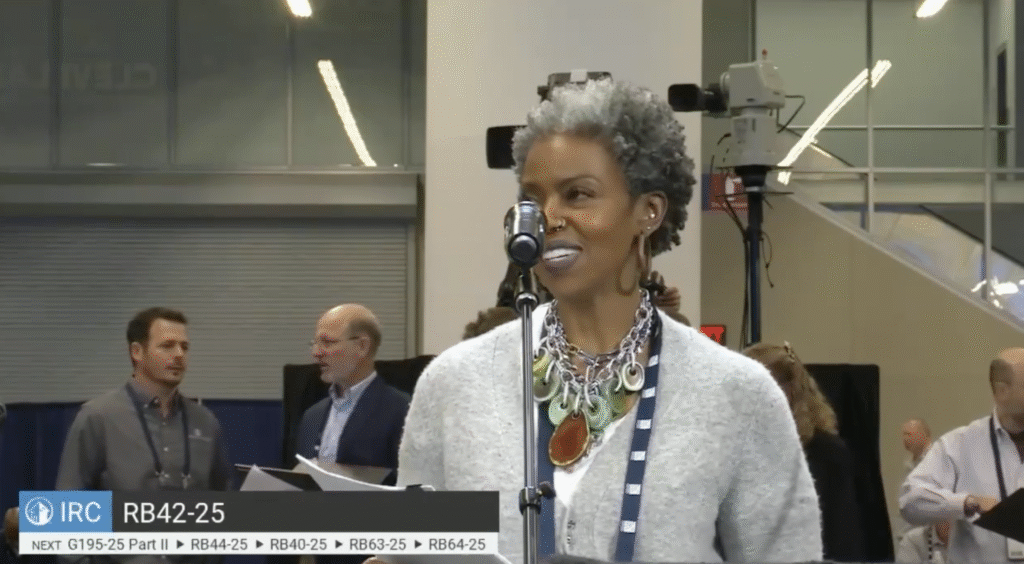
Sadly the public comment to the code proposal RB42-25 was disapproved that would have added chassis provisions to Appendix BB Tiny Houses and is now the 3rd time the chassis provisions were not approved at ICC. The proponents did an amazing job on all their testimonies and the vote was very close-6 to 4.
The proponents have one more chance to go back to the next hearing in the spring, but they are now contemplating how much energy they have to put into this. They have yet to announce their plans.
The Opponents Did Not Have A Clear Understanding About Motor Vehicles
It was so sad to hear the opponents that do not quite have all the facts regarding motor vehicles which include trailers and some think tiny houses on wheels are all RVs. Sadly, they might not know that RVIA will work to kill any bill on a state level if housing and RVs are associated.

Affordable Housing Efforts Threaten RV Industry
RVIA May 17, 2019
In an effort to increase affordable housing, some policymakers across the country have begun to look to tiny homes as a solution. Unfortunately, these efforts have led some legislators, officials and other interest groups to attempt to co-opt RV and PMRV standards and definitions to use them for permanent-use tiny home standards. Washington state was the most active in this effort this year.
Although both NFPA 1192 and ANSI A119.5 specifically state that these standards are for temporary-use vehicles, bills in Washington would have incorrectly defined all types of RVs and used the RV and PMRV standards to define permanent structures.
Defending these standards and definitions to protect our members and keep RVs, including PMRVs, defined as vehicles is a priority issue for the state affairs team. Working directly with Washington state legislators and stakeholders we were able to preserve already existing code and remove incorrect RV and PMRV definitions, while, at the same time, preventing incorrect uses of the RV and PMRV standards.
This push to co-opt RV standards and definitions and apply them to permanent use tiny homes will likely continue to grow in the future. Washington was the most active in this issue area during the 2019 legislative session, but it was not the only state with this type of legislation. It is expected that this push by affordable housing advocates to find some type of permanent use tiny home definition will continue. The state team will continue to defend against these kinds of bills to ensure RVs are not confused with any type of permanent housing.
The regulatory path for tiny houses on wheels for the chassis is already in place including SAE, NHTSA, DOT, the FMVSS, FNCSA, and the Motor Carrier Safety Improvement Act Of 1999.
The Motor Carrier Safety Improvement Act of 1999 is a federal law (Public Law 106-159) that created the FMCSA and requires states to align their commercial motor vehicle safety programs — including VIN enforcement for trailers — with federal standards under Title 49 U.S.C. States must enforce federal VIN and FMVSS rules under the Motor Carrier Safety Improvement Act of 1999.
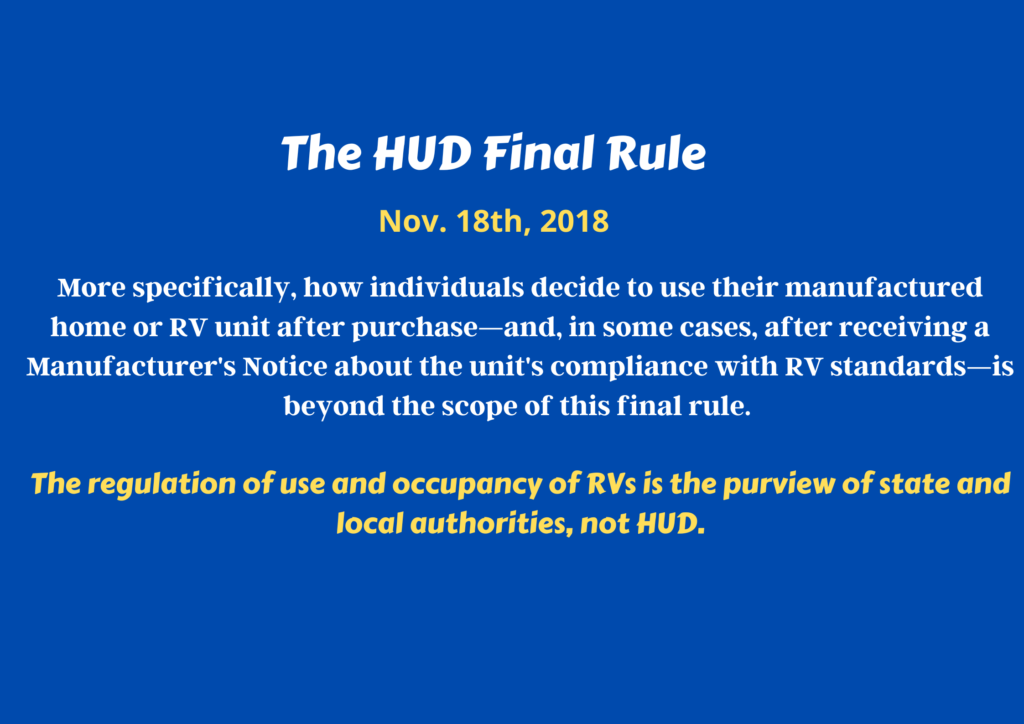
Tiny Houses On Wheels have fallen in between the cracks of HUD, RVs, And ICC. HUD does not regulate the use and occupancy of tiny houses on wheels, they are NOT RVs unless they are built to RV standards, and now ICC is ignoring the regulatory path of NHTSA, FMVSS, FMCSA and does not want to recognize that trailers are motor vehicles and they are trying to override federal laws already in place. See ICC 1215 is Promoting A ‘Ghost Trailer’ For Tiny Houses.
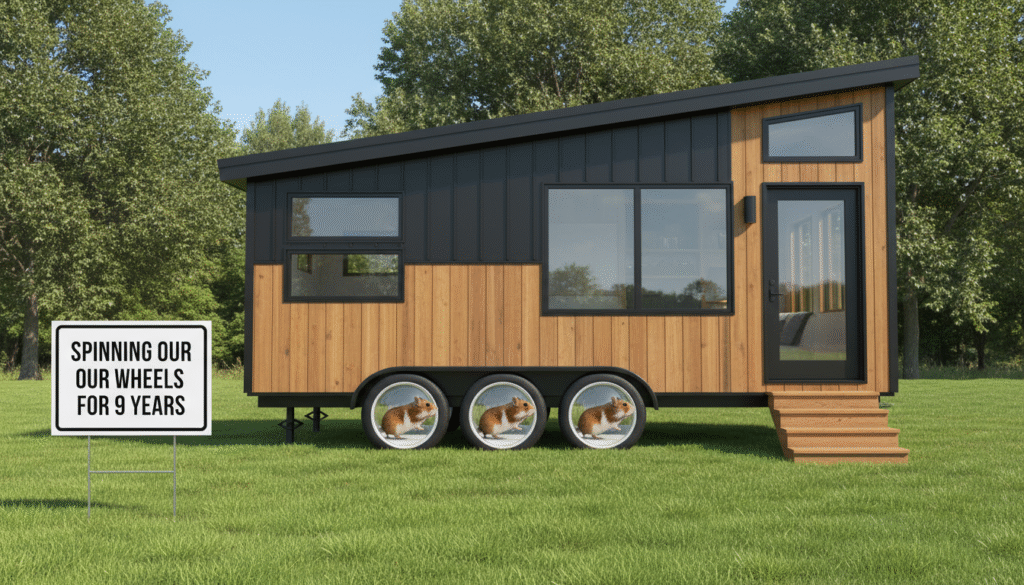
ICC and THIA caused A ONE year delay of the approval process for an ASTM subcommittee on Tiny Houses with false claims of duplication and that standards were not needed even after we had the support of two states and initial collaboration set up with ICC. ASTM and ICC work hand in hand. The 2024 IRC referenced over 500 ASTM standards.
ICC even has ASTM listed in the code criteria policies for code proposals that reference standards, which they include ASTM and ANSI Standards.
- ICC tried to FORCE ICC standards as tiny house requirements even after ICC/MBI 1200 and 1205 were disapproved at the IBC hearing and all tiny house terms were deleted from the standards, with the notion that tiny houses were inclusive without mentioning them. ( That Will Blow Open The Doors! ) NOT
- They objected to ASTM standards, and said it had to be a CODE
- For them to turn around and duplicate ASTM, to develop their OWN standard
- And then the tiny house CODE was turned down.
RB42-25-1 Public Comment
Watch The Hearing
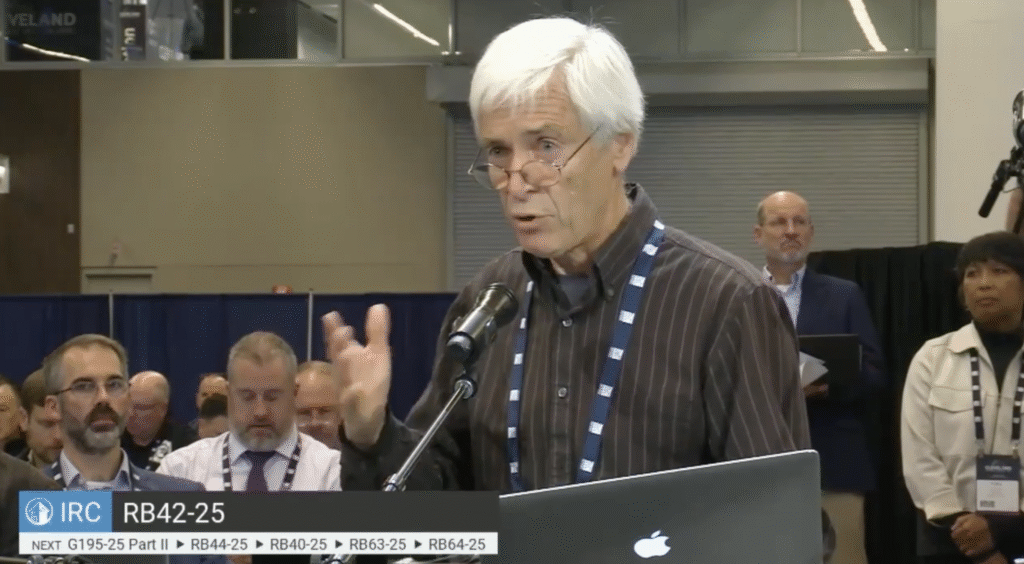
Second Disapproval At ICC
Originally when ICC/MBI 1200 and 1205 were developed, tiny homes were excluded, then included, but after the 2024 IBC hearing, when the standards were turned down, they removed all the terms relating to tiny houses from the committee description, scope of the standards, and the body of the standards, with the ‘notion’ that tiny homes were inclusive, and there was no need to call them out.
Watch The Hearing: Second Disapproval At ICC
First Disapproval At ICC :
The Backstory Of Appendix Q Tiny Houses
Tiny Houses have been held captive by the executives of ICC for over 6 years for their desired outcome that benefits ICC and their services. Appendix Q Tiny Houses, that was adopted into the 2018 IRC, originally had provisions for movable structures, but the head of the ICC code approval process said that he would not accept the proposal as written because he believed it was what they call in the industry a “hijack” of the original proposal.
February 24th, 2018: The International Residential Code Has A Big Vision For Tiny Houses
The inclusion of a new appendix in the 2018 International Residential Code (IRC) addressing standards for dwellings that are 400 square feet in area or less—commonly called “tiny houses”—represents an important milestone not just for advocates of simpler living, but also for the International Code Council.
Appendix Q Tiny Houses is the first set of building standards for dwellings ever incorporated into a model code. The story of how the appendix came to be is a great example of how the Code Council works together with stakeholders and industry professionals to develop model code standards for new and innovative technologies as they emerge.
Tiny-house advocates and code enforcement officials alike have long recognized the need to establish code authority over tiny houses, but it wasn’t until April 2016 that the process to codify requirements for them kicked off in earnest. That’s when the IRC Building Code Action Committee, meeting in Kentucky, heard a proposal submitted by Richard Davidson, a retired building official from Oregon, to create exemptions for design elements that are specific to tiny houses such as minimum floor areas, ceiling heights, door sizes, and hallway widths, and for safety features such as guard rails and automatic fire sprinklers.
Although the committee voted to disapprove Davidson’s proposed changes, it agreed that a more comprehensive approach to tiny houses was certainly needed in the code and suggested that the issue might be better addressed in an appendix.
At the hearing, however, one person had testified in “friendly opposition” to the proposal: Martin Hammer, an architect who had co-authored the IRC’s straw-bale construction appendix. Following the hearing, Hammer received a call from his friend Andrew Morrison of TinyHouseBuild.com, a builder and educator who had helped Hammer write the appendix. “Andrew asked if I thought we could submit a different proposal,” Hammer recalled.
“Andrew asked if I thought we could submit a different proposal,” Hammer recalled. “My first response was yes, but in two and a half years, because the code development cycle was already underway. But after I thought about it some more, I called him back and said he could try submitting a public comment on the disapproved proposal, which would get it in the code cycle right now.”
With Hammer’s help and supported by a volunteer team of designers, engineers and architects, and with the unflagging support of his wife Gabriella, Morrison set out to craft an appendix for tiny house standards in time to submit it to the follow-up round of hearings and public comment reviews scheduled for late October 2016 in Kansas City.
Throughout the process, Hammer tried to manage everyone’s expectations. “Public comments are less likely to be approved than an actual proposal,” Hammer said. “It’s also unusual for a code change proposal that covers new territory to be approved in the first cycle. But I encouraged them to try anyway, because even if it was disapproved, we would learn something for the next time.”
Code Hearing RB196-16 Martin Hammer
An Oral History of Better Building Codes with Martin Hammer
Martin attended the ICC session where 2016 updates to those appendices were approved unanimously for the 2018 IRC, and while there he also testified in friendly opposition to an IRC proposal for ‘Small Houses’, which was then unanimously disapproved. “I saw the potential of the proposal, but wanted to help improve the code language…the subject of tiny houses was and continues to be so widespread. It’s on everyone’s radar,” said Martin. In 2016 he joined forces with tiny house (and straw bale) leader Andrew Morrison to propose IRC Appendix Q – Tiny Houses. With spirited testimony in Kansas City from the tiny house industry and advocates, as well as numerous building officials grappling with code-compliance issues for tiny houses (≤ 400 sf) for ceiling heights, lofts, and their access/egress, the proposal was narrowly approved. The remaining challenges of tiny houses on wheels and chassis standards are now being worked out by the industry with proposed changes to Appendix Q and with a new ASTM standard that is expected to be more applicable worldwide.
Related Blog Posts
Nov 3, 2025