
What Is A Tiny Home?
RVIA’s Position vs. HUD’s 2018 Final Rule on the RV Exemption
In 2018, the U.S. Department of Housing and Urban Development (HUD) issued a Final Rule revising the exemption for the manufacture of recreational vehicles. The purpose of that rulemaking was straightforward: to clarify which recreational vehicles qualify for exemption from HUD’s Manufactured Home Construction and Safety Standards and its Manufactured Home Procedural and Enforcement regulations.
Short Video Explainer Regarding Ths Blog Post
The Rule Does Not Prohibit Or Regulate Occupancy And Use
HUD adopted a recommendation from the Manufactured Housing Consensus Committee (MHCC), while expanding and refining the regulatory language. The final rule established that certain recreational vehicles would be exempt from HUD regulation if they meet specific criteria — including certification to updated consensus standards such as ANSI A119.5-15 (for Park Model RVs) or NFPA 1192.
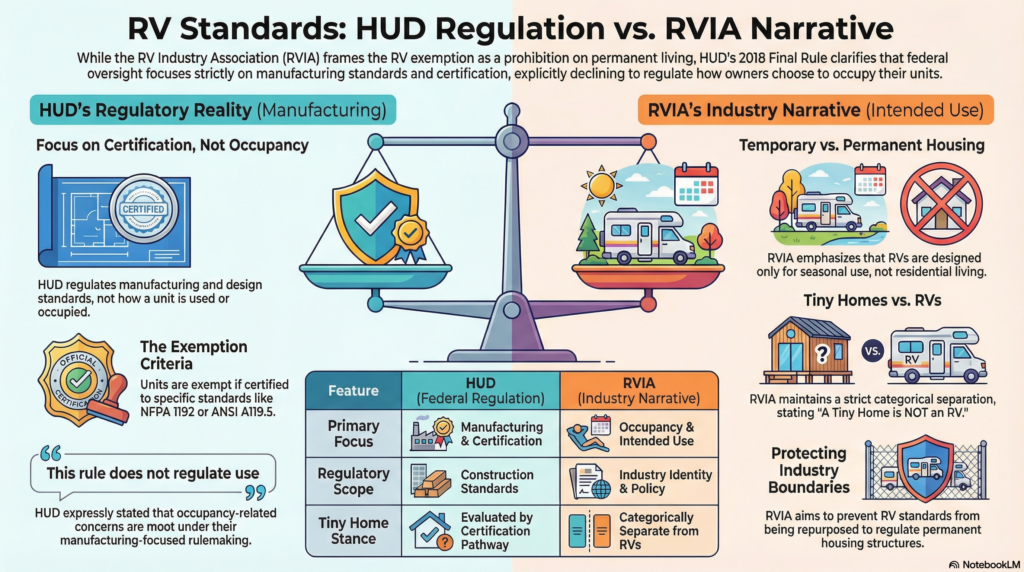
Importantly, HUD emphasized that the rule governs manufacturing classification, not consumer occupancy. HUD expressly stated:
“Because this rule does not prohibit or regulate the use of manufactured homes or RVs, including tiny homes, the secondary consequences described by certain commenters are moot, and HUD does not believe that there exists a need to address them individually.”
In other words, HUD clarified which standards apply at the point of manufacture and certification. It did not attempt to regulate how owners choose to use or occupy those units.
RVIA Article: What Is An RV?
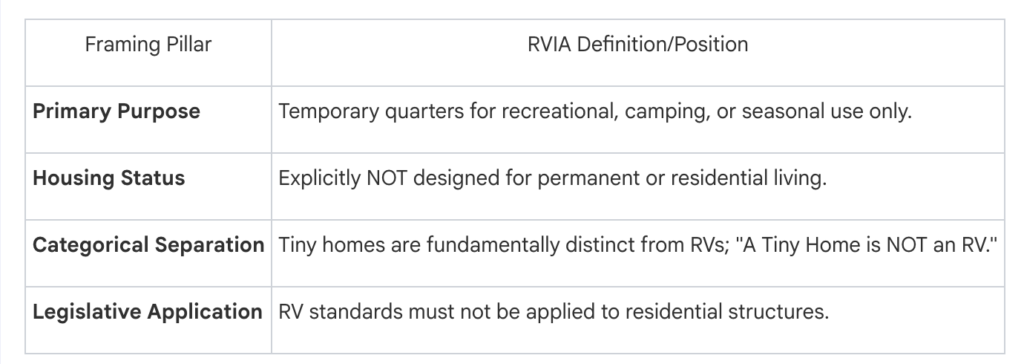
”A recreational vehicle is a vehicular-type unit primarily designed as temporary living quarters for recreational, camping, or seasonal use that either has its own motor power or is mounted on, or towed by, another vehicle. RVs are NOT designed for permanent or residential living. The basic entities are travel trailers, fifth wheel travel trailers, folding camping trailers, truck campers, park model (PMRV) and motorhomes or motorized RVs. ”
”Moreover, the U.S. Department of Housing and Urban Development’s regulatory structure makes clear that recreational vehicles are not regulated for full time use (like mobile homes).[3] As further evidence that the intended use of RVs is for temporary recreational purposes, manufacturers place a label on each of its products which contains information mandated by the Code of Federal Regulations such as the unloaded vehicle weight (“UVW”), the gross vehicle weight rating (“GVWR”), the gross axle weight rating (“GAWR”), Cargo Carrying capacity (“CCC”), and the tire and load information.[4] ”
A Tiny Home is NOT an RV.
”Tiny homes do not currently have a set safety standard for construction, like RVs do. The most crucial distinction between a Tiny Home and a recreational vehicle, that may look like a small residence, is that RVs are not meant to be affixed to real property, must be built on a chassis with wheels, and are NOT built for permanent residence.”
”Additionally, the nationally recognized standards for recreational vehicles – NFPA 1192 Standard on Recreational Vehicles and ANSI A119.5 Park Model Recreational Vehicle Standard – should not be used in legislation as a standard for any vehicle or structure characterized as being “permanent”, “residential”, or described with any similar language.”
RVIA Contradicts The HUD Statement – As HUD stated before-that the rule does not prohibit or regulate the use of manufactured homes or RVs, including tiny homes, the secondary consequences described by certain commenters are moot, and HUD does not believe that there exists a need to address them individually.”
The RVIA Narrative: Protecting Industry Identity
RVIA’s messaging is shaped less by federal manufacturing jurisdiction and more by industry positioning and risk containment. RVIA generally emphasizes that RVs are temporary, recreational products and warns against using RV standards in legislation aimed at permanent residential structures. This framing functions as an industry “firebreak” designed to maintain RVs as consumer products rather than residential real estate.
Analysis of the "So What?" Layer: Strategic Industry Protection
This posture protects the RV category from “residential regulatory creep.” If RV products are treated as residential housing, manufacturers face expanded liability expectations, zoning and siting impacts, consumer finance implications, and potential reclassification pressure. RVIA’s messaging seeks to preserve the RV category as a distinct consumer product class governed primarily by RV standards and applicable vehicle-related requirements—not a substitute housing standard.
Comparative Analysis: Park Model RVs and Tiny Homes
Park Model RVs (PMRVs) and “tiny homes” occupy the market’s most visible overlap zone: they can look similar, but the legal categorization depends on certification pathway and the applicable standard.
PMRV: Certification and Notice Requirements
HUD’s exemption for ANSI A119.5-certified PMRVs includes a required Manufacturer’s Notice. The notice must be delivered prior to completion of the sales transaction and prominently displayed in a temporary manner in the kitchen. The notice text is explicit that the unit is designed only for recreational use and not as a primary residence or for permanent occupancy.
By contrast, RVIA often explains PMRVs using descriptive criteria (e.g., size thresholds, chassis/wheels, and statements about land attachment). But it is noteworthy that concepts such as “affixation to real property” do not appear as criteria in 24 C.F.R. § 3282.15. HUD’s exemption mechanics are driven by certification status, design intent, and compliance with the referenced standards.
Tiny Homes: A Label Without a Federal Category
“Tiny home” is not a federal regulatory classification in this context. HUD acknowledges the term but regulates based on statutory and regulatory triggers and whether a unit fits within an established certification pathway. In practice, many products marketed as tiny homes are not consistently built to ANSI/NFPA RV standards and are not certified as manufactured homes—creating a compliance and consumer clarity challenge that is largely addressed (if at all) at the state and local level.
Park Model RVs (PMRVs) and “Tiny Homes” represent the primary “grey area” where manufacturing standards intersect with market demand for alternative living. These structures often share aesthetic similarities, yet they occupy vastly different regulatory spaces.
Synthesis: Reconciling Design Intent with Market Reality
HUD’s approach is best described as jurisdictional clarity at the point of manufacture: which federal construction regime applies, and when an exemption applies. RVIA’s approach is best described as category protection: reinforcing a boundary between temporary consumer products and permanent residential structures.
Practical Takeaways for Housing Professionals
Certification vs. Occupancy: HUD’s rule determines exemption eligibility based on design intent and certification. It does not regulate occupancy; local jurisdictions regulate siting and residential use.
Federal Criteria vs. Industry Concepts: HUD’s exemption criteria are certification-based (vehicle/vehicular structure not HUD-certified + recreational design intent + ANSI/NFPA compliance). Marketing labels like “tiny home” and industry descriptors like “affixation” are not the operative federal tests in § 3282.15.
Risk and Communications: Professionals should distinguish between HUD’s manufacturing framework and RVIA’s category-protection messaging. They may overlap rhetorically, but they serve different legal purposes.
Understanding these distinctions matters because federal law governs the factory-floor classification and disclosure framework—while local law governs where and how units may be used.
Critical Takeaways for Housing Professionals
HUD Maintains They Are The Only Authority
Conclusion
HUD’s 2018 Final Rule was about defining a federal manufacturing exemption pathway — not about prohibiting full-time living or categorically redefining housing types.
RVIA’s position focuses on preserving a clear separation between recreational vehicles and residential housing in policy discussions.
Understanding that distinction is important: HUD clarified certification and exemption criteria. RVIA advocates for industry boundaries in broader housing debates. While related, those objectives are not identical.
Although I do understand and respect RVIA’s position, I feel they should only quote HUD directly.
Resources
Author's Disclaimer
HUD Is The Only Authority
Related Blog Posts
Manufacturers Notice
Feb, 14, 2026