
Open Road To Full Time Living
For many, the dream of the open road is synonymous with full-time living — a nomadic existence where home is wherever you park. The cultural image of RV life often blurs the line between recreation and residence.
From a regulatory standpoint, however, that line is clearly defined.
Under federal law, recreational vehicles are not regulated as residential housing. They are motor vehicles regulated by the National Highway Traffic Safety Administration (NHTSA). Industry standards such as NFPA 1192 and ANSI A119.5 define these vehicles as designed and engineered for temporary, seasonal, and recreational use.
This distinction is not semantic. It determines which federal safety framework applies, how manufacturers must register and identify their vehicles, and what compliance obligations follow. Questions of occupancy and long-term use fall within the purview of state and local authorities—not federal manufacturing law or trade association bulletins.
A lot of manufacturers build tiny houses on wheels to RV standards for the ability to register and title the unit and that is why this information is relative to tiny houses.
RVIA Publicly States That RVs Are Regulated By NHTSA
RVIA publicly states that recreational vehicles are regulated by the National Highway Traffic Safety Administration (NHTSA) and must comply with applicable Federal Motor Vehicle Safety Standards (FMVSS). It also emphasizes compliance with NFPA 1192 and ANSI A119.5.
Those are their words.
Below are the federal statutes, regulations, agency guidance, and industry bulletins themselves. When read together, they raise an important question: if RVs are motor vehicles under NHTSA jurisdiction, why are core federal requirements—such as VIN structure (49 CFR Part 565), manufacturer registration (Part 566), and SAE WMI assignment—so often absent from public-facing compliance discussions?
This post does not speculate. It simply lays the documents side by side and allows them—and RVIA’s own statements—to speak for themselves.
Short Video Explainer Of The Blog Post
Why Is RVIA Only Referencing Select FMVSS Standards For Compliance?
RVIA States- ” RVs, or recreational vehicles, are not permanent or residential housing. Recreational vehicles are designed, engineered, and assembled for temporary, seasonal, and recreational use. An RV is a vehicle that combines transportation and temporary living quarters for travel, recreation, and camping. RV Industry Association manufacturing members must comply with the nationally recognized standards for RVs – NFPA 1192 Standard on Recreational Vehicles and ANSI A119.5 Park Model Recreational Vehicle Standard – which specifically state that the standards are for temporary, recreational, and seasonal use vehicles.
The RV Industry Association seal that is affixed to RV Industry Association member produced RVs certifies compliance with those standards. Furthermore, a recreational vehicle is regulated by the National Highway Traffic Safety Administration as a motor vehicle and recreational vehicles must comply with applicable Federal Motor Vehicle Safety Standards. Recreational vehicles should not be confused with, or defined as, any product which could be used for permanent habitation. Additionally, the nationally recognized standards for recreational vehicles – NFPA 1192 Standard on Recreational Vehicles and ANSI A119.5 Park Model Recreational Vehicle Standard – should not be used in legislation as a standard for any vehicle or structure characterized as being “permanent”, “residential”, or described with any similar language.”
[1] 49 CFR Part 571 – Federal Motor Vehicle Safety Standards.
[2] NFPA 1192 Standard on Recreational Vehicles (2021 Ed.) Chapter 1 Administration at ¶ 1.1.
[3]See CFR 17 Part 3282 (“Manufactured Home Procedural Enforcement Regulations; Clarifying the Exemption for Manufacture of Recreational Vehicles”).
[4] 49 CFR Part 567.4 and 49 CFR Part 110. The enforcement of the proper labeling and product safety recalls associated with recreational vehicles are regulated by the National Highway Traffic Safety Administration (“NHTSA”), a division of the United States Department of Transportation.
Conflicted Messaging
RVIA publicly states that recreational vehicles must comply with applicable FMVSS and are regulated by NHTSA as motor vehicles.
However:
RVIA articles do not list 49 CFR Parts 565 and 566.
ANSI A119.5 Section 1-4.3 implies that compliance with Part 565 may be optional.
Industry bulletins continue to omit SAE WMI requirements.
Some manufacturers are issuing VINs without completing Part 566 registration.
This creates an inconsistent compliance environment.
Federal Law Is Not Voluntary
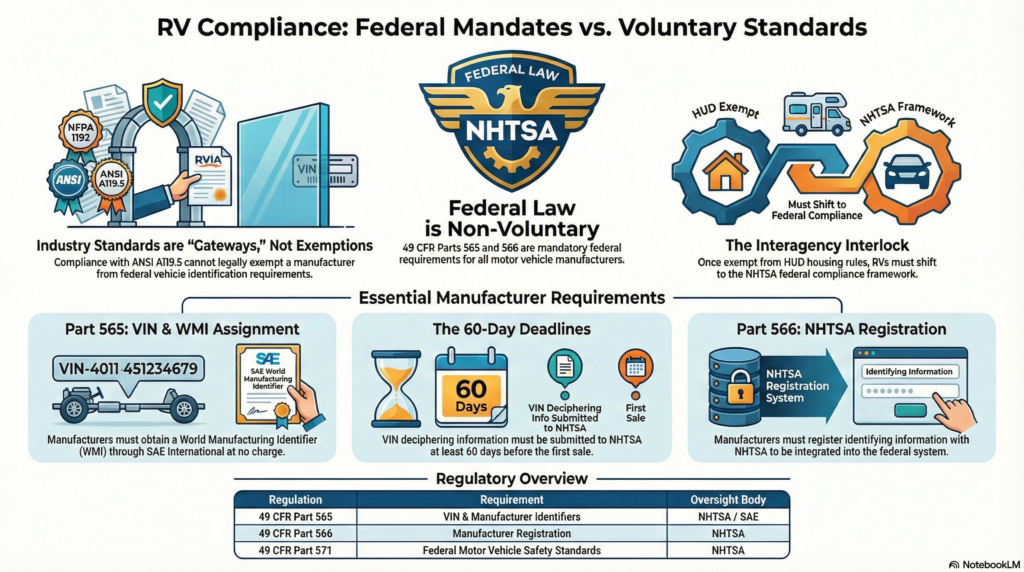
49 CFR Parts 565 and 566 are not discretionary provisions.
They are mandatory federal requirements for manufacturers of motor vehicles and motor vehicle equipment.
A private consensus standard cannot imply optional compliance with federal law.
If Park Model Recreational Vehicles are vehicles — and HUD has clarified they are not regulated as manufactured homes — then applicable motor vehicle laws must be uniformly applied.
Statement Regarding ANSI A119.5 Section 1-4.3 – Vehicle Identification
Section 1-4.3 of ANSI A119.5 states that Park Model RVs “that do not comply with CFR-49 Part 565” must have a seventeen-digit VIN permanently affixed to the chassis. The phrasing is problematic because it implies that compliance with 49 CFR Part 565 is discretionary rather than mandatory.
Part 565 governs federal Vehicle Identification Number (VIN) requirements and operates in conjunction with Part 566 (Manufacturer Identification) and SAE World Manufacturer Identifier (WMI) registration. These are not optional provisions; they are foundational components of the federal motor vehicle regulatory system administered by NHTSA.
When a private consensus standard appears to present an alternative VIN pathway separate from Part 565 compliance, it creates ambiguity regarding whether federal registration, WMI assignment, and VIN decoding submissions are required. That ambiguity is contributing to inconsistent practices in the marketplace, including manufacturers issuing VINs without completing required federal registration steps.
Federal motor vehicle compliance cannot be partial. Any language that suggests otherwise risks confusion, noncompliance, and the creation of parallel identification systems not recognized under federal law.
Clarity is essential. The federal requirements already exist. Industry standards and bulletins should reflect them fully and accurately.
Interagency Interlock: HUD Exemption Pathway Cannot Create a Federal Law Workaround
RVIA has publicly described its multi-year effort to obtain regulatory clarity from HUD and to ensure that recreational vehicles are exempt from HUD manufactured housing regulation. HUD’s 2018 Final Rule then clarified and expanded the RV manufacturing exemption, including by tying exemption eligibility to certification under consensus standards such as ANSI A119.5 (for Park Model RVs) and NFPA 1192.
That structure creates an important interagency interlock: once RVs and Park Model RVs are treated as exempt from HUD’s manufactured housing standards, the remaining federal compliance framework for these vehicular structures necessarily shifts to the motor-vehicle side of federal law where applicable—including NHTSA’s manufacturer identification and vehicle identification systems.
For that reason, it is not sufficient for industry communications to reference only select FMVSS provisions while omitting the core identification and registration requirements that integrate vehicles into the federal system (including 49 CFR Part 565 and 49 CFR Part 566, and the related SAE/WMI process used for lawful VIN issuance).
This is where the voluntary-standard issue becomes legally consequential. HUD itself has stated:
“Additionally, compliance with a voluntary standard such as ANSI 119.5 cannot exempt manufacturers from Federal Law, HUD code, HUD regulations, or HUD Interpretive Bulletins.”
The principle applies with particular force here because ANSI A119.5 is being used as a regulatory gateway—a pathway to claim exemption from HUD oversight. A voluntary consensus standard cannot simultaneously function as a gateway to exemption while also being interpreted (explicitly or implicitly) to make compliance with federal vehicle identification and manufacturer registration requirements optional. Any reading of ANSI A119.5 that suggests Part 565/566 compliance is discretionary risks creating a parallel, non-identical compliance track that federal law does not authorize.
Who Is NHTSA?
The National Highway Traffic Safety Administration (NHTSA) was established by the Highway Safety Act of 1970 (23 U.S.C. 401 note) to help reduce the number of deaths, injuries, and economic losses resulting from motor vehicle crashes on the Nation’s highways.
The Administration carries out programs relating to the safety performance of motor vehicles and related equipment; administers the State and community highway safety program with the FHWA; regulates the Corporate Average Fuel Economy program; investigates and prosecutes
odometer fraud; carries out the National Driver Register Program to facilitate the exchange of State records on problem drivers; conducts studies and operates programs aimed at reducing economic losses in motor vehicle crashes and repairs; performs studies, conducts demonstration projects, and promotes programs to reduce impaired driving, increase seat belt use, and reduce risky driver behaviors; and issues theft prevention standards for passenger and nonpassenger motor vehicles.
Federal Motor Vehicle Safety Standards: FMVSS
NHTSA issues Federal Motor Vehicle Safety Standards to implement laws from Congress. FMVSSs can be found in title 49, part 571, of the Code of Federal Regulations.
CFR: Title 49 Part 571 Title 49
NHTSA Webinar- Trailers
This is an important webinar regarding manufacturing trailers, or importing trailers in the United States, or importing them or motor vehicle equipment. The webinar includes statutory requirements and fines for noncompliance.
What Does DOT Do?
The Department of Transportation (USDOT, DOT) is a cabinet-level executive branch agency responsible for overseeing national transportation systems and infrastructure. Its functions include developing and implementing federal transportation policies; ensuring the safety and efficiency of highways, railroads, air travel, and maritime transport; and administering funding for transportation projects including local transit systems. It was established in 1966.
DOT
FMCSA
The Federal Motor Carrier Safety Administration (FMCSA) was established within the Department of Transportation on January 1, 2000, pursuant to the Motor Carrier Safety Improvement Act of 1999 (49 U.S.C. 113). Formerly a part of the Federal Highway Administration, the Federal Motor Carrier Safety Administration’s primary mission is to prevent commercial motor vehicle-related fatalities and injuries. Activities of the Administration contribute to ensuring safety in motor carrier operations through strong enforcement of safety regulations; targeting high-risk carriers and commercial motor vehicle drivers; improving safety information systems and commercial motor vehicle technologies; strengthening commercial motor vehicle equipment and operating standards; and increasing safety awareness. To accomplish these activities, the Administration works with Federal, State, and local enforcement agencies, the motor carrier industry, labor and safety interest groups, and others.
FMCSA
SAE
The National Highway Traffic Safety Administration (NHTSA) has contracted with the SAE International (SAE) to coordinate the assignment of manufacturer identifiers. Manufacturer identifiers will be supplied by SAE at no charge. All requests for assignments of manufacturer identifiers should be forwarded directly to: SAE International, 400 Commonwealth Drive, Warrendale, Pennsylvania 15096, Attention: WMI Coordinator. Any requests for identifiers submitted to NHTSA will be forwarded to SAE. Manufacturers may request a specific identifier or may request only assignment of an identifier(s). SAE will review requests for specific identifiers to determine that they do not conflict with an identifier already assigned or block of identifiers already reserved. SAE will confirm the assignments in writing to the requester. Once confirmed by SAE, the identifier need not be resubmitted to NHTSA.
(b) Manufacturers of vehicles subject to this part shall submit, either directly or through an agent, the unique identifier for each make and type of vehicle it manufactures at least 60 days before affixing the first VIN using the identifier. Manufacturers whose unique identifier appears in the fourth section of the VIN shall also submit the three characters of the first section that constitutes a part of their identifier.
(c) Manufacturers of vehicles subject to the requirements of this part shall submit to NHTSA the information necessary to decipher the characters contained in its VINs. Amendments to this information shall be submitted to the agency for VINs containing an amended coding. The agency will not routinely provide written approvals of these submissions, but will contact the manufacturer should any corrections to these submissions be necessary.
(d) The information required under paragraph (c) of this section shall be submitted at least 60 days prior to offering for sale the first vehicle identified by a VIN containing that information, or if information concerning vehicle characteristics sufficient to specify the VIN code is unavailable to the manufacturer by that date, then within one week after that information first becomes available. The information shall be submitted to https://vpic.nhtsa.dot.gov/ or to: Administrator, National Highway Traffic Safety Administration, ATTN: VIN Coordinator, 1200 New Jersey Avenue SE, Washington, DC 20590. Manufacturers of replica motor vehicles shall furnish the information by using the portal at https://vpic.nhtsa.dot.gov/.
Conclusion
Confusion in the marketplace does not stem from a lack of federal rules—it stems from inconsistent communication about them. NHTSA’s VIN framework (49 CFR Part 565) exists to standardize vehicle identification and support recall accuracy, traceability, and enforcement. Manufacturer identification reporting (49 CFR Part 566) is the companion mechanism that connects manufacturers and their VIN schemes within NHTSA’s national system.
When industry-facing materials emphasize “applicable FMVSS” while omitting the identification and manufacturer-registration architecture that integrates vehicles into the federal compliance system, manufacturers and third-party programs may treat those steps as optional, delayed, or someone else’s responsibility. That is where compliance risk develops—not because federal law is unclear, but because the messaging becomes selective.
The practical consequence is predictable: inconsistent VIN practices, incomplete manufacturer registration pathways, and a marketplace where enforcement, titling, and consumer expectations no longer align.
Federal law does not operate piecemeal. Where recreational vehicles fall within the scope of federal motor vehicle statutes, compliance with Parts 565 and 566 is not discretionary. Voluntary industry standards cannot substitute for, or diminish, mandatory federal requirements. Once a manufacturer relies on the HUD residential exemption for a vehicular structure, the applicable motor vehicle framework must be applied consistently and in full.
NHTSA Part 565: Obtain a World Manufacturing Identifier (WMI) from the Society of Automotive Engineers (SAE) Application
- NHTSA Part 566: Register With National Highway Traffic Safety Administration (NHTSA) Steps
- Follow Federal And State Laws
Resources
Feb. 15, 2026