
How ICC Is Creating A 'Ghost Trailer'
Imagine building a trailer that can legally travel the interstate — but exists nowhere in the federal motor vehicle system.
That is the legal tension now surrounding ICC 1215 – Design, Construction, Inspection and Regulation of Small Residential Units and Tiny Houses for Permanent Occupancy. What began as a tiny house standard with a focus on chassis provisions, has now been taken on a detour of a small residential unit construct that is re-writing the rules of the road and raises questions about Motor Vehicle Law. . The committee has chosen to ignore and override motor vehicle law preemption and instead are promoting a chassis-based compliance pathway that sidesteps the full NHTSA/DOT federal framework — effectively creating a regulatory “ghost trailer” and an alternative pathway in complete conflict with federal motor vehicle law.
The irony is profound. A “standard” ostensibly designed to provide safety and legitimacy actually strips away the uniform national safety framework that has protected manufacturers for decades. By encouraging builders to follow a non-federal route, ICC 1215 produces vehicles that are “invisible” to the very system meant to regulate their transit, rendering federal safety standards inoperable by denying motor-vehicle classification.
ICC Failed To Answer My Second Preemption Inquiry
ICC Council Policy #49 gives the ICC Board of Directors the authority to strike any provision of a code or standard when the Board, acting on the advice of counsel, determines that it is more likely than not that federal law preempts the provision.
I have sent two formal complaints to ICC regarding motor vehicle preemption.
ICC publicly responded to my first preemption inquiry and their response was posted on their website without the accompanying complaint, rebuttal, or supporting materials. A subsequent formal inquiry raising additional federal motor vehicle conflicts remains unanswered. My complaint including email exchanges from iCCNTA recommending that the committee avoid federal domains, including FMVSS and HUD and avoiding motor vehicle classification. Another contradiction is using HUD code definitions and provisions for manufactured homes which is beyond the scope of the IRC or the standard.
The complete legal analysis follows in a previous blog post that includes my complaint, their reply, my rebuttal, and supportive documentation. Learn more.
Short Video Explainer Of The Blog Post
Is A Tiny House On Wheels A Structure Or A Vehicle ?
It is both. The crux of the matter is this. A tiny house on wheels is both a structure and a vehicle and duo nature of the unit must be recognized with the integration of both the vehicle path and the structure for compliance to be a legal unit that travels down the road.
The Dual Identity Crisis: Structure vs. Vehicle
The Lost Path to Permanence
Motor Vehicle Safety Act
When you pull a new trailer onto the interstate, you rely on something invisible but essential: a uniform national safety framework. NHTSA issues Federal Motor Vehicle Safety Standards to implement laws from Congress. FMVSSs can be found in title 49, part 571, of the Code of Federal Regulations, federal standards that apply from coast to coast. You do not worry that the requirements change when you cross a state line. the product of the Motor Vehicle Safety Act (MVSA), the statutory structure that prevents fifty states from imposing fifty different and conflicting motor vehicle standards.
For decades, the MVSA has provided manufacturers with a clear and predictable compliance pathway. Federal Motor Vehicle Safety Standards (FMVSS) govern the point of fabrication. States regulate use and enforcement—but only within the bounds of federal law. The system works because the line is clear.
That clarity is now being tested by a voluntary consensus standard- ICC/THIA 1215 – . Originally presented as addressing tiny houses.
The Hijacking of a Category: From Tiny House to "Small Residential Unit
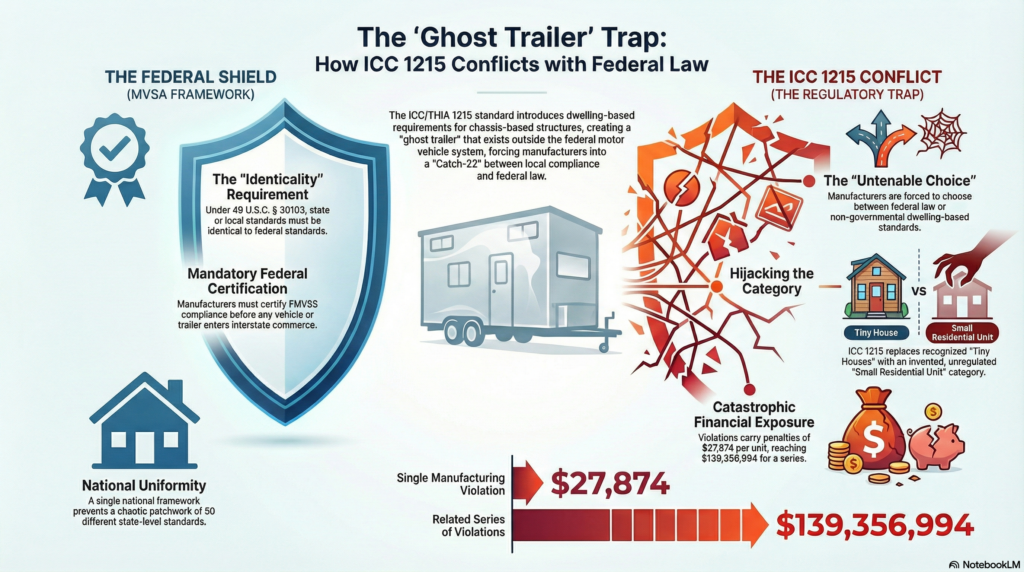
The ICC/THIA 1215 standard was introduced under the banner of regulating tiny houses, but in practice it has redirected and subordinated them beneath an invented category—the Small Residential Unit. Rather than advancing the existing, codified recognition of tiny houses, the standard elevates the Small Residential Unit into a primary regulatory position, displacing tiny houses and severing them from established federal and state compliance frameworks. This detour strips tiny houses on wheels of their lawful motor-vehicle compliance pathway, fragments regulatory authority, and replaces a working, recognized system with a new construct that lacks statutory grounding, uniform adoption, or clear placement authority. The result is not clarity or safety, but regulatory confusion, delayed approval, and the effective hijacking of tiny houses by a category that did not previously exist in code.
Selective Regulatory Extraction
Learn More
The Law of "Identical" Standards
The MVSA is built around one decisive principle: uniformity. Under 49 U.S.C. § 30103(b)(1):
“When a motor vehicle safety standard is in effect… a State… may prescribe… a standard… only if the standard is identical to the standard prescribed under this chapter.”
This is not a policy preference. It is statutory command. States may enforce federal standards—but they may not alter them. Even well-intentioned deviations are preempted if they are not identical.
For manufacturers, this creates a simple rule: there is one compliance pathway at the point of manufacture and while the unit is in transit regarding the trailer.
The Factory Floor vs. The Open Road
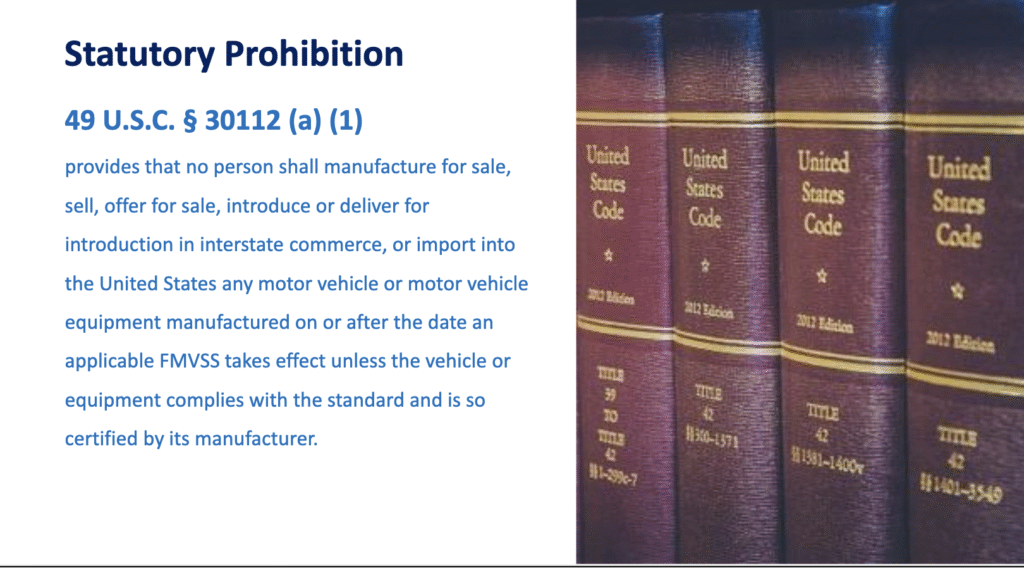
49 U.S. Code § 30112 -
Prohibitions on manufacturing, selling, and importing noncomplying motor vehicles and equipment. Note: motor vehicles include trailers.
a) General.
Source
49 U.S. Code § 30115
Certification of compliance
(a) In General.—
(b) Certification Label.—In the case of the certification label affixed by an intermediate or final stage manufacturer of a motor vehicle built in more than 1 stage, each intermediate or final stage manufacturer shall certify with respect to each applicable Federal motor vehicle safety standard—
If the intermediate or final stage manufacturer elects to assume responsibility for compliance with the standard covered by the documentation provided by an incomplete motor vehicle manufacturer, the intermediate or final stage manufacturer shall notify the incomplete motor vehicle manufacturer in writing within a reasonable time of affixing the certification label. A violation of this subsection shall not be subject to a civil penalty under section 30165.
The ICC/THIA 1215 Conflict—A House Divided
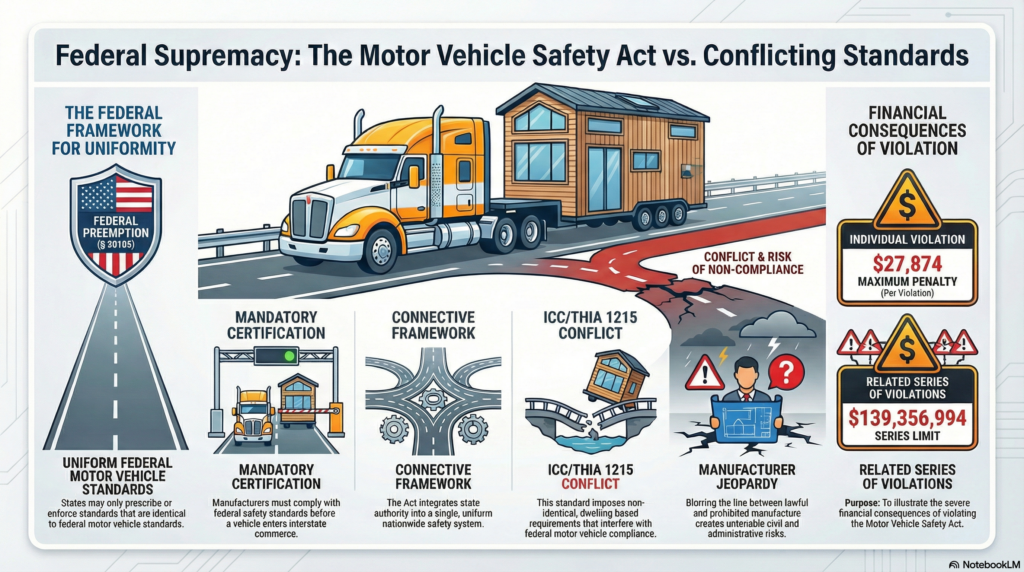
The introduction of ICC/THIA 1215 places manufacturers of chassis-based structures in a difficult and unstable position at the point of manufacture. The standard applies dwelling-based construction requirements to units that are built on a permanent chassis and intended to use public roads and highways during transport.
Manufacturers of these units must design and construct them so they can be lawfully transported over public highways.
If a manufacturer complies with the ICC/THIA 1215 standard, they are in a catch 22, because they cannot also comply to motor vehicle law. The standard is creating both impossibility and obstacle preemption.
- Impossibility Preemption: Applies when a party cannot comply with both state and federal regulations simultaneously (e.g., federal law requires X, state law forbids X).
- Obstacle Preemption: Applies when state law hinders, restricts, or stands as an obstacle to the accomplishment of Congress’s full objectives, even if not directly contradictory.
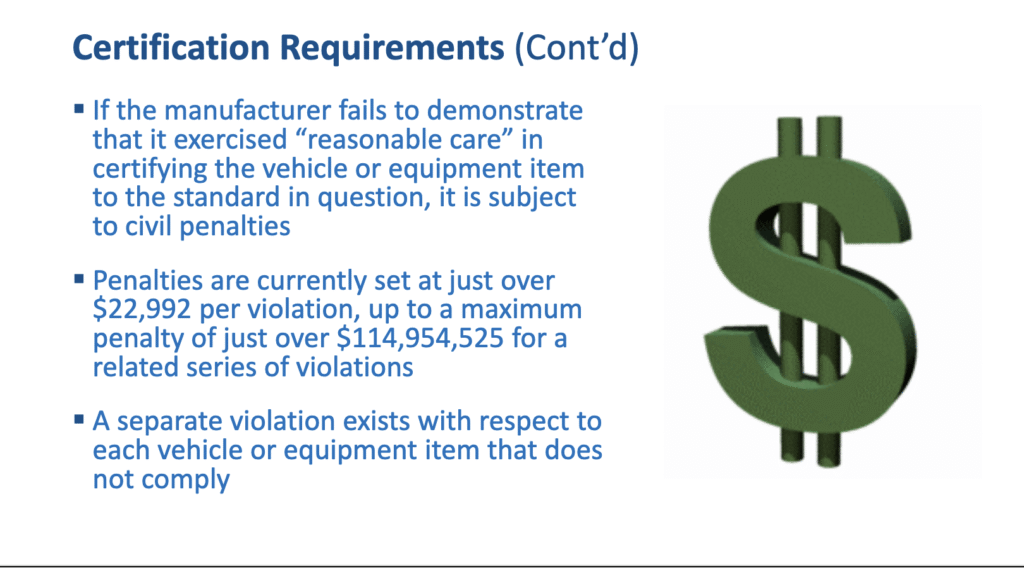
The $139 Million Risk
NHTSA Warns About Illegal Trailers
NHTSA warns consumers to “avoid falling victim to sellers of illegal trailers,” noting that trailers that do not comply with federal regulations “may not be safe and are not allowed to enter the United States.”
Avoiding federal motor vehicle law does not eliminate it. It produces:
• Violations of federal law
• Loss of a lawful compliance pathway that could transition a tiny house on wheels from motor vehicle status (personal property) to real property tied to land
• A disservice to manufacturers who are not given a complete legal framework for compliance
The result is predictable: more non-compliant trailers on the road, instability in the tiny house industry, zoning confusion, and diminished consumer confidence.
Consumer Alert: NHTSA Cautions Buyers that Trailers Must Meet Federal Safety Regulations
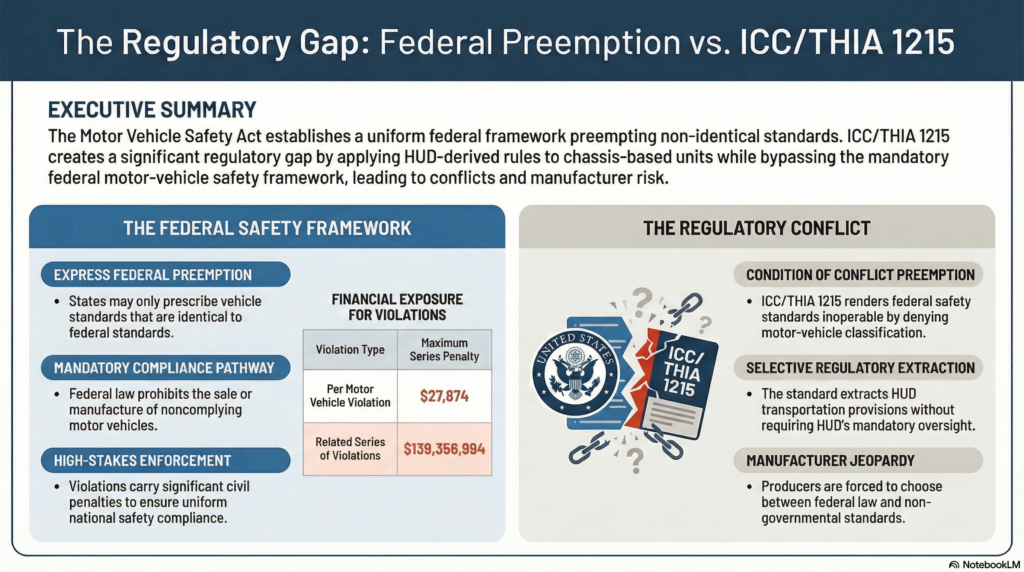
Conclusion: The Future of Uniformity
The mandatory compliance pathway established by the MVSA remains the only lawful route for the manufacture and sale of motor vehicles in the United States.
Why This Matters
Avoiding the federal motor vehicle framework does not eliminate it. It creates consequences.
Exposure to Federal Violations
Transportation-capable units that bypass the Motor Vehicle Safety Act compliance pathway risk being manufactured or sold in violation of federal law.Loss of a Lawful Integration Pathway
There is a legitimate regulatory path by which a transportation-capable tiny house can transition from motor vehicle status (personal property) to a structure affixed to land (real property) through codified steps. That pathway preserves compliance, financing options, and long-term stability. ICC 1215, as written, does not provide that integrated framework.Manufacturer Disadvantage
By failing to clearly anchor chassis-based units within the federal motor vehicle compliance structure, the standard leaves manufacturers without a complete legal roadmap. That ambiguity does not protect builders — it exposes them.
The predictable results of regulatory avoidance are not innovation — they are instability:
Increased circulation of non-compliant transportation-capable units
Industry-wide uncertainty
Continued zoning resistance
Erosion of consumer confidence
Uniform compliance pathways protect manufacturers, consumers, and the legitimacy of the tiny house industry. Replacing them with parallel structures creates risk without providing lawful clarity.
Feb. 21, 2026