
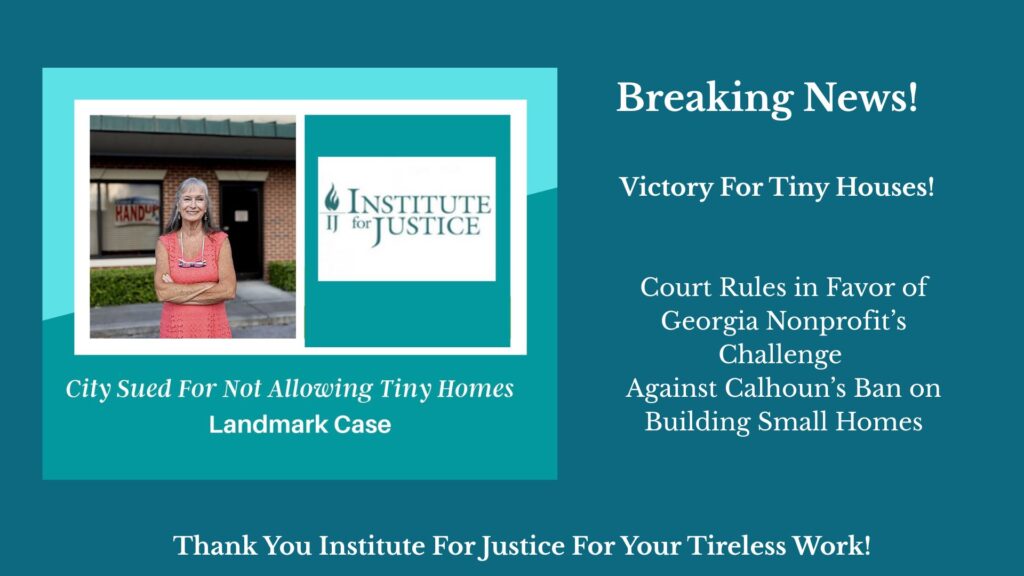
Lifting The Ban On Building Small Houses
Incredible breaking news! This took almost four years! We are so grateful for the Institute For Justice that is working on behalf of the tiny house industry!
Victory! Court Rules in Favor of Georgia Nonprofit’s Challenge Against Calhoun’s Ban on Building Small Homes
Announcement From Institute Of Justice-Philip Suderman
CALHOUN, Georgia—Today, Tiny House Hand Up (THHU) won an important legal victory in their challenge to the city of Calhoun’s ban on building homes smaller than 1,150 square feet. THHU is a Calhoun nonprofit that wants to use donated land to fill a niche for smaller, less costly homes After the Institute for Justice (IJ) argued on their behalf, the judge ruled from the bench, granting a motion in THHU’s favor. A written order will be coming in the next few weeks.
“This is not just a win for our clients, it’s a win for the people of Calhoun,” said IJ Attorney Joe Gay. “The city spent years telling Tiny House Hand Up that they can’t build modest cottages on their property. We are thrilled to finally have their constitutional rights vindicated in court.”
“Small homes offer flexibility for people who might not be able to afford larger homes or who just prefer to downsize,” said IJ Senior Attorney Dan Alban. “Imposing arbitrary limits on home size makes no sense and violates the Georgia Constitution.”
Affordable housing is one of most pressing economic issues facing Americans today, with soaring prices keeping people from obtaining the American dream of housing independence. Even some people with a steady job but modest income are unable to afford housing in today’s economy. Between 2020 and 2024 the media house price in Georgia rose from $248,900 to $381,100 according to Houzeo.
Calhoun specifically has wrestled with affordable housing. Its poverty rate is more than twice the national average and its rate of homeownership is lower by 36%. Unsurprisingly, almost 20% of homeowners and 40% of renters in Calhoun live in housing that costs more than 30% of household income, a percentage generally considered to be unaffordable.
IJ has successfully challenged arbitrary laws that prohibit people from using their property in ways that people have always used their property: to grow vegetables on their front lawn, to run small home businesses, and to bake and sell food from a home kitchen. Government busybodies increasingly want to dictate not only what you may do on your property, but also what kind of home you are allowed to live in. IJ stands ready to continue to help property owners fight these increasingly intrusive and irrational regulations.
Related- The Backstory City’s Ban On Tiny Homes Violates The Georgia Constitution
Institute For Justice Files Court Case On October 27th, 2021
Press Release CALHOUN, Ga.—Your home is your castle. But in cities and towns throughout Georgia, the kind of home you are allowed to buy is limited not just by the price tag but by something unexpected: the government. Tiny House Hand Up (THHU), a Calhoun nonprofit that wants to use donated land to fill a niche for smaller, less costly homes, has been blocked by the town despite demand for these homes. Why? Not because the proposed homes fail any health or safety standard, but simply because they are smaller than the government wants. Yesterday, Tiny House Hand Up, represented by the Institute for Justice (IJ), submitted a lawsuit to the Superior Court for Gordon County challenging Calhoun’s arbitrary restriction for violating the Georgia Constitution.
“There is no health or safety reason to ban smaller homes,” said IJ Senior Attorney Erica Smith Ewing. “People around the country live in smaller homes without any issues, even in Calhoun in homes built before the ban.”
Homeownership is financially unfeasible for too many in Calhoun, with a poverty rate more than twice the national average. A few years ago, Cindy Tucker grew tired of talking about the problem and decided to act. She is the executive director of THHU, which was formed to fill an unmet need in the housing market.
After Tiny House Alliance USA Connected THHU to IJ, They Started Working To Make That Happen.
Cindy and THHU are ready to build. They received a donation of about eight acres of undeveloped land where they want to build a community of beautiful homes called the “Cottages at King Corner.” They will start with six homes with one to two bedrooms and between 540 to 600 square feet each and hope to eventually grow the community to between about 20 to 30 homes. They have housing plans, financial support from a bank, and contractors at the ready.
All they need to start building is for the government to get out of the way. After Tiny House Alliance USA connected THHU to IJ, they started working to make that happen.

Related: Rural Georgia Court Strikes Down Minimum Home Size Rule
The Builder’s Daily’s RIchard Lawson reports on a first-of-its-kind Georgia ruling against minimum home size requirements. The ruling could spark a domino-effect model to ignite zoning reform nationwide.
Legal battles over residential zoning besiege big cities everywhere.
In Georgia, however, a recent court ruling in a small rural city could upend zoning regulations across the Peach State that limit the minimum size of homes that can be built.
What’s more, that one obscure ruling could set off a cascading effect, serving as a lightning rod model for fighting such restrictions nationally.
A state judge in Calhoun, a city of about 20,000 in northwest Georgia, ruled on August 7 that the city’s zoning code, which set the minimum new home size at 1,150 square feet, violates the state’s constitution.
The ruling may be the first of its kind in Georgia—or anywhere in the U.S.
At first glance, the size limit may not seem onerous, especially considering that some minimums across Georgia reach as high as 2,400 square feet.
However, nonprofit Tiny Home Hand Up wanted to build even smaller. It had proposed affordable cottages ranging from 540 to 600 square feet on 7.9 acres of donated land, with a selling price of less than $95,000.

Related: Texas Lawmakers Move Ahead On Bill Triggering Smaller Lots
The new state law — somewhat trimmed in its ambitions — would reduce lot-size minimums to 3,000 square feet in cities with a population of at least 150,000 and counties with a population of at least 300,000.
With the win, Texas joins a handful of states and cities that have approved similar legislation to reduce lot sizes to address widespread housing shortages by enabling the development of smaller, potentially more affordable homes. California, for example, passed legislation in 2021 to promote higher-density, urban center, “missing middle housing.”
Whether it works across the board is a different matter. Economic uncertainty and higher mortgage rates have discouraged buyers, and the inventory of new homes for sale is growing.
Texas’s SB 15 was part of a package of bills endorsed by Texas Lt. Gov. Dan Patrick to address his state’s housing shortage and affordability challenges.
Like any land-use legislative initiative around the country, the Texas effort wasn’t without drama that originated among lawmakers opposed to a bill that would preempt local zoning. Opponents pushed hard to limit the “upzoning’s” impact if they couldn’t outright defeat it.
Fort Worth State Rep. Ramone Romero Jr., concerned that the law would undermine local zoning control, nearly deep-sixed the measure on a technicality in May.
In reviving it over Memorial Day weekend, lawmakers who opposed the legislation inserted a “poison pill” amendment. This added provision would have required local governments to create a new zoning category if they wanted to implement smaller lot sizes. Consequently, local governments would have been able to effectively dodge the bill by voting not to authorize that new zoning category.
Sam Hooper, legislative counsel for the Texas office of the Institute for Justice, an organization that supports individual rights, says that the amendment was nixed during a conference committee to resolve differences between the House and Senate versions, as expected.
Is Your City Prohibiting Tiny Or Small Homes?
Tiny homes, often defined as homes under 400 square feet, offer many benefits. Some view them as a way to simplify and downsize, and others see their quick and affordable construction as a way to combat the housing crisis. The tiny home movement has grown in recent years—there is a tiny home trade association, a grassroots association dedicated to improving the legal environment for tiny homes, and even several TV shows on tiny homes. But the legal landscape is still adjusting, and it can be confusing to determine whether a tiny home is within reach.
Challenges Faced by Tiny Home Owners and Builders
- Tiny Home Zoning. Uses of land may be strictly controlled by zoning ordinances and zoning boards. One common obstacle for tiny homes is minimum square-footage requirements in single-family residential zones—which are often set well above the size of a tiny home. Some cities even go as far as prohibiting small homes under 1,700 square feet.
- Building Codes. Many building codes include requirements for tall ceilings, wide stairs, and exits that are not feasible in a tiny home. Because of these outdated requirements, many tiny home builders face obstacles from city officials and zoning boards.
- Mobile Tiny Homes. Tiny homes on wheels (THOWs) offer unique flexibility and freedom, but the law has struggled to keep pace with their distinctive nature. The closest traditional classifications, RVs and permanent houses, don’t quite apply to this type of home. Living in RVs is typically only allowed in RV parks, and even then, it may just be allowed for a few weeks or months, making that designation inappropriate for THOWs. On the other hand, most building codes and zoning requirements stipulate that houses must be on permanent foundations. Unfortunately, this means that THOW owners and builders must contend with additional challenges.
- Permits. Remember that, whatever the laws are in your town, you will usually need to get a building permit for your tiny home or permission to set up your THOW.
Is the Government Opposing Your Tiny or Small Home?
Are you a tiny home owner or builder? Has your town or city stopped you from building a tiny home or is threatening your current one? If you’ve answered yes to these questions or to any of the challenges listed above, please fill out our form below, we want to hear from you.
Unfortunately, navigating the various legal hurdles faced by tiny home owners is complicated. An attorney may be required to adequetly defend your right to build a tiny or small home.
The Institute for Justice is a non-profit civil liberties law firm, our services are always free of charge.
August 8, 2025