
ICC/THIA 1215 — Design, Construction and Regulation of Small Residential Units and Tiny Houses for Permanent Occupancy
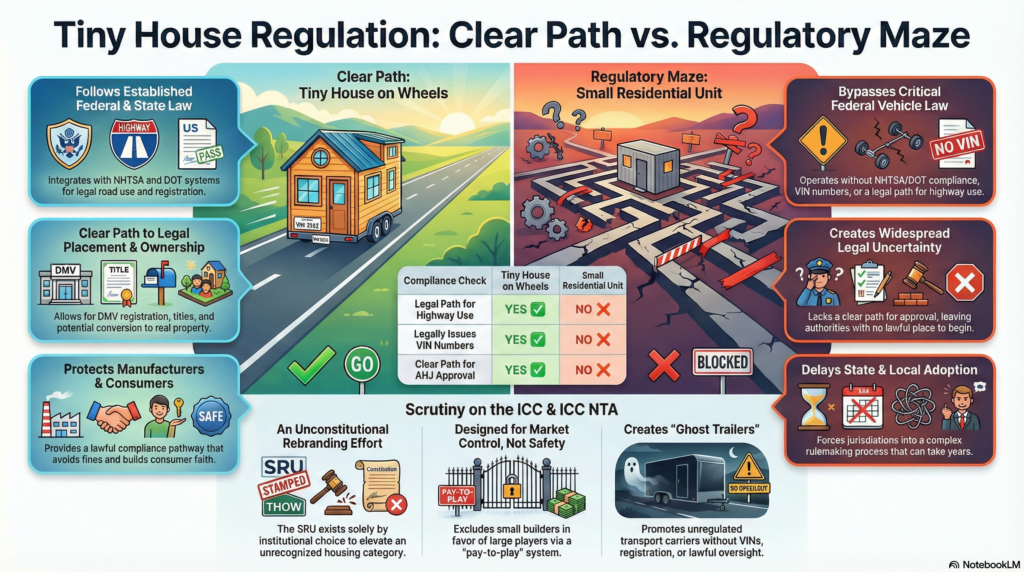
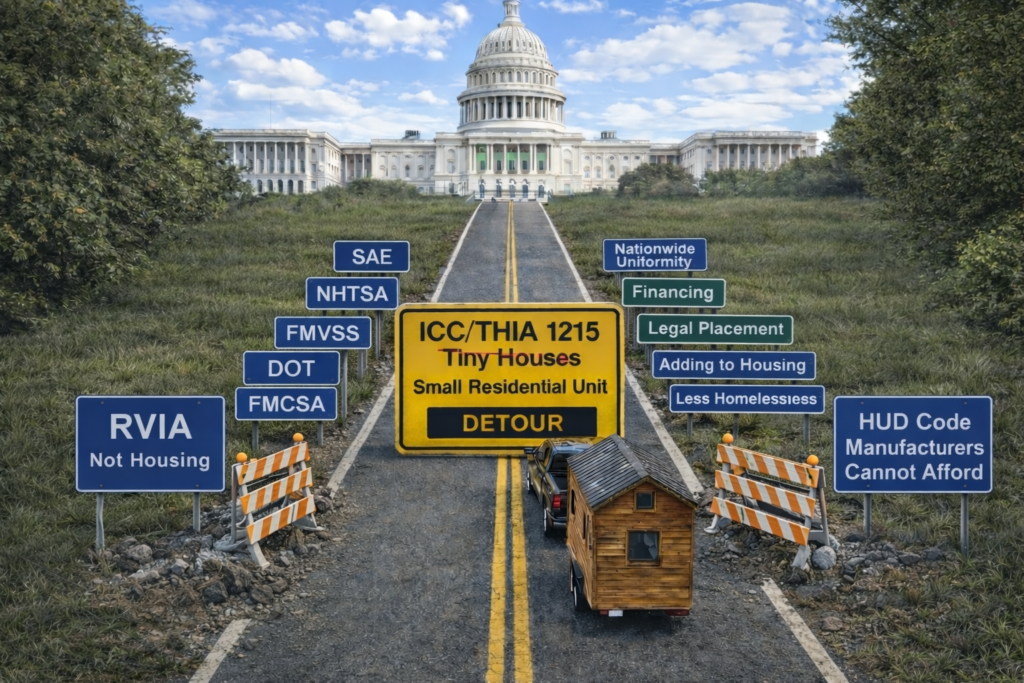
The ICC/THIA 1215 standard was introduced under the banner of regulating tiny houses, but in practice it has redirected and subordinated them beneath an invented category—the Small Residential Unit. Rather than advancing the existing, codified recognition of tiny houses, the standard elevates the Small Residential Unit into a primary regulatory position, displacing tiny houses and severing them from established federal and state compliance frameworks. This detour strips tiny houses on wheels of their lawful motor-vehicle compliance pathway, fragments regulatory authority, and replaces a working, recognized system with a new construct that lacks statutory grounding, uniform adoption, or clear placement authority. The result is not clarity or safety, but regulatory confusion, delayed approval, and the effective hijacking of tiny houses by a category that did not previously exist in code.
Converting A Wheeled Structure To Real Property Is Codified In Federal And State Law
In order for a wheeled structure, which is considered personal property to be converted into real property that is tied to land, it must first be in compliance with all NHTSA and DOT requirements. These steps are codified into federal and state law, and is a requirement to obtain a mortgage.
A Chassis Has A Fixed Federal Indentity
Federal law draws a clear and mandatory distinction between real property and personal property, and these categories are mutually exclusive. Under the Federal Management Regulation administered by the General Services Administration, real property is defined as land and improvements that are affixed to land, including buildings, structures, and fixtures. Affixation to land is the operative legal condition that converts an item into real property (41 CFR § 102-71.20). In contrast, personal property is defined broadly as all property other than real property, creating a categorical exclusion with no overlap (41 CFR § 102-36.40). Federal regulations do not recognize a hybrid or dual-status category in which a structure may be treated simultaneously as both.
A Tale Of Two Tiny Homes
This Video Short story with narration shows the practical and legal outcomes that result from applying two different regulatory paths to a tiny house on wheels with an integrated chassis, versus a Small Residential Unit, and how each path affects lawful manufacture, transportation, property status, approval, and placement.
Tiny Houses On Wheels Vs Small Residential Unit: Both With Integrated Chassis
Why the Small Residential Unit Creates Delay in State and Local Adoption
In most states, adoption of standards, regulations, and enforceable categories occurs through formal administrative rulemaking under authority delegated by the legislature. Rulemaking is not automatic; it is a structured legal process that must be completed before a category can be recognized, enforced, or approved for use. This process typically includes a notice of intent, drafting of regulatory language, public comment, hearings and revision, and final adoption through filing and publication, all operating on established review cycles that routinely take months or years to complete. When a category does not align with existing federal frameworks, it cannot be absorbed into current state systems, requiring new rulemaking or legislation simply to establish authority. Until that occurs, approval remains uncertain, placement is delayed, and the legal basis for action is unresolved.
For an authority having jurisdiction, there is no clear statute, no governing rule, and no lawful place to begin.
Summary — And Consequences Of The Small Residential Unit
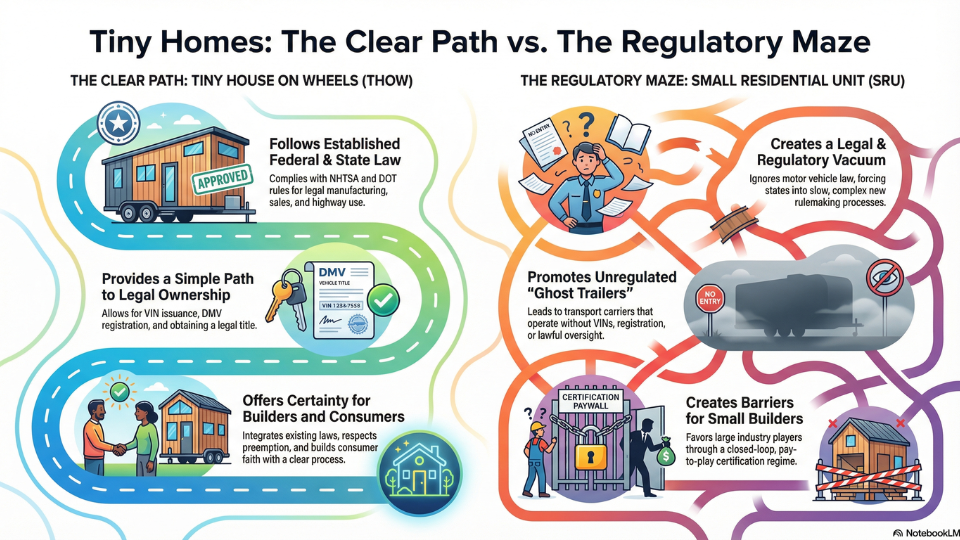
Diverting a tiny house on wheels with an integrated chassis into the Small Residential Unit path does not create clarity or safety—it creates a complex, fragmented, and delayed regulatory maze. Instead of relying on an existing, integrated federal and state compliance framework, the Small Residential Unit forces states and local jurisdictions to rebuild authority from the ground up through administrative rules or legislation, often limited to fixed adoption cycles. Because the Small Residential Unit disregards motor vehicle law and federal preemption, there is no clear, uniform, or immediate path to recognition, approval, reciprocity, or lawful placement. Authorities having jurisdiction are left without enforceable guidance, states are compelled to start from scratch, and legal placement is stalled or denied—not due to any failure in safety, but due to the absence of lawful recognition.
The Small Residential Unit Is Arbitrary And Unconstitutional.
The small residential unit It has no connection to structural integrity, life safety, fire safety, or the welfare of the inhabitants. It does not address a demonstrated public need or a regulatory deficiency. If examined in court, it would be deemed arbitrary and unconstitutional because there is no rational basis for its creation. It exists solely by institutional choice. It is whim and the product of the International Code Council’s deliberate rebranding effort to elevate an unrecognized housing construct into a superior regulatory position that does not exist in code, while pushing tiny houses—a codified and recognized term in the International Residential Code—into a subordinate role for market control.
' Under The Guise Of Standardization '
Under the guise of standardization, the International Code Council is erasing the proven success of Appendix AQ, Appendix BB, and prior code editions, and replacing them with a regulatory reset designed to exclude small, independent, and artisan builders. This reset creates a barrier to entry that favors large industry players operating within a closed-loop, pay-to-play certification regime administered through ICC NTA. The outcome is not improved safety or uniformity, but market control—stunting the progress of tiny houses, suppressing innovation, and dismantling a lawful compliance pathway that already works.
ICC-NTA’s role as a HUD-approved IPIA and DAPIA warrants scrutiny
In this context, ICC-NTA’s role as a HUD-approved IPIA and DAPIA warrants scrutiny. An IPIA or DAPIA is authorized to perform inspection and design-approval functions for compliance with existing HUD standards—not to create, endorse, or operationalize alternative compliance pathways that displace federal statutory and regulatory regimes. Yet ICC-NTA has been positioned as the primary inspection and certification authority supporting this alternative transportation framework, which simultaneously avoids the application of federal motor vehicle safety law and selectively invokes HUD Code provisions outside their intended scope. In practice, this has enabled a workaround for the modular construction industry that is now being extended to tiny houses, substituting private certification and selective federal references for the comprehensive oversight required under federal law.
By structuring silence to avoid invoking federal preemption, while simultaneously exempting the transport carrier and denying VIN or serial number stamping, manufacturer registration, and certification, ICC/THIA 1215 renders Federal Motor Vehicle Safety Standards inoperable in practice.
The result is not regulatory neutrality, but the displacement of an established federal compliance pathway, exposing manufacturers—particularly small builders—to inadvertent noncompliance, enforcement action, and substantial civil penalties for violations of federal law that the standard itself strategically omits rather than integrates.
ICC/THIA 1215 selectively relies on HUD Code provisions while avoiding full federal applicability, advances a state-triggered exemption theory under 24 CFR 3282.12 that conflicts with the structure of federal preemption under 24 CFR 3282.11, and supports transportation omissions that make Federal Motor Vehicle Safety Standards inoperable in practice. It further introduces a non-recognized Small Residential Unit framework that forces tiny houses to lose established ground and start over outside recognized statues, financing, titling, and enforcement systems.
Ghost Trailer The 'Independent Carrier System
Never In The NHTSA/DOT System Without VINS
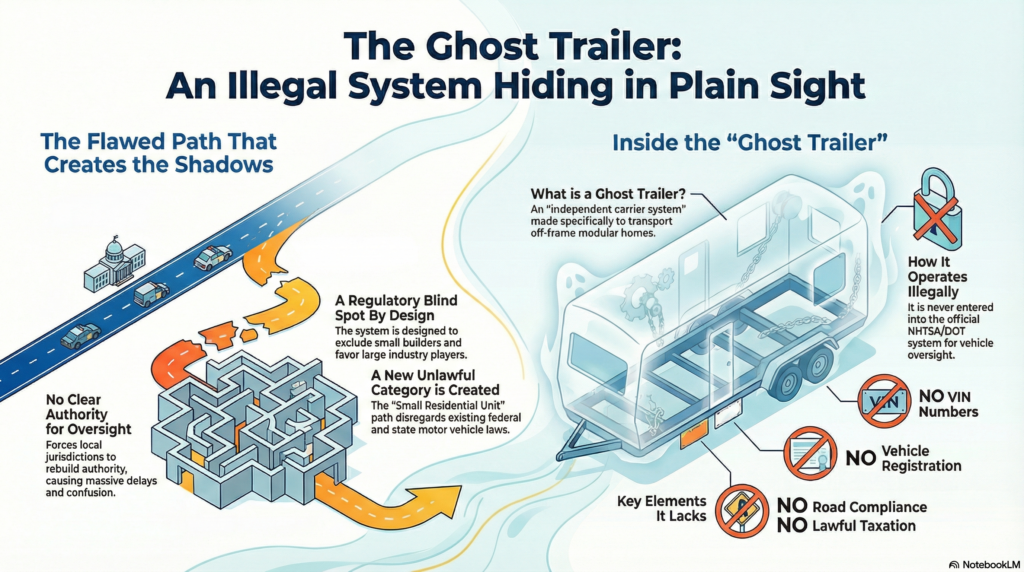
At the end of this regulatory detour is the creation and normalization of what can only be described as a ghost trailer. Through ICC 1215, on behalf of ICC NTA and with the full complicity of the International Code Council, a so-called “independent carrier system” is being promoted that is never placed into the NHTSA/DOT system. This carrier is manufactured for the express purpose of transporting off-frame modular homes, yet operates without vehicle registration, without vehicle identification numbers, without road compliance, without taxation, and without lawful oversight—while falsely characterized as “incidental use” despite a manufacturing purpose that has existed for decades.
This ghost trailer is loosely based on the HUD Code chassis, but stripped of the full application of the HUD Code, including federal oversight, required road tests, stamped VIN or serial identification on the foremost crossmember of the chassis, and registration at the DMV. When the illegality of this construct was identified, ICC 1215 did not correct it, prohibit it, or provide compliance guidance. Instead, the ICC Board adopted a strategy of purposeful omission, relying on silence to avoid triggering the preemption review required of the Chief Executive Officer under International Code Council policy CP-49. The result is a regulatory blind spot by design: a transportation system that exists in practice, evades law in theory, and leaves manufacturers, consumers, regulators, and the public exposed to risk—without accountability, without transparency, and without jurisdiction.
Related Blog Posts
ICC 1215: Chassis Silence or Regulatory Coverup?
On Dec. 9, 2025, I received a reply from the International Code Council regarding a complaint that I sent to them regarding that ICC 1215 was trying to override federal laws for the chassis in the standard and was in conflict with federal laws and ICC policy #49. A copy of my initial complaint and their reply to me is included after my letter.
Learn More

Open Letter To OSMTH Committee Regarding ICC 1215
Chassis provisions for Tiny Houses On Wheels have been treated like an anomaly for now 4 ICC code cycles and now it has been pushed over to the next code cycle which will not be until 2030. Affordable housing cannot wait. All across the world there is a battle for tiny houses on wheels and the question by the regulatory bodies that could approve and regulate them ” Is A Tiny House On Wheels A Structure Or A Vehicle?”. The compliance path is for both, The wheels conjure up complete confusion and they are treated like Godzilla coming down the road instead of a viable solution for housing.
Learn More
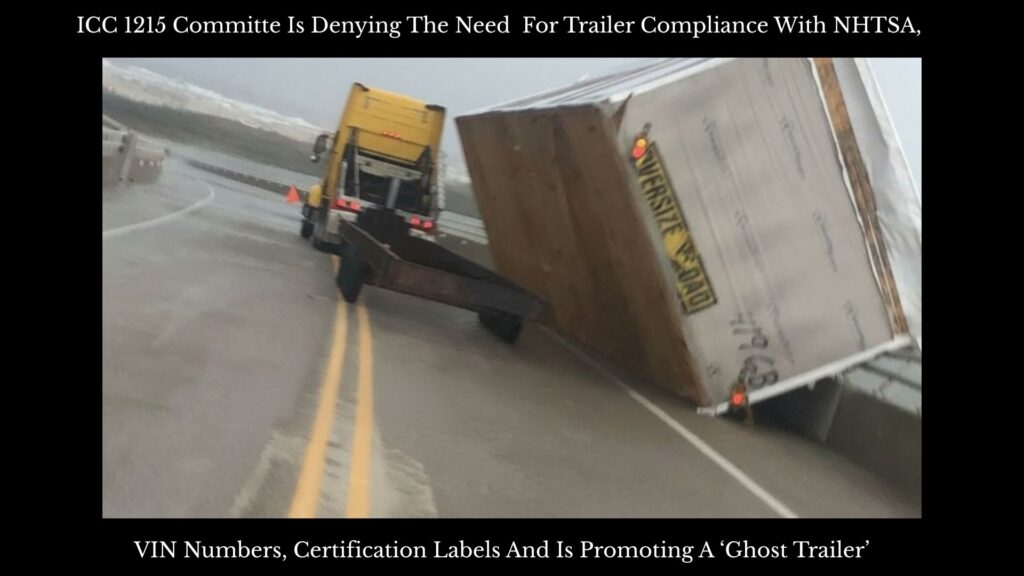
ICC 1215 Is Promoting A ‘Ghost Trailer’ For Tiny Houses
I am getting ready to submit my comments to the first draft of the ICC standard called ICC/THIA Design, Construction And Regulation Of Small Residential Units And Tiny Houses For Permanent Occupancy and I have a lot to say about the Transportation section that is promoting a trailer and asking for an exception to any compliance requirements that is never in the NHTSA/DOT system, does not have a VIN number, it is not labeled, or certified by the manufacturer, is not titled, and is essentially a ‘Ghost Trailer’.
I do not support the Small Residential Unit ( SRU), A made up term that no one uses that places a tiny house, a codified term in the IRC as a subcategory under the SRU, a 1200 square foot house with or without a chassis.
Learn More
Jan. 11, 2025

You have brought up a very excellent points, thankyou for the post.
You are welcome.