
1215 Foreword Statements on HUD Code Applicability
The tiny house industry needs to be aware of statements that are included in the first draft of the ICC 1215 tiny house standard that has been hijacked by the small residential unit that could have consequences for the industry.
Why Was This Information Strategically Placed In The Forward?
- The forward is not part of ANSI review before publication.
- The forward was not written by consensus, or go through the public review process.
- The forward frees ICC of any liability for compliance or noncompliance.
- ICC does NOT speak for HUD and is overreaching with their authority.
- The forward includes interpretations regarding tiny houses and HUD that did NOT go through HUD rule making or was written by HUD.
- The 320 statement is inconsistent with other ICC publications.
- The forward frees ICC of any liability for compliance or noncompliance, shifting the liability to the adopting states and local municipalities, at they same time that they are disregarding and overriding motor vehicle and HUD federal preemption.
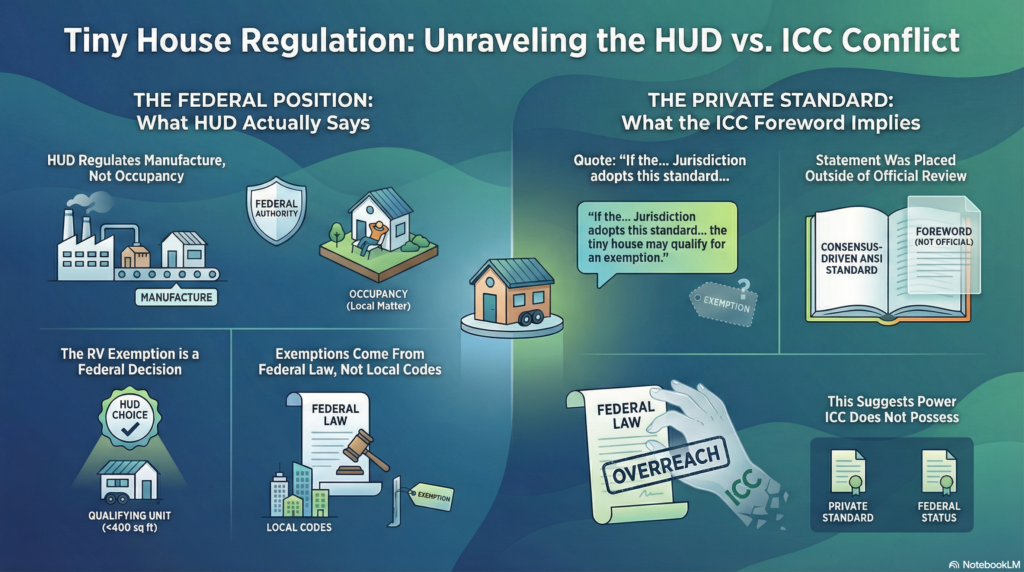
Through ICC/THIA 1215, ICC advances a permanent-occupancy standard while implying consequences under federal HUD law that ICC has no authority to determine — all while disclaiming ANSI review and responsibility for the Foreword’s content.
Source of the Statement and Express Disclaimer
The following statements appear in the Foreword of ICC/THIA 1215-202x, Design, Construction and Regulation of Small Residential Units and Tiny Houses for Permanent Occupancy, issued by the International Code Council (ICC) and the Tiny Home Industry Association (THIA) as a First Draft for ANSI Public Comment.
“The information contained in this foreword is not part of this American National Standard (ANS) and has
not been processed in accordance with ANSI’s requirements for an ANS. As such, this foreword may
contain material that has not been subjected to public review or a consensus process. In addition, it does
not contain requirements necessary for conformance to this standard.”
Immediately following that disclaimer, ICC states:
“In the U.S., off-site constructed units with a permanent chassis and over 320 sq ft may be subject to requirements under the HUD code. If the Authority Having Jurisdiction adopts this standard as part of its building code, the tiny house may qualify for an exemption.”
These Statements Were Not Issued By HUD
These statements were not issued by HUD, were not adopted through HUD rulemaking, and were not reviewed or approved by ANSI. They are unilateral representations made by ICC in a section it expressly acknowledges is outside the ANSI consensus and public review process.
Short Video Explainer : Challenging ICC Overreach Of HUD Authority
Findings Regarding ICC/THIA 1215 Foreword Statements
on HUD Code Applicability
HUD Final Rule RV Exemption 2018
For a deeper dive regarding the HUD final rule in 2018, please go to this resource that includes a lot of resources directly from HUD.
Statutory Definition Of A Manufactured Home
“manufactured home” means a structure, transportable in one or more sections, which, in the traveling mode, is eight body feet or more in width or forty body feet or more in length, or, when erected on site, is three hundred twenty or more square feet, and which is built on a permanent chassis and designed to be used as a dwelling with or without a permanent foundation when connected to the required utilities, and includes the plumbing, heating, air-conditioning, and electrical systems contained therein; except that such term shall include any structure which meets all the requirements of this paragraph except the size requirements and with respect to which the manufacturer voluntarily files a certification required by the Secretary and complies with the standards established under this chapter; and except that such term shall not include any self-propelled recreational vehicle.
ICC Inconsistent Interpretation Of The 320 Square Feet Footprint
From The Forward Of ICC 1215
“In the U.S., off-site constructed units with a permanent chassis and over 320 sq ft may be subject to requirements under the HUD code. If the Authority Having Jurisdiction adopts this standard as part of its building code, the tiny house may qualify for an exemption.”
You will notice that it states ” may be subject to”. That is not a mandatory statement.
From The ICCTHIA Model Legislation For Tiny Houses
“Tiny houses on wheels with a permanent chassis over 320 square feet are subject to the Manufactured Home Construction and Safety Standards administered by the U.S. Department of Housing and Urban Development. Where these requirements apply, a manufacturer may opt-out if they then follow requirements equivalent to those contained in a model building code.”
You will notice that it states ”are subject to”. A mandatory statement.
The statement in ICC Tiny House Model Legislation uses mandatory language (“are subject to”), while the statement in the ICC/THIA 1215 Forward uses permissive language (“may”) suggesting discretion. Taken together, the publications are internally inconsistent in how they describe HUD Code applicability.
From The HUD Final Rule RV Exemption 2018
HUD Response: As stated above, HUD currently regulates as manufactured housing only those structures that are built on a permanent chassis and that “in traveling mode, [are] eight body feet or more in width or forty body feet or more in length or, when erected on site, [are] three hundred twenty or more square feet.” Accordingly, HUD lacks jurisdiction to regulate any tiny home that is less than eight body feet in width, 40 body feet in length, or 320 square feet, or any tiny home that is built on a foundation without a permanent chassis. While this statutorily precludes HUD from regulating many tiny homes, manufacturers can voluntarily opt-in to regulation by HUD (See 42 U.S.C. 5402(6)).
This statute authorizes only a voluntary submission into HUD regulation for certain sub-threshold structures. It does not authorize a voluntary opt-out from HUD jurisdiction once the statutory definition is met.
From ICC Publication: Tiny House Building It Right
It states ” Manufactured Homes ( once called ”mobile homes”) are constructed in a factory in accordance with the U.S. Department Of Housing and Urban Development ( HUD) Manufactured Housing Program. Home homes are over 320 square feet and over 8 feet wide.
The program currently does not define a tiny house.
Finally a true statement, though it conflicts with the other ICC statements. It is an excellent publication written by Steve Van Note.
Where ICC/THIA 1215 Crosses the Line
Now contrast HUD’s position with ICC/THIA 1215’s Foreword statement:
“In the U.S., off-site constructed units with a permanent chassis and over 320 sq ft may be subject to requirements under the HUD code. If the Authority Having Jurisdiction adopts this standard as part of its building code, the tiny house may qualify for an exemption.”
This statement is not issued by HUD.
It is issued by ICC, inside a non-consensus Foreword that explicitly states:
“The information contained in this foreword is not part of this American National Standard (ANS) and has not been processed in accordance with ANSI’s requirements for an ANS… and has not been subjected to public review or a consensus process.”
Yet ICC uses this non-reviewed, non-consensus language to:
- imply HUD regulatory consequences,
- suggest exemption authority ICC does not possess,
- and blur federal jurisdictional boundaries HUD has expressly drawn.
ICC does not have authority to declare when a unit is “subject to HUD.”
ICC does not have authority to create or confer federal exemptions.
ICC does not speak for HUD.
The Core Conflict
HUD says:
- Occupancy is outside federal scope
- Exemptions are federal regulatory choices
- Design intent and certification — not permanence — drive classification
ICC/THIA 1215 does the opposite:
- Anchors regulation to permanent occupancy
- Recasts chassis-based units as dwellings at manufacture
- Suggests federal consequences flow from adoption of a private standard
That is not clarification.
That is jurisdictional overreach.
HUD drew a line and stepped back. ICC steps over that line — quietly, in a Foreword, without consensus, and without authority.
When a private standards body implies federal consequences while disclaiming responsibility, enforcement, and liability, it is not filling a regulatory gap — it is rewriting federal boundaries by Silence and selective omission.
Resources
Author's Disclaimer
This blog post is my interpretation to the best of my ability. HUD is the best and only authority. Please research the sources I included for your own due diligence.
HUD Is The Only Authority For Interpreting The HUD Code
The statement from HUD could easily substitute the ANSI standard for the ICC 1215, a voluntary standard which cannot exempt manufacturers from Federal Law, HUD code, HUD regulations, or HUD interpretative Bulletins, cementing the overreach of ICC.
HUD Approved Document: Author ICF
Description
These resources condense important elements about manufactured housing to serve as a quick reference for housing counselors on key topics.
Guide to Housing Types for Housing Counselors: This short guide provides definitions for manufactured housing and other housing types (such as modular, tiny homes, mobile homes, and more). A comparison chart shows the differences and similarities among these housing types, and additional resources are linked as well.
Financing a Manufactured Home Purchase: This one-page resource provides information about how to finance a manufactured home purchase, depending on whether the buyer owns the underlying land or not. Typical loan products are outlined to allow housing counselors to advise clients interested in purchasing a manufactured home.
Short Video Explainer: Complaint To ICC
Complaint To ICC
Resource Links
Related Blog Posts
ICC 1215 Tiny Houses Vs Small Residential Unit Detour
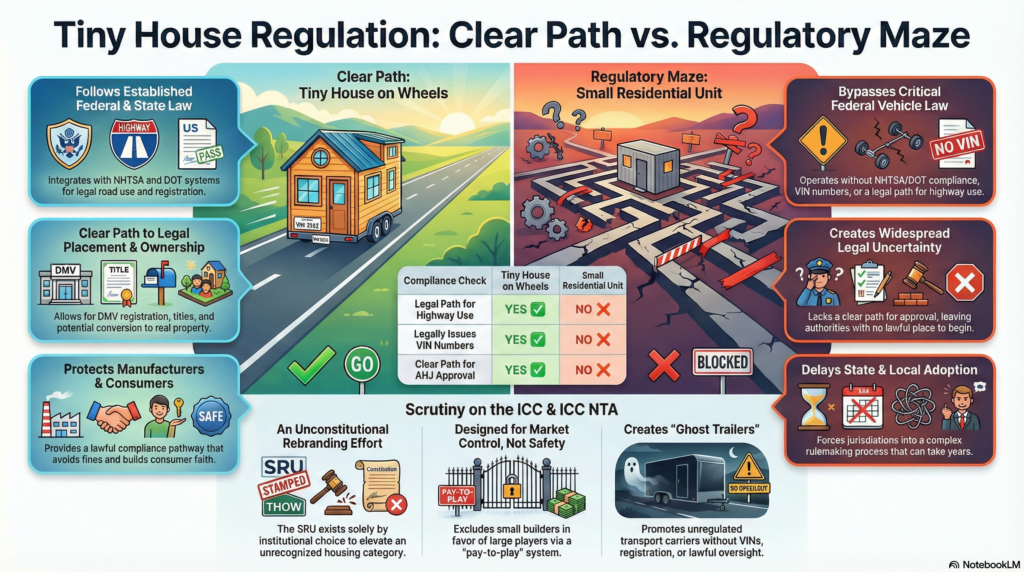
The ICC/THIA 1215 standard was introduced under the banner of regulating tiny houses, but in practice it has redirected and subordinated them beneath an invented category—the Small Residential Unit. Rather than advancing the existing, codified recognition of tiny houses, the standard elevates the Small Residential Unit into a primary regulatory position, displacing tiny houses and severing them from established federal and state compliance frameworks. This detour strips tiny houses on wheels of their lawful motor-vehicle compliance pathway, fragments regulatory authority, and replaces a working, recognized system with a new construct that lacks statutory grounding, uniform adoption, or clear placement authority. The result is not clarity or safety, but regulatory confusion, delayed approval, and the effective hijacking of tiny houses by a category that did not previously exist in code.
Converting A Wheeled Structure To Real Property Is Codified In Federal And State Law
In order for a wheeled structure, which is considered personal property to be converted into real property that is tied to land, it must first be in compliance with all NHTSA and DOT requirements. These steps are codified into federal and state law, and is a requirement to obtain a mortgage.
HUD Final Rule RV Exemption 2018
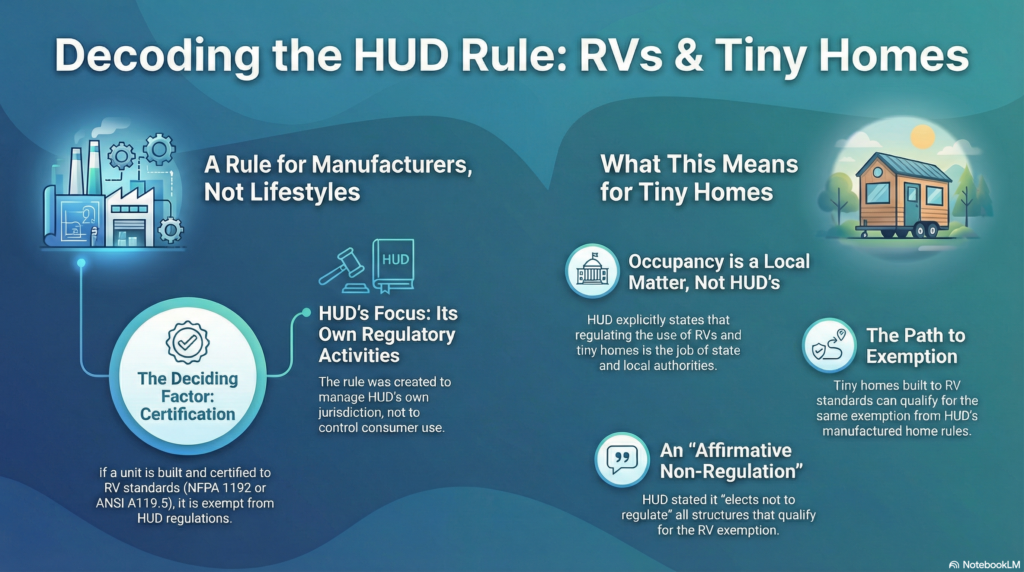
The U.S. The Department of Housing and Urban Development (HUD) redefined and clarified the RV exemption from manufactured housing standards in 2018. The final rule went into effect on January 15, 2019. A lot of manufacturers build tiny homes to recreational vehicle standards and that is why this HUD final rule is important for clarity.
Below are a lot of supporting documents directly from HUD.
ICC 1215 Deceptive DOT Obstacle Preemption Conflict
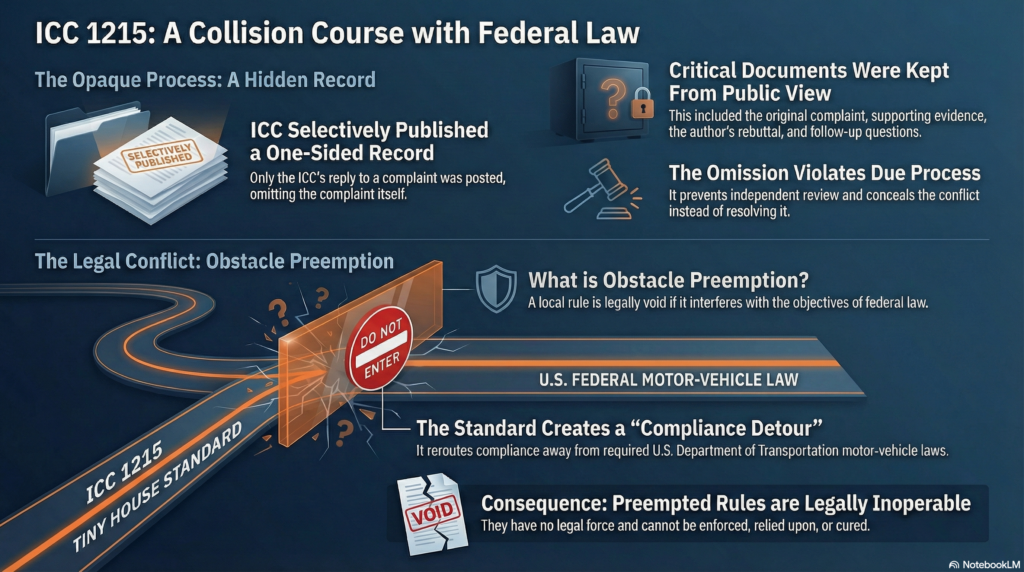
During the development of ICC/THIA 1215, Design, Construction and Regulation of Small Residential Units and Tiny Houses for Permanent Occupancy, questions of federal preemption are unavoidable. The standard reaches into areas governed by United States federal motor-vehicle and transportation law, making transparency and careful legal review essential. In that context, I submitted a written complaint raising federal preemption concerns and providing supporting documentation. What followed raised serious concerns—not about disagreement, but about how the preemption process and public record were handled.
ICC publicly posted only its reply to my complaint, identifying me by name, while withholding my actual complaint, my rebuttal clarifying the unresolved issues, and the ICC Board Committee’s refusal to answer my follow-up questions. This is particularly troubling in light of ICC Council Policy CP#49-21, Conforming Codes and Standards to United States Federal Law and International Law. CP#49-21 states that ICC’s Codes and Standards should conform to, and not conflict with, U.S. federal law, and it authorizes the ICC Board of Directors—acting on advice of counsel—to strike or modify provisions when it is more likely than not that federal law preempts them.
CP#49-21 also lays out a process: any person may submit a written complaint identifying a federal law or requirement they believe preempts a proposed or published provision (with supporting documentation), and the Board may solicit responses in its discretion. But publishing only the Board Committee’s reply—while excluding the complaint that triggered it and the rebuttal that followed—defeats the point of a preemption review. Preemption cannot be evaluated from a record that contains only the conclusion and not the complaint, supporting basis, and unresolved follow-up issues.
Jan. 31, 2026

Hello there! Do you use Twitter? I’d like to follow you
if that would be ok. I’m absolutely enjoying your blog and look forward to new
posts.
I actually do not post there much, but I should thanks.
It is really a nice and helpful piece of
information. I am glad that you just shared this useful information with us.
Please stay us up to date like this. Thanks for sharing.
You are welcome.
I’m not that much of a internet reader to be honest but
your sites really nice, keep it up! I’ll go ahead and bookmark your
site to come back later. Cheers
Thank you.
Do you mind if I quote a couple of your articles as long as I provide credit and sources back
to your site? My blog site is in the exact same niche as yours and my visitors would definitely benefit from a
lot of the information you present here. Please let me know if
this ok with you. Regards!
Of course. Thank you for asking.