ICC Purposely Omits My Complaint From ICC 1215 Website
During the development of ICC/THIA 1215, Design, Construction and Regulation of Small Residential Units and Tiny Houses for Permanent Occupancy, questions of federal preemption are unavoidable. The standard reaches into areas governed by United States federal motor-vehicle and transportation law, making transparency and careful legal review essential. In that context, I submitted a written complaint raising federal preemption concerns and providing supporting documentation. What followed raised serious concerns—not about disagreement, but about how the preemption process and public record were handled.
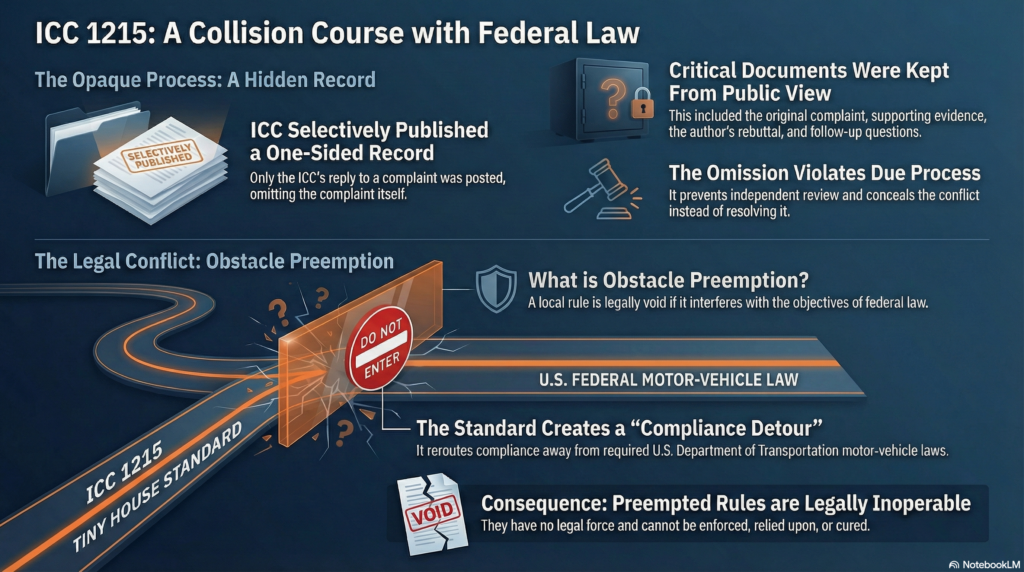
ICC publicly posted only its reply to my complaint, identifying me by name, while withholding my actual complaint, my rebuttal clarifying the unresolved issues, and the ICC Board Committee’s refusal to answer my follow-up questions. This is particularly troubling in light of ICC Council Policy CP#49-21, Conforming Codes and Standards to United States Federal Law and International Law. CP#49-21 states that ICC’s Codes and Standards should conform to, and not conflict with, U.S. federal law, and it authorizes the ICC Board of Directors—acting on advice of counsel—to strike or modify provisions when it is more likely than not that federal law preempts them.
CP#49-21 also lays out a process: any person may submit a written complaint identifying a federal law or requirement they believe preempts a proposed or published provision (with supporting documentation), and the Board may solicit responses in its discretion. But publishing only the Board Committee’s reply—while excluding the complaint that triggered it and the rebuttal that followed—defeats the point of a preemption review. Preemption cannot be evaluated from a record that contains only the conclusion and not the complaint, supporting basis, and unresolved follow-up issues.
Skip Down To A Video Explainer That Gets To The Heart Of The Issue
To see the ICC posting of only their reply to me, you go to the website, click on documents from right, click on resources, and you will see it. ICC 1215 Website
What Was Excluded From The Public Record:
My written complaint identifying federal preemption concerns under CP#49-21
Supporting documentation submitted with that complaint
My rebuttal explaining why the reply did not resolve the preemption conflicts raised
The ICC Board Committee’s refusal to answer follow-up questions relevant to preemption
Any documented analysis showing how CP#49-21 was substantively applied to the complaint
This selective publication also raises due process concerns under the ANSI Essential Requirements. Due process requires that objections be entered into the record and that their disposition be documented in a manner that permits independent review. When only a Board-level response is made public—and the complaint and rebuttal are excluded—the record cannot demonstrate that due process occurred.
CP#49-21 is intended to prevent conflicts with federal law, not to obscure them. When ICC publishes only its reply while withholding the complaint and rebuttal, preemption is not resolved—it is concealed. A standard that relies on record omission to preserve enforceability exposes vulnerability, not compliance.
Short Video Explainer That Gets To The Heart Of The Issue
Consequences When Federal Law Controls
Before defining the legal terminology, it is important to be clear about what is happening here. ICC/THIA 1215 does not merely raise abstract preemption questions; it creates an obstacle to the execution of federal motor-vehicle law by rerouting compliance pathways governed by the U.S. Department of Transportation. That rerouting produces a direct conflict with federal objectives and triggers obstacle preemption, even where the standard attempts to avoid explicit contradiction. Where obstacle preemption applies, the affected provisions are legally inoperable and cannot be enforced, relied upon, or cured through silence or reclassification within a private standard.
Key Terms Explained
Obstacle Preemption
Obstacle preemption is a doctrine of federal law that applies when a state law, local regulation, or private standard stands as an obstacle to the accomplishment and execution of the full purposes and objectives of Congress. Even if a rule does not directly contradict federal law, it is preempted if it interferes with how federal law is intended to operate. In the DOT context, obstacle preemption occurs when a standard disrupts or reroutes federally established motor-vehicle safety, transportation, or compliance frameworks.
Preemption
Preemption is the principle that federal law supersedes conflicting state, local, or non-federal requirements under the Supremacy Clause of the U.S. Constitution. When Congress occupies a field—such as motor-vehicle safety and transportation—non-federal standards may not impose different, additional, or alternative requirements. Preemption applies regardless of whether the conflicting requirement is enacted by a government entity or embedded in a private consensus standard.
Conflict
A conflict exists when a non-federal requirement cannot be applied without undermining federal law. This includes direct conflicts (where compliance with both is impossible) and indirect conflicts (where the non-federal requirement alters classifications, timelines, enforcement pathways, or compliance obligations established by federal law). In preemption analysis, a conflict does not need to be explicit; functional interference is sufficient.
Inoperable
When a provision is preempted by federal law, it is legally inoperable. This means it has no legal force or effect and cannot be enforced, relied upon, or used as a basis for regulatory action. An inoperable provision is not “voluntary,” “advisory,” or “context-dependent”—it is void as applied to the preempted subject matter, regardless of whether it appears in a code, standard, or policy document.
49 U.S. Code § 31141 - Review and preemption of State laws and regulations
(a) Preemption After Decision.—
(b) Submission of Regulation.—
A State receiving funds made available under section 31104 that enacts a State law or issues a regulation on commercial motor vehicle safety shall submit a copy of the law or regulation to the Secretary immediately after the enactment or issuance.
Learn More

The Small Residential Unit as a Compliance Detour
Ultimately, ICC/THIA 1215 does not merely misinterpret federal law—it denies the very path to compliance that federal law requires. Rather than integrating motor-vehicle law with the structural compliance pathway, as Congress intended, the standard attempts to sidestep that obligation by redefining the regulated object itself. By inventing the “Small Residential Unit” as a substitute classification, ICC rewrites the rules of the road instead of following them, fragmenting compliance and displacing federal authority in the process. A private standard cannot nullify federal motor-vehicle law by relabeling the vehicle, rerouting the compliance pathway, or declaring silence where the law speaks.
That is not harmonization—it is evasion, and it renders the standard legally inoperable where federal law controls.
Supportive Documents
The supportive documents include my October complaint, the answer from ICC that was posted on the ICC website, my rebuttal to ICC, and a 27 email exchange with ICCNTA employee advising the committee to avoid FMVSS, HUD, and motor vehicle classification, and statements that misappropriate the HUD code. My last document is the complaint regarding a violation of due process.
October Complaint From Janet Thome To ICC CEO
ICC Response To Janet Thome On ICC Website
Janet Thome Rebuttal To ICC
27 Email Exchange With ICCNTA And Janet Thome
Complaint Regarding The Posting Of Their Reply Without The Full Record
Jan. 29, 2025