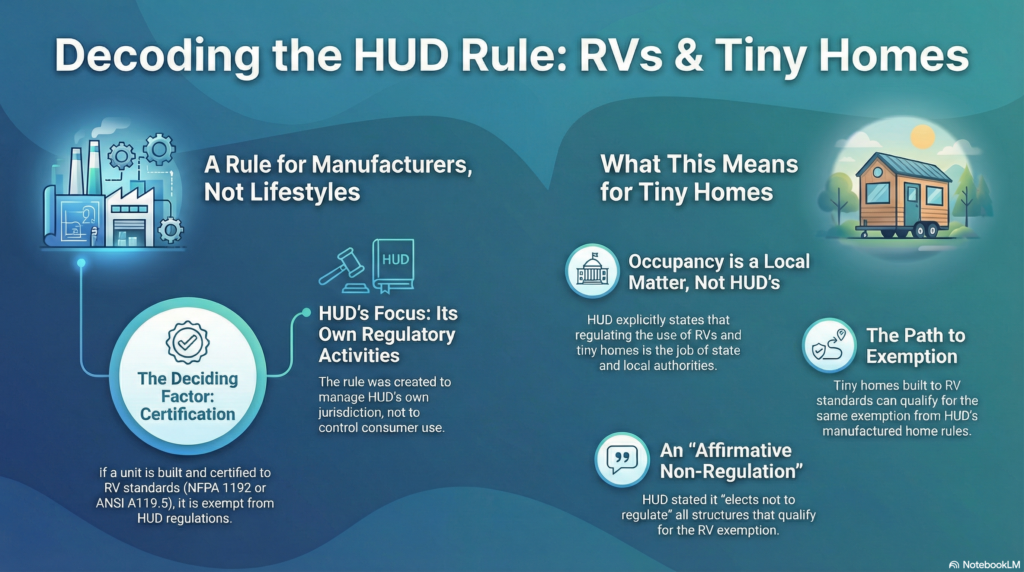
What This Means For Tiny Homes
The U.S. The Department of Housing and Urban Development (HUD) redefined and clarified the RV exemption from manufactured housing standards in 2018. The final rule went into effect on January 15, 2019. A lot of manufacturers build tiny homes to recreational vehicle standards and that is why this HUD final rule is important for clarity.
Below are a lot of supporting documents directly from HUD.
Manufactured Home Procedural and Enforcement Regulations; Clarifying the Exemption for Manufacture of Recreational Vehicles
The final rule went into effect on January 15, 2019.
Short Video Explainer Of This Content
Opening: What this rule is — and why it matters
Today, I want to explain what HUD’s 2018 Final Rule actually does, what it means for tiny homes — especially tiny homes on wheels and what HUD very clearly said is outside the scope of this rule.
1) What HUD said the rule is doing
HUD framed this rule as a manufacturing-side clarification, not a lifestyle rule and was explicit about the legal effect.
HUD Stated:
“This rulemaking revises the exemption for the manufacture of recreational vehicles to clarify which recreational vehicles qualify for an exemption from HUD’s Manufactured Home Construction and Safety Standards and Manufactured Home Procedural and Enforcement regulations.”
“This final rule provides that the requirements of 24 CFR parts 3280 and 3282 do not apply to the manufacture of a ‘recreational vehicle’ as defined by this rule.”
“HUD is adopting a recommendation of the Manufactured Housing Consensus Committee (MHCC) but expanding the definition of recreational vehicle and modifying it to require certification with the updated ANSI standard, A119.5-15.”
2) The “bright line” HUD created
HUD created a regulatory bright line focused on manufacturing standards, not occupancy.
In simple terms:
If a unit is:
- not certified as a manufactured home, and
- built and certified to NFPA 1192-15 or ANSI A119.5-15,
HUD treats it as exempt from the HUD Code and HUD’s enforcement regulations.
HUD explained the purpose of that line clearly.
The rule:
“better differentiate RVs from manufactured homes to ensure that HUD does not unnecessarily regulate RVs.”
And HUD stated its regulatory goal plainly:
“to establish a broad, easily applied exemption for purposes of its own regulatory activities.”
That phrase matters:
“purposes of its own regulatory activities.”
3) HUD Wanted To Reduce The Confusion Between RVs And Manufactured Homes
HUD acknowledged the problem directly: The exemption had been criticized for:
“not drawing a clear enough distinction between RVs, which are designed for temporary, recreational use, and manufactured housing, which is designed for permanent, year-round dwelling.”
HUD explained how the confusion grew:
Manufacturers were producing larger units with:
“more features, such as porches built on the chassis, and that resemble manufactured homes,”
which created disputes over measurement and jurisdiction.
End measurement games around porches and chassis add-ons
HUD specifically identified Park Model RVs with screened porches built on the chassis, marketed for all-season use, as a driver of the rule.
Rather than endlessly litigating square-foot calculations, HUD pivoted to certification to established RV standards.
Keep HUD out of vehicle regulation
HUD recorded a clear consensus view:
“regulating RVs is outside the scope of HUD’s housing mission and is not contemplated by the National Manufactured Housing Construction and Safety Standards Act.”
And HUD noted that RVs are already:
“extensively regulated by the U.S. Department of Transportation and state motor vehicle and taxing authorities,”
and that HUD regulation would create conflicts.
Add consumer disclosure — not occupancy enforcement
For ANSI A119.5-15 Park Model RVs seeking exemption, HUD added a Manufacturer’s Notice.
HUD explained why:
“the Manufacturer’s Notice requirement is an important tool for ensuring that consumers are aware to what standard and purpose the units they are purchasing are built.”
HUD summarized the issues it was addressing as:
“(1) Identify which manufacturing standards apply to what structures; and (2) enhance consumer knowledge and confidence in their purchases.”
4) What HUD said is beyond the scope of this rule
This is critical — especially for tiny homes.
HUD was explicit that use and occupancy are not HUD’s lane.
HUD stated:
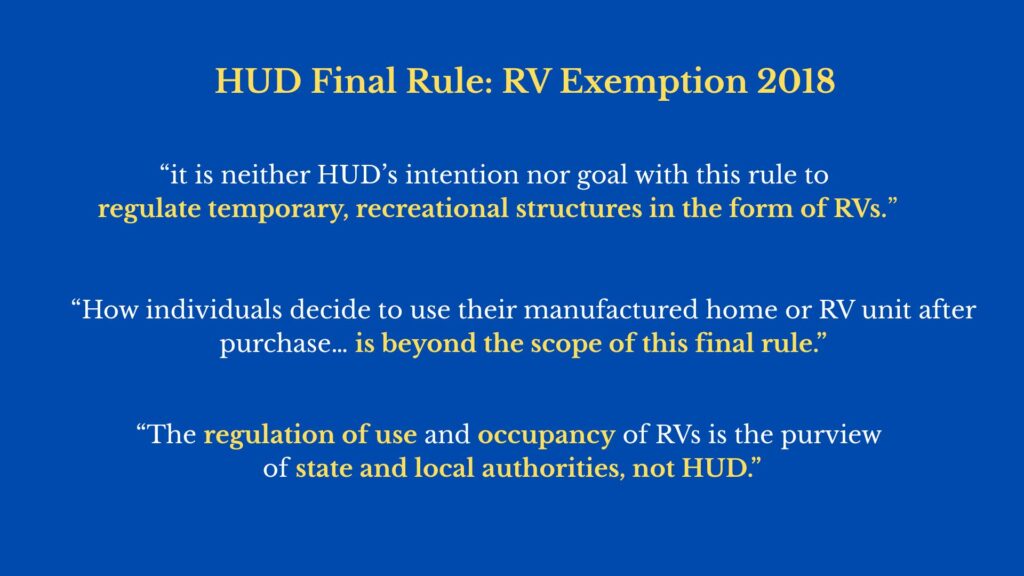
“how individuals decide to use their manufactured home or RV unit after purchase… is beyond the scope of this final rule.”
HUD was even clearer:
“The regulation of use and occupancy of RVs is the purview of state and local authorities, not HUD.”
And HUD reiterated:
“HUD is not regulating use of manufactured homes or RVs.”
“This rule does not affect the use of RVs by consumers.”
This is a manufacture-side classification rule, not an occupancy rule.
5) The actual exemption HUD codified
“In § 3282.8, remove and reserve paragraph (g).”
“Add § 3282.15… Exemption for recreational vehicles.”
HUD’s exact regulatory definition
“A recreational vehicle is:
(1) A vehicle or vehicular structure not certified as a manufactured home;
(2) Designed only for recreational use and not as a primary residence or for permanent occupancy; and is either:
(i) Built and certified in accordance with either NFPA 1192… or ANSI A119.5…
or (ii) Any vehicle which is self-propelled.”
6) What this meant for tiny homes (especially THOW)
HUD directly addressed tiny homes and drew three clear categories.
1) Tiny homes that meet the statutory manufactured home definition. HUD stated:
“If a tiny home is a ‘manufactured home’ as defined by statute, then it can be regulated as manufactured housing, unless it also falls within HUD’s regulatory exemption for recreational vehicles as provided by this final rule.”
HUD also reminded manufacturers of the voluntary opt-in provision in the statute.
2) Tiny homes HUD has no authority to regulate. HUD plainly stated:
“HUD lacks jurisdiction to regulate any tiny home that is less than eight body feet in width, 40 body feet in length, or 320 square feet, or any tiny home that is built on a foundation without a permanent chassis.”
That sentence alone explains why many tiny homes are simply outside HUD’s program.
3) Tiny homes built to RV/ Park Model Recreational Vehicle Standards.
HUD acknowledged many tiny homes are built to RV-type standards and emphasized disclosure:
“HUD believes that consumers should be fully aware of the construction standard used to build a particular product at the time of purchase.”
HUD explicitly rejected the idea that this rule bans tiny homes:
“it is neither HUD’s intention nor goal with this rule to regulate temporary, recreational structures in the form of RVs.”
And reiterated:
“If a tiny home is not a ‘manufactured home’ as defined by statute, then HUD does not have authority to regulate its construction.”
7) The missing but critical point: HUD can choose NOT to regulate
This is the hinge of the rule — and it is HUD’s own language.
HUD stated:
“HUD takes the opportunity in this final rule to emphasize that while it possesses statutory authority to regulate the manufacture of certain types of RV, it nevertheless believes that exercising such authority is currently unnecessary.”
HUD immediately reinforced that point:
“HUD believes that the non-permanent design intent of RVs favors that they be exempt from such regulation, even in cases where they fall within the statutory definition of ‘manufactured home.’”
And HUD made the discretionary nature unmistakable:
“HUD maintains statutory jurisdiction over the manufacture and installation of all structures falling within the statutory definition of ‘manufactured home,’ but it elects not to regulate all structures that qualify for the RV exemption.”
Those are HUD’s verbs:
“declines,” “elects not to regulate,” “believes exercising authority is unnecessary.”
This is not silence.
This is not lack of authority.
This is affirmative non-regulation.
8) Congress vs. HUD — and where the confusion comes from (320 → 400)
Here is where people get confused.
The 320 square-foot figure has always been in the statute.
Congress did not newly add it later.
What Congress did do — through the 1980 conference report — was direct HUD to consider flexibility.
HUD explained:
“Relying on a conference report on the 1980 amendments that directed HUD to consider a more flexible standard for smaller manufactured homes (such as park models) whose square footage is between 320 and 400 square feet, HUD continued the exemption but expanded it to its current form.”
— 81 FR 9603 (Feb. 8, 2016)
HUD then codified that discretion by regulation:
“400 square feet or less when measured at the largest horizontal projections.”
— 24 CFR § 3282.15
That 400-square-foot threshold is HUD’s regulatory choice, not a congressional mandate.
Final Takeaway
Congress defined the outer boundary. HUD exercised discretion Congress explicitly contemplated.
And HUD stated — in its own words — that even when a structure fits the statutory definition, HUD may choose not to regulate it.
Resources
Author’s Disclaimer
This blog post is my interpretation to the best of my ability. HUD is the best and only authority. Please research the sources I included for your own due diligence.
HUD Is The Only Authority For Interpreting The HUD Code
Related Blog Post
ICC 1215 Forward Clash With HUD’s Authority On Tiny Houses
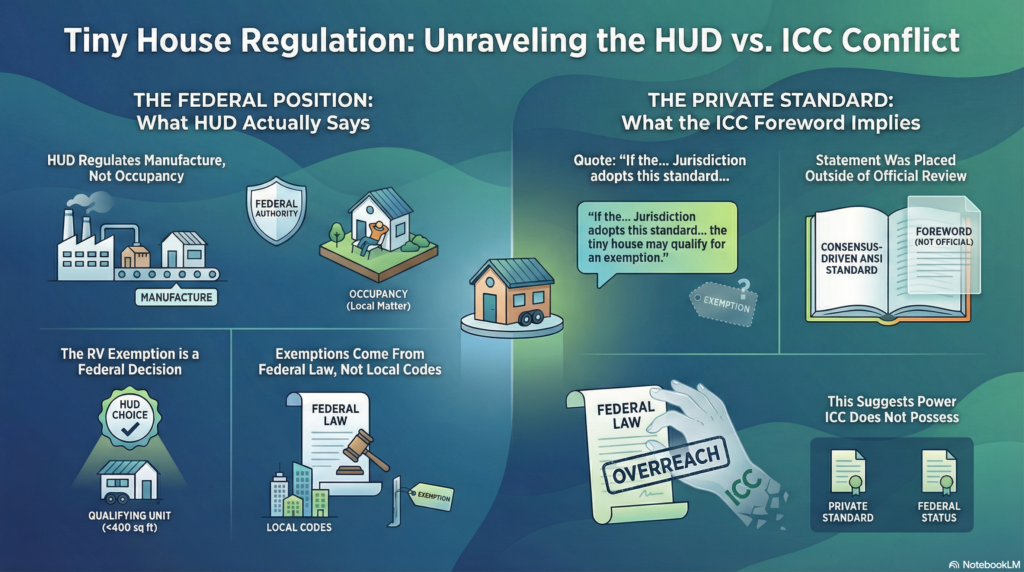
1215 Foreword Statements on HUD Code Applicability
The tiny house industry needs to be aware of statements that are included in the first draft of the ICC 1215 tiny house standard that has been hijacked by the small residential unit that could have consequences for the industry.
Why Was This Information Strategically Placed In The Forward?
- The forward is not part of ANSI review before publication.
- The forward was not written by consensus, or go through the public review process.
- The forward frees ICC of any liability for compliance or noncompliance.
- ICC does NOT speak for HUD and is overreaching with their authority.
- The forward includes interpretations regarding tiny houses and HUD that did NOT go through HUD rule making or was written by HUD.
- The 320 statement is inconsistent with other ICC publications.
- The forward frees ICC of any liability for compliance or noncompliance, shifting the liability to the adopting states and local municipalities, at they same time that they are disregarding and overriding motor vehicle and HUD federal preemption.
Through ICC/THIA 1215, ICC advances a permanent-occupancy standard while implying consequences under federal HUD law that ICC has no authority to determine — all while disclaiming ANSI review and responsibility for the Foreword’s content.
Jan. 31, 2026